Rents in Charlotte Increased Last Month – December 2020 Rental Report

0
After a wild summer in which the rental market saw unprecedented price drops, rents are beginning to line up with seasonal expectations. As the market cools in the fall, rents are down 0.5% month-over-month, consistent with the last two years.
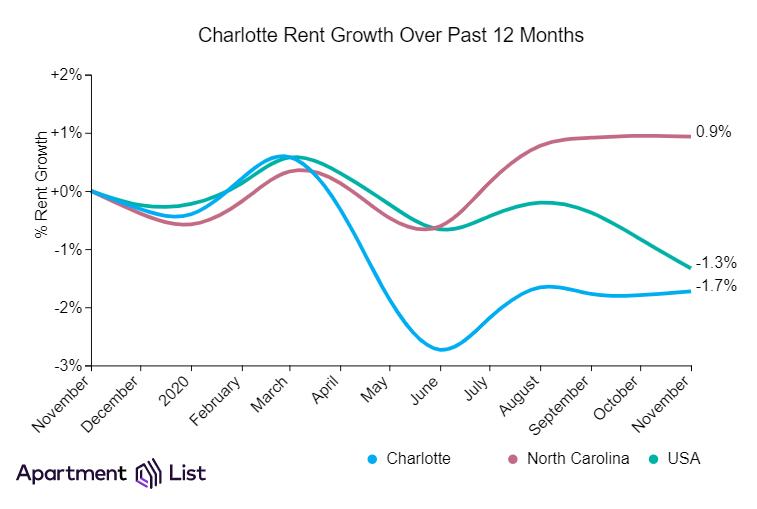
But the fallout from the COVID-19 pandemic has been unequal, so while the national rent index is down 1.3% year-over-year, there is tremendous regional variation beneath the surface. San Francisco, Seattle, Boston, and New York City continue to lead the nation in pandemic rent drops, while smaller markets like Boise and Central California are getting more expensive.
Here are the most recent figures from the Charlotte market:
  • Rents in Charlotte increased 0.1% month-over-month, and are down by 2.3% since the start of the pandemic in March.
  • Year-over-year rent growth in Charlotte currently stands at -1.7%, compared to 2.7% at this time last year.
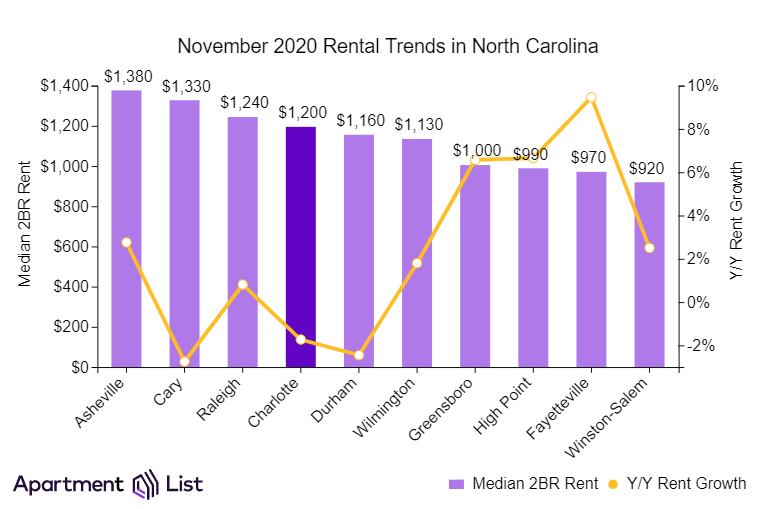
  • Median rents in Charlotte currently stand at $1069 for a 1-bedroom apartment and $1195 for a two-bedroom.

If you’re thinking that rents are now too high and you’d like to buy a home, Charlotte Stories has partnered with the best real estate agents in every part of our region.

If you’re thinking about buying a home in or around Charlotte, let us connect you with a top agent in your area by filling out the form below:

    North Carolina Hunters: Make Sure You Think Twice Before Pulling That Trigger

    0

    The N.C. Wildlife Resources Commission just kicked off their annual Home From the Hunt campaign to remind North Carolina hunters to be aware of their surroundings and positively identify their target before pulling the trigger.


    “Don’t let the excitement of having a deer or other game in your sights overtake the absolute necessity of practicing safe firearm and hunting techniques,” said Chet Clark, the Commission’s eastern outreach manager. “There could be homes, vehicles or even people in front of or behind your target, so it’s important to take the time to make absolutely certain that it’s safe to pull the trigger. Hunters should use binoculars, not a rifle scope, to first identify a target and then take aim only when ready to fire at something they wish to shoot.”

    The four primary rules of firearms safety:

    • Always point a firearm in a safe direction.
    • Treat every firearm as if it were loaded and never assume a firearm is unloaded.
    • Keep your finger out of the trigger guard and off the trigger until ready to shoot.
    • Be sure of your target­–and what’s in front of and behind it.“Last year’s hunting season set the all-time low for hunting and hunting-related incidents,” said Clark. “Of those 22 incidents, eight were firearms-related and none were fatal. By continuing safe, ethical and responsible firearms handling practices, we can continue to progress towards our goal of zero incidents.”For more information on hunting seasons, licenses, Hunting Heritage Apprentice Permits and the Hunter Education Program, go to www.ncwildlife.org or call 919-707-0031.

    The Consequences of Debt Consolidation

    0

    Consolidating debts is a broad term for making them simpler and less costly to pay off. There are a few ways to go about achieving this — with two of the most popular forms being a personal loan or transferring high-interest debts to a balance transfer credit card. In this article you can consider what you need to know before choosing Clear Coast Debt Relief.

    Some property owners decide to take out a home equity loan to wipe out their high-interest debts. Another way to consolidate is signing up for a debt management plan (DMP) through a credit-counseling agency. This means you’ll make one single monthly payment to the agency and it will handle splitting up your funds.

    There are both advantages and disadvantages to consider whichever way a borrower consolidates. Knowing the upsides and downsides before taking action will help you navigate the process more smoothly, hopefully avoiding “potholes” along the way.

    Here are some of the consequences of debt consolidation.

    Your Credit Score May Dip

    One short-term effect of consolidating debt that may surprise borrowers is a temporary dip in credit score. Why does this occur? Because applying for either a loan or a new line of credit triggers a hard inquiry on your credit report. Don’t be alarmed if you see your credit score — which you’ve been working hard to keep as high as possible — drop a couple points in the aftermath.

    The good news is that debt consolidation can raise your credit score, provided you make payments on time and avoid racking up new debts. This is mostly because you’ll be using a healthier percentage of your available credit after paying off high credit card balances, and because your timely installments toward your loan will bolster your credit history.

    You Put Your Assets at Risk (with a Secured Loan)

    There are two main types of loans for debt consolidation: unsecured and secured. The former does not require offering up any assets as collateral, but usually carries higher interest rates as a result. The latter does involve putting up an asset, like a home as collateral — which may lower interest rates and help borrowers with less-than-stellar credit ratings qualify for approval.

    While the option of getting a secured loan does open doors for borrowers, it also puts the asset used for collateral at risk. Missing payments on your loan can result in your lender putting a lien on your property. This is especially risky if you’re using your home as collateral.

    This potential risk underscores the importance of doing the math before accepting a loan to make sure your budget can support monthly payments for as long as it takes to fulfil the obligation — which can often be years.

    You May Be Tempted to Spend

    Whether you transfer balances to a new card, use the bills.com debt consolidation process, take out a loan, use home equity or enroll in a DMP, wiping out your high-interest unsecured debts can definitely create the illusion you’ve suddenly become “debt free.” Of course, we know this isn’t true because you’re actually taking on new debt to satisfy old debt.

    But this illusion can lend a false sense of security, tricking borrowers into thinking it’s fine to start spending on credit again. Avoiding this trap requires avoiding the root behaviors that contribute to the accumulation of debt — and committing to sticking to a healthy budget to avoid backsliding into even more debt.

    Debt consolidation, like any strategy, has its share of potential benefits and potential consequences. Knowledge is power when it comes to avoiding these pitfalls to get the most out of the process.

    How to Cultivate Amaryllis in Pots on the Windowsill

    0

    In the spring and summer, you can find huge lily-like flowers in the flower shops. Many people associate these plants with miniature gramophones, created for wood elves or fairies by nature. If you are a fan of lilies, then amaryllis can become a decent analogue of a garden flower for home growing. This plant is able to please the owners with a delicate aroma and beautiful flowering. Having learned the nuances of growing amaryllis at home, you can have these “fire lilies” on your windowsill almost all year round.

    What Is Amaryllis?

    Amaryllis belladonna is the only variety used in indoor floriculture. Its homeland is the small Karoo desert in South Africa. It is a bulbous plant with large narrow leaves about 0.5 m long. On a peduncle of 0.4–0.6 m high, there are large white or pink flowers resembling lilies in shape. The next feature determines the nuances of growing amaryllis bulbs at home. Like other desert plants, the active lifetime lasts 2-3 months a year. During this period, amaryllis manages to bloom, scatter seeds and prepare for rest until the next year. 

    The most popular varieties are those with large double flowers of 20 cm or more in diameter:

    • Nymph with white petals and bright pink strokes;
    • Macarena – red flower with white stripes in the centre of the petals;
    • Double Dragon – coral petals with white tips.

    The varieties with simple flowers are no less good:

    • Large-flowered plants: white Ice Queen, red Durban, and Red Lion;
    • Medium-sized flowers up to 12 cm in diameter: pink Maxima and pink-yellow Parker.

    But multi-colour varieties with very thin petals are now especially popular:

    • Grandeur – the petals of different shades of pink;
    •  La Paz – green petals with red borders;
    • Chico is perhaps one of the most unusual varieties: at first glance, the flowers look more like some kind of exotic insect thanks to the graceful green-brown petals grown in different directions.

    How to Grow Amaryllis?

    If you do not buy amaryllis already planted in a flowerpot, carefully consider the quality of bulbs you buy. The bulbs must be dry, healthy, free from damage or rot, with strong but small roots. The upper dark scales are removed from the bulbs, then treated with potassium permanganate, dried and planted a day after drying. It is very important to work with the flower in gloves because amaryllis bulbs are poisonous.

    The amaryllis pot should be heavy and stable. Several bulbs can also be planted in one pot – the main thing is that the distance between them should be about 10 cm. Amaryllis does not tolerate stagnant water, therefore, good drainage of 3-4 cm of thickness from gravel and sand on top is very important. Since amaryllis is sun-loving but does not tolerate direct sunlight, the best place for a flower will be a southwestern or southeastern window sill. Finally, you can achieve flowering at almost any time, and if you have several bulbs – even all year round!

    4 Ways to Show Someone You’re Thinking of Them

    0

    In the era of social distancing, it’s a full-time job to stay connected. So many relationships are maintained through brief hallway greetings, little run-in conversations, and ongoing water-cooler chats throughout the day. Without face-to-face interactions, we can forget just how many loved ones we have.

    But with technology on our side, we can show our love in brand-new ways. Whether for a grandmother, best friend, or romantic partner, here are a few ways to show someone they’re in your thoughts.

    #1 – Talk it Out

    Not text. Not email. Take a few minutes out of your day to pick up the phone and actually call your friend. Just sharing your voice lends a personal touch that puts your conversation above the rest.

    And if you’re on friendlier terms, make time for a video call! Zoom may be forever-linked to awkward conference calls and stilted virtual job interviews, but it’s as close to in-person quality time as many of us can get. 

    Prefer things old-school? You can’t go wrong with a handwritten note. Pick up some beautiful stationery and a pack of your favorite pens for all of your note-sending needs.

    #2 – Send a Gift

    What’s better than getting a package in the mail? Plus, online deliveries allow you to maintain a lot more than just six feet of physical distance between you. It doesn’t have to be a holiday to send one of these presents just to say I’m thinking of you:

    • A cozy blanket – Receiving a blanket is the closest thing to receiving a hug these days. Consider sending a fleece throw blanket to embody your warm thoughts for the recipient. 
    • Flowers – This is a no-fail gift. A beautiful bouquet works for friends, family, and lovers alike. Check out some excellent online shops for flowers to send a loved one.
    • Friendship lamps – Missing someone from afar? Matching friendship lamps are a great remedy for long-distance lovesickness. As you tap your lamp, it signals the other lamp to glow, like a magical message of love—or something out of a sci-fi romance novel. 

    #3 – Make Plans to Spend Time Together

    Nothing beats quality time—as long as it’s spent safely. If you’re both comfortable with it, then penciling in a relaxing activity could be a great option for reconnecting.

    Got a friend who’s always en vogue? Take them shopping! Making a point to purchase from thrift stores and small businesses is a great way to support local during these tougher times.

    If you’re both looking to lounge around and catch up, make a reservation at a local restaurant or order take out that you can enjoy in a nearby park. And if your comfort levels are aligned, host an at-home spa night to boost a friend’s mood while shrinking their pores. You could try your hand at a DIY manicure (no pun intended) or get fancy with facials and sheet masks (the spa kind, not the PPE kind).

    #4 – Help with Something They Need 

    Let’s face it: to-do lists are more fun to create than complete. And when your loved one is going through a particularly rough patch, it can be difficult just to get through the basics. Here are some ways to show your thoughtfulness by being the Cinderella of their day:

    • Send groceries – Pick out some pantry staples for a friend and save them from the hour-long wait in the Trader Joe’s checkout line.
    • Clean their house – Know someone with a few messy kids? Or even just an endlessly-shedding puppy? Sending a cleaning service can transform their entire day, week, or even month for the better.
    • Make a meal – Food may be the ultimate wordless “I love you.” And dropping off a home-cooked meal (whether healthy or indulgent) says “I love you a lot.”

    Showing You Care Isn’t Location-Specific

    A hug isn’t about how long you hold it, but how deeply you mean it. The same principle applies to thoughtful gifts and acts of service. Big or small, these simple actions will show your loved ones just how much you care—whether you’re in the next town over or halfway across the world.

    Solving Flat Feet Problems: General Tips

    0

    Flat feet is a type of disorder associated with tissues and bones and typical for many men and women. This condition is normal for babies as it takes time for tendons to form an arch. However, when we become older, the arch should appear. If it doesn’t, something is wrong, and you need to consult your healthcare provider.


    How to solve flat feet problems for people in sports

    There are various recommendations that you can follow to solve this problem, including special shoes and treatment. However, before we dive deeper into those recommendations, it is important to understand how the flat feet condition affects your sports activities. By the way, you can read about walking shoes for flat feet if you experience problems while walking.

    If you have this type of condition, it does not necessarily mean you will experience pain or be affected in any other way. However, in some cases, those who do sports feel pain and discomfort during training or competitions. If you are in this second group, and the pain bothers you from time to time or frequently, you are to do something to minimize the negative consequences of this condition.

    There are various ways to get a flat feet diagnosis. They include X-rays diagnosis, CT scan, Ultrasound, and even MRI. And if the condition is confirmed, it is time to find the solution.

    Treatment

    One of the ways to minimize the negative impact of flat feet is to use special orthotic devices. Those types of arch support will have to relieve the pain caused by pes planus (another name for the flat feet). You can buy those devices on your own or consult your health provider.

    Some special stretching exercises will help to stretch the tendon. Physical therapy may also be helpful, especially in some runners. A physical therapist will analyze the way you run to minimize risks from pes planus and to make your general form and running technique better.

    There is another way to correct this condition, which is surgery. A specialist will place an implant into your foot to raise the arch. However, this type of operation is not recommended for children and adolescents. It is also to mention that surgery is not necessary if you have flat feet, but it doesn’t cause any troubles to you while doing sports or simply walking.

    Modifications of the footwear

    If you have a pes planus and feel pain during your physical exercises, another way to relieve it is to buy special footwear. Pes planus can be the reason for the inside of the show to break down. However, if you are dealing with special footwear, its support prevents this from happening.

    There are also special insoles that will support your foot and create this arch to prevent the pain that may be caused by the flatfeet. You can find them in special stores or even buy them online.

    Is that all?

    Yes, a flat foot is not dangerous at all. Most people even don’t know that they have pes planus as they have no “symptoms” of this condition. However, if you feel pain in your legs after the exercises or walking, you can use those tips we gave in this article.

    What Happens If You Are Injured at a Seasonal Job?

    0

    Getting a temporary job for the summer or the holidays is a great way to earn some extra cash, but is your employer still accountable if you get injured? While this answer may vary based on the type of work and your state, most of the time seasonal workers are entitled to the same protections as other employees.



    Seasonal Work in the USA

    Although fewer teens have jobs these days than they did a couple decades ago, seasonal jobs still account for a huge portion of the labor force. Most winter holiday seasons see at least half a million temporary jobs pop up across the US, whether it’s taking on extra shifts at a popular restaurant, staffing a holiday resort, or working the Santa line at the mall. 

    Furthermore, the high unemployment and underemployment rates in the US, first rising after the 2008 financial crisis and again during the coronavirus pandemic, means that more and more Americans work an extra seasonal job in addition to their primary jobs. This is an important trend, because the more overworked you are, the more likely you are to make a mistake or have an accident. 

    There is no shortage of ways you can get injured at work, but the most common work injuries include: 

    • Tripping or slipping and experiencing a fall
    • Car accidents while in the course of your job
    • Inhalation or other dangerous exposure to toxic material 
    • Cuts, burns, and lacerations
    • Being hit by moving or falling objects
    • Assault or other forms of violence by customers or unknown assailants 

    Employee Protection Laws Vary, but Seasonal Workers Are Usually Eligible for Workers’ Compensation

    Worker’s compensation is a payment that injured workers receive while they are recovering at home or in the hospital from an injury on the job and continue to receive until they are able to return to work. 

    The same insurance coverage that employers hold for worker’s compensation for their full-time employees usually covers seasonal and temporary workers as well. In some states, employers may not be required to have this kind of insurance coverage if they are only employing less than five people, as is the law in Missouri, for example.

    Another way state laws play an essential role here is that some states with less stringent worker protection laws, in the interest of spurring economic growth by reducing business costs, will offer exceptions to seasonal worker protection in certain industries. Some entertainment jobs may fall into this category, as may farming or other part time or seasonal agriculture work. 

    This reinforces just how important it is that you clearly read over your contract. Never be concerned about inquiring as to exactly what your rights are as an employee (and making sure that anything that is promised is also delivered in the written contract).

    Regarding wage benefits, you may be entitled to receive up to two thirds of your former average weekly wage for non-catastrophic injury cases. 

    The Temp Addendum 

    Many Americans looking for temporary or part-time work, or who just want to get their foot in the door with a new industry and need to find a job fast, will seek work through a temp staffing agency (known more commonly as a temp agency).

    While this may be a faster route towards a fresh paycheck and a quick fix to a summer or holiday season job search, be warned: finding seasonal work through a temp agency may complicate your options for compensation if you get injured on the job. 

    Why? The short answer to this complicated (and state-dependent) question is that if you get injured, say, while working a summer holiday resort job that you got through a temp agency, you might technically be employed by the temp agency and not directly through the resort. This could mean that you may not have the resort’s worker compensation coverage.

    Even if your temp agency does offer coverage, the relevant insurance company might create a hassle for you by finding loopholes through which both employer’s insurers can try to dodge responsibility. The devil is really in the details here, so this underscores the previous section’s point that 1) asking questions about what your rights and coverage are and 2) double and triple checking your work contract, even if it’s just a temporary seasonal gig, is really critical.

    Remember, no matter how safe your job might be, accidents do happen, and it’s crucial that you know you’re covered so that if you are injured, you can focus solely on getting better and not take a second hit in your personal finances.  

    How to Succeed in a Virtual Job Interview

    0

    Looking for a new job in the midst of a pandemic? Nervous about making a good impression online? We get it—navigating the virtual job market can be intimidating. But you’re no less qualified now than you were eight months ago. With a little preparation and some basic interview skills, you’ll be ready to impress any prospective employer. 

    To help you feel prepared and confident, we’ve compiled a list of tips so you can make a great first impression and nail your next virtual job interview. 

    Test Technology Beforehand

    Make sure all your technology is working and up-to-date the day before your interview. Trouble-shooting during your interview is unprofessional and distracting. Ensure all apps are updated, and your internet connection is secure. 

    Additionally, double-check which video chat interface you’ll be using for the interview, and make sure you have the correct platform downloaded onto your computer. 

    Quick tip: Use a professional username for the video call. “Horselover95” may have been a fun email address in high school but may not make the best impression in a professional setting. 

    Dress Professionally 

    Just because you’re at home doesn’t mean it’s wise to interview in your PJs or yoga clothes. When making a good virtual impression, it’s important to look polished and dress for success. Take time to select your outfit, and pay attention to the details. 

    • Accessorize – Nice watches for men are a sophisticated, timeless accessory to add to any ensemble.

    Keep it simple – Use restraint with your makeup and hairstyle. Lavish hairdos and bright makeup can be distracting, especially on a video call. Opt for understated, elegant makeup for women.

    Choose a Professional Setting 

    A good virtual impression is all about minimizing distractions. A professional backdrop conveys a polished, productive work environment. If you’re doing your virtual interview at home, scope out a quiet spot ahead of time. Make sure you’re far away from noisy kids and pets. Remove any clutter from behind you, and put away anything you wouldn’t want your potential employer to see. 

    Quick tip: A clutter-free environment includes your screen. Close extra tabs and turn off notifications to eliminate mid-interview distractions. 

    Prepare in Advance 

    Just like in-person interviews, it’s important to prepare for online interviews ahead of time. Prior to your interview, set aside time to research the company and familiarize yourself with their expectations and policies. 

    Here are some tips to get you started:

    • Look at the company you’re applying to and see if their core values align with yours. Ask yourself why this job appeals to you and what you think you’d gain from the experience.

    • Write down a list of questions to ask during your interview. Asking questions demonstrates you are curious and engaged, which is especially essential over video chat. 

    • Think about your preferred salary ahead of time. You don’t want to be caught off-guard if you need to talk about finances.

    Be Authentic

    Above all else, just be yourself! After all, there’s no one else who brings your unique talents to the table. You have something special to offer, so don’t be afraid to let your personality shine. 

    Remember, it’s difficult to read body language over video chat, so sitting up straight and looking into the camera goes a long way. Maintaining eye-contact establishes attentiveness and interest. And don’t forget to smile!

    Follow-Up 

    Send a follow-up email to your interviewer within 24 hours of the interview. Reiterate your interest in the company, and highlight an aspect of the interview you found helpful or illuminating. Sending a follow-up email reinforces a good impression and shows your potential employer your enthusiasm and dedication.

    Now, You’re Prepped for Success

    Remember, job hunting is all about finding an opportunity that works for you. Approach your job search with curiosity and enthusiasm, and don’t sweat the small stuff. 

    When you’ve got a can-do attitude and are prepared, you’ll find your dream job in no time. 


    NCUC Approves Historic $25 Million EV Charging Pilot Program

    0

    The North Carolina Utilities Commission (NCUC) last week approved an electric vehicle pilot program for Duke Energy in North Carolina, the largest such program approved in the state.

    “This pilot will support electric vehicle adoption in North Carolina, which can drive economic and environmental benefits in the state. It also allows Duke Energy to move forward to expand access to charging infrastructure that will benefit all customers,” said the company’s Lang Reynolds, director, Electrification Strategy.

    Duke originally proposed a $76 million plan in April 2019. The North Carolina Utilities Commission gave the go-ahead for a scaled-back version with a currently estimated budget of $25 million.

    Among the programs:

    • Duke Energy will install, own and operate a total of 160 public Level 2 charging stations at public destinations to encourage EV adoption. The company will collect utilization and other load characteristics to understand potential grid and utility impacts.
    • Duke Energy will install, own and operate 40 publicly accessible direct current fast charging stations throughout North Carolina.
    • It will install, own and operate up to 80 Level 2 charging stations for residents of multifamily dwellings — providing easy access to EV charging for non-homeowners throughout the state.
    • It will help replace 30 older, diesel school buses with zero-emission school buses in public school transportation systems. The funding will be up to $215,000 per bus on a first-come, first-served basis to school districts.

    The NCUC left open the door for additional programs – instructing the company to create a stakeholder process to craft other programs to spur future EV adoption in the state.

    The NCUC ruling comes one month after the Public Service Commission of South Carolina approved a $10 million EV charging pilot in South Carolina.

    NCUC Order
    https://starw1.ncuc.net/NCUC/ViewFile.aspx?Id=1c1665d0-d645-4293-82d8-ae9d7e672e3d

    NC Sports Association Announces Formation of North Carolina Sports Leadership Council

    0
    The North Carolina Sports Association (NCSA) is pleased to announce the formation of the North Carolina Sports Leadership Council, comprised of sports leaders from across the state who will serve as the industry’s collective voice on issues impacting sports event tourism.
    The N.C. Sports Leadership Council (NCSLC) includes 31 individuals representing major league sports franchises, conferences, venues, and amateur sports organizations based in North Carolina, along with representatives of the state’s sports tourism industry. The NCSA’s Government Relations Committee spearheaded the effort to create the Council.
    The Council’s primary objectives are:
    • To increase awareness and better amplify the positive impact of the sports industry to North Carolina.
    • To set strategy to address challenges involving legislative, social, and unforeseen national issues (i.e. COVID-19)
    • To establish a call-to-action plan as opportunities and issues arise.
    • To increase communication among all Council members and organizations.
    Fred Whitfield, President of the Charlotte Hornets, will serve as Honorary Chairman.
    Scott Dupree, Executive Director of the Greater Raleigh Sports Alliance, will serve as Chair.
    Here is the complete list of the North Carolina Sports Leadership Council:
    Brad Allen, President, North Carolina Senior Games
    Bonny Bernat, Chair, NCSA
    Demp Bradford, Chair, NCSA Government Relations Committee
    Al Davis, President, USA Track & Field North Carolina
    Ed Duncan, State Chairman, North Carolina USA Wrestling
    Scott Dupree, Executive Director, Greater Raleigh Sports Alliance
    Jeff Elliott, Executive Director, North Carolina Sports Hall of Fame
    Keith Fishburne, President & CEO, Special Olympics North Carolina
    John Mark Freeze, Director of Sports Development, Visit Charlotte
    Kelly Gaines, Executive Director, United States Tennis Assoc. North Carolina
    Tom Glick, President, Tepper Sports & Entertainment
    Chuck Hobgood, President, North Carolina Amateur Sports
    C.J. Johnson, President, Winston-Salem Dash
    Curt Johnson, President & GM, North Carolina FC / NC Courage
    Donna Julian, EVP, Hornets Sports & Entertainment / GM, Spectrum Center
    Kyle Kallander, Commissioner, Big South Conference
    Jacqie McWilliams, Commissioner, Central Intercollegiate Athletic Assoc.
    Danny Morrison, Executive Director, Charlotte Sports Foundation
    Jack Nance, Executive Director, Carolinas Golf Assoc.
    Christopher Parker, President, National Junior College Athletic Assoc.
    David Perkins, Chief Operating Officer, USA Baseball
    Larry Perkins, Vice President & Assistant GM, PNC Arena
    Kathy Robinson, Executive Director, North Carolina Youth Soccer
    Justin Sellers, COO & Commissioner, Coastal Plain League
    John Swofford, Commissioner, Atlantic Coast Conference
    Que Tucker, Commissioner, North Carolina High School Athletic Assoc.
    Don Waddell, President & GM, Carolina Hurricanes
    Greg Walter, EVP & GM, Charlotte Motor Speedway
    Michelle Wells, Executive Director, North Carolina Recreation and Park Assoc.
    Kevin Wendelboe, Executive Director, Carolina Region of USA Volleyball
    Fred Whitfield, President & Vice Chairman, Hornets Sports & Entertainment
    NCSA Government Relations Committee
    Demp Bradford (Chair), Asheville Buncombe Regional Sports Commission
    Brian Ambuehl, Visit Greensboro
    Bonny Bernat, Visit Winston-Salem
    Hill Carrow, Triangle Sports Commission
    Scott Dupree, Greater Raleigh Sports Alliance
    Chuck Hobgood, North Carolina Amateur Sports
    John Mark Freeze, Visit Charlotte
    Ashlee Kirk, Greater Raleigh Sports Alliance
    Lorrie Love, Outer Banks Visitors Bureau
    Jason Philbeck, Greater Raleigh Sports Alliance
    Paul Sheehan, Greenville-Pitt County Sports Commission