
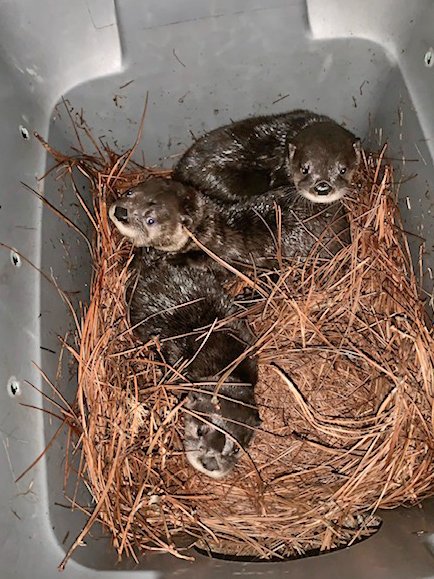
Three recently orphaned North American river otter pups have joined together as a group at the North Carolina Zoo to prepare for their eventual release back in the wild.
The North Carolina Zoo’s Valerie H. Schindler Wildlife Rehabilitation Center is caring for the pups, estimated to be 12 to 18 weeks old. They will eventually be released back into the wild as a group.
 All three otters are ideal candidates for rehabilitation and release as they were recently rescued without excessive human contact.
Dr. Jb Minter, the Zoo’s Director of Animal Health, said they were in good physical condition with no apparent signs of injury or illness.
“We are caring for them as hands-off as possible because we want to preserve their natural behaviors to ensure they have a better chance of surviving in the wild,” Dr. Minter said.
Releasing them as a group can also boost their chance of success, said Halley Buckanoff, the Wildlife Center’s veterinarian technician.
“Creating these foster families allows them to socialize with their species, and the younger ones often learn from their older ‘siblings,’” Buckanoff said. “Right now, they’re sleeping together, eating alongside each other with no signs of competition, and swimming together. They’re doing great as a group.”
How the otters were found
The first otter was rescued in a parking lot in Raeford in Hoke County on May 2 by A Wild Life: Center for Wildlife Rescue, Rehabilitation and Release. The female otter is estimated to be 14 to 16 weeks old. She arrived at the Zoo on May 12.
The second and third otters, both males, were rescued by Outer Banks Wildlife Shelter (OWLS) in Newport in Carteret County. Both otters arrived on May 13 at the Zoo.
The second otter, around six weeks old, was found in the Peletier area on April 25 in the roadway after heavy rain.
The third otter, about eight weeks old, was found April 27 near the Cedar Island Bridge. The body of its mother, who had been hit by a car, was found nearby.
Dr. Emily Christiansen, the Chief Veterinarian for the three North Carolina Aquariums, arranged for all three to be taken to the Zoo.
Transitioning for release into the wild
At the rehabilitation center, the otters will transition from formula to solid food and catching fish on their own during the next several months. Their final stages of care will be in a safe, outdoor, aquatic enclosure where they can prepare for their return to the wild.
Once ready, the Zoo will coordinate the otters’ release with the North Carolina Wildlife Resources Commission (NCWRC). Their release back into the wild is expected to occur in late summer or early fall.
May 27 is recognized as World Otter Day.



 Are you expecting a baby during the coronavirus pandemic? What should be one of the most exciting times in your life has essentially become an utter nightmare. You’re unable to go anywhere or do anything. More importantly, you must social distance from the friends and family you’d like to share this time with. Though this pregnancy might be a bit more stressful and lonely than most, the good news is there are ways you can share your pregnancy milestones while remaining safely at home.
 The mayor said:
 COVID-19 has exposed weaknesses in the country’s healthcare system, from supplies to staffing to bed counts, but issues have been far from uniform across the U.S. To find out which states were most prepared going into the pandemic, the personal-finance website WalletHub today released its report on the

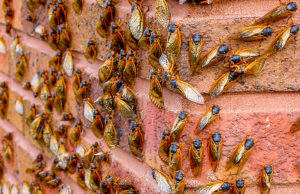 Just when you thought 2020 couldn’t get any worse, one of the largest broods of giant cicadas will soon emerge from the ground after a 17-year slumber.
 President Trump has just released a series of tweets threatening Governor Cooper that if full attendance is not allowed at the Republican National Convention this coming August in Charlotte, he will relocate the massive event.
 With in-person learning threatened by COVID-19 and higher levels of education correlating with higher earnings, the personal-finance website WalletHub today released its report on