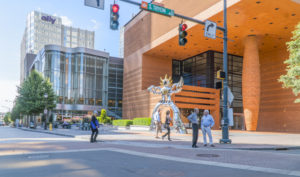
Charlotte-Area Facility Is A Finalist On ‘America’s Best Restroom Contest’

0

Cintas Corporation has just announced the 10 finalists for 2021’s America’s Best Restroom contest, including one right here in the Charlotte region.

Ten finalists are selected based on cleanliness, visual appeal, innovation, functionality and unique design elements. The finalist that receives the most votes from the public will be crowned America’s Best Restroom. Once the votes are tallied, the contest will award one lucky winner with $2,500.

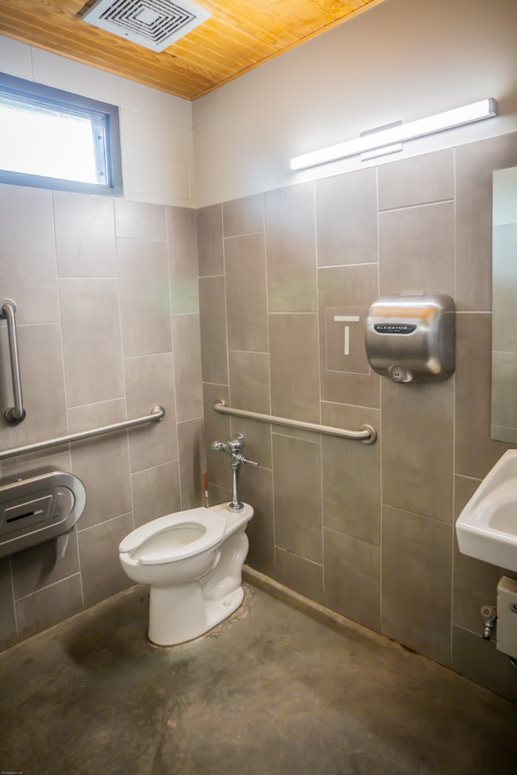
Out of the hundreds of thousands of public restrooms in the nation, Kannapolis’ Pump House was selected having one of the very best. Cintas describes the glorious facilities in Kannapolis as follows:

“The Pump House on West Avenue in Kannapolis, NC is designed as a beautiful place to rest, relax and have fun. In the middle of a beautiful tree lined street the Pump House is surrounded by water fountains, lit by a rainbow of colors, urban swings, public art sculptures, murals, a putting green, entertainment stages, and fun inspirational quotes from children’s books. Vibrant outdoor furniture creates a great hang out spot right outside of the Pump House doors with numerous businesses, restaurants, and a brewery just a few steps away. It’s a great place for children and adults alike. City staff keeps the area spotless – inside and out every day.”

Now through August 20, the public is invited to vote for their favorite finalist at www.bestrestroom.com/us.

If Passed, RAWA Bill Would Send NC $25 Million Per Year To Fight Extinctions

0

New bipartisan legislation in the House and Senate will fund locally led efforts to help prevent extinctions and help wildlife thrive nationwide. The Recovering America’s Wildlife Act (RAWA) will send approximately $25 million to North Carolina each year to help the state’s 500 species of concern, including the Carolina northern flying squirrel, Red-Cockaded Woodpecker and Appalachian cottontails.

“We’re facing a looming wildlife crisis, and this historic, bipartisan bill is by far the most important piece of wildlife legislation we’ve seen in the past half-century,” said Tim Gestwicki, CEO of the North Carolina Wildlife Federation (NCWF). “Scientists estimate that roughly one-third of America’s wildlife species are at an elevated risk of extinction. The Recovering America’s Wildlife Act will allow us to get ahead of the problem by stepping in to help at-risk wildlife early with collaborative, voluntary measures across every state, territory and Tribal nation.”

From the mountains to the coast of North Carolina, there are approximately 1,500 species of wildlife and 6,000 plants. The North Carolina Wildlife Resources Commission (NCWRC) has identified nearly 500 wildlife species in need of conservation action, including restoring habitat, removing invasive species, addressing wildlife diseases, reducing water pollution or mitigating climate change.

Upon the RAWA’s passage, the US Fish and Wildlife Service would distribute $25 million annually to NCWRC to implement North Carolina’s Wildlife Action Plan. Partnering organizations such as NCWF will then be eligible to apply for funding for existing plans that directly benefit at-risk wildlife.

“The bill will go a long way toward state and tribal efforts to help fish and wildlife species in decline while bridging the political divide and creating desperately needed jobs,” Gestwicki said. “More than 100 North Carolina businesses and organizations signed a letter supporting the bill to our state’s congressional delegation. We hope Sens. Richard Burr and Thom Tillis will soon sign on in support of this groundbreaking legislation to help demonstrate that wildlife conservation can unite all North Carolinians.”

Nationwide, the Recovering America’s Wildlife Act dedicates $1.4 billion annually to locally led wildlife restoration efforts. At least 15 percent of the funds will be used to help species already considered endangered or threatened on the tens of millions of acres under Tribal management nationwide.

Tribal Nations, such as the Eastern Band of Cherokee, would share $97.5 million annually to fund wildlife conservation efforts. The tribe is part of the nation’s first Native Fish Conservation Partnership working collaboratively for the Sicklefin Redhorse, a rare fish species endemic to the Hiwassee and Little Tennessee River basins.

The Recovering America’s Wildlife Act was introduced July 20 in the Senate by Martin Heinrich (D-N.M.) and Roy Blunt (R-Mo.). Representatives Debbie Dingell (D-Mich.) and Congressman Jeff Fortenberry (R-Neb.) introduced a similar version of the Recovering America’s Wildlife Act in the House in April.

Indian Land Offering Bus Drivers $20/Hour and $2,500 Bonus To Fill Drastic Shortages

0

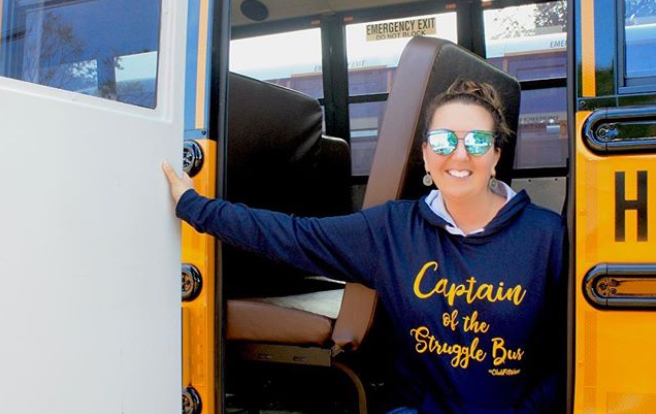
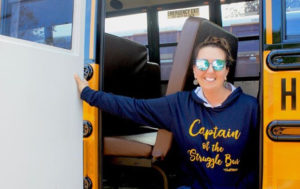
One Charlotte-area school district has gotten so desperate for bus drivers that they’re now offering them over $20 an hour to help transport students.

This week the Lancaster School District announced a 16% increase in pay for bus drivers in Indian Land to help fill badly needed shortages. The school district is also offering significant incentives for drivers who stick around for at least 30 days, including a $2,500 cash bonus.

There are currently 20 bus driver vacancies in Indian Land (the town requires at least 50 total drivers to safely transport all their students).

If you or someone you know would like to help fill the need, you can apply here.

Code Orange Air Quality Alert Issued For Charlotte Region Today

0

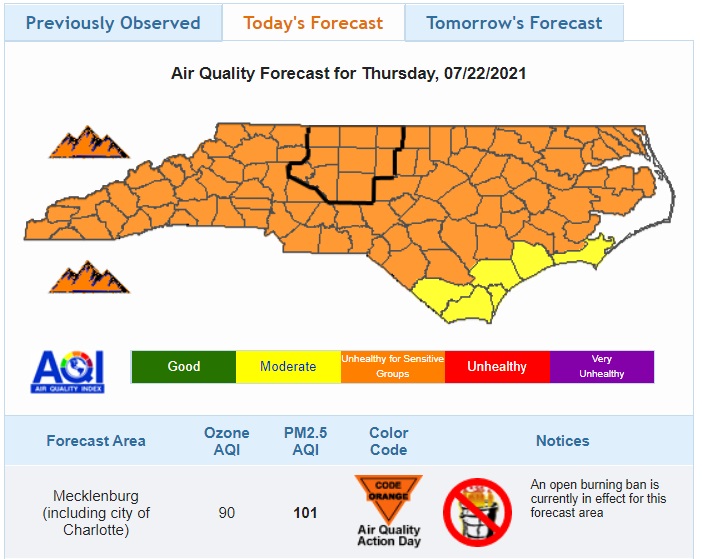
The North Carolina Department of Environmental Quality has just issued a Code Orange Air Quality Alert for Mecklenburg and surrounding counties until midnight tonight due to descending smoke from the wildfires in Canada and western states:

A Code Orange Air Quality Alert for Particulate matter means ground
level Particulate matter concentrations within the region may approach
or exceed unhealthy standards. The general public is not likely to be
affected. Active children and adults, and people with a respiratory
disease such as Asthma, should limit prolonged outdoor exertion.

The reason the smoke is descending on our region this week is due to jet stream pulling up smoke from the west high into the atmosphere, then dropping it in large swaths around the South East.

The smoke will make visibility lower and make the horizon look hazy and discolored throughout the day, and especially this evening.

If you’re planning on spending an extended amount of time outside today, consider wearing an M2 particulate mask to prevent lung damage.

15-Foot T-Rex Makes Debut at Charlotte Blackhawk Hardware

0
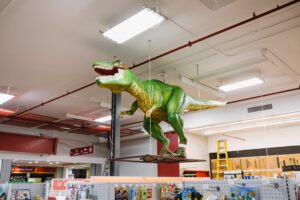
Charlotte’s Blackhawk Hardware just got a new massive store pet.
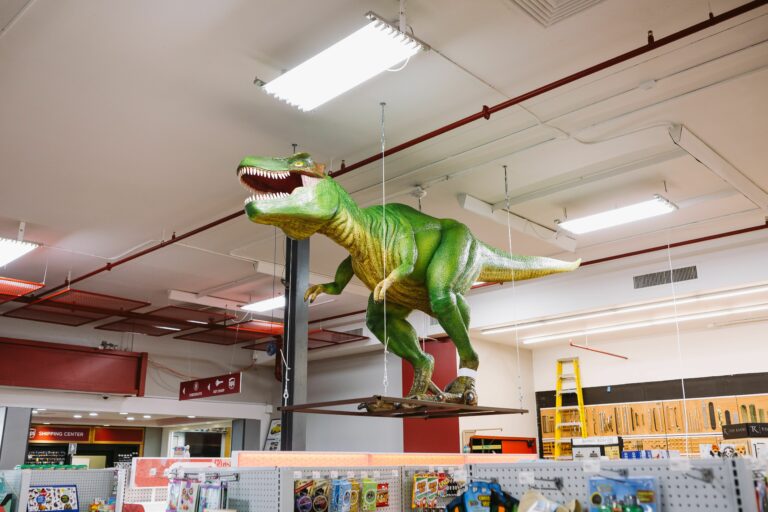
Today, a 15-ft., 400-lb. T-Rex dinosaur was installed at Blackhawk, hanging from the ceiling above the store’s toy section.
Children of all ages are invited to a “Meet the T-Rex” event on Saturday, July 24 from 10 a.m. to 12 pm. There will be goody bags for the first 25 shoppers to visit the toy section and the store will have fun activities for kids. Attendees can enter a contest to name the T-Rex for a chance to win a prize pack and gift certificate to Blackhawk.
The life-like T-Rex was presented to Blackhawk Hardware as the newest flagship store for Schleich, an international manufacturer of hand-painted toy figurines and play sets. Blackhawk is the only flagship retailer for Schleich in the Charlotte area and only the third in the Carolinas.
The giant new T-Rex will have a selfie spot for photos.

Charlotte’s Vile History of Slavery Before and After “The Late War” of The 1860s

0

As our city joins the nation in speaking up for racial justice and removing confederate street names, I decided to do some research into Charlotte’s history before, during, and just after “The Late War” of The 1860s (so named by Charlotte historian John Brevard Alexander).

I began my research by visiting the monuments and memorials of “The Late War” in and around Charlotte.

The largest of these currently sits in the middle of Elmwood Cemetery, in the Northwest corner of Uptown. It includes several large markers around the perimeter;
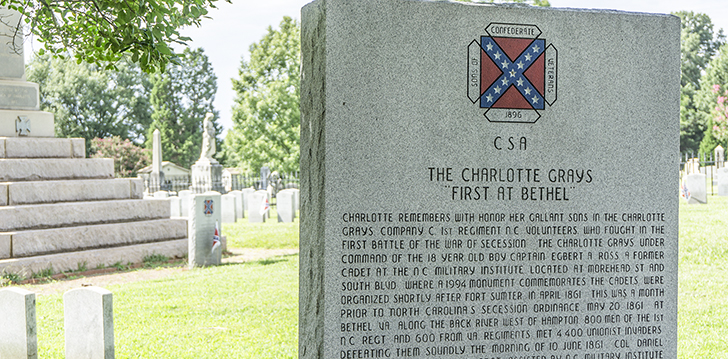
remeberance-statue

This one was moved from Old City Hall on Trade Street after it was vandalized in 2015;
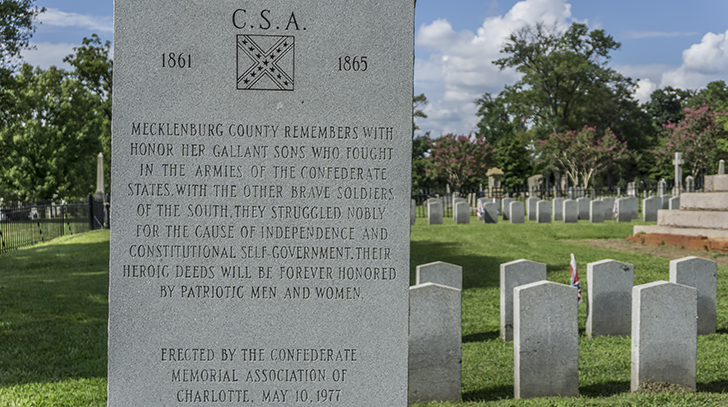
confederate-stone-in-uptown-charlotte-cemetary

The memorial features the largest obelisk in Charlotte in its center (which reads: To The Confederate Soldiers of Mecklenburg County – Erected by The Women of Charlotte 1887);
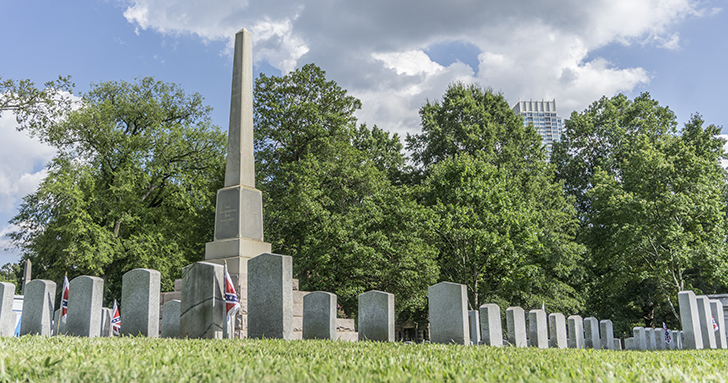
confederate-memorial-pillar-in-uptown-charlotte

And over 250 grave markers for Confederate soldiers surrounding the center obelisk;
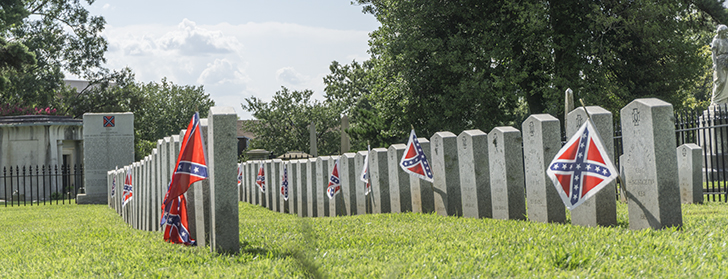
rows-of-confederate-monuments

While researching the confederate plaques and inscriptions, I stumbled across one of Charlotte’s most prominent historians, John Brevard Alexander, who lived in Lemley’s Township, Mecklenburg County (now the western half of Huntersville) during the second half of the 19th century.

He wrote 2 books in particular that details life in Charlotte before and after “The Late War” of The 1860s; The History of Mecklenburg County from 1740 to 1900 and Reminiscences of the Past Sixty Years.

The first of these books talks about the beginnings of slavery in the Queen City:

“From the time Mecklenburg county was the home of the Caucasian race long before the meets and bounds of the county were designated or cut off from Anson the negro was employed as the slave of white men. At that early day they were not numerous according to population but as the population increased they became more numerous. The price in the early times for a grown negro either man or woman did not exceed three hundred dollars but before the Nineteenth century was half over the price of a good looking man or woman would range from $1,000 to $1,800. The market price varied according to the price of sugar rice tobacco and cotton. In this county it was no uncommon thing to find the finest blacksmiths carpenters tanners shoemakers and in fact all kinds of mechanics among the slaves. In the rice plantations of South Carolina the great cotton fields of the more tropical States of the South and wherever the negroes were worked under the overseers of the Southern States they did not have the advantages that were to be had in Mecklenburg.” (pg 125, The History of Mecklenburg County from 1740 to 1900)

As well as the formation of “The Charlotte Negro Patrols“;

“The climate and soil of Mecklenburg were suitable and were eminently fitted for slave labor to be profitable. In one hundred years the increase in numbers was very great notwithstanding large numbers were moved South and West as the citizens sought more fertile lands as the markets of the world were opened up to king cotton. It soon became the custom to sell all the bad negroes in fact the good people of a neighborhood would not tolerate a bad character at home either man or woman. One who was smart and given to crime had a most pernicious effect on those with whom he came in contact hence he was promptly sold out of the State. It was to prevent negroes from holding meetings at night and on Sundays for planning mischief that our county courts organized the patrol to keep the negroes from congregating at places unbeknown to their masters. They were permitted to go to the church of their choice and were not interfered with If they wanted to visit any of their friends at night or Sunday they could easily get a pass which would insure them safety from the patrol. The last twenty five years of their servitude the patrols were very vigilantly engaged in looking after the interests of the South. In about 1845 it was no unusual thing for Northern school teachers both men and women to come down South to teach school and frequently hold secret meetings with the negroes doing a great deal of harm to our system of labor and as abolitionists rendering the negroes dissatisfied with their lot. This was the prime cause of appointing a patrol.” (pg. 329-330, The History of Mecklenburg County from 1740 to 1900)

The second book I found relating to Charlotte’s confederate past is called Reminiscences of the Past Sixty Years, which was also written by John Brevard Alexander.

In this book, Alexander talks more about the time after the Civil War, including what happened immediately after Charlotte’s slaves were freed:

“Scarcely a negro in Mecklenburg county remained upon the farm. It was hard for them to realize that freedom was thrust upon them if they did not leave home. They collected in vast numbers around every town and village. The greatest pressing question was how was our crops to be worked. Our cotton crop was small as our chief aim was to raise bread stuff to feed the army So it did not require as much labor as when cotton was planted. Various schemes were tried to get the crops cultivated. We kept a large garden to supply the negroes with vegetables and this we turned to account by hauling to Charlotte and selling the vegetables to the Yankee soldiers. There was 6,000 troops stationed here to keep us in subjection.” (pg 9, Reminiscences of the Past Sixty Years)

Alexander then begins to paint an exaggerated “Lost Cause” picture of the reconstruction years:

“From 1865 1875 we lived in the Africanised South the most inconceivable government among men according to all the precedent of all the past when for the first time since the begining of time a white race undertook to put the feet of a colored race on the necks of the white men and women of their own blood and breed. No civilized or christian people has ever been forced to drink the gall and worm wood of defeat during the days of so called reconstruction.” (pg. 113-114, Reminiscences of the Past Sixty Years)

He also recounts a truly twisted version of the formation of the Ku Klux Klan in and around Charlotte:

“The Ku Klux Klan a secret oath bound brotherhood rose in a night disarmed every negro and restored civilization. The secret weapon with which they struck was the only one at their command and it was the most terrible and efficient in the history of the rebellion. The movement of these white and scarlet horsemen was like clockwork. They struck shrouded in a mantle of darkness and terror and they struck to kill. Discovery or retaliation was impossible. Their edicts were executed as by destiny without a word save the whistle of the Night Hawk the crack of his revolver and the hoof beat of swift horses moving like figures in a dream and vanishing like mists and shadows. The Southern people in their despair had developed the courage of the lion the cunning of the fox and the deathless faith of religious enthusiasts With magnificent audacity infinite patience and remorseless zeal a conquered people now turned his own weapon against the conqueror and beat his brains out with the bludgeon he had placed in the hands of former slaves And as a lawless band of night riders became the sole guardians of society brought order of chaos law out of lawlessness and preserved our race in America from extinction at least in negroid mongrelism. Had the South in this crisis become mulatto the nation would inevitably have sunk to its level.” (pg. 111-112, Reminiscences of the Past Sixty Years)

John Brevard Alexander is certainly not alone in painting such a skewed version of the past. Many other southern writers, historians, and politicians in the last 1800s and early 1900s attempted to frame slavery in the south in the best possible light – often going so far as to call the institution of slavery a positive thing for all involved.

This false narrative which framed many of the southern school books and encouraged the erection of most of the confederate statues and monuments became known as “The Lost Cause“.

Points to Consider When Finding a Best Seat Cushion

0

Cushions are one of the important products that make interior decoration. Unfortunately, there are few things to consider when buying seat cushions to fit the style of your seats. A lot of cushions are produced by different companies or manufacturers. It is not easy to choose the best product from the many products you will get from the market. In this case, you have to consider reading more information to check details about these products. In the paragraphs below, there are points to help you when choosing a good cushion that fits your interior décor.  

The Color  

Since you want to add a new product to your interior decoration, you have to note the product’s color. Note that the color of the cushion should match the color of the interior décor. These cushions are made in different colors, and you can only consider your favorite color to choose the best. Try and study the color chats and see if you can identify the color that you need. Alternatively, look at the color of the seats you have to help you make a good decision.  

The Design  

Another thing that will help you enjoy using the product is the design. Consider looking at the available designs and see if you can choose from the available. The design will also make the products match the interior décor. Also, you will not want to install a cushion that will not give the seats the best look. In this case, you should choose your design and let the company make one for you. 

Customize The Cushions  

As mentioned above, you have the option of making your cushion. Talk to the manufacturing company to give you the best product. However, you will have to look for a good designer to make the product for you. Start by asking the designer how long they have produced their product to know if they are well experienced in work. It is important to look at the service provider’s license since it will show their ability to do everything involved.  

Choose The Best Shop

If you are buying the available products, then it is essential to choose the right shop. In this case, you should consider buying the products from the online store. You will benefit a lot when you consider buying the product from online shops. Look at the pictures and the description of the seat cushions that are sold on the online platform. To trust the online shopping platform, make sure that you read the comments and testimonies of past clients. Also, check if the online site is licensed and secured. This will give you a better idea about the best cushions that you will buy. 

Calculate The Cost 

After knowing the above, it is time to calculate the cost of these products or determine how much these products cost. You have a budget that must not be overlooked because there are cushions that you can afford and some that you cannot afford. 

With the above points, your work of getting the best seat cushion will be easy. Also, when you check details on the internet, you will know about the best products. Make sure that you buy a product that satisfies you and fits all the reasons you need the product.

Tim Tebow Becomes Spokesman For Charlotte-Based Clean Juice Franchise

0

Charlotte’s own Clean Juice has just announced that former NFL quarterback Tim Tebow is now their official company spokesman.

“Tim Tebow’s natural authenticity, inspiring reputation, commitment to healthy living, and unwavering faith is the perfect embodiment of the personal and professional values we hold dear at Clean Juice,” Landon Eckles, CEO of Clean Juice, said in a statement. “We are truly blessed that Tebow has chosen to stand side-by-side with Clean Juice in becoming the face of the brand’s continued mission and vision of being healthy in body and strong in spirit.”

Clean Juice emerged from the global pandemic with record-breaking growth in 2021. In the first quarter of 2021, Clean Juice exceeded expectations in key performance indicators namely comparable or same-store sales (SSS), which increased 7%. The company reports continued success in April with SSS up 23%. The award-winning company was also named among the fastest-growing privately held companies in both Inc.5000 and Entrepreneur magazine’s 500 ranking lists.

The original Clean Juice location opened in Huntersville in June 2015, on the eighth wedding anniversary of founders Kat and Landon Eckles. Today, there are 14 Charlotte area Clean Juice locations and over 100 nationwide, and another 55+ stores in development.

For more information you can visit cleanjuice.com.

North Carolina Is 2021’s 9th Best State to Start a Business

0

With the COVID-19 pandemic leading to more than 200,000 permanent business closures but the country starting to recover, the personal-finance website WalletHub today released its report on 2021’s Best & Worst States to Start a Business.

To determine the most fertile grounds for planting and growing new ventures, WalletHub compared the 50 U.S. states across 28 key indicators of startup success. The data set ranges from financing accessibility to COVID-19 cases to office-space affordability.

Starting a Business in North Carolina (1=Best; 25=Avg.):

  • 13th – Avg. Growth in Number of Small Businesses
  • 11th – Labor Costs
  • 12th – Avg. Length of Work Week (in Hours)
  • 12th – Cost of Living
  • 25th – Industry Variety
  • 29th – COVID-19 Positive Tests in the Past Week per Capita

Best States to Start a Business

Overall Rank  State Total Score  Business Environment  Access to Resources  Business Costs 
1 Texas 57.89 2 12 32
2 Georgia 56.92 1 31 20
3 California 56.58 3 1 48
4 Florida 55.84 5 15 22
5 Idaho 55.78 4 41 8
6 Utah 55.66 17 4 31
7 Colorado 54.15 9 9 33
8 North Dakota 54.12 6 18 25
9 North Carolina 54.01 10 21 21
10 Massachusetts 53.85 13 2 43
11 Oklahoma 53.47 28 33 1
12 Arizona 53.41 8 16 30
13 Maine 52.57 11 32 18
14 Mississippi 52.52 37 25 2
15 Tennessee 52.46 7 39 16
16 South Dakota 52.33 22 34 5
17 Kentucky 52.27 15 46 4
18 New Mexico 52.01 26 28 9
19 South Carolina 51.79 20 36 13
20 Nebraska 51.65 18 40 12
21 Indiana 51.55 23 35 11
22 New York 51.30 19 3 46
23 Hawaii 50.88 16 7 41
24 Michigan 50.59 34 29 6
25 Wisconsin 49.55 35 22 23
26 Montana 49.35 33 44 7
27 Iowa 49.22 30 26 28
28 Washington 49.20 29 5 42
29 Illinois 48.81 40 8 36
30 Minnesota 48.45 32 14 35
31 Alabama 47.96 24 50 14
32 Nevada 47.73 43 19 29
33 Ohio 47.33 38 38 17
34 Louisiana 47.00 45 24 15
35 Maryland 46.98 12 13 49
36 Arkansas 46.69 41 48 10
37 Vermont 46.34 31 47 27
38 New Hampshire 45.77 14 43 38
39 Kansas 45.65 42 45 19
40 Oregon 45.56 21 27 40
41 Virginia 45.47 25 30 39
42 Delaware 45.33 36 10 44
43 Pennsylvania 44.52 44 20 34
44 Missouri 43.20 47 37 24
45 Alaska 43.14 27 23 45
46 Wyoming 42.76 46 42 26
47 West Virginia 42.16 50 49 3
48 Rhode Island 41.85 48 17 37
49 Connecticut 41.13 49 6 47
50 New Jersey 41.07 39 11 50

Note: With the exception of “Total Score,” all of the columns in the table above depict the relative rank of that city, where a rank of 1 represents the best conditions for that metric category.

Have you started a business in North Carolina or any other state? 

Do you agree with the report? 

1 in 5 North Carolinians Use Social Media While Behind The Wheel, Poll Reveals

0

We’re used to a certain level of distraction while we’re driving: listening to a podcast about serial killers, or catching up with the sports news on local radio. But these kind of things require us to be passive, and don’t require our hands to leave the wheel. However, due to everyone’s increased obsession with social media, it’s become more common to find drivers turning to their phones while on the road – and not just at the traffic lights.

Gunther Automotive commissioned a survey of 3,100 drivers and quite shockingly, found that over 1 in 5 (22%) drivers in North Carolina admit to using social media while behind the wheel. More specifically, almost 1 in 5 (16%) of us have taken a selfie while driving.

Drivers in South Dakota and Rhode Island seem to be the most distracted drivers across the country with half (50%) admitting they have used social media while driving. Comparatively, only 11% of those in Arkansas say they’ve done so.

And what platforms are we most likely to use while driving? Over half (58%) said Facebook, which often involves reading boring status updates or scrolling through quick new snippets. 12% said Snapchat, where you watch short videos – possibly involving cats and 10% said Twitter, which involves reading a range of tweets, some which can make you laugh, some of which can make you angry. 8% said Instagram, involving scrolling through pretty images and perhaps catching up on celebrity updates. Another 8% watch longer videos on YouTube and just 4% exchange messages on WhatsApp while driving.

This all adds up to a driver’s attention being severely distracted from what’s going on them, and on the road ahead. And far more seriously, it turns out 1 in 5 (18%) drivers don’t know it’s actually illegal to use a cellphone while driving. When asked whether people who do this should face the same penalties as drunk drivers, almost half (48%) agreed – but worryingly, 21% of drivers said they didn’t think using social media while driving affected their driving capabilities. And if a friend posted a selfie while driving, 1 in 10 (12%) people admit they would probably like the post.