
North Carolina Sees Its Highest Single Day Increase in COVID-19 Cases

0

Just 8 days after Governor Cooper initiated ‘phase 1’ of our state’s reopening plan, our state has just witnessed its largest single day increase in COVID-19 Cases.

Between Friday, May 15th and Saturday, May 16th, the total number of cases increased by 853, bring the total number of cases in the state to 17,982.
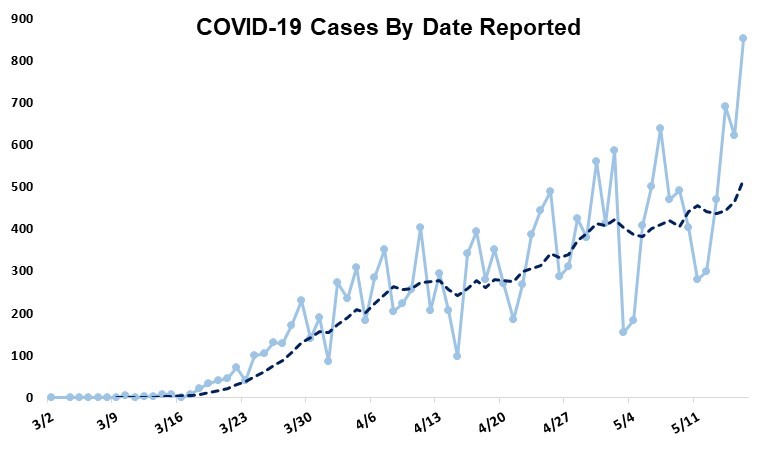
Mecklenburg County is now reporting 2,504 total cases and 62 deaths from COVID-19, an increase of 65 from yesterday’s total of 2,439.

The NCDHHS released the following video this morning encouraging all NC residents to practice “The 3 Ws”:

Governor Cooper’s ‘phase 1’ order is in effect until 5 pm on Friday, May 22. However, the end of this Order does not necessarily mean the state will move to Phase 2. Phase 2 will only start if data and indicators are in the right place.

Phase 2 includes the following changes:

  • Lift Stay At Home order with strong encouragement for vulnerable populations to continue staying at home to stay safe
  • Allow limited opening of restaurants, bars, fitness centers, personal care services, and other businesses that can follow safety protocols including the potential need to reduce capacity
  • Allow gathering at places such as houses of worship and entertainment venues at reduced capacity
  • Increase in number of people allowed at gatherings
  • Open public playgrounds
  • Continue rigorous restrictions on nursing homes and other congregant care settings

After 4-6 weeks of phase 2, if everything still looks under control, the state will move to Phase 3, which includes the following changes:

  • Lessen restrictions for vulnerable populations with encouragement to continue practicing physical distancing and minimizing exposure to settings where distancing isn’t possible
  • Allow increased capacity at restaurants, bars, other businesses, houses of worships, and entertainment venues
  • Further increase the number of people allowed at gatherings
  • Continue rigorous restrictions on nursing homes and other congregant care settings

Governor Cooper underscored the need for the testing, tracing and trends to move in the right direction for each of these phases to move forward. If there is a spike in infections, tightening of restrictions may be needed temporarily.

What do you think about the plans?

Charlotte’s Chef Alyssa’s Kitchen Now Offering Exclusive Memorial Day Weekend Pre-Order Menu

0

Chef Alyssa’s Kitchen of Charlotte, NC is making Memorial Day Weekend cookout easier and more delicious.

“With this time of season, I love being outside and grilling. While not in a regular circumstance, we wanted to create a feeling of normalcy for the weekend, “ said chef Alyssa Wilen owner and executive chef of Chef Alyssa’s Kitchen. “Our goal is to make a one stop and safe pick up or delivery for grilling during the long weekend!” said Wilen

The Memorial Day pre-order menu is available on the Chef Alyssa’s Kitchen website. They are accepting orders online, with no minimums, until Wednesday May 20th at 11:00 am. Guests may choose their pick up or delivery time for Friday May 22nd between 3 and 7 pm, located at their lower South End kitchen space. All items are prepared cold. Wine and local beer products are also available.

“Utilizing some of the great local vendors for the menu include Shipley Farms, Duke’s Bread and Coto Family Farms. I’m most excited for our Wagyu Hot Dogs, Shipley Farms Grass-fed Beef Burgers and our Watermelon and local Strawberry Salad, “added Wilen”

Possible Tropical Storm ‘Arthur’ System Growing – Several Models Showing Impact With Carolinas

0

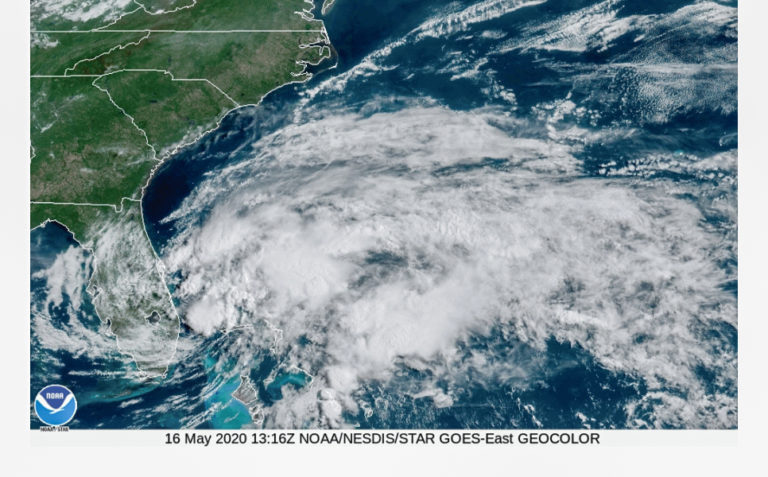
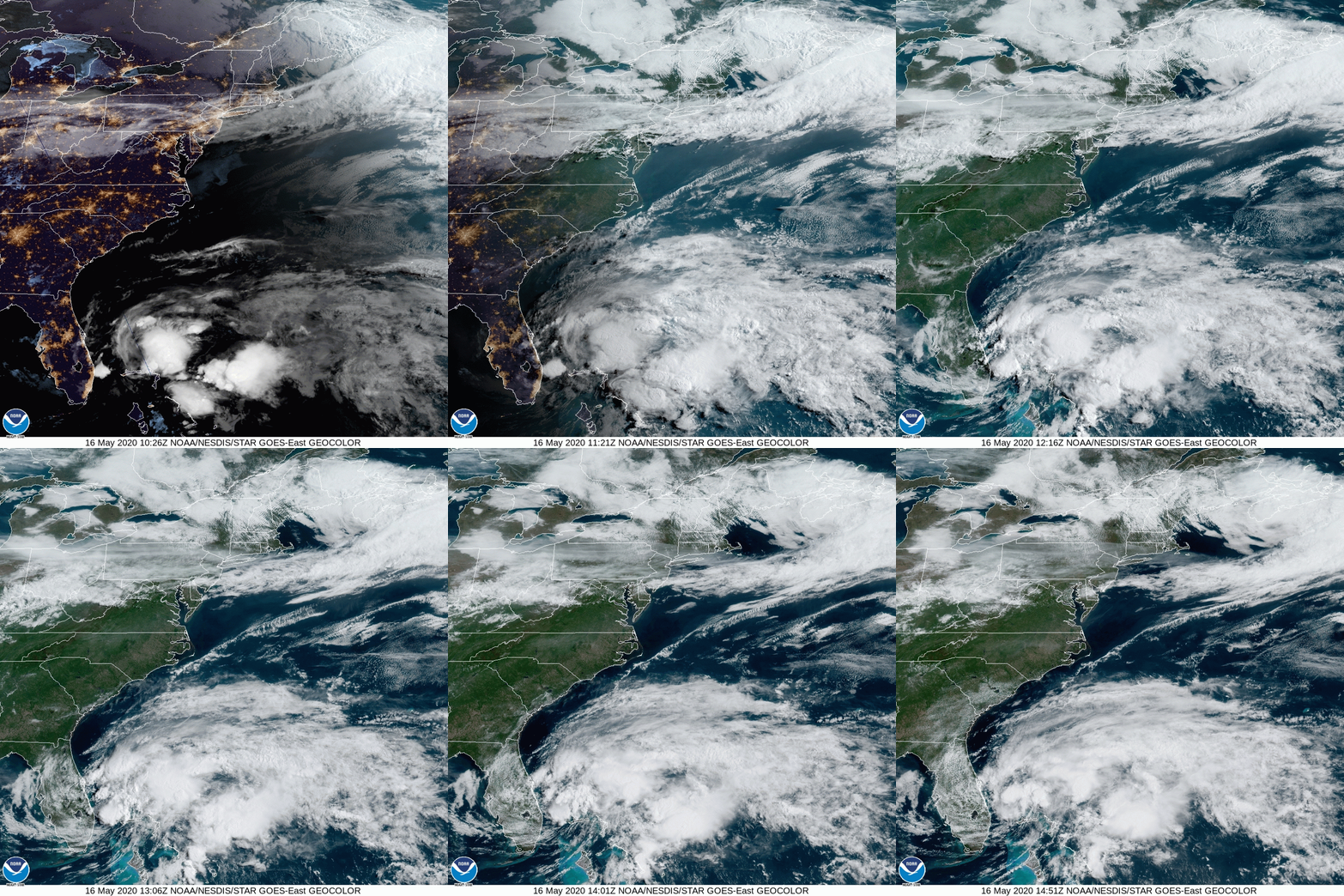
A growing disturbance in the Bermuda Triangle will likely become the first named storm of 2020 by the end of this weekend, according to the National Weather Service.

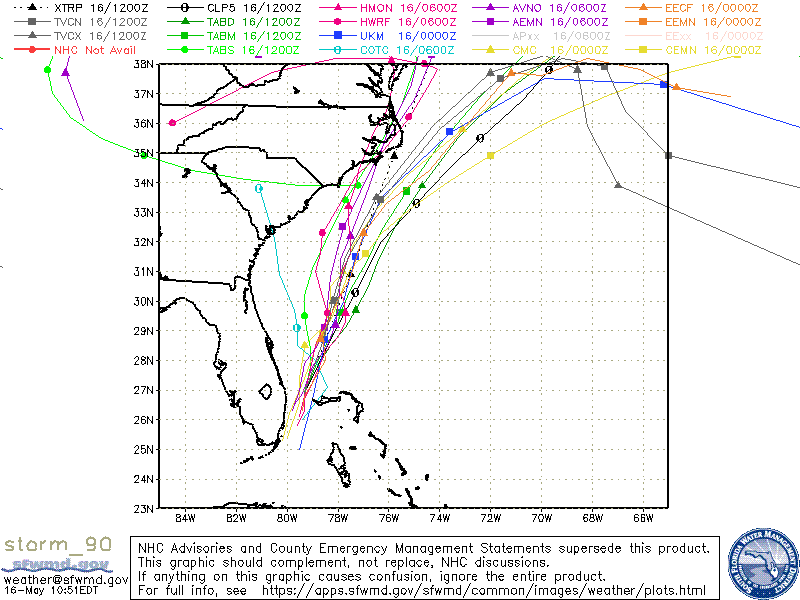
Since first reporting on the storm this past Tuesday, the system has developed a much tighter rotation patter and a more westerly trajectory, with almost half of the forecast models showing a direct impact with the Carolinas.

The NHC has now upgraded the probability of the system becoming a subtropical or tropical storm to 80% (HIGH) within the next 48 hours. If it does develop, they NWS will give the new storm the name ‘Arthur’.

This morning, the National Weather Service issued the following alert:

810 AM EDT Sat May 16 2020
An area of low pressure located just offshore of the southeast 
coast of Florida continues to produce shower activity and gusty 
winds from portions of southeast and east-central Florida 
eastward across the northwestern Bahamas and the adjacent Atlantic 
waters.  Satellite images and surface observations indicate that the 
low is gradually becoming better defined, but the associated showers 
and thunderstorms remain disorganized.  Continued gradual 
development is expected, and the system is likely to become a  
tropical or subtropical depression or storm later today or tonight 
while it moves north-northeastward over the Atlantic waters east of 
Florida.  Later in the weekend and early next week, the system is 
expected to move generally northeastward over the western Atlantic 
near or east of the Carolinas.

The official Atlantic Coast hurricane season for 2020 runs from June 1st through November 30th, so if Arthur does develop into a full blown storm, it would be nearly a month early.

NWS officials are reminding all residents in Atlantic Coast states to start preparing for the upcoming hurricane season.

In case of a power outage, make sure to have the following emergency items stocked in your home;

We will continue to update this article as this storm develops. 

Paycheck Protection Program Leaves NC’s Small Business Employees Without Health Care 

0

A new report by Piedmont Rising reveals that North Carolina’s small and minority-owned businesses may not have received loans under the Paycheck Protection Program (PPP) at the same rate as large businesses.

The report highlights that while PPP funding was intended to keep small businesses afloat amid the COVID-19 pandemic, the program has failed to assist the vast majority of small businesses, including in North Carolina, with a large share of minority-owned businesses left behind. Meanwhile, communities of color are already feeling an overwhelmingly disproportionate impact of the coronavirus pandemic due to inequities in health care access.

Piedmont Rising Executive Director Casey Wilkinson released the following statement in response to these findings:

“For North Carolina’s small businesses, every day without access to this PPP funding means more lost jobs on Main Street. North Carolina is facing a health and economic crisis that is not of their making. These small businesses did their due diligence and were ready to respond, but lawmakers like Senator Thom Tillis and Richard Burr failed them.

“Many of these small business owners and their employees are losing their health insurance and access to care during a global pandemic. As we know, the coronavirus pandemic is impacting communities of color at a disproportionate rate. Minority-owned small businesses and the families that rely on them are no exception to this trend within the outcomes of the pandemic, which makes it that much more vital to ensure they get the help they need.

“We urge Senators Tillis and Burr to support new legislation in Congress that would help to solve this problem so  that every small business owner and their employees gets equal access to critical federal assistance.”

Key Findings:

  • There are 890,000 small businesses in North Carolina with fewer than 500 employees. Meanwhile, North Carolina has received just 66,677 loans from the Paycheck Protection Program.
  • During the first round of PPP funding, 80 percent of small businesses that applied for relief money received none, with North Carolina receiving only 2.5 percent of the nearly $189 billion lent through the Paycheck Protection Program.
  • And, while businesses of color account for 30 percent of all U.S. businesses, roughly 95% of Black-owned businesses, 91% of Latino-owned businesses, 91% of Native Hawaiian or Pacific Islander-owned businesses, and 75% of Asian-owned businesses failed to secure loans from the Paycheck Protection Program.
  • Due to existing inequities in health care in North Carolina, Black and Hispanic communities are experiencing a disproportionate number of coronavirus confirmed cases and, as a result, serious complications from the coronavirus pandemic.
  • Banks that offered PPP loans, including Bank of America, JPMorgan Chase and Wells Fargo, prioritized larger loan applications and charged higher fees in order to maximize loan-origination fees and their own profits.

Pamlico Capital Gives $1 Million to Charlotte’s COVID-19 Fund – Bringing Total To $18.5 million

0

Pamlico Capital announced it is committing $1 million to support the community-wide efforts of the COVID-19 Response Fund. To date, more than $18.5 million has been raised for the fund.

The COVID-19 Response Fund was launched in March by Foundation For The Carolinas and United Way of Central Carolinas to support those most impacted by the pandemic. So far through two grant cycles, the fund has issued nearly $6.5 million in grants to a range of nonprofits – from large institutions to smaller grassroots organizations – on the frontlines of the crisis, providing food, shelter, economic assistance, healthcare and more to families and individuals most in need. Additonal grant awards will be announced shortly.

“Our entire team contributed to this effort and feels a strong commitment to invest in our community at this critical moment,” said Eric Eubank, a partner at Pamlico Capital. “These are unprecedented times, which we felt called for an unprecedented response from those of us who have the ability to make a difference. We hope others will follow us and the many other generous donors to the fund.”

In addition to the $1 million donation to the COVID-19 Response Fund, Pamlico Capital is committing another $150,000 directly to local nonprofits chosen by the firm’s employees, including Loaves & Fishes, Renaissance West, Freedom School Partners and E2D.

“The generosity of our corporate partners, such as Pamlico Capital, continues to move me,” said Foundation For The Carolinas President and CEO Michael Marsicano. “Their leadership is why our fund is still growing steadily two months after its launch. As we approach the fund’s third round of grants, however, it’s clear more help is needed. We must continue to unite to help those who need it the most.”

The COVID-19 Response Fund is administered through a partnership between Foundation For The Carolinas and United Way of Central Carolinas, in close coordination with the City of Charlotte and Mecklenburg County. A COVID-19 Response Fund Grants Committee reviews and distributes grants from the fund. Additional efforts have been established throughout the Carolinas in counties served by FFTC and/or United Way of Central Carolinas.

“This fund was created to support people through our local nonprofits, which is critical in this time of desperate need,” said Laura Yates Clark, president and CEO of United Way of Central Carolinas. “It’s been inspiring to see organizations such as Pamlico Capital rally around this cause and support those facing economic uncertainty, unemployment, homelessness, healthcare concerns, depression and more.”

Donations to the COVID-19 Response Fund have ranged from a two-dollar commitment from an anonymous online donor to $1.3 million from Mecklenburg County. Other major gifts include $100,000 each from the Charlotte Hornets Foundation, the Springsteen Foundation, the Philip L. Van Every Foundation, Kim and Johnny Belk, and Alfred and Amy Levine Dawson; $150,000 each from Wells Fargo, Wells Fargo Championship and Sean & Andrea Smith; $200,000 each from Allstate Insurance and Vanguard; $250,000 each from the Charlotte Mecklenburg Community Foundation, the Weisiger Fleming Family Fund, EY, PwC/The PwC Charitable Foundation, and The Hearst Foundations; $270,000 from BlackArch Partners/The Regions Foundation; $500,000 each from Ally Financial, the Duke Energy Foundation and the John S. & James L. Knight Foundation; and $1 million each from LendingTree, the City of Charlotte, the Howard R. Levine Foundation, Truist Financial Corporation, Bank of America, the David A. Tepper Charitable Foundation, Lowe’s, the C.D. Spangler Foundation/National Gypsum, Coca-Cola Consolidated and the John M. Belk Endowment.

To contribute to the COVID-19 Response Fund, visit HelpCharMeck.org.

Daily Fantasy Sports (DFS) Wins Favor in Significant Court Decision

0

A U.S. court has ruled in favor of a defendant in a case relating to a loss of funds in an online game of Daily Fantasy Sports (DFS).

Daily Fantasy Sports (DFS) is an emerging branch of online entertainment that has seen a resurgence of interest lately following the national sports shutdown. The online activity mimics real-life sports events using accurate statistics of existing players and athletes. 

Users can sign up to an online DFS platform and pay an entry fee to compete for rewards based on the performance of their chosen team or players. Since the activity can result in players winning cash from their choices it has been compared with sports betting and banned in most states.

However, the exact legal situation regarding DFS remains uncertain, with 19 U.S. states allowing the activity to go ahead. Fantasy sports games have been around for many years but the new DFS format presents an element that more closely resembles gambling. In lieu of formal legislation, many states have simply applied existing gambling laws to regulate the industry. However, in some cases, this has opened up the industry to legal challenges. 

Dew-Becker v. Wu

Recently, a DFS player in Illinois argued that his $109 loss on a game of DFS was not legal under the state’s gambling laws. The player hoped to have his money recovered under an Illinois statute that allows victims of gambling to recover their losses. A judgment was delivered by Chief of Justice Anne M. Burke on April 16, 2020.

Hosted by DFS site FanDuel, the event in question involved both players signing up and agreeing to a $109 fee to compete against each other in a fantasy basketball game. For hosting the event, FanDuel took a $9 fee from each player, and the player who put together the winning team received the remaining $200 as a prize.

The plaintiff, Colin Dew-Becker, alleged that since the game constituted gambling it should be deemed illegal and all funds returned. However, the Supreme Court of Illinois rejected the claim and ruled in favor of the defendant, stating that the law “does not allow recovery when the gambling is not connected.” In this case, the facilitation of the event by FanDuel means the players didn’t gamble directly between themselves.

Change in gambling legislation

Existing legislation regarding online gambling has been changing rapidly over the past few years, in both the US and around the world. In the UK, a new law has recently been imposed by the UK Gambling Commission that enforces online gambling operators to stop offering ‘sticky’ bonuses that come with unfair ‘wagering requirements’. Now, many online casinos in the UK, Australia, and New Zealand specifically offer only non sticky bonuses. The law stops operators from offering bonuses that have hidden conditions that essentially trap a players’ cash in the casino until they have wagered a certain amount of money.

While most legislation is aimed at protecting players, some of it can be over-restrictive and harmful to online operators. Most notably, last year’s controversy regarding The 1961 Wire Act cast confusion on the online gambling industry in the US. The law traditionally restricts the offering of bets on sporting events across state lines but the Department of Justice (DoJ) recently suggested it should apply to all forms of gambling.  As a result, many operators have been left unsure whether they can continue to offer their services across state lines. A New Hampshire federal court has since ruled against the DoJ’s suggested changes but an appeal against the ruling is expected.

Charlotte Appears On White House Briefing As #1 ‘Location To Watch’ For COVID-19 Surge

0

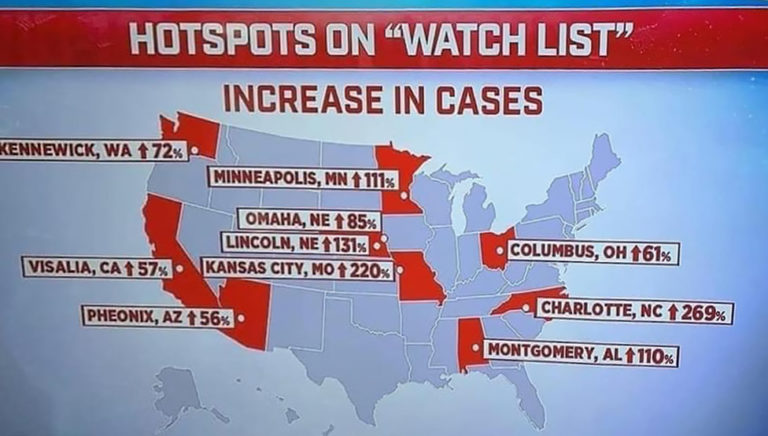
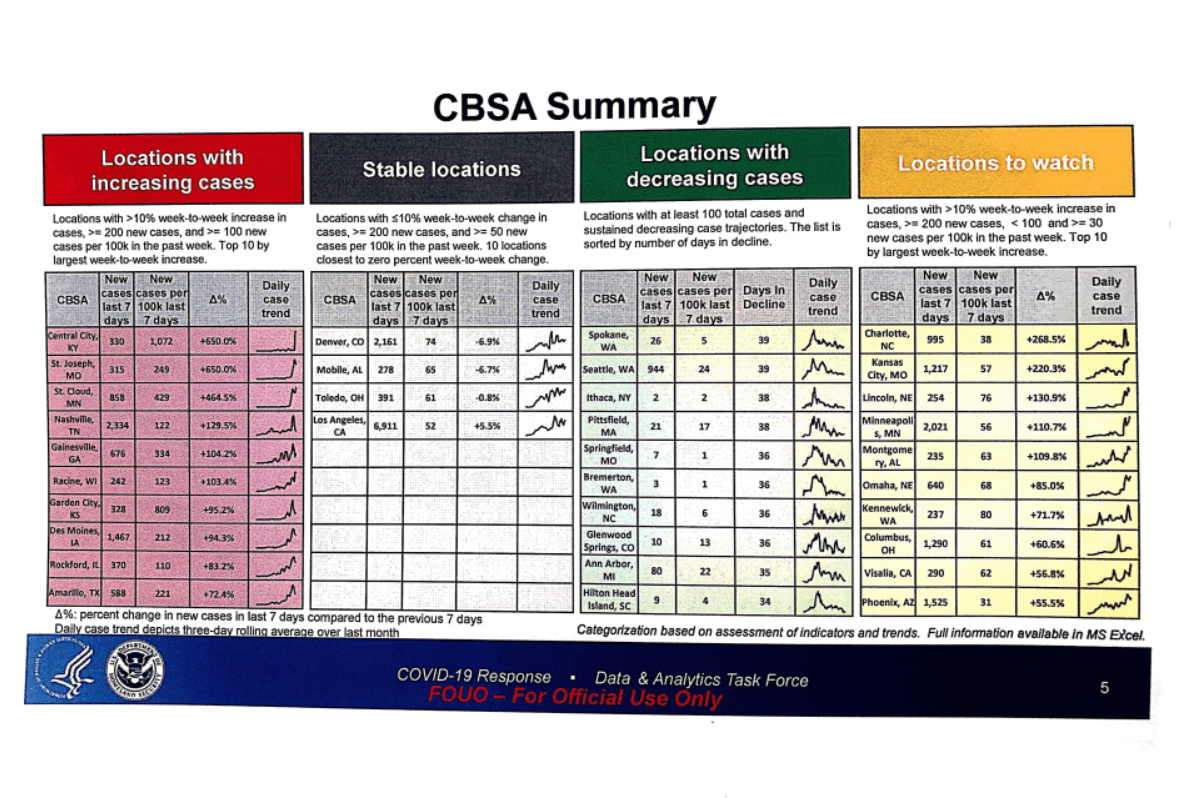
Last week, the City of Charlotte showed up on an official White House pandemic task force briefing as having the highest surge of new COVID-19 cases in the nation.

The document was obtained by NBC News and shows which metropolitan areas have the highest spikes. The document includes a section called ‘Locations to watch’, which lists the 10 top areas that recorded surges of 72.4 percent or greater over a seven-day period compared to the previous week.

Charlotte appears as the #1 ‘location to watch’ on the list:

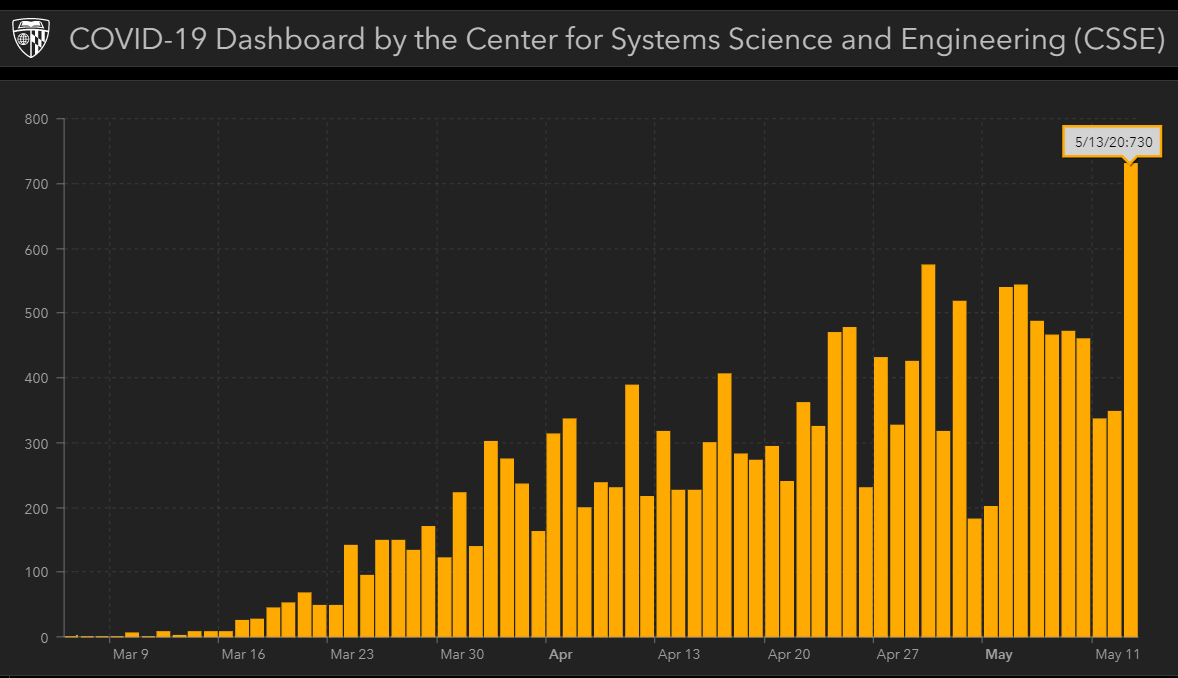
Yesterday North Carolina saw its largest single day increase in cases to date with 730 new COVID-19 cases reported across the state.

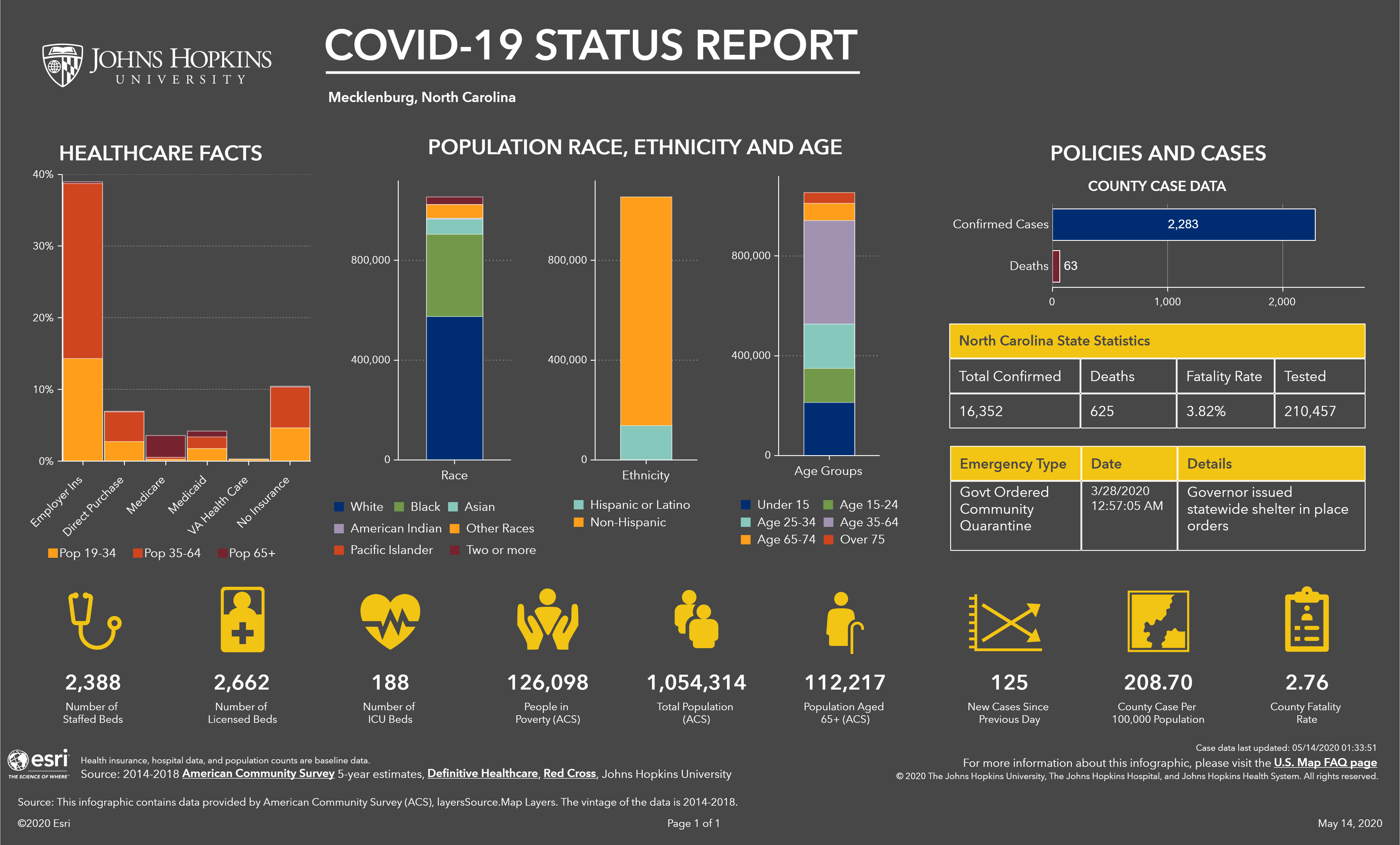
Our state has now confirmed a total of 16,352 total cases, 625 deaths, and 210,457 total tests. Mecklenburg County is now reporting a total of 2,283 cases and 63 deaths from COVID-19 as of 6:00 pm on May 14th, 2020.

Governor Cooper’s ‘phase 1’ order is in effect until 5 pm on Friday, May 22. However, the end of this Order does not necessarily mean the state will move to Phase 2. Phase 2 will only start if data and indicators are in the right place.

Phase 2 includes the following changes:

  • Lift Stay At Home order with strong encouragement for vulnerable populations to continue staying at home to stay safe
  • Allow limited opening of restaurants, bars, fitness centers, personal care services, and other businesses that can follow safety protocols including the potential need to reduce capacity
  • Allow gathering at places such as houses of worship and entertainment venues at reduced capacity
  • Increase in number of people allowed at gatherings
  • Open public playgrounds
  • Continue rigorous restrictions on nursing homes and other congregant care settings

After 4-6 weeks of phase 2, if everything still looks under control, the state will move to Phase 3, which includes the following changes:

  • Lessen restrictions for vulnerable populations with encouragement to continue practicing physical distancing and minimizing exposure to settings where distancing isn’t possible
  • Allow increased capacity at restaurants, bars, other businesses, houses of worships, and entertainment venues
  • Further increase the number of people allowed at gatherings
  • Continue rigorous restrictions on nursing homes and other congregant care settings

Governor Cooper underscored the need for the testing, tracing and trends to move in the right direction for each of these phases to move forward. If there is a spike in infections, tightening of restrictions may be needed temporarily.

What do you think about the plans?

Charlotte Restaurant Owners Donate 575 Meals and More to Local Heroes

0

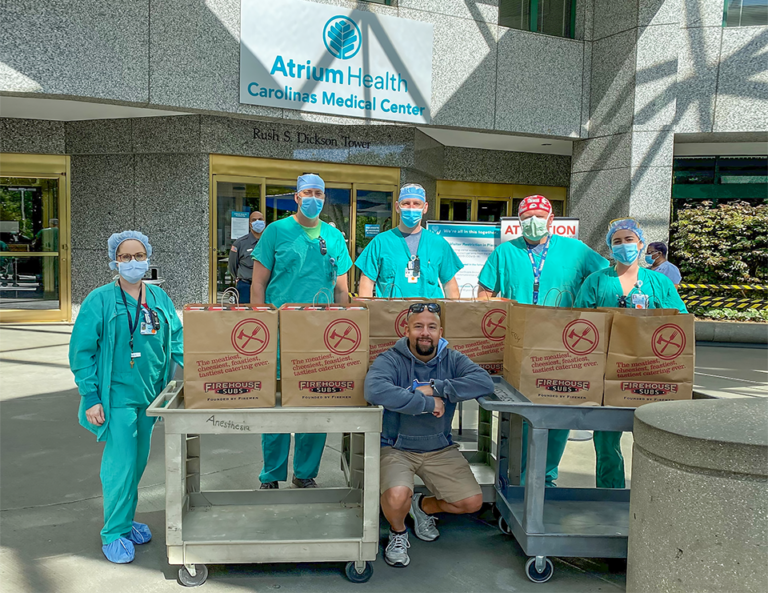
In partnership with the Firehouse Subs Public Safety Foundation, Franchisee Larry Chandler and Area Representative Tim Goss donated 575 meals to local heroes at Carolina Medical Centers, Atrium Health Union Hospital in Monroe, Atrium Health Pineville, Novant Hospital and Charlotte-Mecklenburg Police Department.


“It is my pleasure to deliver meals to the nurses and doctors who are helping keep our community in good health,” said Goss. “Giving back is something we prioritize at Firehouse Subs and we are thankful to continue supporting our community during this time of uncertainty.”

The donation to the Charlotte-Mecklenburg Police Department was part of 800 meals donated by Charlotte Salute to Heroes Hockey in which Goss provided 230 of those meals. The group shared the news to its Facebook page HERE and urges people to visit and donate to the GoFundMe page established to feed local first responders HERE.

Goss owns and operates the Firehouse Subs located at 7211 Waverly Walk Ave., Ste B-1 in Charlotte while Chandler owns five area Firehouse Subs restaurants in Charlotte, Indian Land, Matthews, Pineville and Indian Trail.

These donations were made possible by the Firehouse Subs Public Safety Foundation through the support and generosity of Firehouse Subs restaurants, our guests and donors. Donations to the Foundation can be made at any Firehouse Subs restaurant or online at https://firehousesubsfoundation.org/donate/.

Since March 18, Firehouse Subs restaurants, community partners and the Foundation have donated nearly 67,000 meals across the country to healthcare workers and first responders on the front lines of the COVID-19 pandemic, as well as individuals and families in need and seniors who are unable to leave their homes.

Additionally, due to there being a shortage in hand sanitizer, Franchisee David Velasquez donated 26 pickle buckets for The Dreamchaser’s Brewery in Waxhaw to fill with hand sanitizer and donate to first responders. Velasquez owns and operates Firehouse Subs at 8516 South Tryon St. Ste 105 in Charlotte.

North Carolina Just Opened Their First Ever ‘Alpine Coaster’ At Over 2,100 Feet Long

0

North Carolina has just officially opened our state’s very first ‘alpine coaster’ – an awe-inspiring mountain-side roller coaster ride.

The new ‘Wilderness Run Alpine Coaster’ features 2-person carts that wind through trees, over rocks, and around 360-degree loops on over 2,160 feet of track at speeds up to 27 MPH. The coaster is just slightly longer than the legendary Canyon Flyer Coaster, America’s first alpine coaster which opened in 2014 (there are currently just 34 alpine coasters in the entire United States).

Here is a video from some of the coaster’s first riders this past weekend:

The new Wilderness Run Alpine Coaster is located along NC 184 at 3229 Tynecastle Highway in Banner Elk, about 2 hours Northwest of Charlotte.

City of Charlotte Partners With Duke Energy To Build Massive New Solar Facility

0

The City of Charlotte has become the first municipality to execute a renewable power agreement under Duke Energy’s Green Source Advantage (GSA) program – further expanding solar energy in North Carolina.

The 35-megawatt (MW) solar facility will be constructed in Iredell County. Under a 20-year power purchase agreement, Duke Energy will secure zero carbon power to partially offset the city of Charlotte’s energy demand.

“We are proud to be a municipal leader in North Carolina and in the U.S., not only setting ambitious climate and energy goals, but taking actions on those goals to support the environment and health of our community,” said Charlotte Mayor Vi Lyles.

The city will partner with Carolina Solar Energy, a North Carolina-based solar energy company, and Ecoplexus, an international solar energy company with offices in Durham, N.C., to build the solar farm, which is expected to be fully operational in 2022. The facility will be along Tomlin Mill Road near Statesville.

“Our customers want more options to secure renewable energy and the Green Source Advantage makes that happen,” said Stephen De May, Duke Energy’s North Carolina president. “We designed the program to be flexible and allow larger users to negotiate directly with third-party developers. It supports our customers’ goal and expands renewable energy in North Carolina.”

The GSA program is an outgrowth of 2017’s landmark solar legislation in North Carolina. Programs such as solar rebates for customers and solar leasing were also part of that legislation. In 2015, Duke Energy’s pilot program for GSA – the Green Source Rider – had companies like Google and Cisco participate.

The GSA allows large customers to offset its power purchases by securing renewable energy from projects connected to the Duke Energy grid. The customer may keep the renewable energy certificates (RECs) from the projects and use the energy purchased to satisfy sustainability or carbon-free goals.

The move fits well with Charlotte’s goal to have its municipal fleet and facilities be fueled by 100% zero-carbon energy sources by 2030.

Participation in Green Source Advantage means the City of Charlotte will offset a portion of the energy supplied to its municipal operations with renewable energy. The city and the solar developer agreed on the specific project and additional costs associated with energy from the facility. Other Duke Energy customers will not pay for any part of the project.

Overall, 600 MW of capacity is available under the Green Source Advantage program for large Duke Energy customers in North Carolina. Currently, Duke Energy maintains more than 3,300 MW of solar power on its energy grid in North Carolina and operates 40 solar facilities. North Carolina currently ranks No. 2 in the nation for overall solar power.