Perks & Pitfalls of Using Interac for Online Gambling

0

Interac is one of the most popular and widespread payment methods for sending deposits to online casinos and getting withdrawals from them. It is a very Canadian payment method that stands in line with all the legal aspects. 

Interac is actually a very old payment method as well, it was founded back in 1984 as a facilitator of payments between banks and businesses or individuals, and it was also a non-profit organization. However, as the years passed and the market changed, Interac managed to adapt to its new needs and requirements, and this system works well for almost all types of online payments. 

Two of the main reasons why Interac is so loved in Canada are because it was founded there and also because it has stood the test of time. Moreover, following the worldwide known brand of Canada being one of the most casino gambling countries globally, Interac is and has always been completely casino-friendly. 

As of now, more than 450,000 merchants online accept payments via Interac in Canada, and many merchants that offer their services to Canada but are situation offshore do the same thing. If you are looking for an Interac casino in Canada you will have no problem finding one because more and more platforms add this method to their lists. 

However, even with purely Canadian and fully compatible banking channels, not everything is perfectly smooth. Interac surely has its pros and cons, and being aware of those is crucial for a positive gambling experience. While there are almost no nuances that can totally make or break the experience, it is still better to know about the payment method before you even register an account with it. 

Pros 

There are several serious advantages that make Interac stand out from the crowd of even close to similar payment options. The key advantages for the Canadian gamblers are as follows: 

  • completely online casino-friendly – this is an advantage that is hard to beat because many payment methods available in Canada tend to change their tolerance to online gambling when the local legislation tightens the screws. However, Interac has always been okay with casinos and doesn’t seem to want to change this 
  • linked to many Canadian banks – this way, the player receives more flexibility and at the same time security for their payments 
  • fully in line with local banking policy – if the bank works with Interac, it means that it will not block or suspend the transactions to and from online casinos, and the players can feel safe about this 
  • fast and easy payments – despite being integrated into the banking system, Interac supports fast payments and no magic should be completed to make a payment 
  • safe transactions and personal data are also safe – this company has been around for a while and they are aware of the cost of safety – or lack of it 
  • a stable fee is applied – the users do not have to guess what kind of fee will be applied to this or that payment or service; all fees are stable and transparent 
  • allows deposits to and withdrawals from online casinos – this advantage is hard to overestimate because not many payment methods, even purely Canadian, can do this. 

Cons 

To really evaluate the beauty and convenience of Interac, and make an informed choice about their payment options when it comes to real money gambling, one should be aware of the disadvantages of this system: 

  • the Interac account is connected to the mobile phone number, and this fact may pose a certain level of insecurity 
  • even today, not all banks in Canada work with Interac, so the player should first double-check if their bank allows connection to Interac 
  • the banks may apply additional fees on certain transactions made via Interac and this fact should be asked about beforehand 
  • Interac works seamlessly when in Canada, but the player will not be able to play at their favorite casino from their own account using Interac when abroad, or sometimes even in a neighboring province due to the legislation nuances and Interac strictly following them 

Hopefully, these pros and cons explained will be useful for Canadian gamblers wanting to make payments via Interac!

7 Best Weed-Friendly Countries for Travel in 2022 and Beyond

0

Contents

  1. Colombia
  2. Uruguay
  3. Jamaica
  4. Canada
  5. Mexico
  6. Luxembourg
  7. The Netherlands

Traveling to cannabis

Planning a trip for business or pleasure but not sure if your desired destination is marijuana friendly? Searching for countries where weed is legal in 2022 is much simpler than in previous years.

It seems as if the butterfly effect of legalization is growing globally. As one country amends legislation to accommodate the herb, another follows suit shortly after.

While countries are progressively opening their doors to cannabis enthusiasts, specific laws and regulations still apply. Some allow for the recreational, medicinal use and cultivation of hash seeds, while others don’t.

Irrespective of its legal status within a country, never travel with marijuana in any form across borders. Your number one goal while traveling anywhere is ensuring you stay on the right side of the law.

Let’s look at the seven most weed-friendly countries in the world.

1. Colombia

Understandably, you’d want to be on one of the world’s most pristine beaches, enjoying some of your favorite strains. Colombia is home to the landrace Colombian Gold variant that grows in the Santa Marta Mountains.

Colombians have been lighting up for years, but what does this mean for you as a traveler? In 2016 the government permitted medical marijuana. Recreational use is still illegal but is decriminalized.

The newly appointed president of Colombia, Gustavo Petro, isn’t wasting any time changing the narrative of cannabis in the country. Talks have surfaced about legalizing weed across the board, which would open even more gates for locals and travelers.

2. Uruguay

In what countries is weed legal to consume publicly? Uruguay sits at the top of that list for being the first country in the world to legalize cannabis.

Marijuana enthusiasts in the “river of painted birds” have enjoyed this courtesy since 2013, when Uruguay legalized its recreational and medicinal use.

While the road is clear for tourists to puff on their favorite pot product, they aren’t allowed to purchase the herb in the country. So, how on earth do you get to take part in these legal smoking activities, then? Well, no one said you couldn’t accept gifts from anyone.

Authorities aim to change tourist laws in the future to enable visitors to buy from the legal market.

3. Jamaica

Jamaica is the heart of cannabis culture and the birthplace of the herb’s most commemorated advocate, Bob Marley. A country that’s often associated with marijuana and reggae certainly makes the weed-friendly list.

Cannabis wasn’t always legal in Jamaica despite its cultural importance. Decriminalizing the plant in 2015 allows residents to have up to 2 oz. of flowers for personal use. Citizens can cultivate up to five plants to consume privately.

Smoking in public and the private sale of weed is illegal unless you’re of the Rastafari religion. Medical marijuana is legal in the country, so this is how tourists enjoy a toke when visiting.

4. Canada

On 17 October 2018, Canada legalized recreational and medicinal cannabis. Different provinces set age limits for weed purchase, possession, and consumption.

Individuals are legally allowed to possess up to 1 oz. of marijuana flower anywhere in the country. This amount is enough to make 60–70 pre-rolled joints, more than sufficient for a short trip.

Despite cannabis consumption being legal, people aren’t allowed to toke wherever they want. Smoking is prohibited in public enclosures and workplaces. Designated toking spots make it easy for enthusiasts to consume their weed.

5. Mexico

Mexico legalized cannabis in 2009, allowing for the personal possession and consumption of 0.17 oz. of dry flower. Medical marijuana (less than 1% THC) has been legal since 2016. Like many other governments, Mexico saw that the economic potential of the plant was too good to ignore.

November 2015 marks the month that the Supreme Court in Mexico declared that criminalizing cannabis violated fundamental human rights. Despite this well-meaning sentiment, law-abiding Mexicans are still waiting for the green light from legislators before sparking up.

Discussions are looming about fully legalizing the herb, but until then, growing and selling remain illegal.

If you’re traveling to Mexico, it’s essential to follow the laws of the land concerning the possession and consumption of cannabis. Despite its uncertain legal status, it is a weed-friendly country.

6. Luxembourg

Luxembourg is one of the first European countries to legalize marijuana. CBD laws permit the sale and consumption of cannabidiol-based products (with less than 0.3% THC) throughout the country.

Drafts are in the works to fully legalize cannabis by 2023. Possessing, consuming, or growing it in public spaces is still illegal. If you’re planning on having a euphoric night, it’s best to do so from the privacy of your room.

Marijuana laws allow residents to cultivate up to four plants privately per household. While the sale of weed is still illegal, locals can buy seeds for personal cultivation and consumption.

7. The Netherlands

Will the Netherlands ever lose its position on the best weed-friendly countries list? As one of the world’s favorite go-to places for pot, we’d hope not.

In the early 1900s, the government decriminalized the personal use of cannabis. Anyone residing in or visiting the country is permitted to carry up to 0.17.oz. of marijuana.

Contrary to popular belief, weed is not entirely legal for open consumption in this country. The only way to legally connect with your favorite cultivar is by visiting designated coffee shops in Amsterdam, Terneuzen, or Rotterdam.

Traveling to cannabis

The roots of cannabis culture are slowly making their way to all corners of the world. Countries are waking up to the therapeutic and economic potential of pot. Before you know it, the search for countries where weed is legal won’t be necessary anymore.

Until then, respect the laws of each destination, stay within its legal boundaries and never cross borders with weed. Instead, travel to cannabis-friendly countries, enjoy marijuana worry-free, and revel in euphoric bliss.

Jennifer Gallagher

Jennifer Gallagher, an experienced cannabis grower at SeedSupreme Seedbank. During a 7-year career in the marijuana growing business, Jennifer has gained a high competence in this field. As far as weed is concerned, she knows it all inside out. Jennifer is an expert in pot-growing, as well as cannabis types and their effects. She’s also familiar with all legislation nuances.

LinkedIn

Can Love captain Team USA to another title?

0

Charlotte’s own Davis Love III will embark on another journey into the captaincy of the United States when he leads his team into the Presidents Cup. The 58-year-old already successfully steered the United States to victory in the 2016 Ryder Cup, regaining the trophy from European hands after three-straight defeats for the Stars and Stripes.

The USA have won the last eight tournaments and looked primed for further success in 2022 due to the quality of their line-up along with the critical absences felt by the International team ahead of the competition. If you bet on golf online you will not find value on the USA to win the tournament at odds of 1/6 compared to the 6/1 found on the International side to triumph.

Captain Trevor Immelman faces a major challenge to inspire his team to victory considering that he is without his best player in the form of Cameron Smith. The Australian was not considered for selection after he resigned from the PGA Tour to play in the LIV Golf Series.

Joaquin Niemann is also not available for the same reason, leaving Immelman without two of the top four players that qualified for the Presidents Cup for the standard of performances on the tour. It leaves Hideki Matsuyama as one of the standout options along with Adam Scott. As a result, the International team faces a major battle to avoid a heavy defeat to the USA, who are stacked with talent even with their own absentees due to the LIV Series.

Love will enter the tournament without Dustin Johnson, Brooks Koepka, and Bryson DeChambeau. Despite these setbacks, he still has Scottie Scheffler, Patrick Cantlay, Xander Schauffele, Justin Thomas, and Tony Finau among his six confirmed starters and that’s without the options of Will Zalatoris, Collin Morikawa, and Jordan Spieth.

Love will be determined to win in his hometown at the Quail Hollow Club, although the USA were not overly dominant in their last outing in the Presidents Cup. The 58-year-old has to keep his players focused on the task at hand, despite the other distractions that may threaten to overshadow events on the course. Then there is also a complacency factor. The USA are overwhelming favorites to win the tournament, and that will fire up their opponents. The International team still have a lot of solid golfers and will be desperate to produce and upset to stun the home side.

The US will also have to deal with potential burnout of their key men. Scheffler has been in action throughout the year competing for the major crowns. He won The Masters with an outstanding performance to close out his first major, but further titles eluded him during the rest of the campaign, including the Tour Championship that he allowed to slip away with a poor final round. Cantlay, Finau, Morikawa, Thomas, and Schauffele have all been through tough slogs and may just be looking towards the end of the season rather than having their complete focus on the tournament.

It will be up to Love to ensure that does not happen along with finding the right combinations in the four balls and foursomes to bring success in the early stages of the Presidents Cup before the individual talent takes over in the singles. Everything is seemingly in the favor of the USA, but golf does not always go by the form book.

Much Are Cryptocurrency Exchange Fees?

0

The sheer size of the sector and its reliance on technology for ensuring efficiency and accuracy means it is also becoming more vulnerable to cyber-attacks, corruption, fraud, theft, counterfeit and patent infringement. If you are interested in bitcoin trading click for more info here.

The cryptocurrency world has grown in recent years as a new medium for trade that is both high-tech and decentralized. For these reasons, cryptocurrencies such as bitcoin and Ethereum have gained widespread adoption among finance companies.

 Cryptocurrencies offer advantages over commodity trading methods like a currency exchange or spot contracts because they are anonymous. They are peer-to-peer digital cash without any central authority or middleman involved, making it challenging to trace illicit activity or identify who may be responsible for stealing funds from an oil company’s account. 

Cryptocurrency exchanges are mandated entities in the digital currency ecosystem. Transaction fees are crucial in deciding the viability of digital currency exchange. Let’s find out everything you should know about cryptocurrency exchange transactions. 

What are transaction fees on cryptocurrency exchange?

Transaction fees are the costs that cryptocurrency exchanges charge for each transaction. Typically, these transactions occur when a client buys or sells a cryptocurrency. The fee may be completely flat (e.g., $2), or it could be calculated as an exchange rate based on other fees in the market (e.g., 1% per transaction).

How much does cryptocurrency exchange charge fees?

Cryptocurrency exchanges charge fees according to the type of transactions they offer. The amount of commission a cryptocurrency exchange charges for each transaction depends on the platform, how it determines an exchange rate and the value of whatever is being exchanged.

 For example, cryptocurrency exchanges might charge a percentage fee for trading Bitcoin but keep a flat fee for depositing funds into an account. In addition, some exchanges will let you choose which transactions to include in your transaction (all or none) and will then calculate the amount charged as a percentage of what you have selected (e.g., all deposits are free, but trades incur a commission)

Why does cryptocurrency exchange charge fees?

To cover the costs of running their operation and several other expenses, cryptocurrency exchange charges a fee; moreover, most cryptocurrency fees are given to miners to verify the transactions. In some cases, cryptocurrency exchanges might not charge any fees at all.

It is essential to consider that few exchanges might be vulnerable to theft or fraud where traders’ funds are stolen from an exchange account without their consent. Here are some typical scenarios when cryptocurrency exchanges charge fees:

Deposit

Cryptocurrency exchange charges typically a fee of between 1%-3% of the amount deposited. However, this percentage increases to around 7% on platforms where most users are from the United States. In addition, cryptocurrency exchanges usually place a minimum or maximum limit for all deposits that ensure that users do not get charged for too small or large amounts.

Trades

Trading fees vary slightly from one exchange to another and depend on the trading platform traders use. However, on most exchanges, 2%-4% is generally charged for every transaction, and withdrawals are free except in some cases where a fee gets deducted.

Withdrawal

These fees tend to be higher than other transactions as cryptocurrency exchanges have to cover the costs of their services. In most cases, these types range between 2%-9% and are usually charged on a percentage basis. However, there is an exception where exchanges might charge fees between 0%-2% of the transaction value depending on how large or small a withdrawal amount you want to send.

How to cut down the fees?

Fortunately, you can use several different tips that will help you reduce the number of fees you pay when using a cryptocurrency exchange platform. 

One such concept is “spoofing” this strategy involves making two or more transactions of a similar amount and splitting the money into several accounts instead of placing it in one account. An example would be withdrawing 50% from your account and depositing it into another account from where you withdraw another 50%.

Another concept to consider is “diversifying” this method involves depositing all of your funds into several different cryptocurrency exchange accounts instead of placing all of your funds into one account. The benefits of spreading your funds out over different accounts include a lower total cost, more significant profit and even less risk since if one account is compromised, the entire amount can be salvaged from the other accounts.

Many advantages come with using a cryptocurrency exchange over the traditional financial services you typically receive from banks and brokers. For example, today’s consumers demand simple, quick, transparent ways to transact with their business partners or suppliers. Still, many traditional transaction methods may not always be accessible or affordable in specific scenarios.

New Netflix Series Is Hiring in Charlotte – Both In Front of and Behind The Camera

0

A new Netflix reality show is now hiring in Charlotte for positions both in front of the camera and behind the camera.

“The Ultimatum” series currently needs Production Assistants to help film several episodes in Charlotte over the coming months (you can apply here).

They’re also still looking for local couples to star in those episodes.

According to the online post, Kinetic Casting is specifically looking for “couples in a serious and committed relationship where one of you are ready for engagement and the other is dragging their feet…”


Rents in Charlotte up 0.6% Over Past Month

0
Rent growth is slowing down for the season, a welcome sign for apartment hunters who have battled rapid price increases throughout the pandemic.
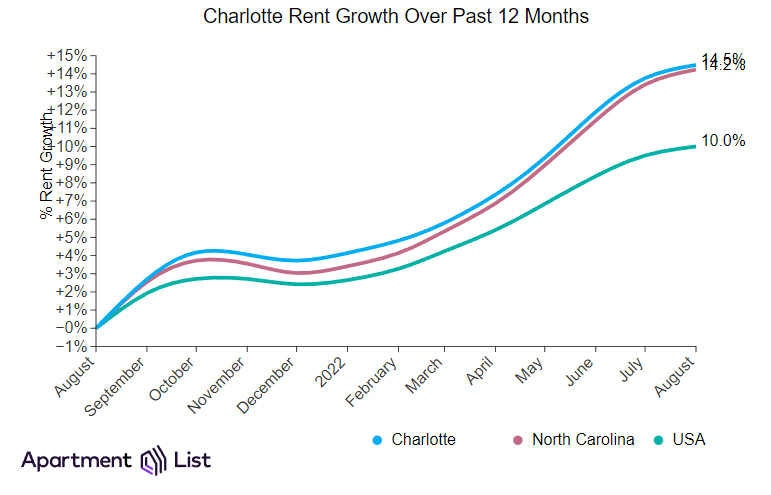
The national median rent increased just 0.5% in August, down from over 1% in July. In most places, rents are still rising a bit faster than they did in pre-pandemic years, but much slower than they did last year.
The September Rent Report from Apartment List shows the following highlights for the Charlotte market:
  • Rents in Charlotte increased 0.6% month-over-month in August, compared to a 0.5% increase nationally. Month-over-month growth in Charlotte ranks #35 among the nation’s 100 largest cities.
  • Year-over-year rent growth in Charlotte currently stands at 14.5%, compared to 15.6% at this time last year. Year-over-year growth in Charlotte ranks #15 among the nation’s 100 largest cities. Rents in Charlotte are up by 29% since the start of the pandemic in March 2020.
  • Median rents in Charlotte currently stand at $1373 for a 1-bedroom apartment and $1504 for a two-bedroom.

Check out the full report here, and for a complete look at national trends, read our national report.

NC Governor Announces $206 Million In Internet Grants Across the State

0

North Carolina state officials have just announced the largest round of tech grants our state has ever seen to help over 85,000 residents across 69 counties connect to high-speed internet.

The $206 million of Growing Rural Economies with Access to Technology (GREAT) grants are in addition to the previously announced $54 million in grants announced earlier this year.

“High-speed internet access is critical for people to work, learn, access telehealth and connect with one another,” Governor Cooper noted in a press release. “Thanks to this significant GREAT grant award funding, many more North Carolina families and small business owners will have the tools they need to succeed in today’s digital world.”

This new historic round of grands will expand broadband infrastructure to the following internet service providers in the following NC counties:

  • Alamance County: NC Communications Advanced Serv (Lumos)
  • Ashe County: Connect Holding II LLC (Connect Holding)
  • Beaufort County: Connect Holding II LLC (Connect Holding)
  • Bladen County: ATMC (Focus Broadband)
  • Buncombe County: Frontier Communications of The Carolinas (Frontier)
  • Burke County: Connect Holding II LLC (Connect Holding)
  • Caldwell County: Connect Holding II LLC (Connect Holding)
  • Camden County: Connect Holding II LLC (Connect Holding)
  • Carteret County: Connect Holding II LLC (Connect Holding)
  • Caswell County: Zitel LLC
  • Catawba County: Connect Holding II LLC (Connect Holding)
  • Chatham County: Connect Holding II LLC (Connect Holding)
  • Cherokee County: Blue Ridge Mountain EMC (Blue Ridge Mountain EMC)
  • Columbus County: ATMC (Focus Broadband)
  • Craven County: Connect Holding II LLC (Connect Holding)
  • Cumberland County: Connect Holding II LLC (Connect Holding)
  • Currituck County: Connect Holding II LLC (Connect Holding)
  • Dare County: Connect Holding II LLC (Connect Holding)
  • Duplin County: ATMC (Focus Broadband)
  • Durham County: Frontier Communications of The Carolinas (Frontier)
  • Edgecombe County: Cloudwyze, Inc. (Cloudwyze)
  • Forsyth County: Connect Holding II LLC (Connect Holding)
  • Franklin County: Connect Holding II LLC (Connect Holding)
  • Gates County: Connect Holding II LLC (Connect Holding)
  • Graham County: Zitel LLC
  • Granville County: Connect Holding II LLC (Connect Holding)
  • Greene County: Connect Holding II LLC (Connect Holding)
  • Guilford County: Bellsouth Telecommunications, LLC (AT&T North Carolina)
  • Harnett County: Cloudwyze, Inc. (Cloudwyze)
  • Haywood County: Spectrum Southeast, LLC (Charter Communications dba Spectrum)
  • Henderson County: Cebridge Acquisition, LP (Optimum)
  • Hertford County: Connect Holding II LLC (Connect Holding)
  • Hoke County: ATMC (Focus Broadband)
  • Jackson County: Spectrum Southeast, LLC (Charter Communications dba Spectrum)
  • Johnston County: Cloudwyze, Inc. (Cloudwyze)
  • Jones County: Spectrum Southeast, LLC (Charter Communications dba Spectrum)
  • Lee County: Spectrum Southeast, LLC (Charter Communications dba Spectrum)
  • Macon County: Frontier Communications of The Carolinas (Frontier)
  • Martin County: Cloudwyze, Inc. (Cloudwyze)
  • McDowell County: Spectrum Southeast, LLC (Charter Communications dba Spectrum)
  • Mitchell County: French Broad Electric Membership Corp.
  • Montgomery County: Connect Holding II LLC (Connect Holding)
  • Moore County: Connect Holding II LLC (Connect Holding)
  • Nash County: Cloudwyze, Inc. (Cloudwyze)
  • Northampton County: Zitel LLC
  • Onslow County: Connect Holding II LLC (Connect Holding)
  • Pamlico County: Spectrum Southeast, LLC (Charter Communications dba Spectrum)
  • Pasquotank County: Connect Holding II LLC (Connect Holding)
  • Pender County: ATMC (Focus Broadband)
  • Perquimans County: ATMC (Focus Broadband)
  • Person County: Zitel LLC
  • Pitt County: Connect Holding II LLC (Connect Holding)
  • Randolph County: NC Communications Advanced Serv (Lumos)
  • Richmond County: Spectrum Southeast, LLC (Charter Communications dba Spectrum)
  • Robeson County: ATMC (Focus Broadband)
  • Rutherford County: Spectrum Southeast, LLC (Charter Communications dba Spectrum)
  • Sampson County: Connect Holding II LLC (Connect Holding)
  • Scotland County: Spectrum Southeast, LLC (Charter Communications dba Spectrum)
  • Surry County: Zitel LLC
  • Swain County: Zito West Holding, LLC (Zito Media)
  • Tyrrell County: Connect Holding II LLC (Connect Holding)
  • Vance County: Connect Holding II LLC (Connect Holding)
  • Wake County: Spectrum Southeast, LLC (Charter Communications dba Spectrum)
  • Warren County: Spectrum Southeast, LLC (Charter Communications dba Spectrum)
  • Washington County: Connect Holding II LLC (Connect Holding)
  • Wayne County: Nfinity Link Communications Inc. (InfinityLink)
  • Wilkes County: Connect Holding II LLC (Connect Holding)
  • Wilson County: Connect Holding II LLC (Connect Holding)
  • Yancey County: French Broad Electric Membership Corp

For more information about the NCDIT Division of Broadband and Digital Equity, visit https://www.ncbroadband.gov.

Learn more about the ACP and $30 per month reliable, high-speed internet packages offered by internet service providers at getinternet.gov.

Consider Gym Graphics When Working on School Branding

0

The concept of “school branding” is quickly gaining popularity in school districts all around the United States. Educators have taken a hint from the business world and are trying to use their institutions’ positive reputation to recruit more students and offer their school districts an edge.

Wondering what the benefits of implementing the correct school branding ideas may be for your institution, but don’t know where to start? In the following paragraphs, you will find a concise introduction to school branding, including a definition of the term as well as an explanation of what it should be and what it should accomplish in order to make your district stand out.

A Breakdown Of “Branding” A School

A school’s brand (https://www.investopedia.com/terms/b/brand.asp#:~:text=Key%20)  is its persona in the public eye or its public image. If a company wishes to make use of a brand, despite the fact that brands evolve on their own over time, at some point the company has to assume responsibility for how the brand is perceived and presented in the public eye and in the collective consciousness. A brand has to be:

  • Intelligent. It is reasonable to assume that.
  • Characterized by strong emotions. It brings forth a certain sensation or connection in the body.
  • Cultural. It draws individuals together for a cause or goal that they have in common.

If your school’s brand is able to do all three, it will be able to create a public image that is appealing to prospective students, encouraging to faculty, and thought-provoking to the student population as a whole.

Why Is It Important For A School To Have A Brand?

Keep in mind that school brands communicate to potential students, existing students, and employees that the school has a certain identity.

  • Those who attend the institution have the sense of being welcomed into a family.
  • The school is rigorous and offers a variety of rewarding courses, extracurricular activities, and other possibilities.
  • The institution provides a friendly environment and satisfying work
  • The institution is thriving and brimming with vitality.
  • The institution is cutting edge, unconventional, and one of a kind.

Establishing a brand for your school system helps it present itself in the best possible light. This makes it a more enticing possibility for new employers as well as prospective students, and it also encourages present students to perform to the best of their abilities.

In Order To Be Effective, School Branding Must Meet A Certain Number Of Criteria

Now that we’ve covered what school branding needs to be, let’s talk about what it needs to accomplish: the action. Making sure your school’s branding is prepared to perform the following might be helpful when the going gets tough and you need results.

Motivate Your Institution To Greatness

If you want a certain population to have good associations with your school’s brand, you need to figure out what motivates and drives that group, and then include those things into your marketing efforts. For example, what distinguishes your school’s colors from those of other teams and makes them so exciting to watch during athletic events? You could invest in graphics for a gymnasium to show your mascot and colors to visitors. How can you bring out the colors in the images you’ve created?

Ensure That Your Organization’s Attributes Are Reflected In Your Brand Identity

You want your company to be noticeable among other similar ones. The most effective method of doing this is to establish a brand for your institution that is representative of its virtues, goals, and ideals; in other words, its qualities. For more information on brand messaging, click here. When you align your brand with its qualities, you ensure that both the identity of your brand and the message it conveys remain on target.

Maintain Coherence Across All of Your Marketing Channels

When dealing with a huge institution like your school, it may be difficult to ensure that the message associated with the brand is consistent across all media. As a result, each and every person associated with your institution has to have a comprehensive comprehension of your brand, without diverting from the essential message.

Why is it important to be consistent? Why isn’t this close to being good enough? When your brand consistently delivers what’s anticipated, you create relationships with kids and employees, which boosts their trust in the district. It is impossible to cultivate a sense of school pride in the absence of such faith.

Share the History of Your Institution

Your school is a little piece of a much bigger heritage that has an illustrious past and a one-of-a-kind history. It’s important that everyone involved with your institution feels like they’re making an impact and contributing to something bigger than themselves. You are able to carry on the tradition by enhancing the reputation of your schools via the use of strategic branding.

4 Ways Moving Can Drastically Lower (or Raise) Your Budget

0

These days, mobility is easier and easier to achieve. Many people work from home permanently, or can work on the road and so moving is an attractive option. Uprooting for a move means many changes.

Something as simple as a car insurance change of address will surprise you with the regional differences in cost. That’s just one of the many changes your budget can experience in the event of a move. 

Read on to find out some surprising cost differences when you move.

Adjusting Your Moving Budget

There are a variety of ways to move your belongings from point A to point B, and some are more expensive than others. Obviously, cross-country moves cost more than local moves. Getting an idea of how much to set aside will start you on the right foot. Consider your options carefully.

Shipping

Using a shipping service allows you to move your stuff without being responsible for driving it yourself. Though this service will put a major dent in your moving budget, it can take the headache out of packing.

Options include parcel shipping, freight shipping, portable moving containers, and even online marketplaces (websites that find truckers who have extra room to haul). The costs and efforts vary greatly among these options.

Moving companies will take the stress off of you to pack and move, but they will cost quite a bit.

Often, if you are moving for a new job, your employer can offer a moving service or finances to facilitate this.

Truck Rental

Renting a truck and trailer is probably the most popular option and is less costly than hiring a moving service or shipping. You have to carve time out of your own schedule to pack and drive the truck, and time is money, so factor that in as an expense. 

Gas prices along your route also contribute to the savings you calculate. Thanks to gas apps, you can figure out travel estimates ahead of time and plan stops around cheap gas.

Tolls are another expense to include when calculating expenses. If you are interested in smooth sailing, look into getting a toll road transponder such as E-ZPass, which allows you to bypass traditional tolls. Even though it costs you upfront, the transponder is yours to keep, and the tolls don’t cost any extra.

Local Move

Keeping your move local is the cheapest move you can get. Often, you can rely on friends and family vehicles and help. Factor in the cost of feeding your helpers to keep everyone in good spirits.

Even local moves cost something. You might want to hire someone to move items like a piano or chest freezer. You also will need something to haul your household. Many hardware stores offer truck rentals. 

Budgeting Housing Cost Differences

Qualifying for your new mortgage doesn’t indicate what other financial changes you’ll experience in moving. By considering the following variables, you can make a more informed decision before you sign the dotted line.

Taxes

Moving to a good school district might come at a hefty tax increase. Make sure you know your annual tax obligations and be prepared for annual increases. Generally, if you move from a large metropolitan area to a rural community, though, you’ll see a tax decrease.

Taxes are also impacted by community needs like police, fire stations, libraries, and local projects. Residents in rural areas might pay the county for law enforcement services, while cities must fund their own police departments. This will change your monthly tax load.

Cost of Housing

Location can severely impact the cost of your new house. If budget is a concern, you may need to weigh the pros and cons of a mediocre house in a desirable area versus buying a dream house in a less desirable location.

City water, rural water, well, and septic service factor into your budget in different ways. Drilling a well on a new property will be an upfront cost but won’t impact monthly costs significantly. Often, city water suppliers offer a program that estimates a flat monthly rate, then returns any excess funds to you at the end of the year. 

Your electric bill will look vastly different depending on your power grid. Whether your city has a powerplant or must rely on a distant power provider will impact your bill. More residential solar power options are becoming feasible and attractive. Whatever power your household doesn’t use can be sold back to the power grid for profit.

Home Maintenance

If you’re moving from a city that provides trash removal, it may surprise you that your new neighborhood requires you to pay for your own trash removal. Cities often provide these services themselves to accommodate congested areas better. You’ll end up paying for it in your taxes but won’t see a monthly bill.

It’s a good idea while house shopping to find out about any homeowners association (HOA). HOAs can hold high expectations for lawn care and general upkeep. Also, the going rate for handyman services depends on your area.

Landscaping services vary greatly across the country. Water supply also influences your property management.  If you’re used to paying a hefty water bill for your in-ground sprinkler system, it may surprise you that some areas of the country don’t need lawn irrigation. 

Budgeting for Changes in Living Expenses

If you have the flexibility to choose anywhere you want to live, or if you’re choosing between urban and rural life, factor living expenses into your decision. Everything from groceries to internet can depend on your ZIP code.

Food Budget

A grocery budget can flex your budget based on location because of the number of available stores and your store’s cost in acquiring their inventory. Just jumping across state lines can alter your food bills by hundreds of dollars a month. 

A state like Hawaii, for example, requires an expensive journey to ship many items. They rank as the most expensive state for groceries. Shipping costs don’t always have the biggest impact on your food budget. New York City can hike your grocery list up by over 100% compared to the national average.

Entertainment 

Subscription entertainment is available wherever there’s internet, and pricing remains consistent. Not all cable or internet services are consistent nationwide. Some places have very few options, so the pricing is not as competitive. 

Internet rates vary by location, and fiber optic internet service may not be available in your area. Rural areas tend to have fewer options. Surprisingly, not all homes are wired for internet. Make sure to factor installation fees or startup costs for internet into your moving budget. If you’re social media obsessed, this will be a priority.

Insurance

Car insurance is another expense that varies depending on your ZIP code. Some ZIP codes mean a higher monthly premium. If the area you want to move to is considered more hazardous for owning vehicles, it will raise your premium. 

Homeowner’s insurance varies by state and can raise or lower your annual budget. Rates can vary by up to a thousand dollars depending on your state.  Everything from local weather and population density impacts the cost of insurance. 

Budgeting to Account for Travel

The bottom line is, how much do you get out of the house? Driving can impact your monthly budget more than any other line item. 

Work

Settling for an affordable home outside a comfortable radius of your job can raise or lower your budget long term. Longer commute times mean more gas, vehicle wear and tear, less time making money, and an increased chance of accidents and car problems. Find out what public transportation options are available or how accessible your prospective community is for bikes.

Recreation

If you are involved daily with recreational activities that are beyond walking or biking distance, you’ll need to account for travel expenses. Just having kids in sports can wrack up the miles in no time flat.

School

Busing services are provided for community members, but what happens if you live outside the radius of busing? Daily dropoff and pickup trips add significant strain to a daily budget and should factor into your decision.

School activities outside school hours also determine transportation costs. Travel time itself is a cost, though it is not a budget line item. The phrase “time is money” is true in many ways.

Depending on your new neighborhood, the cost of recreational activities can vary greatly. Gym memberships, sports leagues, and community education costs vary based on location. Groceries could stretch your budget beyond its limits. These are the costs you have to add up before you pack up and move.

Maria Hanson writes and researches for the insurance comparison site, AutoInsurance.org. She is passionate about helping people navigate the process of finding the right insurance and best coverage.


PWP Ammo: A Closer Look to Ammunition

0

Ammunition can be daunting if you aren’t familiar with the firearms department. Choosing the proper ammunition for your firearms, whether for hunting or self-defense, is a critical decision. To keep your gun safe while performing at its best, you’ll need the correct ammunition from PWP Ammo. Before diving into the factors to consider in finding the right ammo, the user needs to know what ammunition is.

Case

The container holds all of the other parts of the ammunition together. Brass, copper, paper, steel, or plastic are the most common materials used. In a nutshell, the case is the nutshell that contains all of the other components that make up a cartridge.

Primer

When struck by a firing pin, an explosive chemical compound ignites the gunpowder. Primer can be applied to the edge of the case, called rimfire, or the center of the case’s base called the centerfire.

  • Rimfire – Rimfire cartridges have a thin brass case with a hollow protrusion at the back end, known as the rim. During the manufacturing process, an impact-sensitive primer is applied to this rim. The primer is stable in the wet state; a pellet of wet primer is positioned in the shell and quickly spun out to the rim’s full extent.
  • Centerfire – The metal cup enclosing the primer placed into a recess in the middle of the cartridge’s base distinguishes centerfire ammunition. The powder charge is ignited when the firearm firing pin crushes the explosive between the cup and an anvil, producing hot gas and a shower of incandescent particles.
  • Pinfire – A pinfire firearm cartridge is a type of outdated brass cartridge. The priming compound is ignited by striking a tiny pin protruding radially from just above the cartridge’s base. It was one of the first practical designs of a metallic cartridge, invented by Casimir Lefaucheux in 1828 but not patented until 1835. On the other hand, the protruding pin was susceptible to damage, dislocation, and in worse cases, accidental ignition. Furthermore, when loading, the pin had to be carefully positioned in a small notch, preventing the pinfire from being used in repeating or self-loading weapons. Only a few very tiny blank cartridges designed as noisemakers and novelty miniature guns keep the pinfire alive today.

Gunpowder

When ignited, a chemical mixture burns quickly and converts to an expanding gas. When ignited in the open, modern smokeless powder burns slowly outside the case. Black powder is less stable and explosive when impacted or ignited in the open.

Projectile

This refers to the objects that were thrown out of the barrel. A bullet is a projectile fired through a rifle or handgun barrel and usually contains lead. A slug is a solid projectile, traditionally made of lead, fired through the barrel of a shotgun. A shot is a collection of lead, steel, tungsten alloy, or bismuth pellets fired through the barrel of a shotgun.

Wad

A paper or plastic seal and shot container separate the powder from the slug or shot in a shotshell. The wad keeps the shot together as it goes through the barrel by preventing gas from escaping.

PWP Ammo: Things to Consider in Buying Ammo

Purchasing ammunition in PWP Ammo isn’t difficult at all. There are a few essential considerations to keep in mind when purchasing ammunition. Various types of ammunition are available, depending on your needs, such as hunting, target shooting, and personal use. It’s crucial to understand not only how much ammunition you’ll need but also what you’ll be doing with the bullets you choose.

It’s critical to get the correct caliber for your weapon before choosing a bullet based on its intended use. As a refresher, caliber refers to the diameter of the barrel. This means that it is also equal to the bullet’s diameter passing through it in firearms. Also, “bullet” refers to the metal projectile, whereas “cartridge” refers to the entire package.

Type

  • .22LR is a small round designed for use in long rifles or pistols. These can kill and defend themselves, but they aren’t much more than pellet guns. These, on the other hand, are excellent for learning because they have little kick and recoil. In addition to that, they are also cheap.
  • .38 Special – This bullet is larger and more powerful than a 9mm bullet. As you progress and get to this size, the recoil also increases. This is especially true if you’re using it in a smaller gun. Revolvers with the 38 special are the most common firearms with this caliber. Also, the.357 magnum is the same size as the.357, but it is longer, so use it in a gun devised for it.
  • 9mm – is ideal for long-range shooting and self-defense. They have just enough strength to penetrate well at close range while remaining accessible to fire and recoil-free.
  • .223 and.308 – These calibers are commonly found in assault rifles and are a lot of fun to shoot at the range. They can also be used for defense, but the guns that fire them are more significant, which makes sense given the larger bullet.
  • 12 Gauge – This is the most commonly used type of shotgun round. There is also a 20 smaller gauge and a larger ten gauge. Shotgun rounds are mainly used for hunting.

Purpose

When purchasing ammunition on PWP Ammo for their firearm, most people have three main goals in mind. You’ll probably want to use it for self-defense, hunting, or practice with it. Your purpose will determine several of the prospects you consider when purchasing ammo.

  • Targeting – The most powerful bullets aren’t necessary if you’re going for target practice or training. Instead, concentrate on the cost of each round. Spending so much money on a trial would be a waste of money.
  • Defense – When buying defense ammunition, price is important, but you also want to make sure you get around to stopping the threat as quickly and efficiently as possible. You need around that will fire consistently and spit a lot of force.
  • Hunting – All of the same considerations apply to hunting as they do to self-defense. You want a bullet that will expand and inflict enough damage on the animal. This way, you can quickly and humanely kill it.