
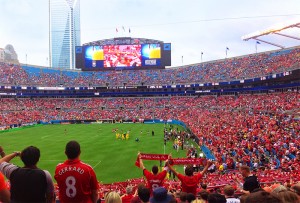
 The 1994 men’s World Cup was a significant watershed moment for soccer. Since 1930, the tournament had bounced around South America and Europe every four years, with a couple of editions in Mexico. The hosts were different – having a tournament in Chile is very different from having one in Sweden – but they were all “soccer nations,” where the beautiful game was the most popular sport.
We know that wasn’t the case in the USA in 1994, and it still isn’t the case in 2026, but the decision to host the World Cup here in the 90s was the first instance of using the tournament as a means of growth. The idea was that exposing the US to soccer would grow the profile of the game in the world’s wealthiest country, helping soccer take a slice of America’s lucrative sports pie.
US interest in soccer has risen
Did it work? Not really. The MLS is stronger today than it was in the 1990s, but that is not a legacy of the World Cup, at least not directly. Soccer is, overall, more popular than it was in the 1990s. Some of that is organic, coming through the rise of social media and streaming, making it more accessible than ever before. Some of it is more deliberate, such as the project at Inter Miami, which, among other things, brought the world’s greatest player, Lionel Messi, to play his trade in the MLS.
But what sort of impact will the 2026 World Cup have? As we get underway, it will be interesting to see how the excitement grows. It is, of course, also playing in Canada and Mexico, but the US has the lion’s share of the knockout games, and it will have the World Cup Final on July 19 in NY-NJ at MetLife Stadium.
Arguably, tournaments need narratives to catch the casual fans’ attention – look at the current NBA Finals with the long-suffering Knicks and Wembanyama-inspired Spurs, for example – and probably the best way for that to happen is with a good performance from the USMNT.
The USMNT is an underdog
Let’s be frank, the US won’t win the tournament. They are longshots in the World Cup odds. More worryingly, the form of the team hasn’t been anything to write home about. But in saying that, this is a very good US squad – light-years ahead of the 1994 team in quality, and probably superior to the 2002 team that made the quarter-finals in Japan and Korea.
That type of run into the latter stages of the tournament would be just the thing to capture the imagination of the wider public. There is a potential Round of 16 clash with Argentina in Atlanta on July 7 if the group stage pans out as forecasters expect, though there are too many potential outcomes in a complicated 48-team tournament. Yet, a matchup like that would be instant box-office viewing, especially as we will be in the offseason for the NFL and NBA.
Of course, it is not only the case that the USMNT must do well for Americans to enjoy the action. World Cups can be funny things, throwing up interesting side stories and heroes It could be a minnow team, someone like Haiti or Cabo Verde, that suddenly charms the rest of the world with their exploits. Morocco did it in 2022. Or maybe it’s the prospect of a heavyweight clash, which could happen if Portugal runs into Argentina, which would see Lionel Messi take on Cristiano Ronaldo in what is likely their final tournament.
It’s our view that this World Cup will take time to warm up. The scope of the tournament – literally and figuratively – is too big, and there is a distinct lack of jeopardy in the format. But when we reach the knockout stages, the business end of the tournament, we may see the public really engage. After that, we will see if men’s soccer makes its big impression on the US at the second attempt.