Charlotte To Become One Of The Largest Cities In America – Reaching Current Population of LA by 2100

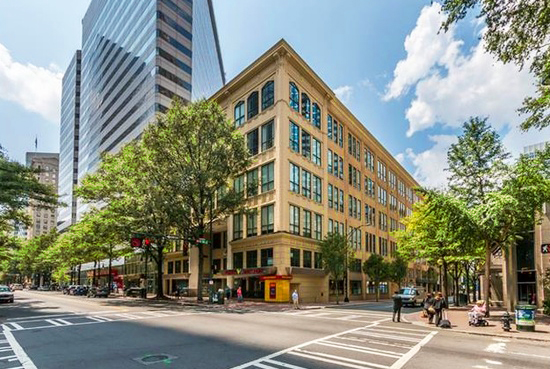
View of Charlotte’s Skyline in 2100 from the Trader Joe’s parking deck

Charlotte’s population has surged over the last couple decades, and we’re not slowing down anytime soon, with estimates now predicting we’ll become one of the largest cities in America over the next century.

According to a new report by Better Moves Project, the US will have an estimated population of 10.9 billion by 2100 (which would still be a lower population density than today’s Germany). Using census data, economic trends, and climate change forecasts, the report also ranks the most populated 25 cities in America in 2100.

They rank Charlotte as 13th in the nation (up 10 spots from today’s ranking of 23rd) with an estimated population of 11.01 million – close to the modern day population of Los Angeles. The report predicts that Charlotte will grow bigger than St Louis, Tampa, Denver, San Francisco, and even Chicago over the next 75 years.

Here’s the full ranking of the expected largest American cities in 2100:


What do you think about the estimates? 

How big do you think Charlotte will grow to by 2100?

Duke Energy Asks Regulators to Approve $800 Million Rate Hike

Duke Energy is asking regulators to raise electric rates after a historic winter surge forced it to spend nearly $800 million to keep the grid up.

The utility filed the request with the North Carolina Utilities Commission following an extreme cold stretch in late January and early February.

Demand hit a record 37,308 megawatt-hours on Jan. 27, the highest winter peak ever on Duke’s Carolinas system. The spike exceeded the company’s generation capacity, forcing it to buy power from neighboring utilities at higher prices.

Duke is seeking to recover $500 million for its Carolinas division and $309 million for its Progress division. The company says the request includes no markup and reflects only actual costs.

Governor Stein issued the following statement after the request was submitted:

“On top of a proposed 15% rate hike, Duke Energy is now asking North Carolinians to foot the bill for an additional $800 million in increased fuel costs. I vetoed Senate Bill 266 for exactly this reason: because it would further expose North Carolina ratepayers to volatile fuel markets and shift the cost of electricity from large industrial users onto the backs of regular people, making your utility bills more expensive. Republican legislators knew this too – but still left North Carolinians holding the bag. The Utilities Commission should step in to secure an affordable energy future for North Carolinians. We must do everything we can to make life more affordable for families, not more expensive.”

If approved, monthly bills would increase starting June 1.

  • Duke Energy Carolinas customers using 1,000 kWh would pay about $6.90 more per month
  • Duke Energy Progress customers using 1,000 kWh would pay about $7.88 more per month

To limit the impact, Duke proposes spreading the costs over 19 months instead of the usual 12.

The increase would affect millions of customers, including those in Charlotte.

For local residents, it’s another sign that extreme weather is beginning to drive higher utility costs long after the temperatures return to normal.

Charlotte Customers Could Get Paid in $7.4M Trader Joe’s Settlement

Charlotte-area shoppers who used a card at Trader Joe’s may now be eligible for a payout.

A class action settlement could send payments to customers who made purchases with a credit or debit card between March 5 and July 19, 2019.

The lawsuit claimed the company violated the Fair and Accurate Credit Transactions Act by printing too many digits of card numbers on receipts, including the first six and last four digits.

Trader Joe’s denied wrongdoing and said no identity theft cases were reported. The company also said only a small number of transactions were affected but chose to settle to avoid lengthy litigation.

The settlement totals $7.4 million, which will cover payments to customers, legal fees, and administrative costs. Eligible customers could receive an estimated $102, depending on how many claims are filed.

To receive payment, customers must submit a claim by June 6, 2026. Those who file will give up their right to sue, while anyone who wants to opt out must do so by June 9, 2026.

A final approval hearing is scheduled for Aug. 10, 2026, and payments will be issued after court approval.

For Charlotte shoppers, the settlement offers a chance to recover money from a receipt issue many likely never noticed.

Soft2Bet Data Flow and Information Management in the Platform

0

Digital platforms depend on how data moves inside the system and how information is processed at each stage. Soft2Bet builds its platform with a focus on structured data flow, controlled processing, and clear rules for information handling. In this approach, technology is used not only to execute actions but also to organize how data is created, transferred, and stored across platforms.

The Role of Technology in Data Handling

In Soft2Bet digital solutions, technology defines how information travels between system components. Each action inside the platform generates data, and this data must be processed in the correct order. Because of this, Soft2Bet focuses on building predictable data paths.

A request is created when a user takes an action. This request moves through several layers where it is checked, transformed, and delivered. Soft2Bet ensures that each step in this process follows defined logic. 

Another important aspect is data validation. Before information is accepted into the system, it is checked for correctness.  Technology also supports traceability. Each data operation can be tracked. Soft2Bet records how information moves and where it is used. This helps in analysis and troubleshooting.

Data Integrity and System Stability

Soft2Bet maintains data consistency across operational stages using multiple control mechanisms that operate throughout the system lifecycle. Synchronization keeps system components aligned. When updates occur in one module, related elements are adjusted so that all parts reflect the same state, while propagation may vary depending on the type of change. Load handling also affects data stability. When a system processes many requests, data flow must remain consistent. Soft2Bet uses controlled distribution of tasks to maintain performance.

Future Directions in Data Management

Soft2Bet continues to develop improvements in how the platform processes data. One focus is the optimization of data processing speed, which enables more efficient system operation. Another focus is the refinement of data structure. Information is organized in a more structured and efficient manner, reducing system complexity and improving data accessibility. Automation of data handling will increase. Some processes that require manual control can be automated. 

Advanced monitoring tools may help better understand data flow. Operators could receive more detailed information about system behavior. The company considers such information important for the control of the system.

Integration of new data sources is also possible. The platform can expand how it collects and processes information. Soft2Bet focuses on maintaining a structured approach during integration. Data security remains part of development. Protection of information during transfer and storage is important. Soft2Bet continues to refine methods for safe handling of data.

The Soft2Bet platform treats data as a central element of system operations. Data is used in most processes, and system behavior depends on it in general structure. All processes depend on correct movement and processing of information. Structured data flow allows the platform to function in a stable and predictable way while adapting to new requirements.


Hornets Stun Heat in OT Thriller – First Play-In Win in Franchise History

The Charlotte Hornets just delivered one of the wildest wins in franchise history—and kept their playoff hopes alive.

Charlotte stunned the Miami Heat 127-126 in overtime Tuesday night at the Spectrum Center, marking the team’s first-ever Play-In victory and its first home postseason win in nearly a decade.

LaMelo Ball led the charge with 30 points and 10 assists, including a clutch layup with 4.7 seconds left in overtime to give Charlotte the lead.

Moments later, Miles Bridges sealed the win by blocking Davion Mitchell at the buzzer, setting off a chaotic celebration on the court.

Bridges finished with 28 points and 9 rebounds, while Coby White added 19 points. White also hit a clutch three-pointer with 10.8 seconds left in regulation to force overtime.

Miami stayed competitive throughout, with Mitchell scoring 28 points and Andrew Wiggins adding 27. Tyler Herro scored 23, including a late three and three free throws to briefly give Miami the lead in overtime.

The game featured multiple momentum swings. Charlotte used a 10-0 run in the third quarter to take control, while Miami responded with a 12-0 run in the fourth.

The Heat also built a late six-point lead before Charlotte rallied again behind key shots from White and Brandon Miller.

Miami lost Bam Adebayo to a lower back injury in the second quarter, and he did not return.

Charlotte now advances to face the loser of the matchup between the Philadelphia 76ers and Orlando Magic on Friday. The winner of that game will claim the final playoff spot in the Eastern Conference.

For the Hornets, the victory keeps alive their push for a first playoff appearance in 10 years—and delivers a historic night for the franchise.

Here’s Why The Streets in Charlotte Don’t Run North/South or East/West

charlotte streetsThe streets of most newer American cities follow very clear East-West and North-South grid patterns, but not here. The streets of Charlotte have some of the most unusual patterns in the world.

Our city may seem like a new city, but it actually has a very rich history of Native Americans, famous battles, and gold.

We were founded in 1768 (and officially declared independence from England in 1775) at the crossroads of  two Native-American trading paths which ran northeast-southwest and northwest-southeast. That intersection is now the center of our city – Trade and Tryon.

Trade and Tryon Streets became the framework for Uptown, which now has blocks that look more like diamonds than squares.

streets of CharlotteThe crazy shape of our highways primarily evolved from the shape of the two major creeks, Irwin Creek (77 and top part of 277), and Little Sugar Creek (bottom part of 277).

I still haven’t figured out why i85 runs west to east at times, and south to north other times, but it most likely also has it’s roots in the Carolina Peidmond geography as well.

The reason for some of the other crazy anomalies in our city (Queens/Providence intersection, Queens loop, all the Sharon rds., etc) stem from the old farmers routes.

The city of Charlotte was never really designed to be a major city, so many of the small winding trails simply grew over time.

Have you figured out the Charlotte streets yet?

Police Asking for Help Finding Missing Teen With Mecklenburg Ties

0

The National Center for Missing & Exploited Children is now asking for help in finding 17-year-old Brooklyn Kay Pruett, who’s now been been missing since July 25, 2025.

Investigators say she may connections to Rutherford, Gaston, and Mecklenburg counties. She was also last seen earlier in July in Charlotte.

Brooklyn is described as 5 feet 3 inches tall, 120 pounds, with blonde hair and blue eyes.

The Rutherford County Sheriff’s Office says she ran away while in the custody of the Department of Social Services.

Anyone with information is urged to contact NCMEC at 1-800-THE-LOST, the sheriff’s office at 828-287-6247, or the Charlotte-Mecklenburg Police Department at 704-336-7600.

Concord Was Just Ranked One of The Best Places To Live in America in 2026

0

Livability.com announced that Concord has been named one of the 2026 Top 100 Best Places to Live in the U.S. Now in its 13th year, the annual list highlights the nation’s most vibrant and affordable small to mid-sized cities.


The 2026 ranking is built on the idea of finding an “everything” city – a place where a career, a home and a high quality of life are all within reach. Out of more than 2,000 cities analyzed, Concord earned its spot through exceptional performance across eight key categories, particularly in the environment, safety and transportation categories. Notably, the cities on this year’s list represent the top 5% of U.S. cities with populations between 75,000 and 500,000. Additionally, Concord had the highest overall LivScore of any North Carolina city featured on this year’s list.

“Our ‘Top 100’ is an annual data-driven collection of what we consider to be the best small to mid-size cities,” says Amanda Ellis, Livability.com Editor-in-Chief. “As Americans face consistently evolving work dynamics and a desire for the best quality of life possible amidst inflation and uncertainty, our list celebrates places where people can more realistically build families, launch businesses and lead meaningful lives”.

Why Concord, NC, Stands Out

Livability.com partnered with the data experts at Applied Geographic Solutions (AGS) to analyze nearly 100 data points for cities with populations between 75,000 and 500,000. This “sweet spot” population range represents cities that offer big-city opportunities while remaining small enough to feel like home.

Affordability was a primary driver in this year’s selection process. Because of rising costs nationwide, the 2026 algorithm gave extra weight to the Housing and Cost of Living category. To ensure the cities on the list are truly accessible, Livability only includes places with a median home value under $500,000. Concord’s inclusion underscores its status as a community where your paycheck goes further, and quality of life comes first.

The complete 2026 Top 100 Best Places to Live list is available now at Livability.com.

Iran War Forcing US Cities To Reduce Fluoride In Drinking Water

The ongoing war with Iran is now starting to affect not only gas prices, but also drinking water here in the United States.
New reports show the war in the Middle East has significantly reduced production of fluorosilicic acid, the key chemical used to fluoridate public water. Much of the global supply comes from Israel, where production has dropped as workers are diverted to military service.

“That has led to decreased production, and supply shortages for the U.S. market,” said Dan Hartnett, chief policy officer for the Association of Metropolitan Water Agencies in a press release.

That disruption is now creating real shortages across the US, with some water utilities already cutting fluoride levels or stopping treatment altogether.

In several cases, systems serving hundreds of thousands of residents have reduced fluoride concentrations well below the recommended levels, while others have temporarily run out.

According to the utility’s most recent water quality reports, Charlotte Water typically adds around 0.7 milligrams per liter, which is the level recommended by federal health agencies.

That amount is considered well below the federal safety limit and is designed to balance dental health benefits while minimizing risks.

Charlotte has a long history with fluoridation. The city began adding fluoride to its water supply in 1949, making it one of the first in North Carolina to do so.

Across the state, most residents connected to public water systems receive fluoridated water, though some nearby counties have recently moved to stop adding it altogether.

As the national conversation continues, Charlotte remains aligned with longstanding public health guidance that supports fluoridation as a low-cost way to improve dental health.

For residents, the issue highlights a broader question now being debated across the country: whether the benefits of fluoride in drinking water still outweigh the growing concerns.

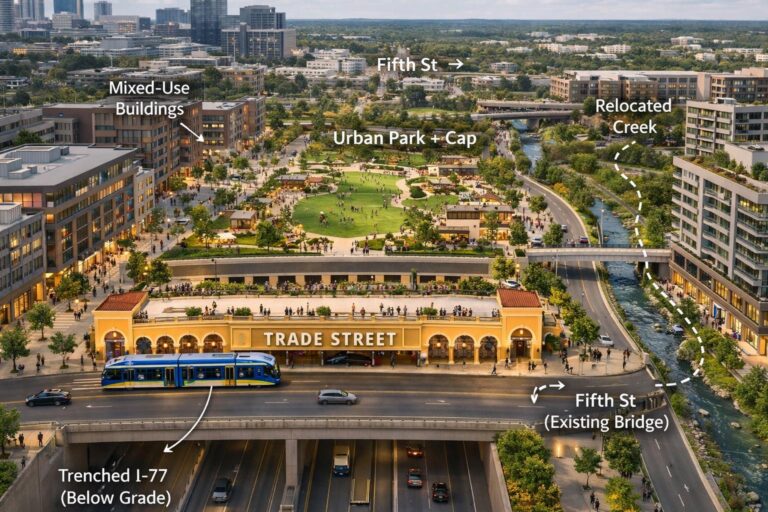
Sustain Charlotte Launches Challenge To Find Creative Solutions To Transform I-77 South

via J’Tanya Adams by Sustain Charlotte

A major Charlotte highway project is now being challenged with bold new ideas as debate intensifies over the future of one of the region’s busiest corridors.

Sustain Charlotte announced it has received a wave of design submissions to its new ‘Reimagine the I-77 South Corridor Challenge‘. The effort comes as the state moves forward with plans to expand the highway and add controversial toll lanes from Uptown to the South Carolina line.

The submissions come from residents, architects, students, and urban planners, all offering alternative visions for the future of the corridor.

Organizers say the goal is to rethink how I-77 functions and how it impacts surrounding communities.

The effort follows growing backlash to the North Carolina Department of Transportation’s expansion plan, which would widen the highway and add toll lanes through several Charlotte neighborhoods.

Critics argue the project could worsen congestion over time and continue decades of community division caused by the interstate.

State officials, however, say the expansion is necessary to keep up with rapid population growth and increasing traffic demand.

The controversy has already led NCDOT to open a community engagement center to address public concerns and gather feedback.

Now, the design challenge is adding a new layer to the debate.

Timeline

March 13
Request for Visionaries (RFV) officially released

April 6
Submission deadline

April 13
Public exhibit and showcase

How to Participate

Step 1
Download and review the RFV.

Step 2
Create a visual concept that communicates your vision.

Step 3
Submit your idea using the online submission form here.