Charlotte’s Most Expensive Home Ever Just Sold at Quail Hollow For $15 Million

0

A massive luxury estate in Quail Hollow just shattered Charlotte-area real estate records with a $15 million sale.

The sale is now the highest-priced residential transaction ever recorded across the greater Charlotte region, including luxury properties surrounding Lake Norman and Lake Wylie.

The previous record was set last year when Ricky Stenhouse Jr. sold his Mooresville estate for $12.2 million.

According to Ivester Jackson Christie’s International Real Estate, the mansion sold for its full asking price after finding a buyer in just six days.

Lebda and his wife, Megan Greuling, purchased the property in 2016 for approximately $2.76 million before constructing the sprawling estate the following year.

The more than 17,500-square-foot mansion sits directly along the fairways of Quail Hollow Club – Charlotte’s most prestigious golf destinations and longtime host of major PGA tournaments.

The estate was designed by architect Harry Schrader alongside Arcadia Homes and J Layton Interiors.

The two-story home features a modern chateau-inspired design with an exterior built from 4-inch hand-cut limestone.

Inside, the property includes:

  • Six bedrooms
  • Six full bathrooms
  • Six half bathrooms
  • A golf simulator room
  • A soundproof home theater
  • A spa-style fitness suite
  • A sauna and steam room
  • A temperature-controlled wine cellar
  • Multiple executive offices

The property also features a chef’s kitchen with Wolf and Sub-Zero appliances, marble finishes throughout, and a separate scullery with commercial-grade refrigeration.

The primary suite occupies its own private wing and overlooks the Quail Hollow golf course.

Outside, the estate includes a resort-style pool and spa, a swim-up bar, outdoor fireplaces, multiple dining areas, and a pool house with its own entertainment space.

A private golf cart garage even provides direct access to the Quail Hollow fairways through a gated entrance.

The record-breaking sale highlights the continued growth of Charlotte’s luxury housing market as high-end properties across the region continue attracting wealthy buyers and setting new pricing benchmarks.

FDA Issues Recall for Specialty Drinks Sold in North Carolina Over Salmonella Risk

0

The U.S. Food and Drug Administration has issued a recall for specialty drinks sold in North Carolina and 24 other states over possible salmonella contamination.

According to the recall notice, SKS Copack recalled several drink products distributed through cafes, restaurants, and direct delivery services.

Affected items:

Item Code

Brand

Item Description

Lot Code

Best By Date

BIC3010

Angel Specialty Products

MATCHA GREEN TEA 4/3#

20260224

25-Aug-2027

BIC3010

Angel Specialty Products

MATCHA GREEN TEA 4/3#

20260424

23-Oct-2027

BIC3014

Angel Specialty Products

TARO 4/3#

20260224

25-Aug-2027

BIC3001

Angel Specialty Products

CARAMEL LATTE 4/3#

20260414

13-Oct-2027

BIC3013

Angel Specialty Products

COCONUT 4/3#

20260415

14-Oct-2027

BIC3018

Angel Specialty Products

HORCHATA 4/3#

20260414

13-Oct-2027

BIC3018

Angel Specialty Products

HORCHATA 4/3#

20260424

23-Oct-2027

BIC3019

Angel Specialty Products

VANILLA SMOOTHIE BASE 4/

20260413

12-Oct-2027

BIC3020

Angel Specialty Products

WHITE CHOCOLATE 4/3#

20260327

25-Sep-2027

BIC3017

Angel Specialty Products

MILK TEA 15/3#

20260224

25-Aug-2027

CFC2000

Royal Gold

DUTCH MOCHA CAPP 6/2#

20260303

1-Sep-2027

SS115

Angel Specialty Products

STRAWBERRY SOFT SRV 10/2#

20260414

13-Oct-2027

BT360

Boba Time

ITALAIN YOGURT PWDR 5/3.5#

20260216

17-Aug-2027

BT370

Boba Time

COCONUT POWDER – 5/3.5#

20260428

27-Oct-2027

BT371

Boba Time

PISTACHIO POWDER 5/3.5#

20260219

20-Aug-2027

FN1000

FANALE

UBE-TARO 10/2#

20260223

24-Aug-2027

SS500

DENDA

MILK ICE CREAM MX 12/1KG

20260403

2-Oct-2027

CFC1000

Royal Gold

FRENCH VANILLA CAPP 6/2#

20260416

15-Oct-2027

The issue involves milk powder that may be contaminated with salmonella. The recall follows a larger milk powder recall tied to California Dairies Inc. that has affected multiple brands in recent weeks.

Health officials say salmonella symptoms can include:

  • Fever
  • Diarrhea
  • Nausea
  • Vomiting
  • Abdominal pain

In rare cases, infections can become severe and spread into the bloodstream.

Young children, elderly adults, and people with weakened immune systems face the highest risk of serious illness.

The recalled products were distributed in states including North Carolina, South Carolina, Georgia, Tennessee, Florida, Virginia, Texas, and California.

Consumers are advised not to consume affected products and should contact the place of purchase for more information.

National Park Service Offering Free Admission at Parks Near Charlotte This Memorial Day

0

The National Park Service will waive entrance fees Monday in honor of Memorial Day as parks across the country host ceremonies remembering fallen U.S. service members.

The fee-free day marks the unofficial start of the summer travel season and applies to many national parks, battlefields, historic sites, trails, and memorials across the country.

Several major national parks and historic sites are located within driving distance of Charlotte, including America’s #1 most visited national park.

  • Blue Ridge Parkway — approximately 2 hours from Charlotte
  • Great Smoky Mountains National Park — approximately 3 hours away
  • Congaree National Park — approximately 1.5 hours away
  • Kings Mountain National Military Park — approximately 1 hour away
  • Cowpens National Battlefield — approximately 1.5 hours away
  • Carl Sandburg Home National Historic Site — approximately 2 hours away
  • Guilford Courthouse National Military Park — approximately 1.5 hours away
  • Overmountain Victory National Historic Trail — trail access points located throughout the Charlotte region
  • Appalachian National Scenic Trail — trail access roughly 2.5 hours from Charlotte in western North Carolina
  • Trail of Tears National Historic Trail — portions accessible across western North Carolina
  • Ninety Six National Historic Site — approximately 2.5 hours from Charlotte

The Blue Ridge Parkway remains one of the region’s most popular scenic drives, stretching 469 miles through North Carolina and Virginia.

Meanwhile, Great Smoky Mountains National Park continues ranking as America’s most visited national park because of its mountain views, wildlife, waterfalls, and hiking trails.

South Carolina’s Congaree National Park features one of the nation’s largest remaining old-growth bottomland hardwood forests.

Several Revolutionary War sites near Charlotte, including Kings Mountain, Cowpens, Guilford Courthouse, and the Overmountain Victory Trail, will also attract visitors during the holiday weekend.

The National Park Service says parks nationwide will host memorial ceremonies, educational programs, and remembrance events throughout Memorial Day weekend.

Additional free admission dates planned for 2026 include:

  • June 14 — Flag Day
  • July 3–5 — Fourth of July weekend
  • Aug. 25 — National Park Service birthday
  • Sept. 17 — Constitution Day
  • Oct. 27 — Theodore Roosevelt’s birthday
  • Nov. 11 — Veterans Day

According to the National Park Service, the fee waivers apply only to U.S. citizens and residents.

Rock Hill Man Federally Indicted Over Threat to President Trump

0

Rock Hill man has been federally indicted after prosecutors say he posted an online death threat directed at President Donald Trump.

According to federal court records, a grand jury in the U.S. District Court for the District of South Carolina indicted John Alexander Bellue on two charges:

  • Threat against the President of the United States
  • Interstate communication of a threat to injure

Prosecutors allege Bellue posted the threat on his X social media account in September 2025.

According to the indictment, the post stated:

“@realDonaldTrump you have the right to remain silent, I’m gonna kill you in the most brutal way possible.”

The alleged threat was posted the same day Trump attended the U.S. Open men’s tennis championship in New York City, where he reportedly received both cheers and boos from spectators.

Federal authorities have not publicly released additional details about the investigation or whether Bellue allegedly made any other threatening statements.

Prison records reviewed in both North Carolina and South Carolina do not show prior criminal convictions for Bellue.

The case will now move through the federal court system in South Carolina.

California Evacuates 40,000 Over One Tank — Fort Mill’s Silfab Factory Could Be Catastrophically Worse

0

A 34,000-gallon tank of methyl methacrylate (MMA) at the GKN Aerospace facility in Garden Grove, CA continues to overheat and vent vapors, with 6,000–7,000 gallons at immediate risk of catastrophic spill or explosion. The incident has forced the evacuation of more than 40,000 residents (some reports cite up to 79,000 impacted), closed schools, shut down roads, and prompted Governor Gavin Newsom to declare a state of emergency.

MMA is a volatile, flammable liquid and respiratory irritant/sensitizer. A large release produces heavy vapors that can travel along the ground, causing widespread eye/throat irritation, dizziness, nausea, and potential asthma-like symptoms. While serious, it is considered a moderate-hazard industrial chemical compared to many others.

Now consider a significantly more severe incident at Silfab Solar’s heavy industrial factory at 7149 Logistics Lane in Fort Mill, located immediately adjacent to Flint Hill Elementary School and near residential neighborhoods and major roadways.

Silfab’s Hazardous Materials Inventory: Vastly More Dangerous Than GKN’s MMA

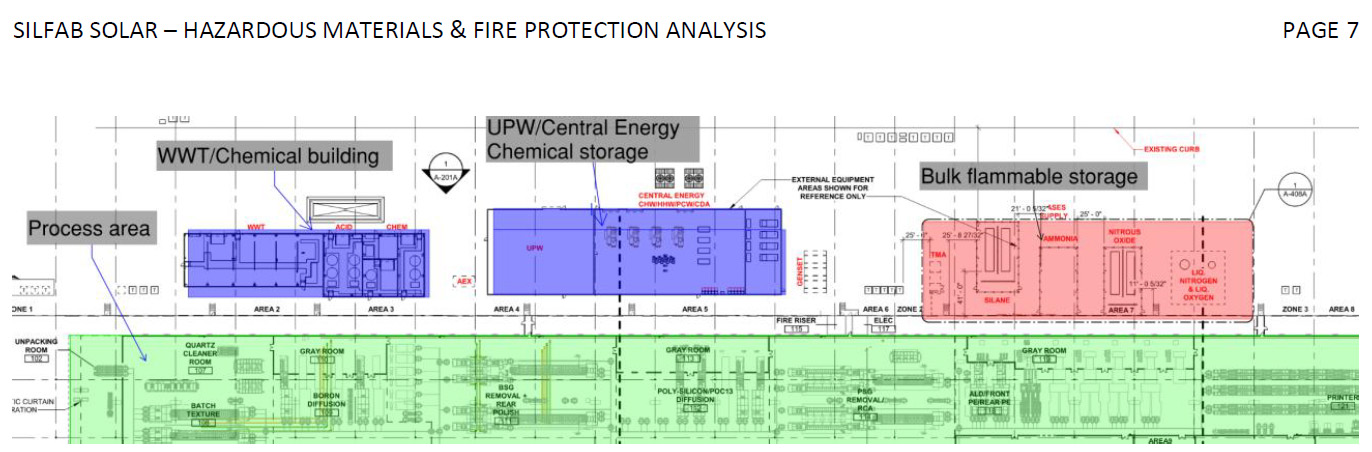
Silfab’s official Hazardous Materials Inventory System (HMIS) report, DES Air Permit, and Industrial Wastewater Treatment Plans all detail massive quantities of chemicals that far exceed MMA in acute toxicity, corrosivity, reactivity, and potential for chain-reaction disasters. The Wastewater Treatment/Chemical storage area is classified as a High-Hazard Group H-3/H-4 occupancy because quantities vastly exceed Maximum Allowable Quantities (MAQs) under the South Carolina Fire Code.

Silfab’s full list of chemicals and the quantities they would need to store on site.

Key chemicals and quantities include:

  • Hydrofluoric Acid: 17,435 gallons in bulk storage
  • Anhydrous Ammonia: 1,020,408 cubic feet in exterior bulk storage
  • Silane Gas (SiH₄): 289,210 cubic feet in tube trailers (pyrophoric)
  • Liquid Oxygen (LOX): 13,000 gallons (powerful oxidizer)
  • Nitrous Oxide (N₂O): 245,614 cubic feet (oxidizing gas)
  • Trimethylaluminum (TMA): 100 gallons in a dedicated 4-hour fire-rated H-3 building (extremely pyrophoric and water-reactive)
  • Phosphorus Oxychloride (POCl₃): 59.4 gallons (plus process quantities; violently water-reactive, releases HCl gas)
  • Boron Trichloride (BCl₃): 1,348 cubic feet (corrosive/toxic gas; reacts with moisture to form HCl fumes)
  • Sulfuric Acid: 1,500 gallons
  • Additional bulk corrosives: Hydrochloric Acid and Potassium Hydroxide at 11,095 gallons each, plus Hydrogen Peroxide at 7,978 gallons.

Real-World Precedents: These Exact Chemicals Have Already Caused Mass Casualties

History shows the deadly consequences of these chemicals — especially when stored or handled in large quantities:

  • Silane Gas: Silane is notoriously pyrophoric and has caused a long history of fatal explosions in semiconductor and solar/PV manufacturing. A 2023 overview of silane incidents documents at least 12 fatalities across major events, including two separate backflow incidents (1988 in the US and 1991 at Osaka University in Japan) that each killed 5 people when nitrous oxide contaminated silane cylinders, creating explosive mixtures. Gas cabinet explosions alone have caused 7 fatalities worldwide between 1976 and 2012, often due to human error during cylinder changes. In solar plants specifically, silane leaks have led to fires, explosions, and worker deaths, including a 2007 incident in India that decapitated a worker and a 2005 Taiwan factory explosion that killed one worker and shut down production for months.
  • Anhydrous Ammonia: In September 2023, a tanker truck carrying anhydrous ammonia overturned in Teutopolis, Illinois, releasing approximately 15,000 liters (~4,000 gallons). The resulting toxic vapor cloud killed five people (including a father and his two young children) and injured seven others. Hundreds of residents within a 1.6 km radius were evacuated. This was from a single tanker — far smaller than Silfab’s stored inventory of over one million cubic feet.
  • Hydrofluoric Acid: A 2015 HF leak in China injured 253 workers, demonstrating the chemical’s ability to cause rapid systemic poisoning, severe burns, and cardiac effects even from limited exposure.
  • Sulfuric Acid: In September 2025 at Hexin Chemical Industry in Henan Province, China, a sulfuric acid leak reacted in a septic tank to produce hydrogen sulfide gas, killing five people in a factory restroom.

These incidents involved the exact same classes of chemicals Silfab stores and uses in much larger volumes.

Why Silfab’s Placement in a Light Industrial Zone Is So Alarming

via Silfab’s HMIS

Silfab’s operation is not light industrial assembly — it is a full-scale chemical manufacturing plant using High-Hazard Group H-3/H-4 processes and quantities. Placing it in a light industrial zone next to an elementary school and residential areas creates unacceptable risk. Real-world accidents prove that leaks, backflows, rollovers, or unintended reactions with these chemicals can kill or injure dozens to hundreds of people in minutes through toxic plumes, fires, explosions, and systemic poisoning.

A failure at Silfab could trigger cascading reactions: TMA or silane igniting spontaneously and being supercharged by LOX or nitrous oxide; POCl₃ or boron trichloride releasing HCl gas clouds; HF causing delayed cardiac arrests; ammonia forming ground-hugging lethal plumes; and sulfuric acid generating exothermic steam explosions and acidic mists.

Community impacts could be devastating:

  • Children at Flint Hill Elementary facing immediate corrosive burns, respiratory failure, or cardiac effects from HF.
  • Nearby homes and residents suffering toxic contamination and long-term health damage.
  • Drivers on Logistics Lane and I-77 trapped in drifting plumes, leading to mass casualties and accidents.

Previous smaller releases at Silfab (KOH spill and HF leak in March 2026) already preceded school closures and 911 surges, including vomiting blood, trouble breathing, and seizures. A major event would dwarf the current Garden Grove crisis.

The Garden Grove incident shows how seriously even moderate chemicals like MMA are treated. Silfab’s far more hazardous mix, operating in improper zoning near sensitive populations, represents an unacceptable public safety risk that demands immediate action.

South Carolina Ranks Among Most Accident-Prone States for Hazardous Materials Transport

0

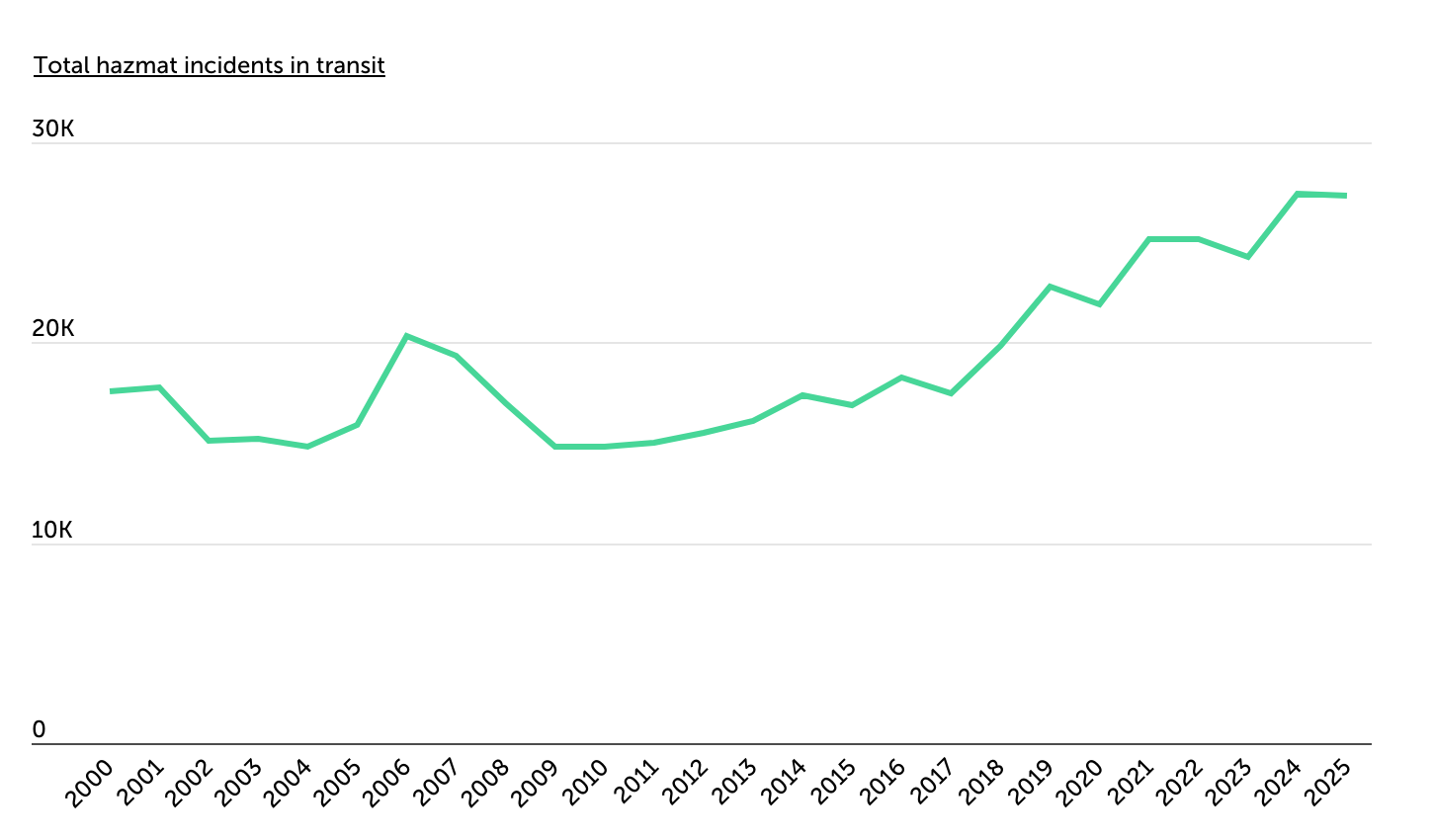
New analysis of federal Pipeline and Hazardous Materials Safety Administration (PHMSA) data shows America’s hazardous materials transport incidents have skyrocketed — up 84.8% since 2010 — with highway trucking responsible for the overwhelming majority of the chaos.

A detailed five-year review (April 2021–April 2026) by Trace One reveals more than 119,000 highway hazmat incidents nationwide, dwarfing rail, air, and water transport combined.

Corrosives and flammable liquids dominate the spill lists, and the consequences are getting uglier: injuries, hospitalizations, evacuations, and millions in damages.

via U.S. Department of Transportation

Over the past 5 years, South Carolina had a total of 1,336 total hazmat transit incidents, resulting in $13,223,021 in total damages, with the most common hazmat incident involving corrosive substances, according to the report.

Our state’s booming manufacturing and logistics corridor — anchored by the I-77 and I-85 corridors that feed directly into Charlotte — puts it squarely in the crosshairs of this national crisis. And now one local factory is preparing to dramatically escalate the risk.

Silfab Solar’s Toxic Chemical Cocktail Is Coming by Truck

At the Silfab Solar plant in Fort Mill — literally feet from Flint Hill Elementary School’s playgrounds — the company is ramping up full-scale TOPCon solar cell manufacturing. Their heavy industrial factory requires over 1 million lbs of some of the most dangerous substances on the PHMSA watch list, including:

  • Hydrofluoric acid (HF)
  • Hydrochloric acid (HCl)
  • Silane gas
  • Anhydrous ammonia
  • Phosphrus Oxyhclroide 
  • Boron Trichloride
  • Trimethylaluminum 
  • Potassium Hydroxide 
  • Liquid Oxygen

These chemicals aren’t just sitting in tanks. They arrive by truck, get stored on-site, get used in production, and generate waste that must be hauled away. Every single truck movement adds another potential spill point along South Carolina highways that already see thousands of hazmat shipments annually.

We’ve already seen what happens when things go wrong at Silfab. In March 2026, a potassium hydroxide spill triggered a hazmat response that required 300,000 gallons of hazmat waste to be disposed of. Days later, a hydrofluoric acid leak forced a two-day closure of nearby schools. There have also been a steady stream of 911 calls at the factory for breathing problems, chest pain, and other symptoms consistent with exposure to these exact chemicals.

Fort Mill residents didn’t ask to have their risk increased (hazardous treatment and storage facilities, like Silfab, are actually prohibited in Fort Mill, according to York County’s zoning code), but in spite of the law, York County Chairwoman Christi Cox and manager Josh Edwards are continuing to allow Silfab, without zoning compliance, to truck in hundreds of thousands of gallons of dozens of highly toxic and explosive chemicals into Fort Mill, turning the region into a constant high-stakes gamble.

Pentagon Releases New UFO Video Filmed Off North Carolina Coast

0

A U.S. military infrared video showing a UAP captured off the North Carolina coast has been officially declassified and released to the public today as part of the Department of War’s second major UAP release.

The footage, labeled DOW-UAP-PR086 “UAP from Dec 2019 (East Coast)”, was captured by a military sensor off the North Carolina’s coastline.

The 34-second infrared clip shows a sensor tracking an anomalous heat signature against the background. The object remains unidentified.

The video is part of Release 02 under the PURSUE system. The Department of War announced the new batch today on X, noting massive public interest in the war.gov/UFO site.

North Carolina’s coast is a frequent hub for Navy, Marine Corps, and Air Force training operations. This release adds to the growing archive of declassified UAP material being made public.

North Carolina has a long history of UAP and UFO sightings across our state, including the Brown Mountain Lights, orbs and crafts spotted over the piedmont, and a numerous coastal sightings.

Two-Time NASCAR Champion Kyle Busch Dies in Charlotte Area at 41 Years Old

0

Two-time NASCAR Cup Series champion Kyle Busch has died at the age of 41 following a sudden illness.

The announcement came Thursday after Busch’s family earlier revealed he had been hospitalized in the Charlotte area with a severe illness. The exact cause has not been publicly disclosed.

According to reports, Busch became unresponsive Wednesday while testing in a Chevrolet racing simulator in Concord before being transported to a Charlotte-area hospital.

Busch was one of the most successful drivers in NASCAR history.

During his career, he captured Cup Series championships in 2015 and 2019 while earning 63 Cup Series victories. He also became the all-time winningest driver in both the NASCAR Truck Series and Xfinity Series.

Known to fans as “Rowdy,” Busch built a reputation as one of racing’s fiercest and most aggressive competitors.

His driving style made him both controversial and wildly popular throughout a Cup Series career that began in 2005.

Busch joined Richard Childress Racing in 2023 and remained one of the sport’s biggest stars.

News of his death has sent shockwaves through the Charlotte-area racing community just days before the Coca-Cola 600 at Charlotte Motor Speedway.

8 Things to Prepare Before Building a Medical Center

0

Across the Charlotte area, healthcare demand is growing almost as fast as the housing market. New neighborhoods continue to expand into the suburbs surrounding the city, but medical infrastructure often struggles to keep up. In some parts of the region, residents already drive across multiple towns just to find same-week specialist appointments or avoid packed urgent care waiting rooms. That demand is creating major opportunities for new medical centers and outpatient clinics. However, a project can look promising on paper but still run into problems once patients, staff, and daily operations come into play. Before construction begins, developers and medical providers need to think beyond the building itself.

1. Make Sure the Location Actually Makes Sense

A cheap piece of land that allows you to build a fancy building doesn’t always make it a good location for a medical center because patients care more about convenience than architecture. If traffic is difficult, parking is limited, or the facility feels disconnected from surrounding neighborhoods, people quickly notice.

Anyone who has spent time driving around crowded medical campuses in growing Charlotte suburbs already understands the problem. Patients rarely care how impressive a building looks if finding parking adds 20 minutes to every appointment.

Location planning should account for traffic congestion during peak hours, nearby residential growth, access from major roads, public transportation options, and emergency vehicle access.

Zoning can also unexpectedly slow projects down. Medical properties often require additional approvals depending on the services being offered, especially if imaging, surgery, or urgent care services are involved.

2. Construction Costs Are Only the Beginning

One of the most common mistakes in medical development is underestimating what happens after the building opens.

The real costs start showing up once patients begin coming through the doors. Equipment, licensing, staffing, insurance, software systems, and maintenance can quickly push budgets higher than expected.

Even smaller outpatient clinics may require costly upgrades for backup generators, ventilation systems, secure records storage, and diagnostic technology.

Hiring costs are also becoming a larger issue. Hospitals and clinic operators across the country are competing for the same nurses, technicians, and specialists, especially in fast-growing regions where demand keeps climbing.

3. Compliance Problems Can Delay Everything

Medical construction comes with stricter regulations than most commercial projects. Developers need to consider accessibility standards, infection control requirements, emergency evacuation procedures, fire safety systems, patient privacy protections, and medical waste disposal before construction begins.

Waiting too long to address those issues leads to costly redesigns halfway through the project. That is one reason many providers now bring compliance specialists into projects early rather than treating regulations as a final-stage checklist.

4. Patients Will Judge the Experience Immediately

Confusing entrances, crowded waiting rooms, poor signage, and difficult parking all shape how people feel about a facility from the moment they arrive.

Some newer clinics and outpatient centers are putting far more emphasis on patient flow and convenience because operational bottlenecks quickly affect both satisfaction and staffing efficiency.

Clear navigation between departments, covered drop-off areas, larger waiting rooms, easier accessibility for older patients, and faster digital check-in systems can all significantly improve the experience.

5. Weak Technology Systems Create Problems Fast

A medical center built without strong digital systems today will feel outdated almost immediately. Providers now rely heavily on telehealth platforms, electronic medical records, secure patient messaging systems, cloud-based storage, and digital imaging technology.

Adding those systems later becomes far more expensive and disruptive. This matters even more in suburban and rural communities, where telehealth access can reduce the need for long travel times for specialist appointments.

Cybersecurity is also becoming a larger concern. Medical facilities remain major targets for data breaches because patient records contain sensitive personal and financial information.

6. Design for the Community You Expect in 10 Years

Medical demand changes quickly in fast-growing regions. A clinic focused on primary care today may eventually need urgent care services, rehabilitation programs, specialty treatment areas, or expanded diagnostic space as surrounding neighborhoods continue growing.

That is why more developers are prioritizing flexible layouts instead of designing only for immediate demand. Some facilities now leave room for future building additions, expandable parking, adaptable treatment rooms, larger utility capacity, and additional office space.

Projects designed with flexibility in mind usually avoid expensive expansion problems later. This is especially important for behavioral health providers entering fast-growing suburban markets. Teams focused on starting an ABA practice often need flexible clinic space that can expand as patient demand rises, which is why organizations like Missing Piece have become valuable resources for providers planning long-term operational growth.

7. Staffing Should Be Part of the Plan From the Start

Medical providers across the country are already competing aggressively for nurses, physicians, technicians, and administrative workers. In some markets, staffing shortages can delay openings even after construction is complete. That reality is changing how facilities are designed.

Break rooms, workspace layouts, parking access, security measures, and workflow efficiency all affect recruitment and retention more than they did a decade ago. A facility that frustrates employees will eventually become frustrating for patients, too.

8. Study What Healthcare Gaps Exist Locally

Not every community needs the same type of medical center. A younger suburb filled with new families may need pediatric care and urgent care access. Areas with older populations may require cardiology, rehabilitation services, or chronic disease treatment.

Key Takeaways Before You Get Building

The strongest projects are usually the ones built around actual service gaps instead of broader development trends.

Before construction starts, developers should study:

  • Population growth patterns
  • Age demographics
  • Provider shortages
  • Emergency room demand
  • Insurance coverage trends
  • Existing medical access in surrounding areas.

As the Charlotte region continues growing, pressure on medical infrastructure will likely keep rising alongside it. In fast-growing areas, the facilities that succeed will likely be the ones designed around everyday patient realities instead of simple expansion trends.

How Divorce Can Affect Small Business Owners in Coastal Communities

0

Divorce can create serious financial and emotional challenges for business owners, especially in smaller coastal communities where personal and professional relationships are closely connected. Many individuals searching for a Pawleys Island divorce lawyer are often trying to understand how divorce may impact shared business assets, long-term financial stability, and the future of a company they spent years building. In places like Pawleys Island, where local businesses often rely on community reputation and seasonal customer traffic, the effects of divorce can extend far beyond the home and directly into day-to-day business operations.

The Financial Pressure Divorce Places on Business Owners

Small business owners often have much of their personal wealth tied directly to their company. Unlike traditional employees who may rely on salaries and retirement plans, entrepreneurs frequently reinvest profits back into the business. During divorce proceedings, this can create disputes about how the company should be valued and whether it is considered marital property.

In coastal communities such as Pawleys Island, many businesses are family-run operations connected to tourism, hospitality, real estate, or local services. A divorce can place additional strain on these businesses, as seasonal income patterns may complicate financial evaluations. Determining accurate revenue, future earning potential, and ownership interests often requires careful legal and financial analysis.

How Divorce Can Disrupt Daily Business Operations

Running a business already requires significant attention and decision-making. Divorce proceedings can add emotional stress, scheduling conflicts, and financial uncertainty, distracting owners from important operational responsibilities. This can affect productivity, employee morale, and customer relationships.

In smaller coastal communities, reputation also plays an important role in long-term business success. Business owners may worry about how public legal disputes could influence partnerships or local customer trust. Since many local businesses rely heavily on repeat clients and word-of-mouth referrals, personal challenges can sometimes create professional consequences.

The Challenge of Dividing Shared Business Interests

When spouses both contribute to a business, separating ownership interests can become highly complex. One spouse may have managed finances while the other handled operations, customer service, or growth strategy. Even if only one spouse officially owned the company, the court may still consider the business a shared marital asset.

Business valuation is often one of the most difficult aspects of divorce involving entrepreneurs. Coastal businesses can experience fluctuating revenue depending on tourism seasons, economic conditions, or property market trends. Because of this, determining a fair valuation may require accountants, financial experts, and legal professionals to evaluate both current and projected income.

Why Coastal Businesses Face Unique Risks

Coastal communities have economic patterns that differ from larger metropolitan areas. Businesses in places like Pawleys Island may depend heavily on peak travel seasons, vacation homeowners, and tourism-related spending. Divorce during slower economic periods can place even greater financial pressure on an already vulnerable business.

Many coastal businesses are also closely tied to personal relationships within the community. Restaurant owners, real estate professionals, contractors, and hospitality operators often build their success through long-standing local connections. A stressful divorce can sometimes affect networking opportunities, partnerships, and public perception within smaller community environments.

Protecting the Future of the Business

Preparation and planning can help reduce some of the long-term damage divorce may create for business owners. Keeping accurate financial records, separating personal and business expenses, and maintaining proper legal agreements can make the process more manageable. These steps also help establish clearer financial boundaries during asset division discussions.

Legal guidance becomes especially important when a business represents a major portion of a couple’s shared assets. Business owners may need assistance addressing ownership structures, property division, future income concerns, and buyout options. In many cases, early legal planning helps protect both the company itself and the livelihoods connected to it.

The Importance of Long-Term Stability After Divorce

Divorce does not only affects current finances. It can also influence future business growth, retirement planning, and long-term investment opportunities. Business owners may need to restructure debt, revise partnership agreements, or rebuild financial reserves after the divorce process is complete.

For entrepreneurs in coastal communities, maintaining stability is often essential because local markets can be more sensitive to economic changes and seasonal demand. Owners who take proactive steps to manage both legal and financial challenges are often better positioned to protect their businesses and continue serving their communities successfully.

Divorce can create significant uncertainty for small business owners, particularly in close-knit coastal communities where professional and personal lives often overlap. From asset division and business valuation to reputation management and financial recovery, the challenges can affect nearly every aspect of a company. With careful planning and experienced legal support, business owners in Pawleys Island can work toward protecting both their personal interests and the long-term future of the businesses they have worked hard to build.