NC Woman Charged With Leaking Classified Delta Force Information to Journalist

0

A North Carolina woman is facing federal charges after prosecutors say she leaked classified military information to a journalist.

Courtney Williams, 40, was arrested Tuesday and indicted the following day on a charge of transmitting classified national defense information, according to the U.S. Department of Justice. She is now facing up to 10 years in prison.

Williams worked in a support role for Delta Force at Fort Bragg from 2010 to 2016 and held top secret clearance. Prosecutors say that between 2022 and 2025, after leaving the Army, she shared sensitive materials with a journalist, including documents, photos, and notes sent on a thumb drive.

The information was later published in a Politico Magazine article and a book by Seth Harp that examined alleged misconduct within the unit. Authorities say the disclosures may have exposed military tactics and techniques.

Williams had described her time in the unit as involving sexual harassment and discrimination. The journalist has defended her, calling her a whistleblower and criticizing the charges.

Williams is being held ahead of a preliminary hearing scheduled for April 13.

Charlotte Douglas Now Ranks as Sixth Busiest Airport in the World

Charlotte Douglas International Airport (CLT) has just been ranked as the 6th busiest airport in the world, according to a new report from the Airports Council International (ACI).

The report shows that Charlotte Douglas handled 596,583 takeoffs and landings, marking an 11% increase and moving it up one spot from last year.

The airport also rose two spots to seventh in North America for total passenger volume. Globally, CLT now ranks 23rd for passenger traffic, with final ACI rankings expected later this year.

CLT set a new all-time passenger record in 2025, welcoming 58.8 million travelers, a 10% increase from its previous record of 53.4 million in 2024. International travel rose 13%, with 2.4 million international passengers, up from 2.1 million in 2024. The airport currently serves 42 international destinations and is home to three foreign flag carriers.

Charlotte Douglas outpaced global hubs including Los Angeles (LAX), Shanghai Pudong (PVG), Istanbul (IST), and Guangzhou (CAN) in total aircraft operations.

Meanwhile, the airport continues major construction under its Destination CLT program. The Terminal Lobby Expansion, set for completion this year, will add 175,000 square feet of new space and renovate 191,000 square feet of existing facilities. On March 24, CLT opened Transportation Security Administration Checkpoint 2, completing its shift from five lettered checkpoints to three numbered ones.

New Mixed-Use Development Bringing Organic Farm and Village Life to Lake Norman

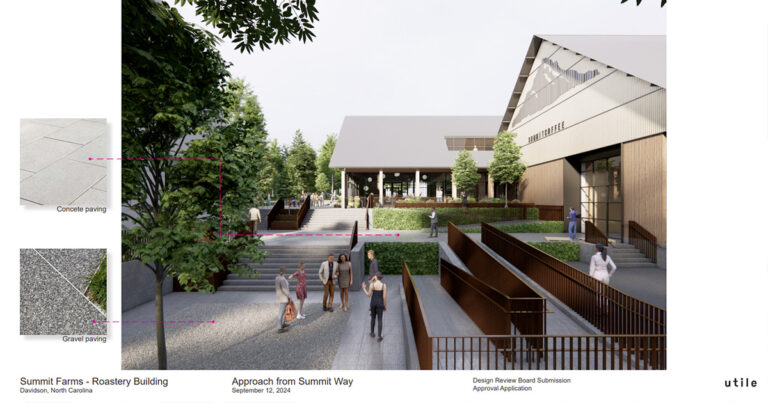
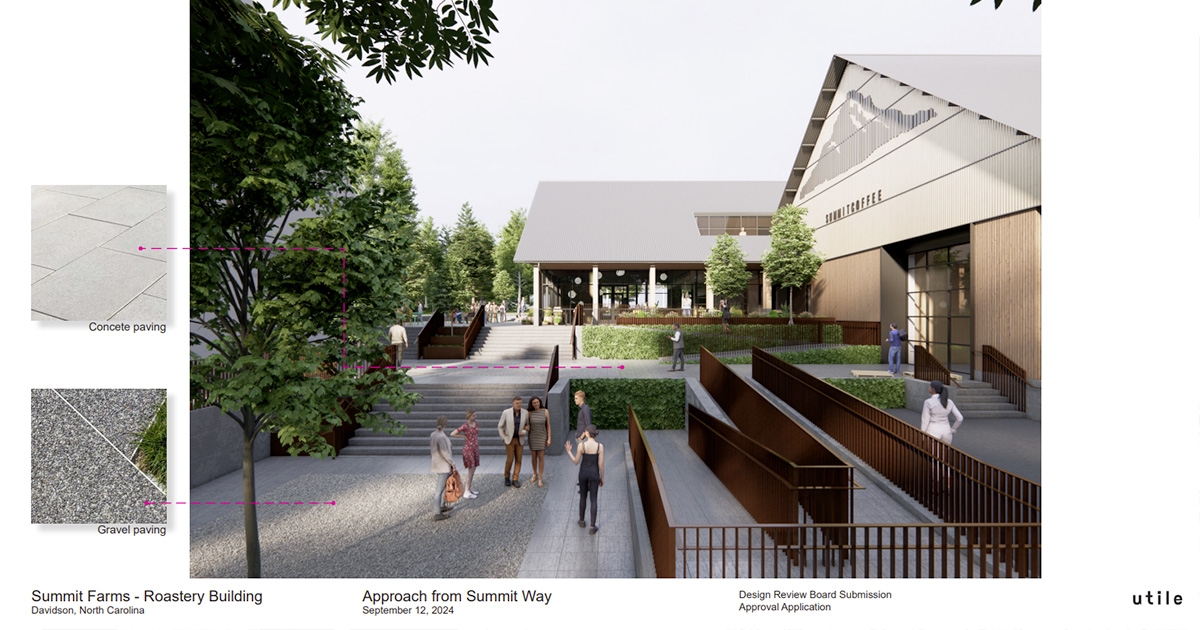
A major new development is taking shape in Davidson, blending agriculture, dining, and housing into one destination.

Summit Farms, a 62-acre mixed-use development from the team behind Summit Coffee, is expected to open in spring 2027. The project aims to create a European-inspired village centered around food, community, and open space.

At the heart of the development will be a 10-acre organic working farm, supplying fresh produce, herbs, and flowers directly to on-site businesses. Plans include a market, deli, and wood-fired pizza restaurant that will use ingredients grown steps away.

Construction is already underway, beginning with infrastructure, trails, and the initial phase of the commercial village. Early plans also include gathering spaces designed to create a walkable, outdoor-focused environment.

Details

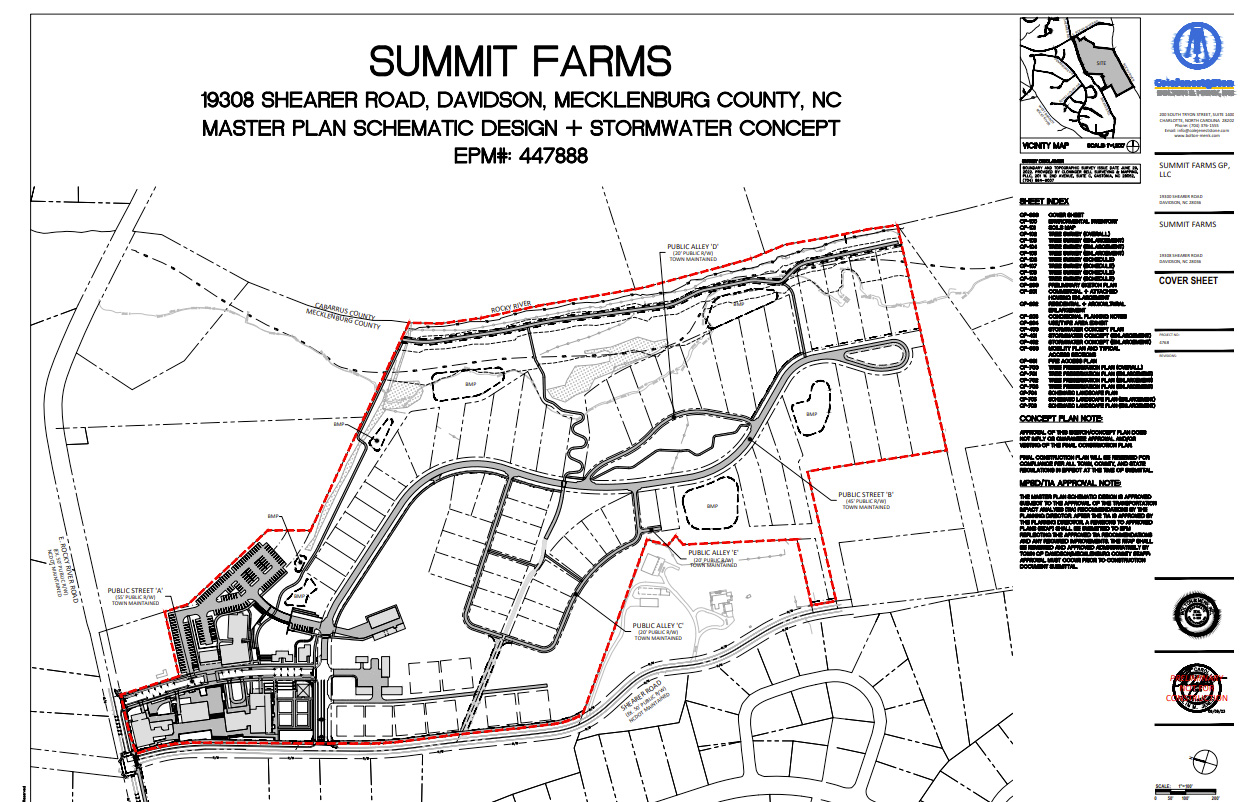
According to the Town of Davidson’s conditional master plan, Summit Farms will combine residential, commercial, and agricultural uses into a single mixed-use community.

The development is planned for 19300 Shearer Road and will include:

  • Up to 109 residential units, including affordable housing
  • A mix of commercial buildings and retail spaces
  • A working farm integrated into daily community life
  • Multi-use paths connecting the site to surrounding areas
  • At least 45% preserved open space throughout the property

Additional plans call for a residential section known as “The Preserve,” featuring single-family homes on larger lots, as well as potential hospitality elements like an inn.

Background

The project has been in development for several years and received town approval after extensive planning and public input. Officials have positioned it as a model for sustainable, small-scale agricultural communities.

Developers say the concept responds to the growing difficulty of maintaining small farms, aiming to integrate agriculture directly into a modern, mixed-use environment.

Local impact

Summit Farms is expected to become a major destination near Lake Norman, attracting visitors for dining, shopping, and outdoor experiences.

For the Charlotte region, the project represents a shift toward farm-to-table living and walkable development, while preserving large portions of land as open space.

Wells Fargo to Announce $6M Investment in West Charlotte

0

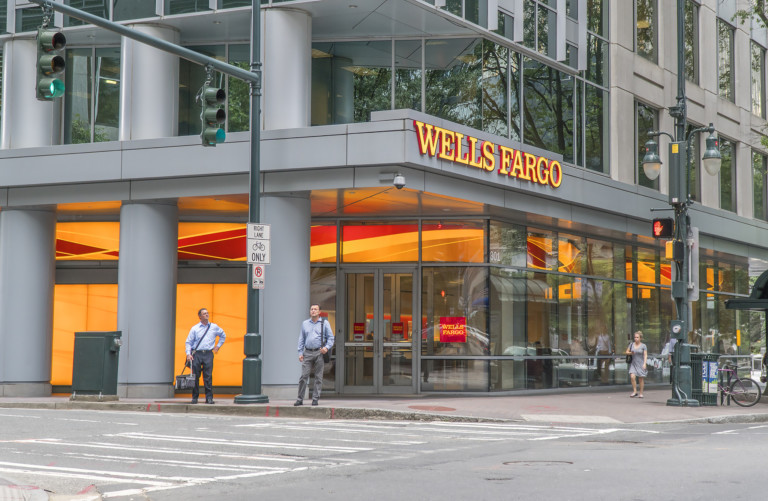
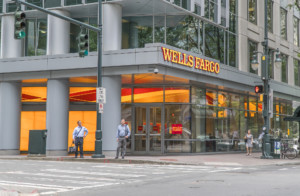
Wells Fargo today announced a $6 million philanthropic investment in Charlotte, North Carolina, reinforcing the company’s longstanding commitment to the city. Focused on West Charlotte, the new funding will support six nonprofit organizations working across housing, workforce training, and small business growth to deliver coordinated, community driven solutions. The announcement was made at an event hosted at Johnson C. Smith University.

The grant announcement builds on Wells Fargo’s broader community engagement in Charlotte, where the company has its largest employee base. Between 2020 and 2025, Wells Fargo and the Wells Fargo Foundation invested more than $48 million in philanthropic initiatives in the Charlotte region, and employees have volunteered more than 675,000 hours in the local community.

“Wells Fargo’s deep roots in Charlotte drive our commitment to fuel economic growth for our customers, employees, and the communities we serve across North Carolina,” said Jason Rosenberg, Wells Fargo’s Head of Public Affairs. “This investment in West Charlotte will support expanded housing options, more capital for businesses, and access to workforce development in the community.” 

Grant recipients and community impact

The $6 million philanthropic investment from the Wells Fargo Foundation includes grants to six nonprofits:

Housing access

  • Freedom Communities: Supporting the creation of 12 affordable rental units for workforce program participants, helping promote housing stability and economic mobility
  • Lakeview Neighborhood Alliance: Supporting construction of 15 accessory dwelling units (ADUs), expanding affordable rental options, and enabling home repairs, solar installations, and energy upgrades

Workforce development

  • CodePath: Expansion of CodePath’s industry-aligned computer science courses, career services, and interview preparation into programs at UNC Charlotte and Johnson C. Smith University, with plans to expand to additional institutions across the region

Local business growth

  • CLT Alliance Foundation: Supporting assessment of small business needs and launching readiness programs with a focus on West Charlotte
  • ASPIRE Community Capital: Investment in the Financial Empowerment for Growth initiative to help 24 business owners work toward sustainable growth
  • West Boulevard Neighborhood Coalition: Establishing Three Sisters Market, the first fullservice grocery store in more than 30 years for West Boulevard Corridor, expanding access to fresh food

“Philanthropic investments like this, backed by Wells Fargo’s long-standing support of Charlotte, help translate community vision into measurable progress,” said Charlotte Mayor Vi Lyles. “Supporting housing access, workforce training, and local businesses in West Charlotte strengthens the city as a whole.”

Horse Hit by Car in Uptown Charlotte After Rider Tries To Impress His Friends and Falls Off

0

A late-night ride through Uptown Charlotte over the weekend ended with a loose horse being struck by a vehicle.

According to a video from a bystander, two men were riding horses along East 7th Street late Friday night when one rider fell off. The horse then ran loose through nearby streets.

About a block later, at East 7th Street and North College Street, the horse entered the intersection and was hit by a passing vehicle. Witnesses at the scene report that the horse got back up and did not appear to be seriously injured.

Here’s the full video of the incident (viewer discretion advised):

City ordinances and state law make clear that riding a horse on public roads is legal in North Carolina. Under North Carolina General Statute §20-171, traffic laws apply to “persons riding an animal” on a highway, effectively recognizing horses as a form of transportation.

However, local law places clear limits on how animals can be ridden in the city. Under Charlotte Code Section 3-70, it is illegal to engage in “reckless riding or driving of an animal.”

Additional ordinances also prohibit allowing animals to roam freely on public streets, reinforcing requirements that livestock remain under control.

Police said both riders were charged with public disorder and disorderly conduct.

Snakebite Season Upon Us – Here’s How You Can Stay Safe

Spring is here, and along with warmer temperatures and flowers everything, it’s also snakebite season. Venomous Copperheads are having babies and finding far more cover under an increasing number of dead leaves around our city.

According to the N.C. Wildlife Resources Commission, “Copperheads mate in the spring and fall. Females give birth to 3 to 14 (up to 20) live young during the late summer or early fall.”


View this post on Instagram


A post shared by Susan Dolinski (@dog_creek_farm)

If you do a lot of walking or hiking around the Charlotte region, it’s recommended that you carry a snake bite kit and/or venom extractor in your backpack or car.

The Carolina Poison Center also suggests that:

If bitten by a snake, you SHOULD:

  • Sit down and stay calm.
  • Gently wash the area with warm, soapy water.
  • Remove any jewelry or tight clothing near the bite site.
  • Keep the bitten area still, if possible, and raise it to heart level.
  • Call the Carolinas Poison Center:  1-800-222-1222.

If bitten by a snake, you SHOULD NOT:

  • Ice the area.  Icing causes additional tissue damage.
  • Make and apply a tourniquet or any tight bandage.  It’s better for the venom to flow through the body than for it to stay in one area.
  • Attempt to catch or kill the snake.

If a snakebite victim is having chest pain, difficulty breathing, face swelling, or has lost consciousness, call 911 immediately.

Call Carolinas Poison Center at 1-800-222-1222 for questions about a snake bite or for more information.

North Carolina’s Cannabis ‘Wild West’ May Finally Be Ending. Here’s What That Means for Charlotte

A state advisory council just told lawmakers to legalize and regulate adult-use cannabis. If the General Assembly listens, Charlotte residents could see licensed retail shops, consumer protections, and the end of nearly 11,000 annual marijuana arrests.

On April 2, 2026, a 25-member panel of law enforcement officials, health experts, and bipartisan legislators handed the North Carolina General Assembly something it has never received before: a formal recommendation to legalize marijuana for adults. The North Carolina Advisory Council on Cannabis, created by Governor Josh Stein through Executive Order No. 16 in June 2025, released its interim report last week with a conclusion that left little room for ambiguity. The status quo, the council wrote, “is not an option.”

For Charlotte, a city that has watched neighboring states build billion-dollar cannabis industries while North Carolina remained one of roughly 10 holdouts without any medical or recreational program, the report represents the furthest any official body in North Carolina has gone on cannabis reform. It does not make anything legal yet. The Republican-led General Assembly still has to act, and neither House Speaker Destin Hall nor Senate leader Phil Berger has publicly endorsed legalization. But the blueprint is now on their desks, and a federal deadline seven months away is forcing the issue.

What Charlotte Residents Are Already Buying (Without Any Rules)

Walk into a vape shop, convenience store, or gas station in Charlotte today and you can buy delta-8 gummies, THCa flower, hemp-derived delta-9 edibles, and vape cartridges that produce genuine psychoactive effects, all of it legal under the 2018 Farm Bill and North Carolina Session Law 2022-32, which removed hemp-derived THC from the state’s Controlled Substances Act. There are no enforceable statewide age restrictions on these purchases. No mandatory testing standards. No potency limits. No ingredient labels you can trust. Governor Stein has repeatedly described this situation as “the Wild West,” and the data backs him up: North Carolina’s hemp industry generates roughly $1 billion annually, almost entirely without state oversight.

The legal loophole is straightforward. The 2018 federal Farm Bill legalized hemp products containing less than 0.3% delta-9 THC. But manufacturers quickly figured out that other cannabinoids (delta-8, THCa, and various synthetic derivatives) could produce intoxicating effects while technically complying with that threshold. THCa flower, for instance, is non-psychoactive in its raw form but converts to regular THC when smoked or vaped. The result is a de facto recreational cannabis market operating without a single consumer protection.

The advisory council’s report found that this unregulated market puts North Carolinians at risk, particularly children. There are no statewide age restrictions on purchasing these products. Some are packaged to look like candy. Parents, educators, and law enforcement have all raised alarms, but existing law gives regulators almost no tools to respond.

Nearly 11,000 Marijuana Arrests in a Single Year

While THC products sit openly on store shelves across Charlotte, police continue enforcing prohibition against traditional marijuana. In 2024, North Carolina logged more than 10,800 marijuana possession arrests, placing the state in the top five nationally. Roughly 94% of those arrests were for simple possession, not trafficking or sales. Since 2018, state and local police have made over 100,000 marijuana-related arrests, the vast majority for low-level offenses.

Possession of less than half an ounce is technically a Class 3 misdemeanor in North Carolina, punishable by a fine of up to $200 but no jail time. That sounds minor until you consider that an arrest still produces a criminal record, which affects employment, housing applications, professional licensing, and student financial aid eligibility. Marijuana arrests accounted for 35% of all drug arrests in North Carolina in 2024, consuming law enforcement resources that could be directed elsewhere.

The contradiction speaks for itself: a Charlotte resident can legally buy an intoxicating THC gummy at a gas station with zero oversight, but possessing a small amount of actual marijuana flower can result in a criminal charge. The advisory council acknowledged this absurdity directly, noting that restricting cannabis access to medical patients alone “could fuel an already robust illicit market, without regulation to ensure consumer safety.”

The Council’s Blueprint for Regulation

The interim report recommends creating a regulated adult-use cannabis market with licensed retail sales for anyone 21 and older. Rather than maintaining separate legal frameworks for hemp and marijuana (the patchwork that created the current mess), the council proposes regulating all cannabis products based on their intoxicating effect, regardless of source.

Under this framework, adults would purchase cannabis through state-licensed retail outlets, similar to how North Carolina already controls liquor sales through the ABC system. Governor Stein has explicitly endorsed this model, calling for standardized testing, ingredient labeling, concentration disclosure, and enforceable age restrictions. The council’s report argues that regulation would generate hundreds of millions of dollars in state tax revenue while creating “clear and enforceable rules” and “dedicated resources for compliance and enforcement.”

The council includes co-chairs Dr. Lawrence Greenblatt (State Health Director) and District Attorney Matt Scott of Robeson County, along with representatives from law enforcement, the state health department, the Office of Budget and Management, tribal governments, and agricultural stakeholders. Its final recommendations are due to the legislature by December 31, 2026.

A Federal Deadline Makes State Action Urgent

Here is the detail that most coverage has missed: the state does not have unlimited time to figure this out. Public Law 119-37, signed on November 12, 2025, redefines hemp at the federal level and caps THC in finished products at just 0.4 milligrams per container. That law takes effect on November 12, 2026, roughly seven months from now.

When it does, the vast majority of hemp-derived THC products currently sold in North Carolina stores will become illegal overnight. Industry analysts estimate that roughly 95% of current products would not survive the new threshold. The state’s $1 billion hemp industry, which supports approximately 9,000 jobs, faces an existential threat. Without a state-regulated cannabis framework in place by then, North Carolina could simultaneously lose its existing hemp economy and continue prohibiting the regulated alternative. The short legislative session begins this month, giving lawmakers a narrow window to act before the federal deadline reshapes the market by force.

Where Medical Cannabis Fits In

North Carolina’s failure to establish a medical marijuana program stands out even among conservative states. Thirty-nine states now allow some form of medical cannabis access. North Carolina is one of just 10 without any program at all. The state’s only existing medical exception, the 2014 Epilepsy Alternative Act, permits CBD extract with less than 0.9% THC for patients with intractable epilepsy, a provision so narrow it helps almost nobody.

The NC Compassionate Care Act, which would have created a tightly regulated medical cannabis program, passed the state Senate 36-7 with bipartisan support in 2022 before stalling in the House without a vote. A new version was introduced in 2025 but remains stuck in committee. A 2025 Meredith College poll found that 71% of North Carolinians support legalizing medical marijuana, with support spanning all party affiliations, education levels, and age groups.

For patients in the Charlotte area living with chronic pain, PTSD, epilepsy, or other conditions that qualify for medical cannabis in neighboring states, this legislative gridlock has real consequences. Many travel to states with established programs, or to the Eastern Band of Cherokee Indians’ dispensary in western North Carolina (the tribe legalized adult-use cannabis on its lands in 2023). Others turn to the unregulated hemp market, where product quality and safety are anyone’s guess. In the 40 states with medical programs, patients can schedule telehealth appointments for medical marijuana evaluations with licensed physicians and receive a recommendation the same day. None of that is available to North Carolina residents. Until the General Assembly passes legislation creating a medical cannabis program, patients in Charlotte and across the state have no legal pathway to physician-recommended marijuana, no matter their diagnosis.

What Charlotte Should Watch For

The advisory council’s interim report is a recommendation, not legislation. Top Republican lawmakers pushed back immediately after its release, and the General Assembly’s appetite for cannabis reform during a short session remains uncertain. But several factors are converging to make 2026 different from every previous attempt.

The federal P.L. 119-37 deadline creates genuine economic urgency. The unregulated market has become a bipartisan embarrassment, with both parties acknowledging that the current system fails to protect children or consumers. The advisory council itself includes members from law enforcement and Republican legislators, making its recommendations harder to dismiss as partisan. And the example of the Cherokee Nation’s successful cannabis operation on North Carolina soil undermines the argument that the state is not ready.

For Charlotte residents, the practical implications of legalization would include licensed retail locations with age verification and tested products, tax revenue directed toward public health and education, the end of thousands of low-level criminal charges annually, and a legal framework for medical patients who currently have no options. The council’s final report arrives in December. The General Assembly will then decide whether North Carolina joins the majority of states that have chosen regulation over prohibition, or whether it continues operating a cannabis market that everybody acknowledges is broken.

North Carolina already has a thriving market for intoxicating hemp-derived products. It just has no rules governing that market, no medical program for patients who need one, and nearly 11,000 marijuana arrests a year to show for the contradiction. The advisory council has handed lawmakers a blueprint. Whether they use it before the federal deadline wipes the board clean is the only question left.


Charlotte One of Two Finalist Cities Battling To Become Host of WTA Finals Starting in 2027

Charlotte is now one step away from landing one of the biggest events in global tennis.

The Women’s Tennis Association has narrowed its finalists for the WTA Finals beginning in 2027 to just two cities: Charlotte and Gdansk.

The WTA Finals is the sport’s premier year-end championship, featuring only the top eight players in the world and determining the season’s top-ranked player.

Charlotte’s bid builds on two years of hosting major tennis events through the Charlotte Invitational. City leaders have used those events to strengthen the city’s case as a destination for elite competition.

The WTA is seeking a new host as its current agreement in Saudi Arabia expires after this year’s tournament. Officials said the event generates more than $24 million in economic impact wherever it is held.

If selected, the deal could run through 2029, giving Charlotte a multi-year run as the home of women’s tennis’ biggest stage.

NC Police Uncover Major Drug Trafficking Mule – 134 Lbs of Pure Marijuana Found in Car

0

Deputies with the Northampton County Sheriff’s Office arrested 24-year-old Patrick Medina Cortorreal after discovering approximately 134 pounds of marijuana inside his vehicle during a Friday night stop in Garysburg.

According to investigators, Sergeant J. Velez initiated the stop around 9:11 p.m. on April 3 after observing a gray Kia failing to maintain its lane while traveling southbound on I-95. During a brief roadside interview, deputies said the driver showed deceptive behavior when questioned about his travel history.

Authorities then detected a strong odor of marijuana coming from the vehicle. Cortorreal also admitted to having marijuana inside, which led deputies to conduct a probable cause search.

During that search, officers said they found four large boxes containing the drugs.

Cortorreal, who is from Virginia, now faces three felony counts of trafficking marijuana, along with one felony count of maintaining a vehicle and one infraction for failing to maintain lane control. Officials said he received a $60,000 secured bond and was taken to the Northampton County Detention Center.

His court date is scheduled for April 16 in Northampton County.

Major HQ Coming to Charlotte as SMBC Announces Major $50.5 Million US Expansion

Charlotte just landed one of its biggest financial expansions in years.

Sumitomo Mitsui Banking Corporation (SMBC) announced Tuesday it will build a new U.S. headquarters in Charlotte. The Tokyo-based bank plans to invest $50.5 million by 2027 and create 2,000 jobs, with about 1,800 hires locally.

“As SMBC continues to grow substantially in the United States, Charlotte is a standout location for us to invest in North Carolina for the long term in a major expansion that will establish our roots in the community,” said SMBC CEO Hirofumi Otsuka in a press release. “A major financial services hub, Charlotte has a deep pool of talent that we will tap into and help build out as we position our bank for long-term success while contributing to the broader local economy. We appreciate the support of Governor Stein and other public leaders as we set out to create 2,000 jobs over the next six years.”

The expansion will support SMBC’s banking, leasing, securities, and consumer finance operations as it grows its U.S. presence. State officials estimate the project will generate $13.4 billion in economic impact.

North Carolina continues to attract strong Japanese investment. More than 230 Japanese companies already operate in the state, including major projects from Toyota and Fujifilm.

The move also follows recent restructuring by SMBC, including plans to sell parts of its Los Angeles-based banking business and wind down its digital division.

The new headquarters will bring thousands of high-paying jobs and further advance Charlotte’s goal to become America’s leading banking center.