
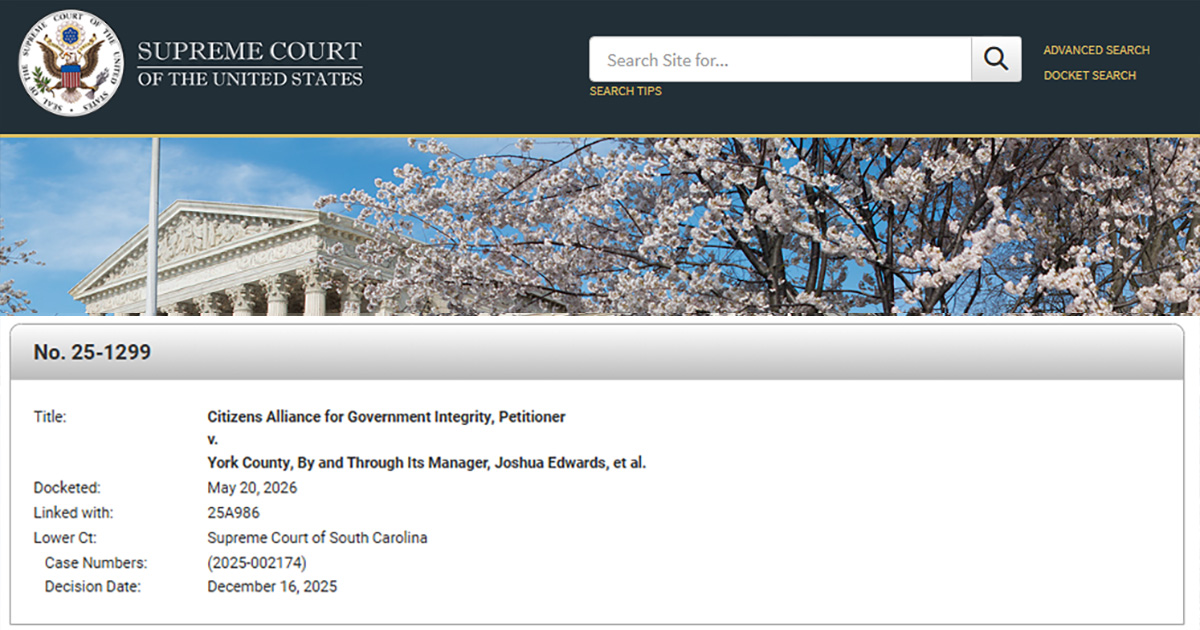
Citizens Alliance for Government Integrity (CAGI), a nonprofit representing over 8,000 Fort Mill area residents, has just filed a Petition for a Writ of Certiorari with the U.S. Supreme Court challenging York County officials’ permits and CO for Silfab Solar’s proposed solar-panel and solar-cell manufacturing facility at 7149 Logistics Lane in Fort Mill after the county’s own Board of Zoning Appeals ruled the use prohibited.
The petition, filed May 14, 2026, argues that county executives’ actions amount to arbitrary executive conduct in violation of the Fourteenth Amendment’s substantive due process protections. It highlights a clear split among federal appeals courts on when local officials’ issuance of land-use permits — after a zoning board has ruled the proposed use illegal and without any rezoning, variance, stay, or other lawful authorization — crosses into unconstitutional territory.
 The facility, currently being built on a Light Industrial (LI) zoned area next to Flint Hill Elementary and Middle Schools and within three miles of more than 53,000 residents, would involve over 1 million lbs of highly toxic and explosive chemicals including trimethylaluminum, phosphorus oxychloride, hydrofluoric acid, hydrochloric acid, silane, anhydrous ammonia, sulfuric acid, and boron trichloride, according to company documents.
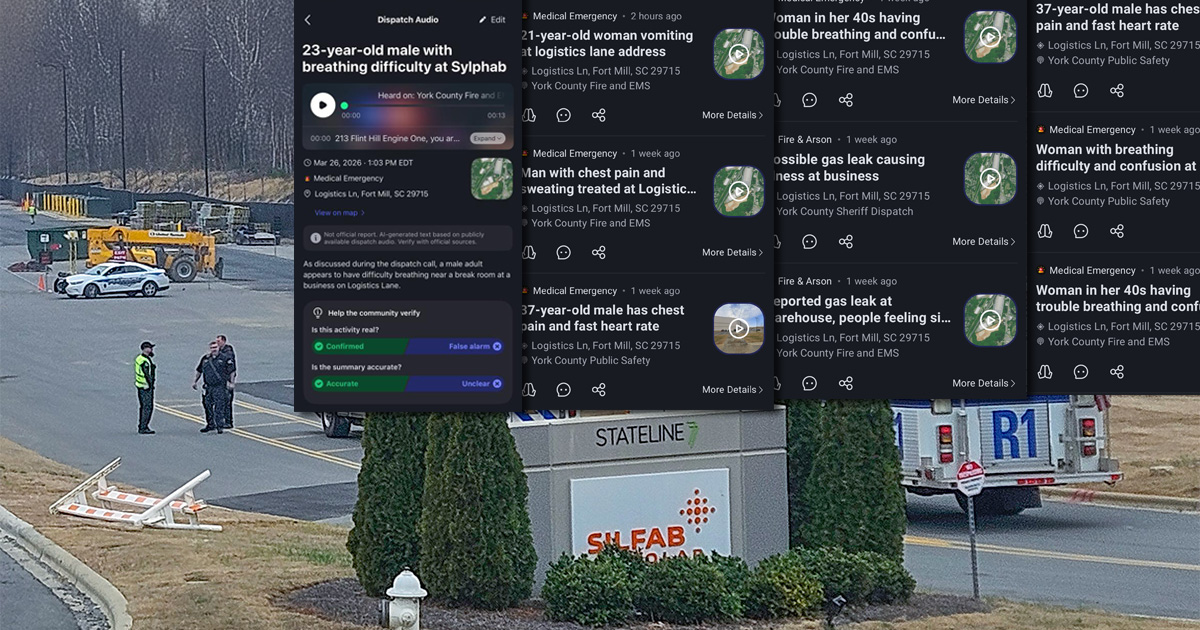
These hazards now show real consequences. Workers suffer repeated medical emergencies after multiple chemical spills at the plant. Recent calls include a 23-year-old man struggling to breathe, a 25-year-old woman vomiting blood, as well as numerous other calls involving seizures, chest pain, high blood pressure and gas leaks.
County Defied Its Own Zoning Board, Petition Alleges
According to the petition, the York County Board of Zoning Appeals unanimously ruled on May 9, 2024, after a public hearing, that solar-panel manufacturing “did not constitute ‘Computer and Electronics Product Manufacturing,’ was not a listed use in the LI district and therefore was prohibited under the York County Code.” (Petition at 5; see also BZA Order, App. 213a–214a).
Despite that binding written ruling, “county officials nevertheless began issuing permits for the project without any rezoning, variance, stay, or other lawful change-of-use approval.” (Petition at 5). The petition repeatedly characterizes the county’s conduct as taken “without legal authority,” “ultra vires,” and rendering the permits “void ab initio.” (Petition at 6).
CAGI’s original petition to the South Carolina Supreme Court expressly framed the county’s actions as “arbitrary and irrational” executive action “having no foundation in reason and no substantial relation to public health, public safety, or welfare.” (Petition at 7, quoting Nectow v. Cambridge, 277 U.S. 183 (1928)).
State Courts Declined to Intervene — Leaving Construction Unchecked
South Carolina courts have so far failed to halt the project:
- CAGI’s September 2024 circuit court action seeking declaratory and injunctive relief was stayed pending resolution of the administrative appeal — with no stay on construction permits. (Petition at 6).
- A separate neighboring property owner’s suit was dismissed in substantial part on pleading grounds. (Petition at 6; see Bivins v. York County Order, App. 3a–31a).
- On December 16, 2025, the South Carolina Supreme Court issued a one-page order declining to exercise original jurisdiction over CAGI’s petition for mandamus, prohibition, and injunctive relief. The order simply stated: “We decline to entertain this matter in our original jurisdiction.” (App. 1a–2a). No opinion explained whether the court rejected the federal due-process claim or relied on state procedural grounds.
The petition notes that “the harm is imminent and potentially irreversible” because “ordinary litigation has not kept pace with rapid construction.” (Petition at 5).
CAGI still has three pending lawsuits in South Carolina courts that could deliver relief. See current status of all lawsuits.
National Implications: A Clear Circuit Split
The core question presented to the Supreme Court is:
“Whether, and under what standard, local executive officials’ issuance of land-use permits after a local board of zoning appeals has ruled the proposed use prohibited may support a claim of arbitrary executive action under the Fourteenth Amendment.” (Question Presented, Petition at i).
The filing details a sharp disagreement among the circuits:
- The Second Circuit has held that land-use action “tainted by ‘fundamental procedural irregularity,’ including action taken without legal authority,” may be “sufficiently arbitrary” to violate substantive due process. (Cine SK8, Inc. v. Town of Henrietta, 507 F.3d 778 (2d Cir. 2007)).
- The Third Circuit and others require “conscience-shocking” misconduct beyond even bad-faith violations of state law.
- The Eleventh Circuit generally bars substantive due process review of executive deprivations of state-created land-use rights altogether.
“This geographic lottery cannot stand,” the petition argues. (Petition at 10).
If the Supreme Court grants certiorari, it could issue a landmark ruling clarifying constitutional limits on unauthorized executive permitting nationwide. If denied, CAGI plans to immediately file in federal district court under 42 U.S.C. § 1983, preserving all federal claims.
You can find out more about CAGI and their SCOTUS filing here.