North Carolina’s First Citizen Bank Agrees To Buy Silicon Valley Bank for $16.5 Billion

0

In a significant move following the largest US banking collapse since Lehman Brothers, North Carolina’s First Citizens Bank & Trust Co. has agreed to acquire Silicon Valley Bank’s (SVB) deposits and loans in their entirety.



According to an official press release from the FDIC, “today’s transaction included the purchase of about $72 billion of Silicon Valley Bridge Bank, National Association’s assets at a discount of $16.5 billion. Approximately $90 billion in securities and other assets will remain in the receivership for disposition by the FDIC. In addition, the FDIC received equity appreciation rights in First Citizens BancShares, Inc., Raleigh, North Carolina, common stock with a potential value of up to $500 million.”

The estimated cost of SVB’s failure to the Deposit Insurance Fund is around $20 billion, with the final cost determined upon the termination of the receivership.

The high-profile collapse of SVB, a prominent player in the tech and venture capital sector, occurred on March 10, marking the largest US bank failure since the global financial crisis.

The downfall was triggered by clients withdrawing billions from their accounts and a dramatic drop in the value of previously considered safe assets, such as US Treasury bills and government-backed mortgage securities. This came in response to the Federal Reserve’s aggressive interest rate hikes. Struggling to meet clients’ withdrawal demands and fund new lending, the bank unsuccessfully attempted to raise $2.25 billion.

The collapse of SVB sent shockwaves through global banks and was identified as a catalyst for Credit Suisse’s eventual downfall and emergency rescue by domestic rival UBS.

Despite the ensuing market volatility, many analysts argue that the unique flaws that left SVB and Credit Suisse vulnerable were not indicative of a broader market issue. Nevertheless, the loss of investor confidence has undoubtedly had a considerable impact on the financial landscape.

4 Scenarios Where Photographer Insurance Comes in Handy

0

When you’re running a business as a photographer, it’s essential to ensure you have the right insurance to protect your investments and livelihood. Though many people think insurance is only necessary if something bad happens, having the right coverage in place can give you peace of mind knowing that you’re protected in any situation.

This blog post will look at four scenarios where photographer insurance comes in handy. Let’s dive in to learn more about how this insurance can benefit you.

What Is Photographer Insurance?

Before diving into the scenarios when photographer insurance is helpful, let’s briefly discuss what photographer insurance is and what types of coverage are available. Photographer insurance typically covers equipment damage, professional liability, injury protection, and business interruption for photographers. Photographer insurance also provides coverage for legal defense costs if someone sues you for negligence or copyright infringement related to your photography services. 

1 – Equipment Damage

If you’re a professional photographer, you need protection in place should something happen to your expensive equipment. The best way to do this is with photographer insurance, which not only helps cover lost or stolen items but can also come in handy when your camera or other tools get damaged.

Insurance for such events can mean that minor damage repair costs are covered, and lost income due to any repairs is also taken care of. This will provide you with peace of mind whenever disaster strikes.

2 – Professional Liability

If someone claims that they have suffered damages as a result of your work as a photographer—even if it wasn’t intentional—you could be sued for negligence or copyright infringement. Professional liability coverage can help defray the costs of legal defense fees should this happen.   Though this type of coverage isn’t required by law, it can be beneficial if worse comes to worst and there are legal repercussions from your photography services.      

3 – Injury Protection     

Another benefit of photographer insurance is injury protection—specifically, protecting yourself in case one of your employees gets injured while on the job or transporting equipment to a job site. This type of coverage typically includes medical expenses related to injuries sustained by employees while performing their duties as photographers for your business.     

4 – Business Interruption     

Lastly, photographer insurance also protects against unexpected disruptions due to circumstances outside of your control, like natural disasters or even pandemics, that may force businesses like yours to close temporarily or permanently due to a lack of resources (or customers). If this happens, business interruption coverage provided by an appropriate policy may offer some financial support until operations can resume normally.  

Invest In Photographer Insurance For Peace Of Mind

While no one likes thinking about worst-case scenarios when embarking on any new venture—especially one as creative and rewarding as being a professional photographer—it pays off big time to consider getting some form of photographer insurance just in case something goes wrong down the line. It could save you from financial ruin in an emergency and provide much-needed assurance knowing that no matter what life throws at you, you have someone looking out for you and your business.

Massive Solar Storm Produced Aurora Borealis Over North Carolina Mountains Last Night

0

A major geomagnetic solar storm peaked late last night across most of North America. The storm was so strong that resulting Aurora Borealis was even seen as far south as the North Carolina mountains along the Blue Ridge Parkway for one of the first times in years.

Here’s a stunning shot showing the Aurora in a pink hue over North Carolina mountains taken by Asheville photographer James O. Reynolds:

Although last night’s light show over Asheville didn’t compare to what those in more northern latitudes witnessed:

Have you ever seen the Aurora before?

Blue Star Blitz Festival and Races Returns To Fort Mill for 7th Year

0

Soak up sunshine at Blue Star Blitz, a celebration of outdoor recreation. The annual festival at Fort Mill’s Anne Springs Close Greenway offers something for everyone. Trail runners may compete in the 5K or 10K, and mountain bikers, even youth riders, may register for the short-track MTB races. For less competition but equal excitement, register for the un-timed hiking challenge or the youth scavenger hunt.

For those not looking to register for active pursuits, Blue Star Blitz offers laid-back entertainment. Appreciate the fresh air and live music. Air Tropicali will perform at 10:30am, and U-Phonik will take the stage at 12:30pm. Bring a blanket or chairs to enjoy a picnic lunch from our food truck, and ages 21 and older may sample craft beer at tents and pour stations set up by local breweries. 

New this year is the Recover Closed Loop Tour. Bring old cotton or polyester tees to the Recover booth at the event. Recover will recycle them into new gear, and those opting to donate will be entered to win a free Recover product of their choice. The Greenway uses Recover race tee shirts for the Blue Star Blitz event, which are made from recycled materials. The Greenway loves being green!

Find the full schedule of events, pricing and list of participating breweries on the Greenway’s website here. Members and non-members are welcome to attend this event.

Cost of Living in Charlotte is 4% Lower Than National Average

0

When you’re considering a move to a new city, one of the first things you ask yourself is – how far will my money go?

Apartment List answers that question in a new report and interactive data tool examining differences in cost of living across the U.S. With this tool you can compare cost of living in many of the nation’s largest cities along six dimensions: housing, groceries, utilities, transportation, healthcare, and other miscellaneous goods & services.

Some highlights include:

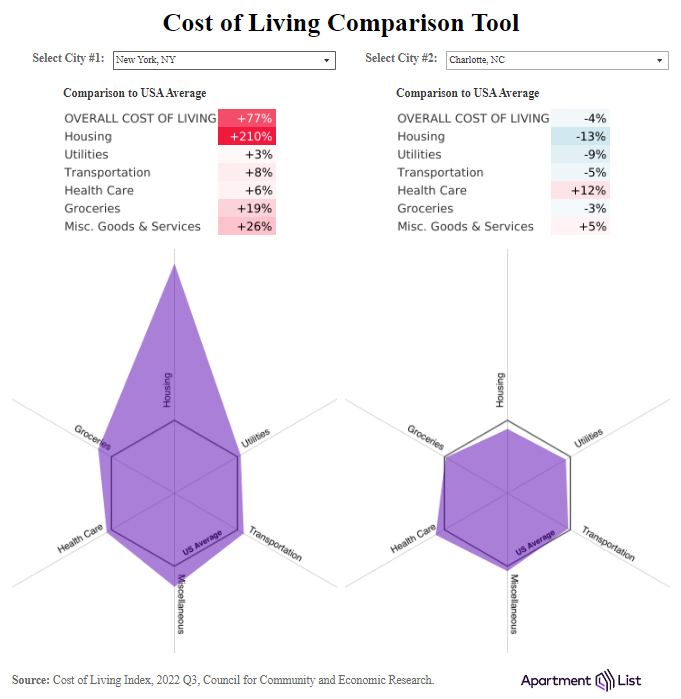
  • The overall cost of living in Charlotte is 4% lower than the national average. This ranks 55th out of the 100 large cities included in the report.
  • Across the county, housing is by far the most impactful expense when it comes to overall cost of living. In Charlotte, housing costs are 13% lower than the national average.
  • As for the other cost of living components: when compared to the national average, groceries in Charlotte are 3% cheaper, transportation costs are 5% cheaper, health care is 12% more expensive, and utilities are 9% cheaper.

Here’s a comparison between New York (where many of transplants are coming from) and Charlotte:

NFL Icon Mike Ditka Opening New ‘Catalina Kitchen’ in Elizabeth Neighborhood

0

Legendary NFL icon Mike Ditka is bringing a new California coastal cuisine restaurant to Charlotte this coming Fall.

Ditka Restaurant Group’s new Catalina Kitchen + Bar will be opening at the new Elizabeth on Seventh mixed-use development in the Elizabeth neighborhood. Other retail tenants include Rosemont Market and Wine Bar, a new concept from the team behind The Crunkleton and the nearby Cheat’s Cheesesteak Parlor.

Office leases at Elizabeth on Seventh have been signed for approximately 34,000 square feet by companies including Lodging Capital Partners, Hord Coplan Macht, and LifeStance Health. In addition, construction of five move-in ready suites totaling 16,000 square feet will offer newly constructed offices to potential tenants. One of the five suites has been pre-leased.

“We are excited by the leasing activity from retail, restaurant, and office users,” said Ned Austin, Vice President of Leasing at Crescent Communities’ Commercial Business Unit. “With state-of-the-art amenities, tenants at Elizabeth on Seventh will be met with a superior, modern office experience that’s unique to the Elizabeth neighborhood. We are eager to meet the market with move-in ready spec suites ranging in size from 2,200 square feet to 4,900 square feet that will deliver in Spring 2023.”

SC’s Comptroller General Resigns After Discovery of $3.5 Billion Accounting Error

0

Richard Eckstrom, SC’s longest serving Comptroller General, has just submitted a letter of resignation after his $3.5 billion accounting error was brought to light. The error started as a $12 million coding mistake in 2007 and was exacerbated when the state switched accounting systems in 2011.

The crux of the error involved state cash transfers to colleges and universities, which were being double-counted. Despite running unopposed in the last two elections and last facing a challenger in the Republican primary in 2010, Eckstrom’s reputation has been significantly marred by the accounting fiasco.

Auditors claim that Eckstrom overlooked numerous warnings about the issue and took five years to initiate a comprehensive review that ultimately brought the problem to light a year ago.

In recent weeks, the discovery of the accounting error has led state senators to advocate for changing the Comptroller General’s office from an elected to an appointed position. Senate members also presented a resolution to remove Eckstrom from office, with House members slashing his annual salary to a symbolic $1. Impeachment was even contemplated as a possible course of action.

As Eckstrom prepares to leave his post on April 30, South Carolina faces a period of reckoning and reform. The implications of the $3.5 billion error will undoubtedly lead to changes in the way the state manages its finances and the structure of the Comptroller General’s office, marking the end of an era and the beginning of a new chapter in South Carolina.

How Much Vacant Land is There in Charlotte Compared to Other US Cities?

0

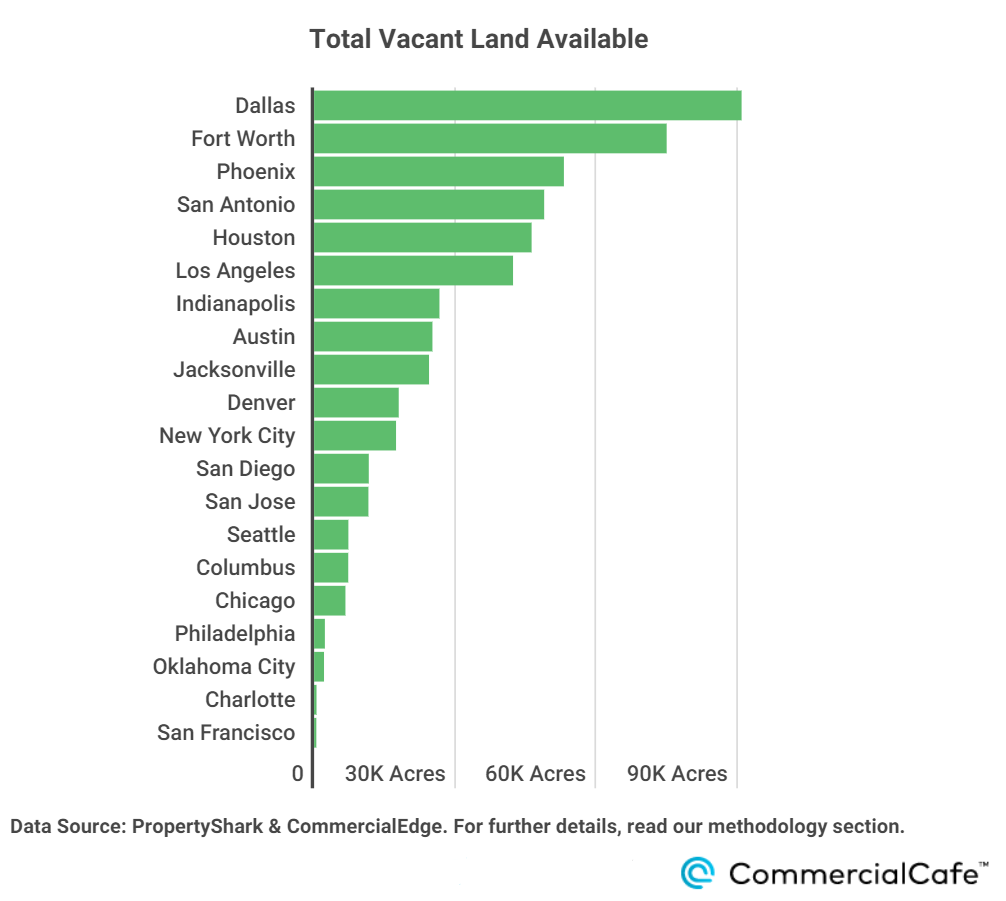
The newest study published by CommercialCafe analyzes how much vacant land is available in 20 of the most populous urban centers in the U.S while also highlighting the construction activity in each area.

For this, our team estimated undeveloped land sizes using the most recent data made available by Property Shark and online government records, and identified local initiatives maximizing land use from CommercialEdge data.

Here are some of the key takeaways:

  • Charlotte had the second-least amount of vacant land among the top 20 most populous U.S. cities: The North Carolina city – ranked 19th – had a total of 512 acres of undeveloped tracts accounting for 84 parcels of undeveloped land.
  • Here, the average parcel size of 6.09 acres, highest among the top 20.
  • In contrast, Dallas leads the list with a whopping 90,739 acres across more than 30,000 parcels.
  • At a regional level, cities across the South and Southwest boast tens of thousands of acres of undeveloped lots each.
  • Among the 20 cities, there are 516,980 acres of land currently still awaiting development – with the average lot size resting at roughly 1.22 acres.

Duke Energy To Help Charlotte Customers Go 100% Renewable

0

Duke Energy has proposed a major expansion to its Green Source Advantage (GSA) program, giving Charlotte customers the option to supplement their power usage with 100% renewable power – and the ability to pair renewable projects with energy storage.
Details for the GSA Choice program were outlined in a filing with the North Carolina Utilities Commission.

“Many of our large business customers seek renewable power sources and are making decarbonization a long-term part of their business plans,” said Lon Huber, Duke Energy’s senior vice president, Pricing and Customers Solutions. “Duke Energy is proud to offer these customers a wide range of options including the ability to increase their hourly use with carbon-free energy in one of the country’s first time-aligned clean-energy programs.”

Duke Energy’s GSA program was launched in 2017, and has been used by customers such as the City of Charlotte, Bank of America, Wells Fargo and Duke University. The changes build and expand on that program.

Up to 4,000 megawatts of capacity will be available under the GSA Choice program, which is more than 10 times the capacity now available. It will provide customers a path towards having 24×7 clean energy. It allows large customers to offset their power purchases by securing renewable energy from projects connected to the Duke Energy grid. The customer may count the renewable energy generated to satisfy their sustainability goals.

Among the changes to the program:

  • Customers can contract for up to 100% of their energy use. Previously, the program’s details only allowed for about 30% of total energy use.
  • Customers can work directly with Duke Energy or independent developers for their long-term purchase of renewable energy.
  • Customers may also combine energy storage with their project – allowing them to align the production of renewable energy with their energy load.
  • Duke Energy is also proposing a new 10-year avoided cost bill credit option in addition to the existing hourly, 2-year and 5-year options.

Clean Energy Impact

Another program being proposed – Clean Energy Impact – is ideal for customers who  want to claim a certain percentage of renewable energy through environmental attribute purchases in support of corporate sustainability goals, or for residential customers that would like to support the local renewable energy industry.

The program with feature locally source renewable energy certificates (RECs); month-to-month contracts with no long-term commitments. Clean Energy Impact will be available to residential customers, who can purchase renewable energy to match their energy use at the level of their choosing. It will be ideal for renters, or customers who aren’t able or looking to install solar.

“We’re continuing to fine-tune our renewable energy options for all customers and are looking at programs such as community solar in the future. That will allow customers to directly subscribe to the output of a solar facility,” added Huber.

To learn more about these programs, business customers can visit here, while residential customers can find more information here.

Why Is the Price of Gas Falling?

0

According to AAA, which analyzes gas prices, the national average price for regular gasoline as of March 9 was $3.467 per gallon. Compared to some of this year’s pricing, it’s a significant bargain. 

The price reduction is most noticeable when comparing the current average to peak pricing; it had decreased by 37% from June 2022, when the average gallon price was $5.006 in the United States, according to statistics from the EIA.

It’s still less expensive when you go further back and contrast current pricing with those from early March of the previous year. According to AAA data, the average price of petrol is currently around 28 cents less expensive than it was a year ago. 

What Causes Price Drops?

Several factors have contributed to the drop in gas prices.

In the commodities market, it’s a well-known adage that high prices are the cure for high prices. And it has come to pass. In other words, low demand reduces price increases as a result of high pricing. Due to high fuel prices, drivers had to look for how to get a personal loan guide by Trice or other sources of extra cash to manage some money to fill up their cars.

Although some driving is necessary—for example, to go to work—with costs at record highs, consumers may opt against going on a road trip or to carpool with friends instead. Government consumption statistics, which indicate a decline in demand, have revealed this to be the case.

Additionally, some states have halted their gas taxes, artificially bringing down costs. However, the drop in oil prices is the primary cause of the downturn. Crude makes up more than 50% of the cost of gasoline, making it the single biggest factor affecting pricing.

After Russia invaded Ukraine in March, the U.S. oil benchmark West Texas Intermediate crude surged beyond $130 per barrel, rocking the world energy markets. WTI traded at that price for the first time since 2008. However, since that time, both oil and gasoline prices have declined.

China’s demand has also been weak as it fights Covid instances there. Additionally, in a bid to restrain rising oil prices, the United States has taken unprecedented action by releasing record volumes of oil from the Strategic Petroleum Reserve.

In the run-up to the 2017 midterm elections, the cost of gasoline has become a significant issue for the White House, and President Joe Biden has frequently stated that his government is doing everything it can to make life easier for customers.

Which Way Are Gas Prices Going?

The majority of analysts do not anticipate a short-term price increase unless an unexpected event occurs, such as a major hurricane that stops oil production in the Gulf of Mexico or floods refineries along the Gulf Coast. Even if hurricane season is still in effect, that has happened previously. To reach 223.6 million bbl, the total domestic gasoline stockpiles increased considerably by 4.5 million bbl.

The countrywide average gasoline price decline that has lasted for the past 58 days may shortly halt. In addition to the storm threat, refineries will need to slow down because they have postponed maintenance work, and that work cannot be postponed indefinitely.

How Much Will Gas Prices Decline?

U.S. gas prices can be greatly impacted by several factors: the global economy, demand for oil and gas, running of refineries and pipelines, the fuel blend federal regulations, taxes imposed on fuel consumption rates, weather conditions as well as geopolitics situations in different countries. The resulting changes are often drastic – take June 2020’s record-high average price of a gallon, just above $5 compared to today, where it is more than $1.80 cheaper!

With petrol prices on the down, Americans may resume their usual driving patterns, which would boost demand. In general, we can see that the statistics reflect a steady downward trend in gasoline prices, which saves drivers a lot of money.

Source: https://gasprices.aaa.com/pump-prices-rise-slightly-but-still-lower-than-a-month-ago/ 

But as the temperatures start to heat up, so will gasoline prices. The special summer blend of gas is designed to reduce emissions during peak months and requires a more costly refining process, which adds approximately 5-10 cents per gallon of fuel. In light of this expected increase in cost at the pump, motorists should anticipate higher prices throughout the summertime.

How Does the Cost of Gas Work?

Long before the gas arrives at your local station, a number of complicated factors that affect pricing are already in play. According to data from the Mercatus Center at George Mason University in Virginia, consumer confidence in the nation’s economic situation tends to decline as petrol prices rise.

What you should know regarding how gas prices operate is as follows:

At the pump, there are four different gasoline kinds that have varying prices. The octane rating, a gauge of fuel stability, divides standard, midgrade, and premium gasoline into three categories (the pressure at which a fuel will combust in an engine).

  • Regular is the most affordable.
  • Super or mid-grade is less expensive than premium and diesel but more expensive than normal.
  • Most costly non-diesel gasoline is classified as premium or super premium.
  • In vehicles with diesel engines, such as freight trucks and buses, diesel, also known as distillate fuel oil, is utilized. It is the priciest fuel available on the retail market.

Low oil Prices

In the meanwhile, as Wednesday’s market closed, WTI went up by 64 cents to finish at $77.69. The surge in crude prices was caused by a combination of factors. 

The rise of manufacturing activity in China last month indicated that global oil demand might be more active than expected this year. The EIA report stated that domestic and commercial crude inventories rose 1.2 million bbl, reaching 480.2 million bbl over the course of last week were two contributing causes for the sudden spike in price values yesterday evening.

Conclusion

Gasoline prices are plummeting so quickly that they are starting to put actual money back in drivers’ pockets, confounding predictions and providing an unexpected holiday present. Right before Russia’s invasion of Ukraine sparked a worldwide energy crisis, gas prices were as low as they are right now.