One of the World’s Biggest Asset Managers Is Opening $116 Million Hub in Charlotte

0

Capital Group, one of the world’s largest active asset managers with $3.4 trillion in assets, is bringing a major East Coast operations hub to Charlotte, a project expected to create 600 jobs, generate more than $116 million in annual payroll, and drive an estimated $5.2 billion in economic impact across North Carolina.


“Charlotte stood out as a natural fit for Capital Group’s next phase of growth,” said Capital Group COO Rob Klausner in a press release. “North Carolina’s strong financial services ecosystem, growing talent base and long-term outlook align closely with our priorities as a firm. This investment strengthens our operating resilience, supports better outcomes for our clients, and reflects our commitment to building careers and community alongside our associates in Charlotte.”

The privately owned company, headquartered in Los Angeles, has more than 90 years of investment management experience. Founded in 1931, Capital Group is known for its early stewardship of one of the country’s first mutual funds, the Investment Company of America.

The Charlotte hub will support the company’s growth across the U.S. and around the world. It also adds another major financial name to Charlotte’s expanding business and banking sector.

The project is being supported in part by a Job Development Investment Grant, or JDIG, approved by the state’s Economic Investment Committee. The agreement allows for potential reimbursements of up to $17.17 million over 12 years, but only if the company meets verified job creation and investment targets.

State officials said the project includes a planned $60 million capital investment. They also said the return on public dollars is projected at 341 percent, meaning the state expects to receive $4.41 in revenue for every dollar of potential cost.

Because the project is landing in Mecklenburg County, a Tier 3 county under North Carolina’s economic system, the agreement will also direct $5.72 million into the state’s Industrial Development Fund – Utility Account. That fund helps rural communities pay for infrastructure upgrades needed to attract future employers.

Why Do So Many People Keep Getting Sick and Injured At Fort Mill’s Silfab Factory?

0

UPDATE 3/30/2026 4:00pm:

Another emergency medical call came in for someone experiencing blood pressure problems at Silfab’s factory. This is another potential health side-effect of the toxic chemicals they use on site.

UPDATE 3/28/2026 8:00am:

Yet another call came in late last night of a 25-year-old woman vomiting blood at Silfab – here was last nights call heard over the emergency scanners:

Sat. 3/28/2026 12:50 AM YC Fire/EMS Emergency Dispatch to Silfab, EMS 214 Abdominal pain. Adult female patient abdominal pain, 25 YO female, located in women’s locker room, meet at the front entrance, vomiting blood, also complaining of lightheadedness and headache.

Original Article 3/26 6:00pm

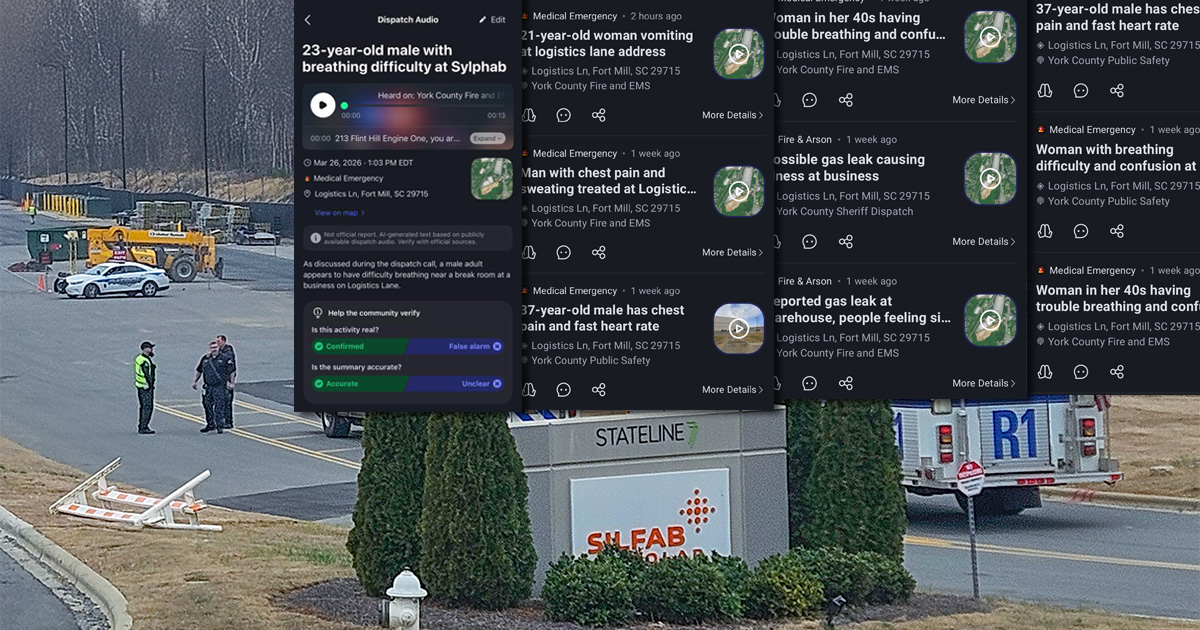
This afternoon York County emergency crews rushed to the Silfab factory after reports of a 23-year-old male was having trouble breathing.

Today’s incident is just one more in an ever-growing list of medical calls, emergency alarms, and leak-related responses at Silfab Solar – adding new pressure to an already volatile fight over the Fort Mill factory’s safety and legality.

The concern is no longer limited to zoning lawyers and nearby residents. In recent weeks, York County reported that 1,530 gallons of potassium hydroxide spilled into a retention pond beside Flint Hill Elementary School, and officials later confirmed a second leak involving hydrofluoric acid that led to a two-day school closure and a state-ordered operational pause.

That backdrop makes the factory’s recent string of emergency calls even more significant. Publicly available dispatch calls show repeated calls for breathing trouble, chest pain, vomiting, seizure activity, and other significant health and safety issues at Silfab’s factory at 7149 Logistics Lane over the past couple months.

There have been no similar emergency calls over the past 2 months at ES Foundry solar cell factory in Greenwood, SC, nor at the Suniva solar cell factory in the Atlanta area (both of which are located in heavy industrial zoned areas).

Recent documented emergency calls at 7149 Logistics Lane include:

  • 3/30/2026, 3:59 p.m. – an emergency call came in for a person at Silfab experiencing blood pressure problems.
  • 3/28/2026, 12:50 a.m. – 25-year-old woman vomiting blood with abdominal pain, lightheadedness, and headache.
  • 3/26/2026, 1:01 p.m. — 23-year-old male trouble breathing call; dispatch said the patient called from inside the building
  • 3/9/2026, 9:51 p.m. — neighbors called after hearing emergency evacuation alarms; no injuries were reported
  • 3/4/2026, 8:03 p.m. — woman reported sickness, breathing trouble, inability to talk or swallow, and vomiting; transported to Pineville
  • 3/1/2026, 6:48 p.m. — 21-year-old woman reported sickness and vomiting for about 30 minutes
  • 2/26/2026, 1:42 p.m. — 45-year-old woman reported severe headache and high blood pressure; taken to Pineville Hospital
  • 2/20/2026, 12:45 a.m. — 37-year-old man reported cardiac symptoms and chest pain
  • 2/19/2026, 10:48 p.m. — 40-year-old woman reported trouble breathing and confusion
  • 2/17/2026, about 3:00 a.m. — gas leak call brought fire, emergency management, and sheriff’s deputies; caller reported people getting sick
  • 2/4/2026, 3:28 a.m. — seizure call
  • 1/12/2026, 8:10 a.m. — 29-year-old man reported chest pain and difficulty breathing

Those calls come from a roughly 900,000-square-foot TOPCon solar cell and panel facility we previously reported on. Technical documents tied to the project show the plant is designed to turn raw silicon wafers into finished solar panels through a multi-stage manufacturing process involving strong acids, explosive gases, chemical wastewater treatment, toxic air emissions, and industrial sludge.

Silfab’s own documents indicate the company planned to store major quantities of hazardous chemicals on site, including:

  • 15,850 gallons of hydrofluoric acid — corrosive; fatal if inhaled, swallowed, or in contact with skin
  • 26,456 pounds of silane — pyrophoric toxic gas that can ignite on contact with air
  • 44,000 pounds of anhydrous ammonia — highly flammable, corrosive, and toxic if inhaled
  • 1,945 pounds of phosphorus oxychloride — a Schedule 3 chemical under the Chemical Weapons Convention
  • 1,540 pounds of boron trichloride — toxic if inhaled; causes burns and eye damage
  • 951 pounds of trimethylaluminum — pyrophoric, toxic, and violently reactive with water
  • 10,560 gallons of hydrochloric acid — corrosive; can cause severe burns and lung damage
  • 9,198 pounds of sulfuric acid — oxidizer; can cause respiratory injury, burns, and blindness

The growing safety concerns have now spilled into schools and state politics. On March 10, the Fort Mill School Board passed a formal resolution asking top state officials and York County Council to permanently limit the site to “non-hazardous assembly processes” and remove all hazardous chemicals from the property “in accordance with the facility’s current light industrial zone.” The board acted after the potassium hydroxide and hydrofluoric acid incidents that occurred within a few hundred feet from Flint Hill Elementary School.

The legality fight remains just as serious. York County’s own Board of Zoning Appeals ruled unanimously on May 9th, 2024 (before any of Silfab’s permits were issued) that solar panel manufacturing “is not listed” in the Light Industrial district and is therefore prohibited under section 155.270(G). Attorney General Alan Wilson recently issued a letter to York County Council Chairwoman Christi Cox asking why permits were issued to Silfab after the BZA ruled their use unlawful.

For Fort Mill, the local impact is becoming harder to ignore. Families next to the plant are now weighing not only the zoning question, but also a mounting record of medical calls, alarms, spills, and emergency responses at a factory that stores some of the most dangerous chemicals used in advanced manufacturing.

Mecklenburg County Igniting a ‘Controlled Burn’ at McDowell Nature Preserve Today

0

The Mecklenburg County Natural Resources staff has just announced they will be setting the McDowell Nature Preserve on fire today at around noon as part of a controlled burn.

The county sent out an alert noting that smoke will be seen around Charlotte today between 12-3 pm:

“Mecklenburg County Natural Resources staff are conducting a controlled burn today beginning around noon at McDowell Nature Preserve. Smoke will affect air quality in the downwind area for 2-3 hours. To reduce your exposure to smoke, stay indoors or avoid areas of heavy smoke.”

For more information on controlled burns click here.

Cornelius Man Admits to $8 Million AI Music Streaming Fraud Scheme

0

A Cornelius man has admitted to running a massive music streaming fraud scheme that used artificial intelligence and automated bots to steal more than $8 million in royalties, federal prosecutors said. Michael Smith, 54, pleaded guilty to conspiracy to commit wire fraud in federal court in New York.

Prosecutors said Smith created hundreds of thousands of AI-generated songs and then used automated programs to stream them billions of times on platforms including Amazon Music, Apple Music, Spotify, and YouTube Music. Instead of driving traffic to a few tracks, officials said he spread the fake plays across a huge catalog to avoid fraud detection systems.

Federal officials said the scheme drained money from the shared royalty pool while legitimate artists competed for small payouts. Investigators said the operation averaged roughly 660,000 fake streams per day and generated about $1.2 million a year.

Authorities said Smith used thousands of bot accounts and fake email accounts to keep the streams running around the clock. Prosecutors also said he attached fake artist names and song titles to make the tracks appear legitimate.

As part of his guilty plea, Smith agreed to forfeit $8,091,843.64. He faces a maximum sentence of five years in prison and is scheduled to be sentenced on July 29, 2026.

The FBI investigated the case, which is being handled by the Southern District of New York’s Complex Frauds and Cybercrime Unit. Federal officials say it is one of the first major criminal cases involving large-scale AI-driven music streaming fraud.

Charlotte Metro Now Ranks As The 7th Fastest-Growing in America New Census Data Shows

0

The Charlotte metro continues to grow at one of the fastest rates in the country, and new Census Bureau data shows the region remains near the top nationally.

The Charlotte-Concord-Gastonia metro ranked seventh in the nation for population growth over a five-year period, according to new Census estimates. The bureau tracks 387 metro areas nationwide.

The momentum is still going. Between 2023 and 2024, the Charlotte metro ranked 11th nationally in numeric growth and added more than 61,000 residents.

The new figures also reflect a wider national trend. Census said metro areas collectively added nearly 3.2 million people between 2023 and 2024, and about 86% of Americans now live in a metro area.

Double Decker Toll Lanes Planned for I-77

Charlotte’s growth also fits the broader Sunbelt pattern. Census said several fast-growing metros in the South and West posted some of the nation’s biggest gains, including Charlotte, Raleigh, Myrtle Beach, and Wilmington.

For Charlotte, the continued growth means more demand for housing, roads, schools, and infrastructure. At the same time, it also means a larger workforce, a stronger economy, and more momentum for one of the fastest-growing major metros in the Carolinas.

Busta Rhymes, DaBaby, and 50 Cent Coming To CLT For The Summer’s Biggest Festival

0

Charlotte rapper DaBaby and 50 Cent will headline a new music festival debuting in Concord this summer, bringing a major hip-hop lineup to the Charlotte area.

The Be More Grateful Music Festival is scheduled for Saturday, June 13, at Route 29 Pavilion near Charlotte Motor Speedway.

In addition to DaBaby and 50 Cent, the lineup includes Boosie, Busta Rhymes, BigXthaPlug, Waka Flocka Flame, Webbie, Big Boogie, Ykniece, Bunna B, Trap Dickey, Fetty P. Franklin, and Mellow Rackz. Organizers say more artists will be announced later.

The festival shares its name with DaBaby’s “Be More Grateful” album. His tour supporting the project ends in Los Angeles on May 14, just ahead of the Concord event.

Organizers say the festival will also feature food trucks, vendors, VIP sections, and live DJs, and could become one of the biggest hip-hop events the Carolinas have seen in a long time.

Ticket sales begin Friday, March 26 and can be purchased here.

CMS Unveils $1.97 Billion Budget With Raises, Facility Upgrades, and Staffing Changes

0

Charlotte-Mecklenburg Schools leaders unveiled a proposed $1.97 billion budget Tuesday for the 2026-27 school year, outlining a plan focused on student performance, staff pay, and rising costs across the district.

CMS said the budget would support about 139,600 students and continue its push to improve academics, especially in early literacy, middle school reading, Math 1, and post-graduation readiness.

About 78 percent of the budget would go toward salaries and benefits. The district is planning a 3 percent pay increase and is also asking for a 5 percent teacher pay supplement, though future raises could depend on state funding. CMS is also requesting nearly $700 million from Mecklenburg County.

To help balance the budget, district leaders identified about $6.6 million in trade-offs, including staffing adjustments. Officials said most affected employees have already been reassigned.

The proposal also includes nearly $33 million for roofing, HVAC, safety upgrades, and other facility work tied to more than 300 projects.

Major budget highlights include:

  • $1.97 billion proposed operating budget
  • Support for about 139,600 students
  • 3 percent pay increase for staff
  • Request for a 5 percent teacher supplement
  • Nearly $700 million requested from Mecklenburg County
  • About $6.6 million in budget trade-offs
  • Nearly $33 million for facility upgrades
  • More than 300 maintenance and safety projects

If approved, CMS’s total recommended budget, including capital and other funds, would exceed $2.1 billion.

The school board will hold a public hearing on April 14 and vote on the proposal on April 28.

Some Charlotte Douglas Flights Will Soon Feature Economy Seating That Converts Into a Bed

0

United Airlines is planning a new way to make long-haul economy flights easier, especially for families traveling with young children.


The airline announced its new United Relax Row, a three-seat economy section that converts into a couch-like sleeping space after takeoff. United says the new option is expected to launch in 2027, with a wider rollout planned across more than 200 Boeing 787 and 777 aircraft by 2030.

At first, the Relax Row looks like a normal row of three economy seats. However, each seat includes an adjustable leg rest that folds up to create a flatter space for stretching out, sleeping, or letting kids lie down during long flights.

“Customers traveling in United Economy on long-haul flights deserve an option for more space and comfort, and this is one way we can deliver that for them,” said Andrew Nocella, United’s Executive Vice President and Chief Commercial Officer in a press release. “United is the only North American airline offering a product like the United Relax Row and is one of the many reasons why we’re continuing to win brand loyal customers.”

Passengers who book the Relax Row will also get extra comfort items, including a custom mattress pad, a specially sized blanket, and two extra pillows. Families with children will also receive a stuffed animal and a Children’s Travel Kit.

United is marketing the new setup to families with small children, couples, and solo travelers willing to reserve all three seats. Each plane will offer up to 12 Relax Row sections, so availability will be limited. The airline has not released pricing yet.

United says it will be the first North American airline to offer this type of seating and has exclusive rights to the design.

The Relax Row is also part of a broader push to attract family travelers. United says it already offers several family-focused perks, including:

  • Free family seating: children under 12 can be seated next to an adult in their party at no extra charge
  • Kids’ meals onboard: parents can pre-order child-friendly meals like french toast, chicken fingers, and grilled cheese
  • Family-friendly inflight entertainment: curated options include titles like Bluey, Paw Patrol, Zootopia 2, and Paddington in Peru
  • Children’s Travel Kit: a Sesame Street-themed kit with activities, a slide puzzle, and a sensory calming strip

United is one of the major network carriers serving Charlotte Douglas, connecting local travelers to its hubs across the U.S.

For Charlotte-area families, the new seating option could eventually offer a much more comfortable way to handle long international flights without paying for premium cabins.

Charlotte’s Run Jen Run 5K and Festival Breaks Record with Over $241,000 Raised

0

More than 1,300 participants took strides for local breast cancer patients at the 14th Annual Run Jen Run 5K and Festival. To date, the event has raised more than $241,000 – the highest total in the event’s 14-year history – to support The Go Jen Go Foundation and the local breast cancer community.

“Our hearts are full after such an incredible fourteenth year of Run Jen Run,” said Susan Evren, executive director of Go Jen Go. “Run Jen Run embodies Jen’s legacy of compassion in action, helping local breast cancer patients navigate the financial challenges of diagnosis, treatment and recovery. We are so grateful for our grantees, fighters, survivors and thrivers, sponsors, donors, participants, ambassadors, volunteers, and race committee.”

The event took place on Saturday, March 21 at Symphony Park in SouthPark, and featured a 5K, fun run, festival with music, and a family fun zone. There was also an expo area with community-driven sponsors and partners, Jen’s Garden of Hope with Signs of Hope on display, and Hope Village for breast cancer fighters, survivors and thrivers to celebrate and connect.

Other event highlights include:

  • 1,313 participants and 83 teams
  • 130 breast cancer survivors, thrivers and fighters
  • 40 Go Jen Go Grantees
  • 74 sponsors and partners
  • 86 volunteers
  • 13 states represented

Returning as title sponsor was Consolidated Planning, and presenting sponsors were Coastal Bridge Advisors, Novant Health, and Smiley’s 4 C’s Charitable Endowment. All proceeds from Run Jen Run support The Go Jen Go Foundation, which provides hope and critical support to families in the greater Charlotte area who are facing the financial burden of a breast cancer diagnosis.

Why Your GSA Contract Isn’t Delivering Results – and How to Fix It Quickly

0

For many businesses, winning a GSA contract feels like a major breakthrough. Working with a GSA expert is often a key step towards building steady government revenue and long term growth. Once the contract is awarded, however, companies may face a different set of challenges.

Instead of a steady flow of orders, companies often face silence. Weeks or even months pass with little to no activity. No incoming requests, no meaningful traction, and no clear explanation of what went wrong.

The core issue is a misunderstanding of what a GSA contract actually provides. It gives you access to the federal marketplace, but it does not create demand, promote your offerings, or position your company in front of buyers automatically.

As a result, many contractors find themselves in the same situation. They have done the hard work to get awarded, yet struggle with low visibility, minimal orders, and stalled growth. This is where experienced teams like Price Reporter often step in to help identify gaps and improve performance.

The good news is that this situation is not unusual. It is a common stage that many businesses go through after contract award. More importantly, it is a fixable problem once you understand what is missing and how the GSA marketplace really works.

What a GSA Contract Actually Does (and Doesn’t Do)

A GSA Schedule (MAS) contract gives your business access to the federal marketplace and allows government buyers to purchase your products or services under pre negotiated terms. This is a powerful opportunity, but it is often misunderstood, especially by companies entering the space for the first time.

Many businesses assume that once they are awarded a contract, government demand will naturally follow. In reality, the contract itself does not create any activity. It simply gives you permission to compete within an established system where many other vendors are already active.

A GSA contract is not a sales engine. It is a platform that enables transactions, not one that drives them. It provides structure, credibility, and access, but it does not replace the need for strategy and ongoing effort.

It does not:

  • Promote your products automatically
  • Generate leads or bring buyers to your listings
  • Ensure your pricing is competitive
  • Position your company ahead of other vendors
  • Guarantee any level of sales or revenue

In addition, it does not help you differentiate your offerings or communicate your value to buyers. That responsibility remains entirely on your side. If your catalog is either unclear or your pricing is not aligned with the market, buyers will move on to other vendors without hesitation.

What it actually does is much simpler. It places your company in a system where federal buyers can search, compare, and purchase from approved vendors. It creates an opportunity, but not a result.

However, that opportunity only turns into revenue if your offerings are visible, clearly presented, and competitively structured. Buyers need to be able to find you, understand what you offer, and see why your solution is the right choice.

In other words, the contract gives you access, but success depends on how well you use it.

The Most Common Reasons Your GSA Contract Isn’t Performing

Many contractors assume that low sales are caused by external factors. In reality, the issue is often internal. Most underperforming GSA contracts share the same set of problems, and they are usually fixable with the right approach.

Below is a breakdown of the most common reasons and how they impact your results:

Issue What’s Happening Impact on Your Sales
Catalog is not optimized Listings are incomplete, outdated, or poorly structured Buyers cannot find your products or do not trust the information
Pricing is not competitive Prices are too high or not aligned with the market You lose to competitors during buyer comparison
Lack of visibility No active effort beyond listing on GSA Advantage Low traffic and minimal buyer engagement
Poor contract management Missed updates, outdated terms, compliance gaps Reduced competitiveness and potential risk issues
No automation or efficiency Manual processes for orders and updates Slower operations, higher error rates, missed opportunities

If your listings on GSA Advantage are incomplete, outdated, or poorly structured, buyers simply will not find you. Even if they do, unclear descriptions or missing details reduce trust and make it easier for them to choose another vendor.

Government buyers actively compare vendors. If your pricing is too high or not strategically aligned with the market, you will consistently lose opportunities even if your offering is strong.

Another common issue is low visibility. Many contractors rely only on being listed on GSA Advantage, without taking additional steps to improve discoverability or engage with buyers. This results in very limited traffic and minimal activity.

Contract management also plays a critical role. Missed updates, outdated terms, or compliance gaps can weaken your position over time and reduce your ability to compete effectively.

Finally, lack of automation slows everything down. Manual handling of orders, catalog updates, and reporting increases the risk of errors and limits your ability to scale within the federal marketplace.

How to Fix It Quickly: Practical Steps That Work

If your GSA contract is not delivering results, the solution is not to wait for activity to increase on its own. You need a structured approach focused on optimization, visibility, and efficiency.

Here are practical steps that can quickly improve your performance:

Step 1: Audit Your GSA Catalog

Start with a full review of your catalog. Check product descriptions, keywords, pricing, and overall structure. Make sure all information is accurate, up to date, and easy for buyers to understand. A well organized and optimized catalog improves both visibility and conversion.

Step 2: Reevaluate Your Pricing Strategy

Your pricing should reflect current market conditions and align with your Most Favored Customer logic. Review competitor pricing and adjust where necessary. Even small improvements in pricing strategy can significantly increase your chances of winning bids.

Step 3: Improve Your Visibility

Do not rely only on being listed. Take active steps to increase your presence in the marketplace:

  • Optimize your listings for search
  • Use GSA eBuy to find opportunities
  • Track demand trends and adjust your offering accordingly

Step 4: Strengthen Contract Management

Make sure your contract is actively maintained. Keep your catalog updated, process modifications on time, and ensure full compliance. Strong contract management helps you stay competitive and avoids unnecessary risks.

Step 5: Implement Automation Tools

Manual processes slow down your business and create room for mistakes. Automating order processing, catalog updates, and reporting improves accuracy, saves time, and allows your business to scale more efficiently.

These steps do not require a complete overhaul of your business. In most cases, targeted improvements in these areas can quickly turn an underperforming contract into a productive sales channel.

Why Many Companies Struggle to Fix These Issues on Their Own

Improving GSA performance is not just about making a few adjustments. It requires ongoing attention, specific expertise, and consistent effort. For many businesses, this becomes difficult to manage alongside daily operations, especially when federal contracting is not their core focus.

Many companies underestimate how much work is required after the contract is awarded. They expect the system to generate results on its own, but quickly realize that without active management, nothing changes. Over time, this leads to frustration and declining expectations from the program.

Common challenges include:

  • Limited understanding of how GSA systems actually work
  • Lack of internal resources to manage and optimize the contract
  • Missed opportunities to improve catalog structure, pricing, and visibility

In addition to these challenges, there is often a lack of clear strategy. Businesses may not track performance metrics, analyze buyer behavior, or adjust their approach based on market demand. Without this level of insight, it is difficult to identify what is holding the contract back.

GSA is not a set it and forget it process. It is an active sales channel that requires regular updates, ongoing analysis, and informed decision making. Even small delays in updates or missed improvements can gradually reduce your competitiveness.

Another common issue is time. Internal teams are usually focused on operations, sales, and customer service. GSA management becomes a secondary task, which means it does not receive the attention it needs to perform well.

As a result, many companies find themselves stuck in the same position. They have access to the federal marketplace, but they are not fully using its potential, and their contract remains underutilized despite the opportunities available.

How Expert Support Can Turn Your GSA Contract Into Revenue

Working with experienced GSA consultants can significantly change how your contract performs. Instead of trying to manage everything internally, businesses gain access to proven processes, tools, and expertise that directly impact results.

Many contractors spend months trying to figure out what is not working, often making small changes without seeing real improvement. Expert support removes this uncertainty by identifying the exact issues and applying solutions that are already tested in the federal marketplace.

With the right support, you can:

  • Optimize your catalog and pricing to improve competitiveness
  • Maintain compliance and keep your contract up to date
  • Automate routine operations and reduce manual workload
  • Increase visibility and attract more government buyers

In addition, experienced consultants can help you better understand buyer behavior, market demand, and how your competitors are positioned. This insight allows you to make smarter decisions and adjust your strategy more effectively.

Professional support helps eliminate guesswork. It allows you to focus on your core business while specialists handle the technical and strategic aspects of GSA. Instead of reacting to problems, you can take a more proactive and structured approach to growth.

Over time, this leads to more consistent performance, improved efficiency, and better use of your contract. What once felt like a static listing becomes an active and scalable sales channel.

This type of support helps contractors move from simply having a contract to actually generating consistent and predictable revenue from it.

Final Thought: A GSA Contract Is a Tool, Not a Strategy

Winning a GSA contract is only the first step. Real success comes from how well you manage, optimize, and actively develop your presence in the federal marketplace. If your contract is not delivering results today, it does not mean it failed. It simply means it has not been fully leveraged yet, and there is still untapped potential.

Companies like Price Reporter, founded in 2006, have helped over 1,000 contractors turn underperforming contracts into consistent revenue streams. With deep experience in contract management, compliance, automation, and market intelligence, their team supports businesses in navigating the complexities of the GSA marketplace and building long term growth.