$1.5 Billion Octapharma Deal Saved — But Rock Hill Calls It an Embarrassment

0

Rock Hill officials slammed York County leaders yesterday. They called recent decisions an embarrassment to South Carolina. Those moves nearly killed a massive $1.5 billion project.

City leaders expressed fresh doubts. They questioned future cooperation between the city and county. Yet both sides finally aligned on key terms.

Rock Hill approved a tax incentive deal Thursday morning for Octapharma. The Swiss biomedical giant plans to create 1,500 high-paying jobs. The site sits at Palmetto Research Park, the former Carolina Panthers headquarters off Interstate 77 at Exit 81.

The York County Council approved identical terms Monday.

County Salvages Deal With Last-Minute Amendment

York County Council acted swiftly to save the project. Members voted 7-0 during a special meeting. They approved an amended revenue-sharing agreement for Project Palmetto Rock.

The 40-year deal routes all project revenues into one fund first. Officials then distribute shares among three partners. The Rock Hill School District receives just under 67 percent. The City of Rock Hill gets just over 19 percent. York County claims just under 14 percent.

This vote followed chaos on July 8. Chairwoman Christi Cox suddenly called an unscheduled session. She moved the final reading of the Octapharma FILOT deal. Officials had planned that reading for July 13.

During the tense meeting, an amendment passed 4-3. It shifted most of the city’s tax revenue share to the school district. Rock Hill had already rejected such changes in a prior resolution.

Councilman Tom Audette offered a compromise. It would have given schools even more money while keeping a fair split. Leaders rejected that option too.

Pattern of Controversy Raises Concerns

For several elected officials, Thursday marked their first public comments. They did not hold back.

Their comments echo a clear and very troubling pattern under Cox’s leadership. She strongly backed the failed Panthers headquarters project early on. Yet her public finger-pointing reportedly accelerated its collapse in 2022.

The Silfab Solar controversy stands out as another flashpoint. Despite a 5-0 zoning board ruling against the plant in May 2024, a clear violation of the zoning code, and continuous public outcry, Christi Cox and Josh Edwards forced approves for the project anyway. Internal records show permits were back-dated, and a Certificate of Occupancy was issued without zoning compliance.  The factory sits near Flint Hill Elementary School. It handles hazardous chemicals like hydrofluoric acid and explosive silane. Reports detail multiple chemical spills and worker emergencies.

High Stakes for Jobs and Revenue

If the Octapharma deal did fall through, York County would have faced steep losses. It would forfeit $1.5 billion in investment. More than 1,200 high-paying jobs would vanish. Decades of tax revenue for schools, roads, and services would disappear.

Instead of smooth collaboration, the rushed amendment appeared to corner the city. Rock Hill officials voiced deep frustration.

The the Octapharma deal may now be saved, the damage to York County’s reputation with major employers may linger for years to come.

Pentagon Confirms Another North Carolina Soldier Killed in Growing US-Iran War

0

The Pentagon has identified another North Carolina soldier killed in the growing U.S.-Iran war, as 30-year-old Sgt. Michael Emmanuel Swinton of Fayetteville died while attempting to disarm an Iranian drone in Iraq.

The Pentagon said Swinton was killed Sunday during a controlled detonation at an air base in Irbil, in northern Iraq. Swinton was a husband and father of two children. He enlisted in the U.S. Army in 2017 and served with the 55th Air Defense Artillery Regiment, 108th Air Defense Artillery Brigade based at Fort Bragg, North Carolina.

“Sgt. Swinton was an experienced noncommissioned officer who took great pride in his work and the people around him,” said Brig. Gen. John L. Dawber in a press release. “He answered the call to duty with courage, honor, and selfless dedication.”

The Army announced Swinton will be posthumously awarded the Bronze Star Medal, Purple Heart and Combat Action Badge. He will also be promoted to the rank of staff sergeant.

His death comes as the conflict between the United States and Iran continues to claim American lives overseas.

Last week, two other U.S. Army soldiers were killed in Jordan while defending against Iranian ballistic missile and drone attacks.

Those troops were the first Americans killed by direct Iranian fire since the opening days of the war.

$1.3 Billion Stadium Makeover Grows as David Tepper Invests Another $500 Million

0
via Panthers

Bank of America Stadium is about to undergo its biggest transformation since it opened, as newly released renderings reveal the first detailed look at a $1.3 billion renovation designed to reshape the fan experience and help attract some of the world’s biggest sporting events to Charlotte

Tepper Sports & Entertainment unveiled the new images Thursday while also announcing that Panthers owner David Tepper is investing an additional $500 million into the project, including the $650 million in tax payer funds going toward the project. The investment is aimed at improving the overall fan experience and strengthening Charlotte’s bids for future events, including the Super Bowl, NFL Draft, the 2031 FIFA Women’s World Cup, and other major sporting events.

“The long-term extension with Bank of America reflects the strength of our partnership and our shared commitment to the Carolinas,” said David Tepper in a press release. “For over three decades, Bank of America Stadium has helped create lasting memories for our fans and we’re excited for them to see what’s ahead. Our goal is to create experiences that enhance the passion and energy of the region while transforming this corridor into a weekend destination for world-class sports, entertainment and community events.”

The renderings showcase major upgrades planned for the longtime home of the Carolina Panthers and Charlotte FC, including larger end-zone scoreboards, upgraded seating, expanded food and beverage options, more restrooms and new premium hospitality experiences.

via Panthers

The designs also feature expanded indoor-outdoor gathering spaces, including a new 500-level social patio with panoramic views of Uptown Charlotte. Fans can also expect upgraded technology, larger video displays and a more personalized game-day experience.

Outside, the stadium will receive modern exterior finishes and a new illuminated crown designed to become a signature feature of the Charlotte skyline. Designers say the renovations will draw inspiration from the people, places and landscapes of the Carolinas.

The project also includes flexible event spaces and a planned 4,400-seat entertainment venue expected to host 80 to 100 events each year, while providing enhanced hospitality on Panthers game days.

via Panthers

On the same day, Tepper Sports & Entertainment also announced it had reached a long-term extension of the stadium’s naming rights agreement with Bank of America.

City leaders believe the renovation will boost Charlotte’s economy by attracting more concerts, sporting events and major entertainment. Construction remains on schedule and will be completed in phases, allowing Panthers and Charlotte FC games to continue throughout the project. Interior work is underway in 2026, with the first major fan-facing improvements expected in 2027.

North Carolina Rent Growth Slows as Two-Thirds of Cities See Flat or Falling Prices

0

A new report has just been released showing a surprising trend in North Carolina’s single-family rental market.

According to Rentometer’s latest analysis North Carolina’s rental market continues to cool, with 66% of cities tracked by Rentometer recording either flat or declining rents over the past year. The statewide median asking rent for a three-bedroom single-family home now stands at $1,915, as increased housing supply continues to moderate rent growth.

Some highlights from the state’s largest markets:

  • Charlotte: $2,035 (+1.8%) – modest rent growth, though well below the rapid increases seen during the pandemic years.
  • Raleigh: $1,995 (+0.3%) – essentially flat over the past year.
  • Durham: $2,078 (+0.4%) – another Triangle market showing little change.
  • Greensboro: $1,805 (+1.4%)
  • Winston-Salem: $1,770 (+0.5%) – both Piedmont Triad markets remain broadly stable.
  • Wilmington: $2,199 (-0.1%) – effectively unchanged from a year ago.
  • Asheville: $2,200 (-8.1%) – one of the state’s largest year-over-year declines.

The full report is available here:

https://www.rentometer.com/2026-mid-year-single-family-rental-market-report

North Carolina Just Approved Installing AI-Powered Flock Cameras on Every Highway in The State

0

North Carolina has just approved one of the state’s biggest expansions of government surveillance in history, allowing A.I. controlled Flock cameras to be installed along every highway in our state.

The change was included in the newly approved state budget, making permanent what had previously been a limited pilot program.

The new A.I. Flock cameras automatically record the license plate, make, model and color of every passing vehicle and feed the data to a centralized database. Using artificial intelligence, they compare that information with suspicious behavior, suspected stolen vehicles, wanted suspects, missing people and other investigative leads.

Supporters say the technology has already helped solve major crimes. Earlier this year, ALPR data helped authorities arrest a former Chapel Hill police officer in Florida who was accused of planning a mass shooting at a New Orleans festival.

State highways had long remained off-limits after bipartisan lawmakers raised concerns about privacy and government surveillance. However, a 2023 pilot program involving 32 law enforcement agencies paved the way for the permanent expansion.

Participating agencies must adopt written policies governing camera use and report how many license plates are captured and how often data is kept beyond 90 days.

Critics warn the system could be misused to track romantic partners, family members or political protesters. Others question how long the data is stored and shared between agencies.

Those concerns intensified after the Georgia Bureau of Investigation just charged five former Albany police officers with allegedly accessing Flock Safety license plate data for non-law enforcement purposes. The officers were fired before the charges were filed.

Just weeks ago, two Flock Safety camera poles were intentionally cut down in Pageland, South Carolina, prompting a criminal investigation and highlighting growing public frustration over expanding surveillance technology.

Now, with North Carolina authorizing the cameras along state highways, supporters say the system will help solve crimes and recover stolen vehicles. Critics argue it also creates a searchable record of where millions of law-abiding drivers travel, ensuring the fight over privacy, government oversight and public safety is only beginning.

American Eagle Investing $41 Million in Massive New Charlotte-Area Distribution Hub

0

Popular clothing retailer American Eagle Outfitters is bringing a major investment to the Charlotte region, announcing plans to spend $41 million on a new distribution hub that will create more than 200 jobs in Rowan County.

North Carolina Gov. Josh Stein said the new facility will open in Salisbury and serve the entire southeastern United States.

The Salisbury hub will create more than 200 new jobs, including about 70 skilled positions in management, maintenance and operations. Those jobs will pay an average annual salary of $57,351, slightly above Rowan County’s average wage.

Overall, the expansion is expected to generate more than $4 million in annual payroll for the local economy.

To help secure the investment, AE Regional Distribution Co., LLC was approved for a performance-based $150,000 grant from the One North Carolina Fund. The company must create at least 70 jobs and meet its investment commitments before receiving any grant funding.

The lease was arranged by Cushman & Wakefield after a multi-year search for a new Southeastern distribution hub spanning markets across three states. Brokers Patrick Decker, Ben Brenner, Mark Zaziski and Patrick McGrath represented American Eagle Outfitters, while Fermin Deoca and Matt Treble represented the property’s developer, Crow Holdings Development.

Founded in 1977, American Eagle Outfitters owns several well-known brands, including American Eagle, Aerie, OFFL/NE by Aerie, Todd Snyder and Unsubscribed. The company operates stores across the United States, Canada and Mexico, while also serving customers in more than 30 countries.

Charlotte Premium Outlets Hosting Free Sip, Shop & Stroll Event with Mocktails and Giveaways

0

Charlotte shoppers will soon have a chance to score exclusive deals, free mocktails and prize giveaways during a one-day interactive shopping event at Charlotte Premium Outlets.

The outlet mall’s Sip, Shop & Stroll event will take place Saturday, July 25, from 2 p.m. to 6 p.m. and is free to attend.

The event begins at the Welcome Tent, where guests will receive a complimentary mocktail and a Sip, Shop & Stroll passport.

From there, shoppers can visit participating stores throughout the center to collect passport stamps while enjoying exclusive promotions, giveaways and special in-store experiences.

Featured retailers include American Eagle, Huk, Tommy Hilfiger, Vera Bradley, Brooks Brothers, Michael Kors and several others.

Guests who complete their passports will be entered for a chance to win one of three themed prize packages.

The giveaways include The Ultimate Wine Night, Self-Care & Sip, and Best Beach Day, featuring gift cards, home goods, self-care items and other prizes.

The free event offers shoppers a chance to explore the outlet center while discovering special promotions and interactive experiences at participating stores.

Charlotte Premium Outlets is located at 5404 New Fashion Way in southwest Charlotte. The Sip, Shop & Stroll event runs from 2 p.m. until 6 p.m. on Saturday, July 25.

In Landmark Ruling York County Judge Upholds BZA and Rules Silfab’s Fort Mill Operations Unlawful

0

A York County Circuit Court judge has just delivered a devastating blow against Silfab Solar’s chemical factory currently under construction in Fort Mill.

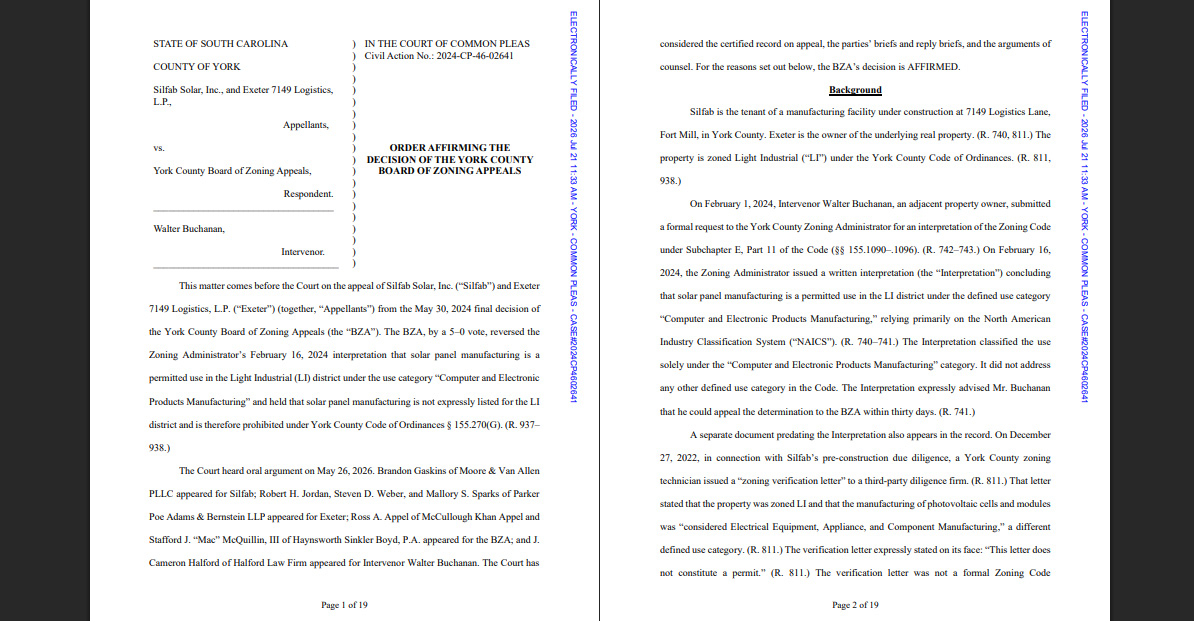
In today’s landmark ruling, York County Circuit Judge William A. McKinnon affirmed the York County Board of Zoning Appeals’ ruling “in all respects,” finding that Silfab’s solar panel manufacturing operation is indeed prohibited in its current location.

The ruling means the BZA’s 2024 decision now stands with judicial backing: solar panel manufacturing is expressly prohibited under York County Code §155.270(G).

For residents near Flint Hill Elementary and Flint Hill Middle School, the ruling raises an immediate question:

Why is York County still allowing Silfab to move forward?

The court did not merely issue a technical ruling. Judge McKinnon directly rejected Silfab’s attempt to overturn the BZA’s decision. He found the BZA acted within its authority, had evidence supporting its decision, and made no legal error in concluding that solar panel manufacturing is prohibited under the zoning category Silfab relied on.

The ruling also undercuts several public arguments York County has used for months to defend its handling of the project.

York County’s public Silfab page, updated June 25, says the county was waiting for the court to determine whether the BZA ruling applied to Silfab. The page also says the county would “enforce whatever the courts determine.”

Now the court has determined it.

The BZA was right.

Silfab and York County officials were wrong.

All permits issued to Silfab are now legally void and must be revoked, along with Silfab’s certificate of occupancy.

The county’s page also argues that the 2024 BZA ruling should apply only to future permits, not existing projects, uses or approvals. But the circuit court’s order repeatedly ties the case to the actual Silfab facility at 7149 Logistics Lane. The court noted Silfab is the tenant of the manufacturing facility under construction, Exeter owns the property, and the site is zoned Light Industrial.

On pages 9-10, the Judge William A. McKinnon’s ruling specifically states:

“…Third, the record affirmatively supports the BZA’s finding that the manufacturing process at issue is qualitatively distinct from the listed Computer and Electronic Products Manufacturing examples and is more consistent with heavy industrial activity than light. The Code defines Light Industrial as activity that “ordinarily do[es] not create noise, smoke, fumes, odors, glare, or health or safety hazards outside of the building or lot” and expressly excludes “hazardous material treatment and storage facilities, plating or enameling, or petroleum and gas refining.” § 155.1301. The record contains an excerpt of Silfab’s Construction Air Permit Application disclosing the use of hydrofluoric acid, hydrochloric acid, potassium hydroxide, and silane (R. 750–758, 763), the projected emission of hydrogen fluoride at substantial percentages of rural and urban thresholds (R. 755), and the contemporaneously increased stack height of the acid-scrubber stack from 19.7 feet to 70 feet (R. 755). CDC information in the record describes hydrogen fluoride as a substance that “can irritate the eyes, nose, and respiratory tract” and that “can cause death from an irregular heartbeat or from fluid buildup in the lungs.” (R. 765.) The Code’s own point of contrast was also before the Board. Section 155.1301 defines heavy industrial use as manufacturing “by means that ordinarily have greater than average impacts on the use and enjoyment of adjacent property in terms of noise, fumes, odors, glare, health, and safety hazards.” And the purpose provision of the LI district states that the district’s “less intensive uses protect nearby residential areas from the encroachment of heavy industrial uses.” § 155.041(A)(2). The Board heard testimony walking through these provisions (R. 883, 888, 890), including testimony that hydrogen fluoride is a “category three air pollutant” under the applicable DHEC classification, a category defined by pollutants “which can cause chronic effects resulting in death or permanent injury after very short exposure to small amounts” (R. 880–881), and that silane, stored on site in compressed form, can “ignite spontaneously in air” (R. 881). The BZA’s on-the-record deliberation reflected substantive engagement with these record-based hazards. Board Member Bud Smith identified as the “biggest problem” with the Interpretation “the fact that there there’s differences between the hazards from the experts” and that “[n]one of . . . the things that these people pointed out were listed as a hazard in . . . our documentation.” (R. 930.) BZA Chairman Blair observed on the record: “when you have a production facility … that has a rather lengthy pollution scrubber … I begin to question whether or not it’s truly a light industrial use.” (R. 932.) Board Member Rob Cameron, an engineer by background, acknowledged during deliberation that “solar hasn’t been here in South Carolina” and that the Code contains no “specificness” and no “slot for solar.” (R. 931.) Board Member Lauren Hebert then concurred that the NAICS-only analysis and “the lack of clarity there” did not give the Board “enough purview to be able to uphold” the Interpretation. (R. 932.) These deliberations, recorded on the transcript and reflected in the Board’s 5–0 vote at a properly convened session, are findings of the Board as a body on which this Court may rely under Vulcan Materials and Boehm. Each of these record materials provides evidence in support of the BZA’s conclusion that the actual activity at issue does not fit the Code’s defined Light Industrial category. See DT LLC v. Horry Cnty. Zoning Bd. of Appeals (In re Venture Eng’g), 433 S.C. 419, 433, 858 S.E.2d 638, 646 (Ct. App. 2021) (“Although the Board’s written order failed to set forth any reasoning, the hearing transcript and the Board’s minutes indicate the Board’s decision was supported by the testimony of residents in the surrounding community expressing concerns about particulates, noise, and traffic.”)….”

The court also addressed the 2022 zoning verification letter York County and Silfab have repeatedly pointed to as a shield.

That letter said Silfab’s use was considered “Electrical Equipment, Appliance, and Component Manufacturing.” But the judge made clear the letter was not a permit. The ruling states that the letter said on its face: “This letter does not constitute a permit.” The court also found it was not a formal zoning interpretation and was not the decision being appealed.

The ruling also rejects another key Silfab argument involving County Council’s FILOT tax-incentive agreement.

Silfab argued, in part, that York County Council’s FILOT ordinance ratified earlier actions related to the project. Judge McKinnon rejected that argument. He wrote that a FILOT agreement is a tax-incentive instrument, not a zoning amendment. He also warned that accepting Silfab’s theory would allow County Council to amend zoning by side agreement, violating South Carolina zoning procedures and the bar on contract zoning.

In plain English: a tax-break deal does not rewrite zoning law.

That finding lands directly on one of the biggest public concerns surrounding Silfab. Residents have argued for months that York County treated an economic development project as if it could bypass normal land-use safeguards. The court’s order now gives that argument legal force.

How did we get here? 

Evidence now shows that Council Chairwoman Christi Cox and County Manager Josh Edwards’ staff not only fast-tracked the project — they back-dated permits, issued a Certificate of Occupancy without zoning compliance on February 13, 2026, and deliberately ignored their own laws to make it all happen.

In February 2024 a neighboring property owner asked the county to interpret whether Silfab’s operations were allowed at 7149 Logistics Lane. Zoning Administrator Rachel Grothe responded on February 16 that it was permitted under the vague “Computer and Electronic Product Manufacturing” use. The neighbor then appealed.

On April 18th, York County Economic Development Director David Swenson confirmed to Silfab’s Director of Operations, Greg Basden, that the upcoming BZA hearing was about Silfab’s operations.
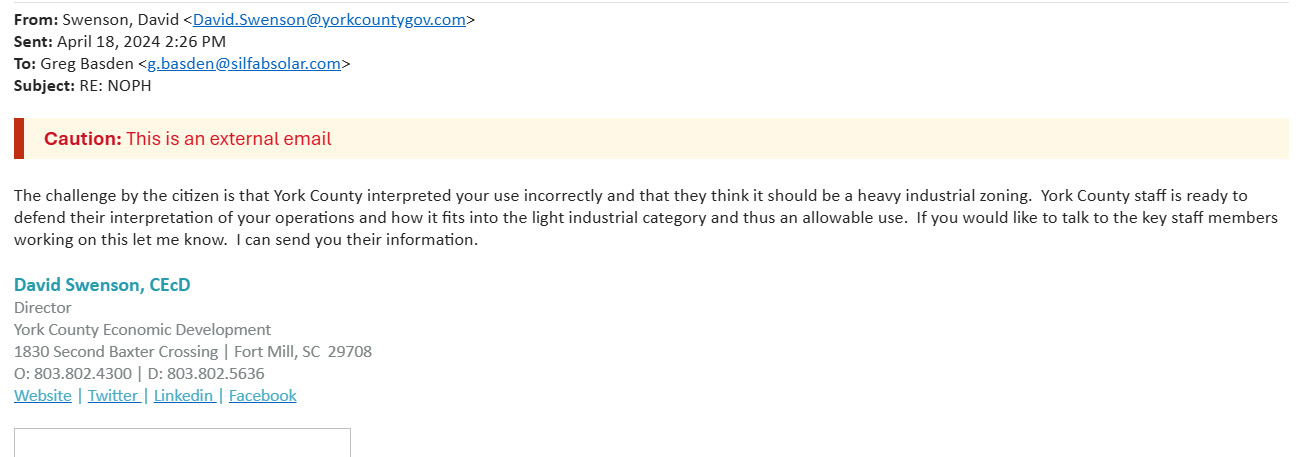
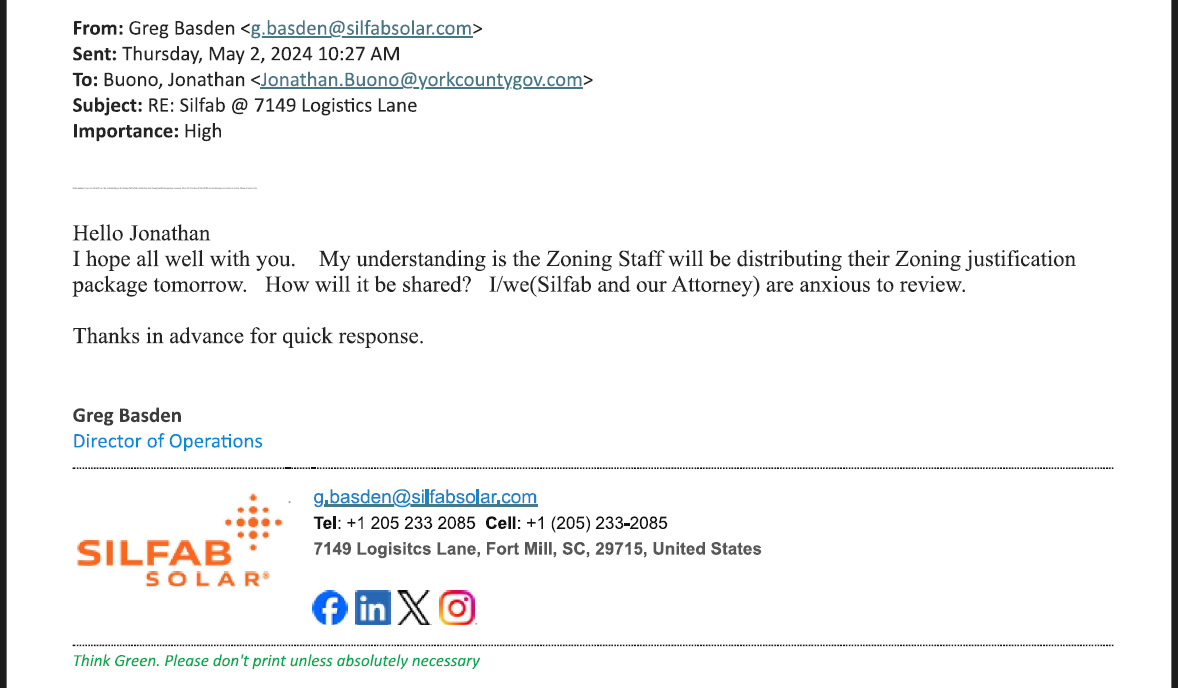
On May 2, 2024, Greg emailed county staff asking to review the county’s justification package.
On May 9th, 2024, the Board of Zoning Appeals ruled 5-0 that Silfab’s operations were not allowed in a light industrial zone.

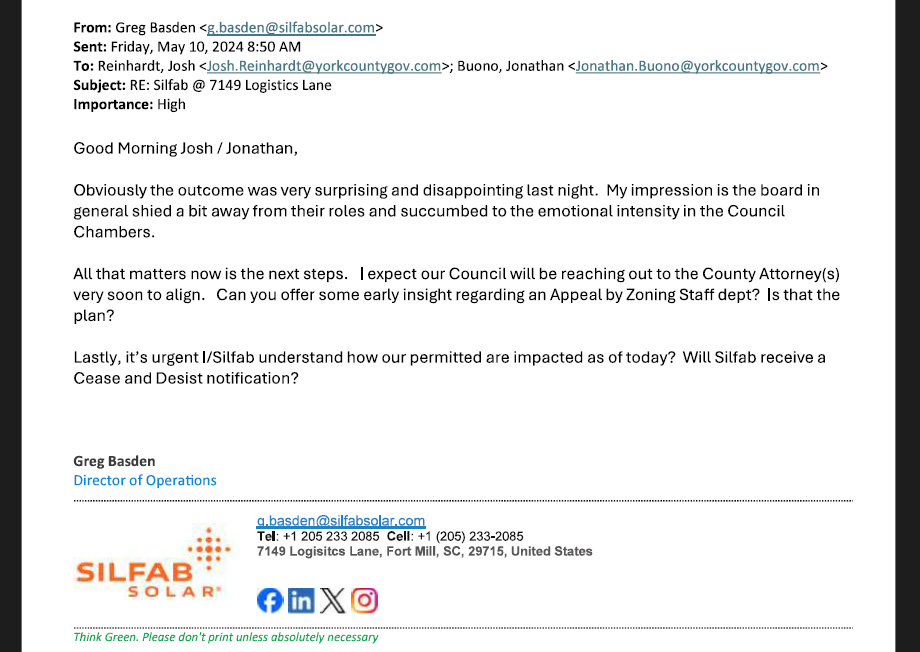
On May 10, 2024, Silfab’s Greg Basden emailed county officials asking point-blank if Silfab would be receiving a cease and desist:
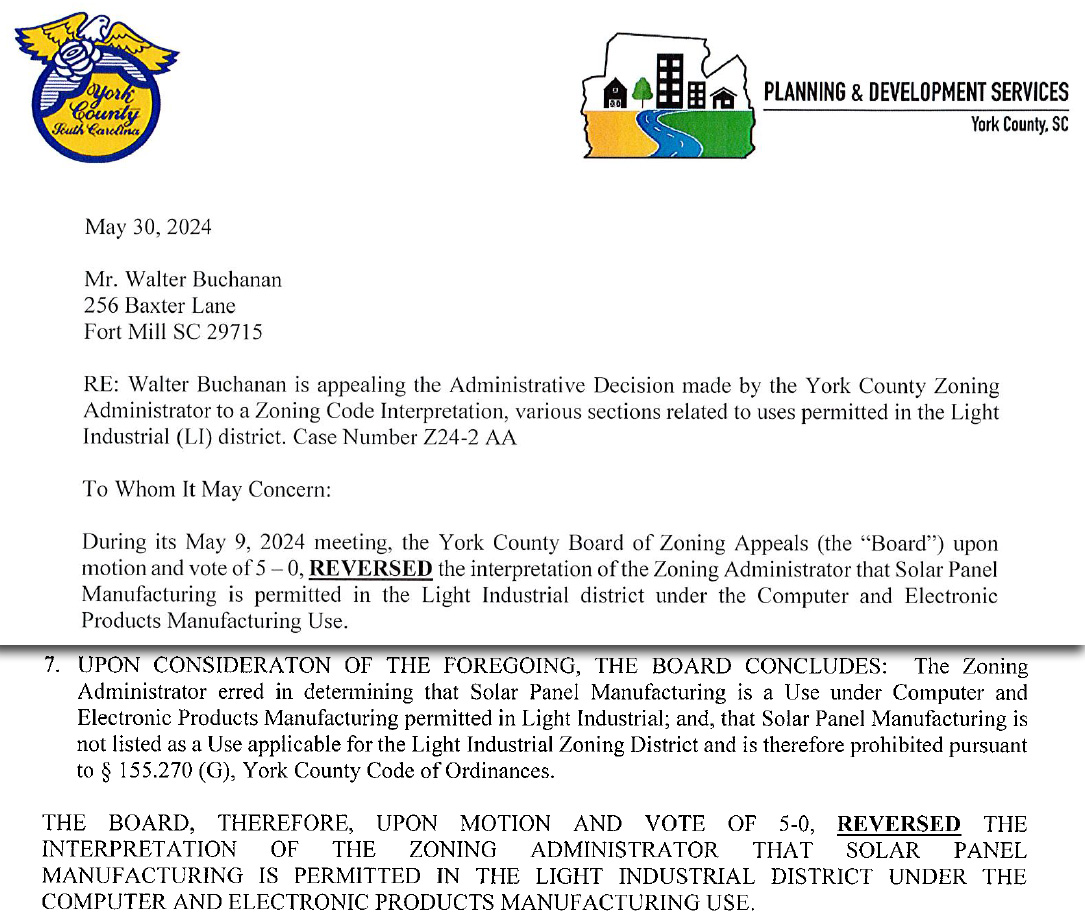
On May 30 the BZA issued its written decision:
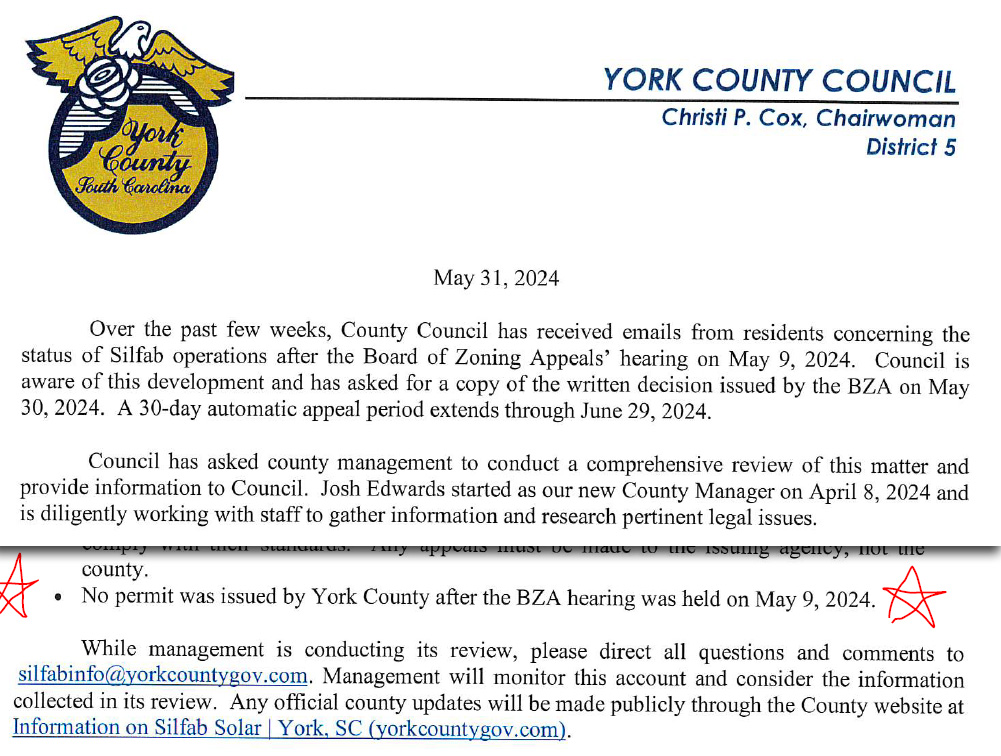
The very next day, May 31, 2024, Christi Cox signed a public letter telling residents that “No permit was issued by York County after the BZA hearing was held on May 9, 2024,” and that, Josh Edwards, who had started as County Manager on April 8, 2024, was “diligently working with staff to gather information and research pertinent legal issues.”
Silfab COO Treff MacDonald then asked for a meeting with Christi Cox a few days later on June 6th, saying “it is paramount that we have a few minutes of face-to-face discussions on this matter, it is also imperative that we meet sooner than later, as time is of the essence for both parties.”
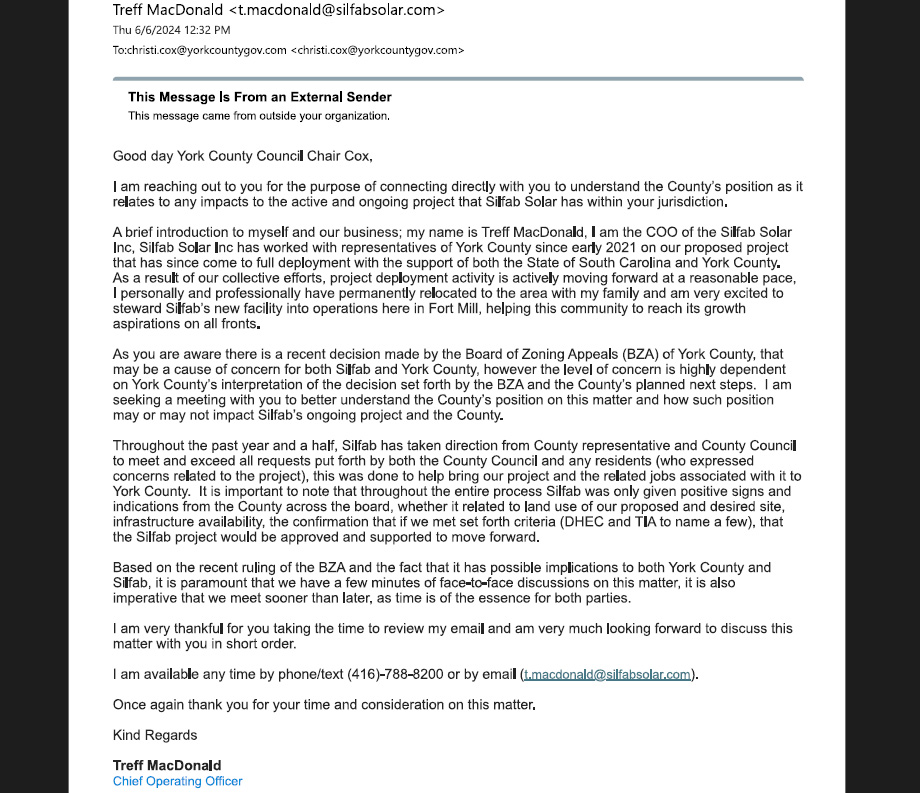
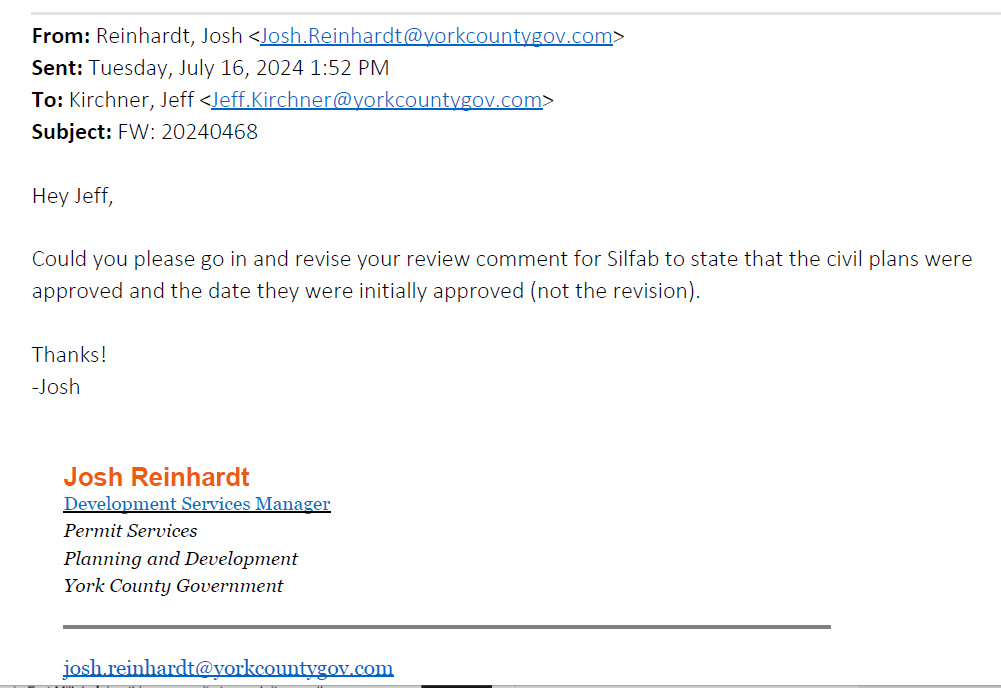
Internal emails also show that Cox and Edwards’ staff (including Reinhardt and Kirchner) discussing changes to approval dates. Silfab’s parking-lot civil plans were stamped April 24, 2024 — before the BZA hearing. The up-fit approval was dated July 16, 2024 — after the BZA reversal. The final “zoning compliance” stamp was back-dated to April 24 to pretend a valid approval existed before the BZA ruling and before citizens’ appeal window closed.
Roughly 1 month later, in August of 2024, Silfab began receiving all of their permits for the up fit of their main distribution building into a manufacturing factory, as well as the permits for the new construction of their chemical storage buildings and bunkers, wastewater treatment plant, and central energy plant.
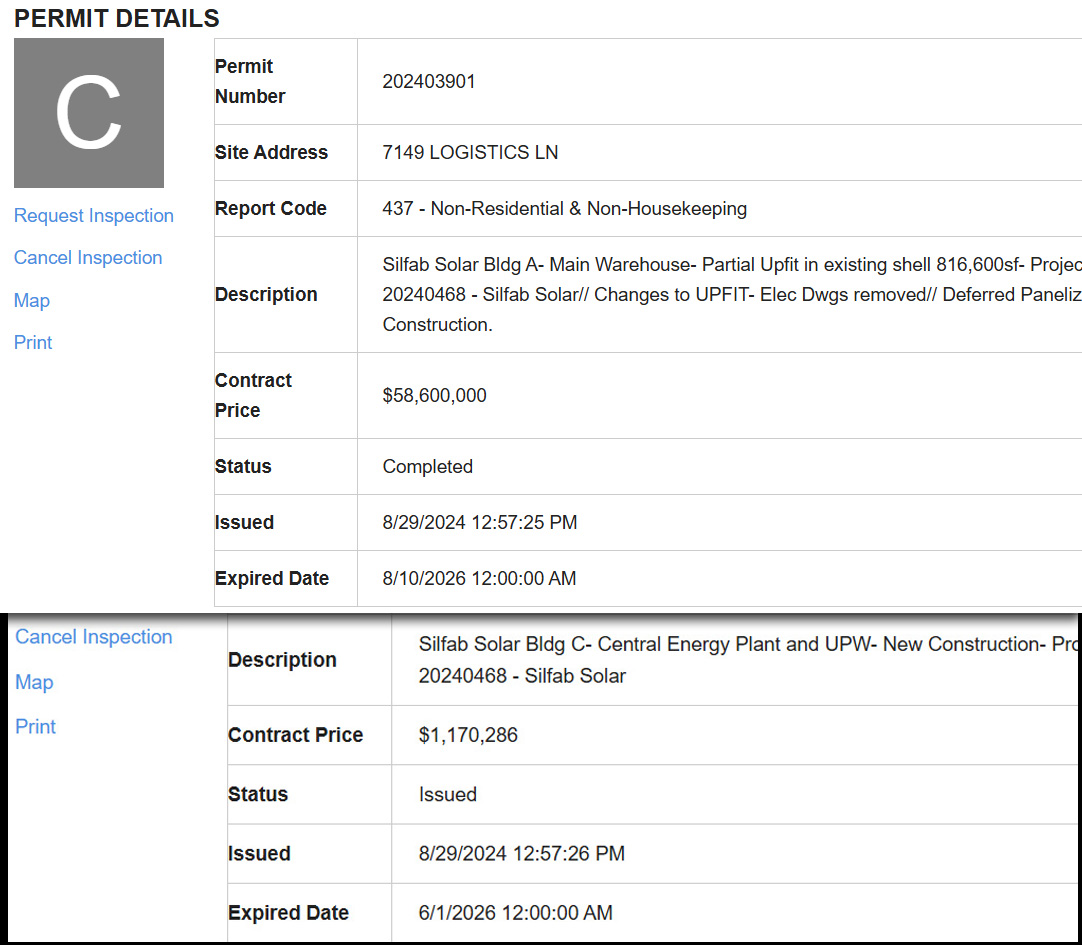
These permits issued after the BZA ruling directly violated York County Zoning Code § 155.270(G), which states any use not expressly listed in the Use Tables “is prohibited.” It also violated York County Code § 155.262, which requires a formal Zoning Compliance application before any new or changed use can proceed. Silfab never filed one — it relied only on a 2022 non-binding “Zoning Verification” letter that county documents repeatedly describe as “not a permit or licensing” and “only states that the site can, with the proper permits, be used…”

Additional laws ignored include S.C. Code § 6-29-950 (unlawful to construct or occupy any building without a permit that complies with zoning ordinances) and S.C. Code § 6-29-800 (prohibiting the BZA from granting a variance that would allow a use not otherwise permitted).

Cox, Edwards, and the Council Vice Chair personally control what goes on the County Council agenda. Yet when two different council members publicly asked — twice — in open meetings that Silfab’s permits be placed on a future agenda, their requests were ignored. This was a direct, intentional violation of York County Code § 30.04(b), which mandates: “Any item … deferred from a proposed agenda shall be immediately placed on a future meeting agenda … by request of two members of Council.”

Under Christi Cox and Josh Edwards, the county continued issuing permits and ultimately the Certificate of Occupancy while a massive industrial operation loaded with hazardous chemicals moved forward next to Flint Hill Elementary School. Dispatch records show repeated 911 calls from inside the factory for workers vomiting blood (a 25-year-old woman on March 28, 2026), trouble breathing (a 23-year-old man on March 26, 2026), seizures (February 4, 2026), chest pain, high blood pressure, and cardiac symptoms — incidents that have occurred with alarming frequency and have no parallel at comparable solar plants.
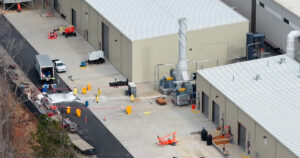
The danger spilled over to the children. On one day in March 2026, while school was in session and kids were playing near the fence, 1,530 gallons of potassium hydroxide poured into the retention pond directly bordering Flint Hill Elementary. Days later a hydrofluoric acid leak forced the school to close for two days out of an abundance of caution. In response, Silfab pumped roughly 300,000 gallons of liquid from the retaining ponds for off-site disposal over a single weekend.

On March 10, 2026, the Fort Mill School Board passed a formal resolution demanding that Governor McMaster, the General Assembly, Attorney General Alan Wilson, and York County Council “permanently limit the facility’s operations strictly to non-hazardous assembly processes and remove all hazardous chemicals on site in accordance with the facility’s current light industrial zone.”

Even now, with the factory fully operational and the school regularly placed in harm’s way, Cox and Edwards have refused to place the matter on the council agenda despite two formal requests by fellow council members, and they have allowed the prohibited use to continue unchecked.

All records cited — the May 30 BZA decision, the May 31 Cox letter, the Silfab Processes Memo, internal staff emails (including Basden’s cease-and-desist inquiry and Buono’s response), the hazardous-materials inventory, dispatch logs, the School Board resolution, and the 300,000-gallon pump-out — are from FOIA (Freedom of Information Act) productions or public filings. They paint a damning picture: under Christi Cox and Josh Edwards’ leadership and direction, their staff treated its own zoning code, council rules, public safety, and the health of elementary school children as optional while enabling a prohibited and dangerously toxic facility to begin operations within yards of elementary school children.

A Circuit Court judge has now affirmed the BZA’s decision. The judge found the BZA had jurisdiction. He found Buchanan had standing. He found the BZA’s decision was supported by evidence. He found the zoning code prohibits uses not listed in the use table. And he denied Silfab’s appeal.

York County can no longer credibly tell residents it is waiting on the court.

The court ruled.

Now the county must act.

An Earthquake Just Struck The Charlotte Region Early This Morning

0

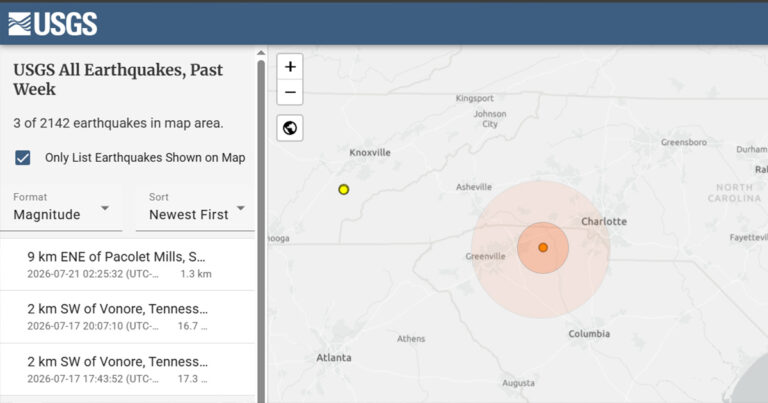
Early this morning, an earthquake struck the Charlotte region, about halfway between Charlotte and Greenville, SC.

According to the USGS, the 1.4 M quake struck at 06:25:32 (UTC) with a 1.3 km depth and had an epicenter roughly 9 km ENE of Pacolet Mills, South Carolina.

Earthquakes have been increasing in frequency around the Charlotte region over the past few years. Last year, we experienced the largest earthquake in over 100 years when a 5.1 magnitude quake hit Sparta, NC, and since then, dozens of aftershocks have continued to rattle our state.

According to USGS.gov, “Moderately damaging earthquakes strike the inland Carolinas every few decades, and smaller earthquakes are felt about once each year or two.”

Have you felt any of the quakes?

Last Night’s York County Council Vote Attempts To Saves $1.5 Billion Octapharma Project

0

York County Council members unanimously approved a major amendment last night to attempt to salvage the Octapharma deal.

After a controversial vote threatened to derail the proposed $1.5 billion Octapharma project on July 8th, York County Council unanimously approved a new agreement last night that might keep the largest economic development deal in our county’s history alive.

The council voted 7-0 during a special meeting to approve an amended revenue-sharing agreement for Project Palmetto Rock, the proposed Octapharma plasma facility in Rock Hill.

The amendment establishes a 40-year revenue-sharing agreement among York County, the City of Rock Hill and the Rock Hill School District.

Under the new plan, all project revenues will flow into a single fund before being distributed among the three government entities.

The Rock Hill School District will receive just under 67% of the revenue over the life of the agreement.

The City of Rock Hill will receive just over 19%, while York County will receive just under 14%.

Last night’s action follows a chaotic special meeting on July 8. Chairwoman Christi Cox suddenly called that unscheduled session. She moved the third and final reading of the Octapharma FILOT deal. Officials had long planned that reading for July 13. Instead Cox changed the date and location at the last minute. An amendment proposed during that meeting which shifted the majority of the City of Rock Hill’s share of the tax revenue from the $1.5 billion project to the Rock Hill School District passed 4-3.

This came after the City of Rock Hill had already passed a prior resolution, saying that they would not accept such a change.

During the meeting, Councilman Tom Audette offered a compromise amendment that the City had reportedly already agreed to — which would have given the schools even more money ($238 million total over the life of the deal) while preserving a fair split. That amendment was rejected.

This wasn’t an isolated incident. Under Christi Cox’s leadership, York County has seen a troubling pattern of decisions that prioritize personal or political conflicts over practical outcomes:

  • The Panthers HQ Collapse — Cox was a very vocal supporter early on, but became one of the loudest proponents of helping the Panthers when cracks started to form in 2022. Many believe her repeated public finger-pointing between the county and city accelerated the project’s death.
  • Silfab Solar Controversy — One of the most alarming examples involves the Silfab Solar manufacturing plant. Despite the Board of Zoning Appeals (BZA) ruling 5-0 in May 2024 that Silfab’s operations are not allowed in their Light Industrial district, Cox and her county staff ignored the ruling and the zoning code and started issuing permits to Silfab to build unlawful factory beginning in the summer of 2024. Internal records show permits were back-dated, and a Certificate of Occupancy was issued without zoning compliance. The facility, located yards from Flint Hill Elementary School, contains massive amounts of hazardous chemicals (including hydrofluoric acid and explosive silane). Multiple chemical spills and worker medical emergencies have been reported, including a potassium hydroxide spill into a retention pond bordering the school.
  • Repeated Transparency Issues — Multiple sources say Cox has canceled several scheduled meetings with Rock Hill Mayor John Gettys aimed at resetting county-city relations.

The Human Cost

If the Octapharma deal collapses, York County stands to lose:

  • $1.5 Billion in investment
  • 1,200+ high-paying jobs
  • Decades of tax revenue that could have helped schools, roads, and services

Instead of working collaboratively with Rock Hill to close the deal, last night’s rushed amendment appears designed to force the city into a corner.

The ball is now in Rock Hill City Council’s court. But the damage to York County’s reputation with major employers may already be done.