
A York County Circuit Court judge has just delivered a devastating blow against Silfab Solar’s chemical factory currently under construction in Fort Mill.
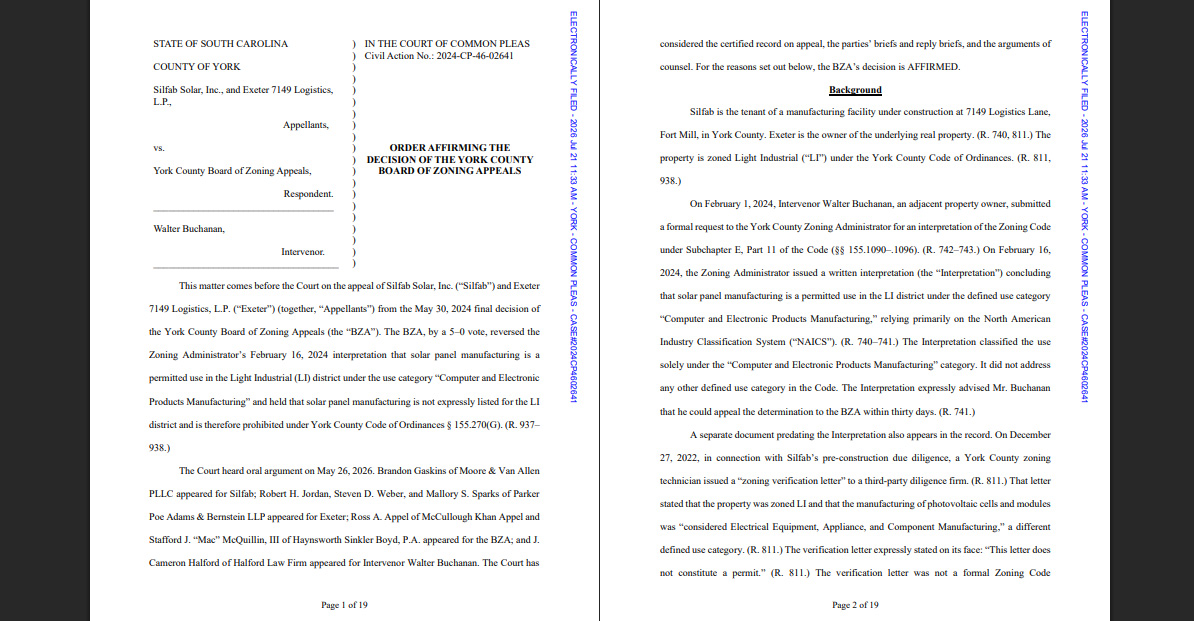
In today’s landmark ruling, York County Circuit Judge William A. McKinnon affirmed the York County Board of Zoning Appeals’ ruling “in all respects,” finding that Silfab’s solar panel manufacturing operation is indeed prohibited in its current location.
The ruling means the BZA’s 2024 decision now stands with judicial backing: solar panel manufacturing is expressly prohibited under York County Code §155.270(G).
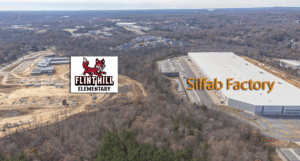 For residents near Flint Hill Elementary and Flint Hill Middle School, the ruling raises an immediate question:
Why is York County still allowing Silfab to move forward?
The court did not merely issue a technical ruling. Judge McKinnon directly rejected Silfab’s attempt to overturn the BZA’s decision. He found the BZA acted within its authority, had evidence supporting its decision, and made no legal error in concluding that solar panel manufacturing is prohibited under the zoning category Silfab relied on.
The ruling also undercuts several public arguments York County has used for months to defend its handling of the project.
York County’s public Silfab page, updated June 25, says the county was waiting for the court to determine whether the BZA ruling applied to Silfab. The page also says the county would “enforce whatever the courts determine.”
Now the court has determined it.
The BZA was right.
Silfab and York County officials were wrong.
All permits issued to Silfab are now legally void and must be revoked, along with Silfab’s certificate of occupancy.
The county’s page also argues that the 2024 BZA ruling should apply only to future permits, not existing projects, uses or approvals. But the circuit court’s order repeatedly ties the case to the actual Silfab facility at 7149 Logistics Lane. The court noted Silfab is the tenant of the manufacturing facility under construction, Exeter owns the property, and the site is zoned Light Industrial.
On pages 9-10, the Judge William A. McKinnon’s ruling specifically states:
“…Third, the record affirmatively supports the BZA’s finding that the manufacturing process at issue is qualitatively distinct from the listed Computer and Electronic Products Manufacturing examples and is more consistent with heavy industrial activity than light. The Code defines Light Industrial as activity that “ordinarily do[es] not create noise, smoke, fumes, odors, glare, or health or safety hazards outside of the building or lot” and expressly excludes “hazardous material treatment and storage facilities, plating or enameling, or petroleum and gas refining.” § 155.1301. The record contains an excerpt of Silfab’s Construction Air Permit Application disclosing the use of hydrofluoric acid, hydrochloric acid, potassium hydroxide, and silane (R. 750–758, 763), the projected emission of hydrogen fluoride at substantial percentages of rural and urban thresholds (R. 755), and the contemporaneously increased stack height of the acid-scrubber stack from 19.7 feet to 70 feet (R. 755). CDC information in the record describes hydrogen fluoride as a substance that “can irritate the eyes, nose, and respiratory tract” and that “can cause death from an irregular heartbeat or from fluid buildup in the lungs.” (R. 765.) The Code’s own point of contrast was also before the Board. Section 155.1301 defines heavy industrial use as manufacturing “by means that ordinarily have greater than average impacts on the use and enjoyment of adjacent property in terms of noise, fumes, odors, glare, health, and safety hazards.” And the purpose provision of the LI district states that the district’s “less intensive uses protect nearby residential areas from the encroachment of heavy industrial uses.” § 155.041(A)(2). The Board heard testimony walking through these provisions (R. 883, 888, 890), including testimony that hydrogen fluoride is a “category three air pollutant” under the applicable DHEC classification, a category defined by pollutants “which can cause chronic effects resulting in death or permanent injury after very short exposure to small amounts” (R. 880–881), and that silane, stored on site in compressed form, can “ignite spontaneously in air” (R. 881). The BZA’s on-the-record deliberation reflected substantive engagement with these record-based hazards. Board Member Bud Smith identified as the “biggest problem” with the Interpretation “the fact that there there’s differences between the hazards from the experts” and that “[n]one of . . . the things that these people pointed out were listed as a hazard in . . . our documentation.” (R. 930.) BZA Chairman Blair observed on the record: “when you have a production facility … that has a rather lengthy pollution scrubber … I begin to question whether or not it’s truly a light industrial use.” (R. 932.) Board Member Rob Cameron, an engineer by background, acknowledged during deliberation that “solar hasn’t been here in South Carolina” and that the Code contains no “specificness” and no “slot for solar.” (R. 931.) Board Member Lauren Hebert then concurred that the NAICS-only analysis and “the lack of clarity there” did not give the Board “enough purview to be able to uphold” the Interpretation. (R. 932.) These deliberations, recorded on the transcript and reflected in the Board’s 5–0 vote at a properly convened session, are findings of the Board as a body on which this Court may rely under Vulcan Materials and Boehm. Each of these record materials provides evidence in support of the BZA’s conclusion that the actual activity at issue does not fit the Code’s defined Light Industrial category. See DT LLC v. Horry Cnty. Zoning Bd. of Appeals (In re Venture Eng’g), 433 S.C. 419, 433, 858 S.E.2d 638, 646 (Ct. App. 2021) (“Although the Board’s written order failed to set forth any reasoning, the hearing transcript and the Board’s minutes indicate the Board’s decision was supported by the testimony of residents in the surrounding community expressing concerns about particulates, noise, and traffic.”)….”
The court also addressed the 2022 zoning verification letter York County and Silfab have repeatedly pointed to as a shield.
That letter said Silfab’s use was considered “Electrical Equipment, Appliance, and Component Manufacturing.” But the judge made clear the letter was not a permit. The ruling states that the letter said on its face: “This letter does not constitute a permit.” The court also found it was not a formal zoning interpretation and was not the decision being appealed.
The ruling also rejects another key Silfab argument involving County Council’s FILOT tax-incentive agreement.
Silfab argued, in part, that York County Council’s FILOT ordinance ratified earlier actions related to the project. Judge McKinnon rejected that argument. He wrote that a FILOT agreement is a tax-incentive instrument, not a zoning amendment. He also warned that accepting Silfab’s theory would allow County Council to amend zoning by side agreement, violating South Carolina zoning procedures and the bar on contract zoning.
In plain English: a tax-break deal does not rewrite zoning law.
That finding lands directly on one of the biggest public concerns surrounding Silfab. Residents have argued for months that York County treated an economic development project as if it could bypass normal land-use safeguards. The court’s order now gives that argument legal force.
How did we get here?
Evidence now shows that Council Chairwoman Christi Cox and County Manager Josh Edwards’ staff not only fast-tracked the project — they back-dated permits, issued a Certificate of Occupancy without zoning compliance on February 13, 2026, and deliberately ignored their own laws to make it all happen.
In February 2024 a neighboring property owner asked the county to interpret whether Silfab’s operations were allowed at 7149 Logistics Lane. Zoning Administrator Rachel Grothe responded on February 16 that it was permitted under the vague “Computer and Electronic Product Manufacturing” use. The neighbor then appealed.
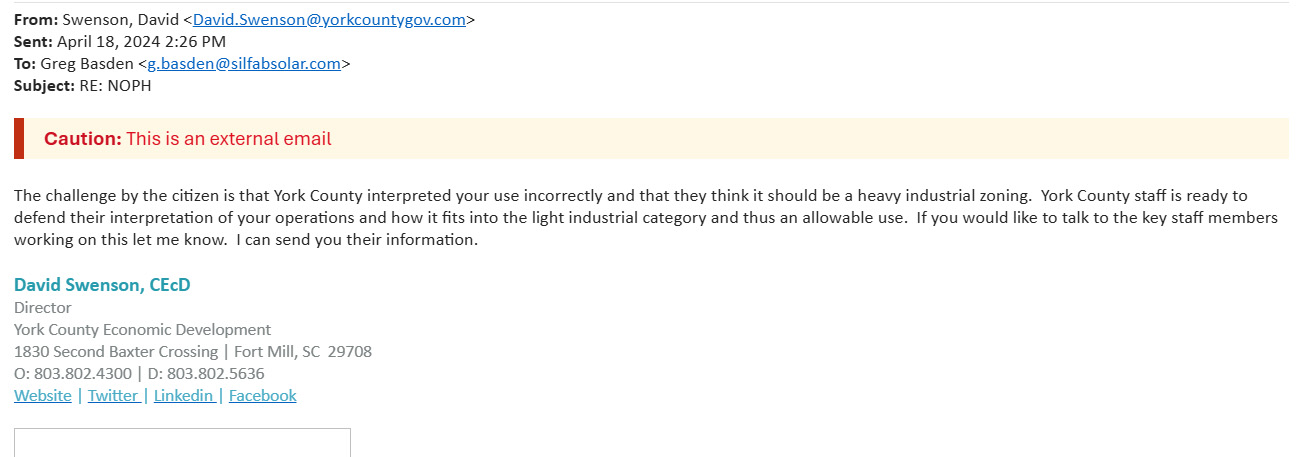
On April 18th, York County Economic Development Director David Swenson confirmed to Silfab’s Director of Operations, Greg Basden, that the upcoming BZA hearing was about Silfab’s operations.
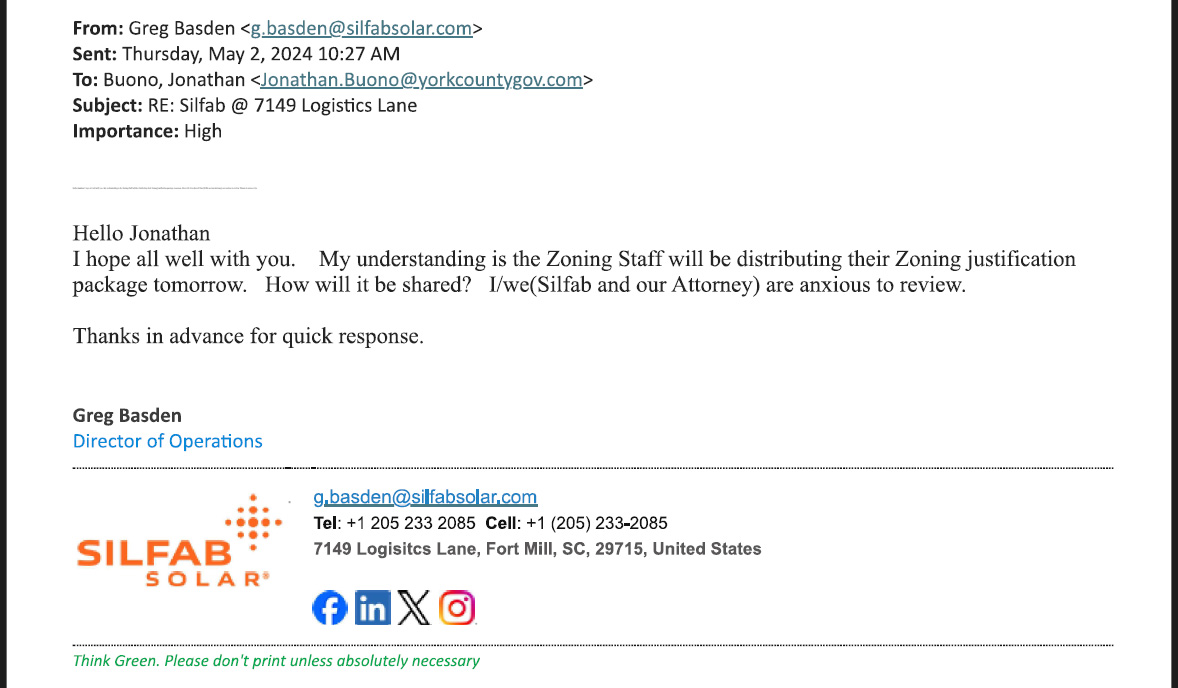
On May 2, 2024, Greg emailed county staff asking to review the county’s justification package.
On May 9th, 2024, the Board of Zoning Appeals ruled 5-0 that Silfab’s operations were not allowed in a light industrial zone.
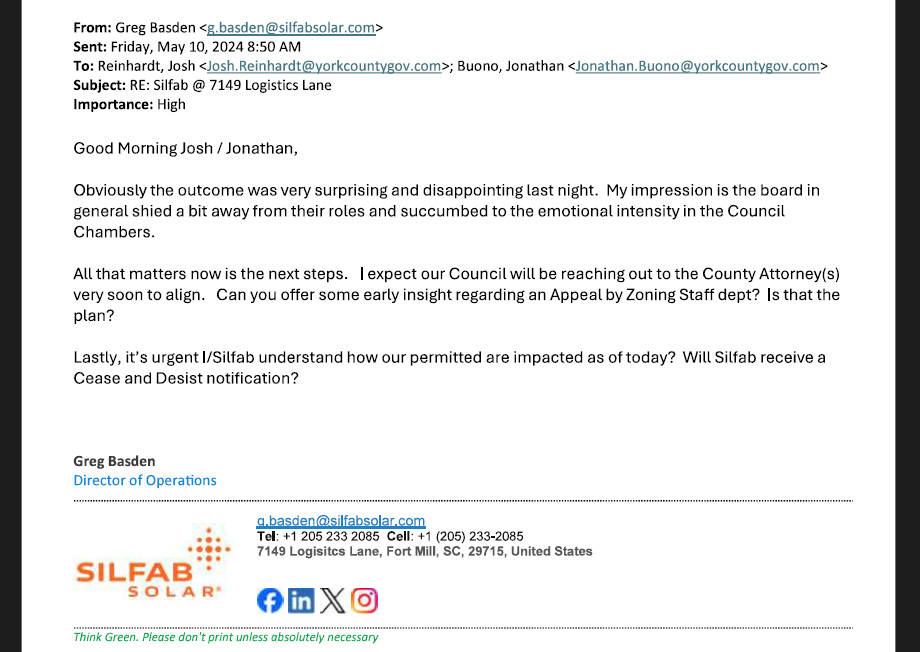
On May 10, 2024, Silfab’s Greg Basden emailed county officials asking point-blank if Silfab would be receiving a cease and desist:
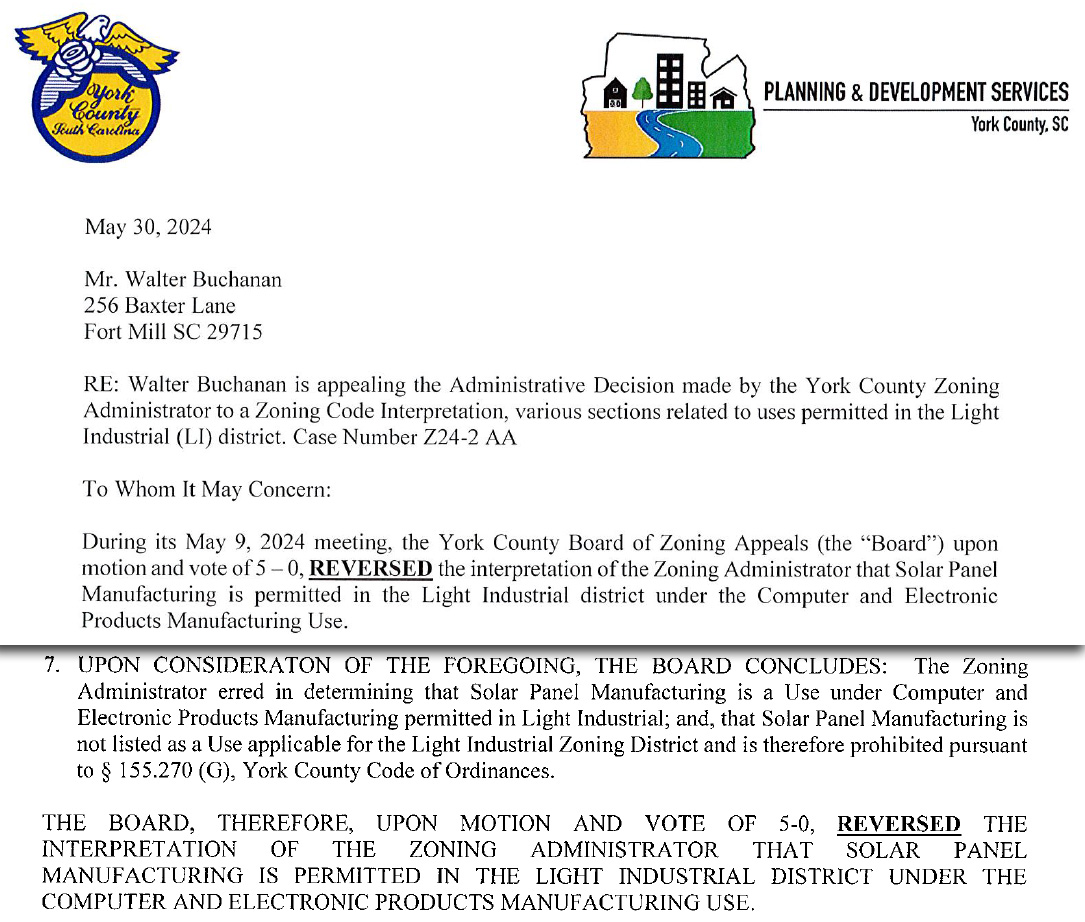
On May 30 the BZA issued its written decision:
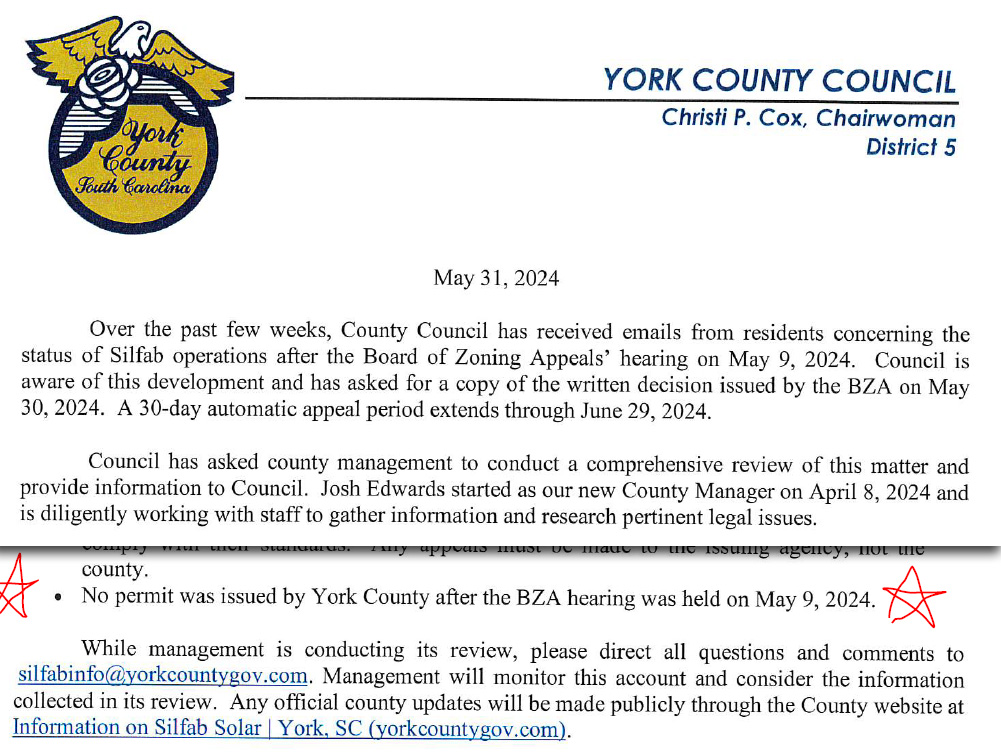
The very next day, May 31, 2024, Christi Cox signed a public letter telling residents that “No permit was issued by York County after the BZA hearing was held on May 9, 2024,” and that, Josh Edwards, who had started as County Manager on April 8, 2024, was “diligently working with staff to gather information and research pertinent legal issues.”
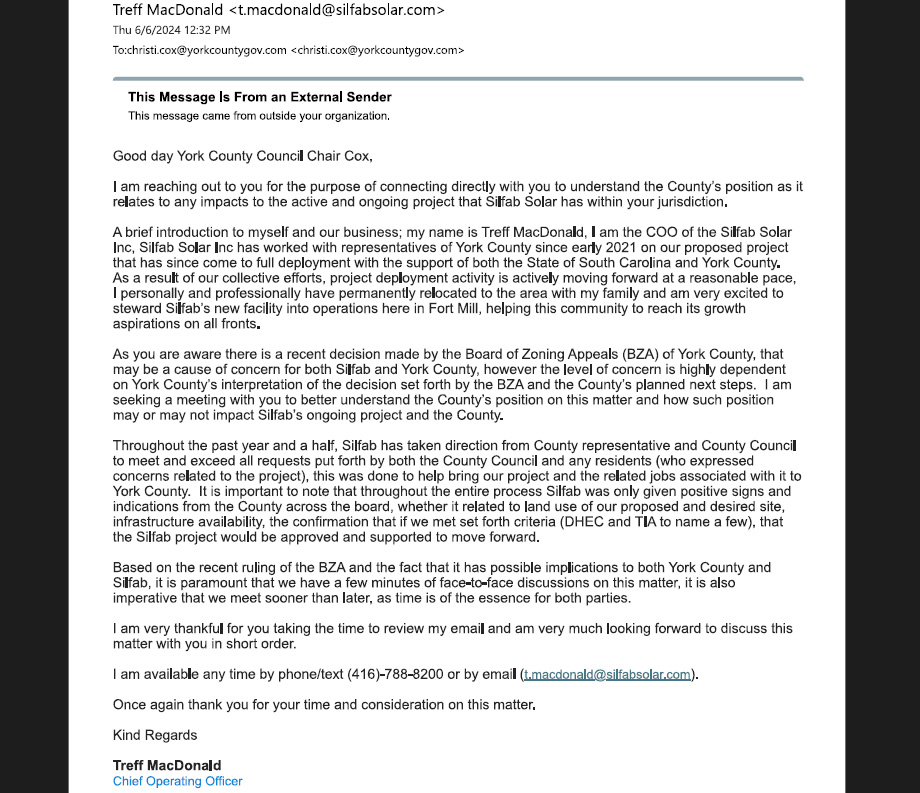
Silfab COO Treff MacDonald then asked for a meeting with Christi Cox a few days later on June 6th, saying “it is paramount that we have a few minutes of face-to-face discussions on this matter, it is also imperative that we meet sooner than later, as time is of the essence for both parties.”
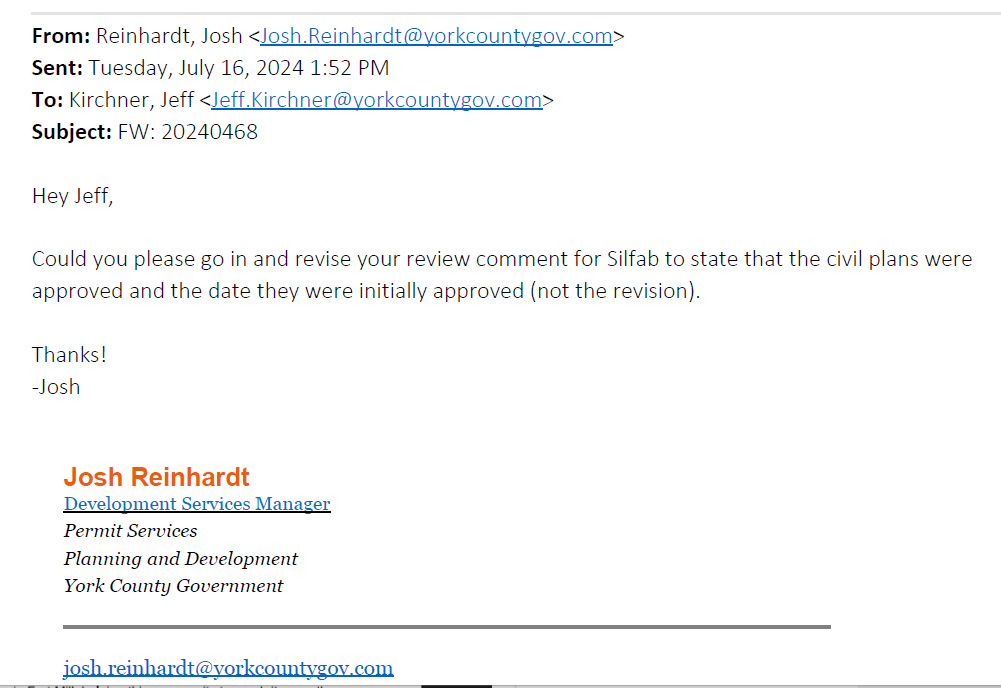
Internal emails also show that Cox and Edwards’ staff (including Reinhardt and Kirchner) discussing changes to approval dates. Silfab’s parking-lot civil plans were stamped April 24, 2024 — before the BZA hearing. The up-fit approval was dated July 16, 2024 — after the BZA reversal. The final “zoning compliance” stamp was back-dated to April 24 to pretend a valid approval existed before the BZA ruling and before citizens’ appeal window closed.
Roughly 1 month later, in August of 2024, Silfab began receiving all of their permits for the up fit of their main distribution building into a manufacturing factory, as well as the permits for the new construction of their chemical storage buildings and bunkers, wastewater treatment plant, and central energy plant.
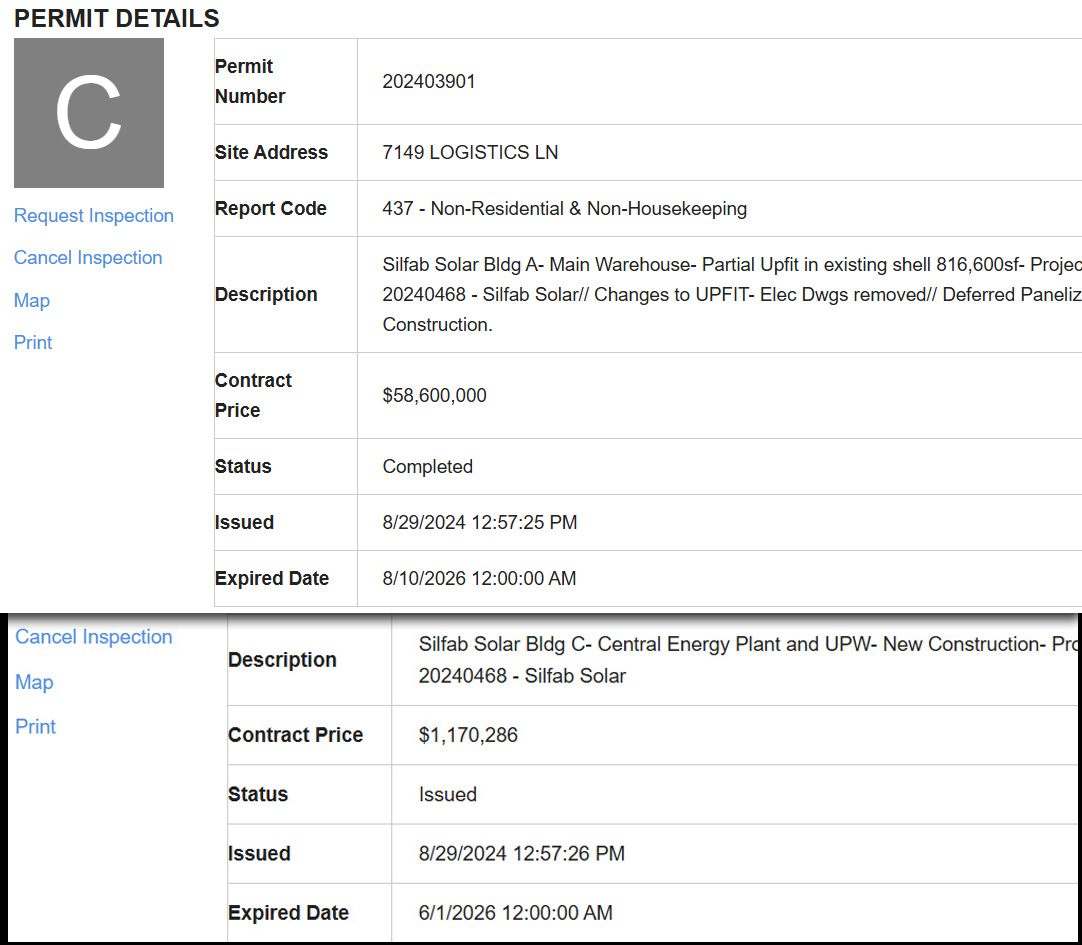
These permits issued after the BZA ruling directly violated York County Zoning Code § 155.270(G), which states any use not expressly listed in the Use Tables “is prohibited.” It also violated York County Code § 155.262, which requires a formal Zoning Compliance application before any new or changed use can proceed. Silfab never filed one — it relied only on a 2022 non-binding “Zoning Verification” letter that county documents repeatedly describe as “not a permit or licensing” and “only states that the site can, with the proper permits, be used…”
Additional laws ignored include S.C. Code § 6-29-950 (unlawful to construct or occupy any building without a permit that complies with zoning ordinances) and S.C. Code § 6-29-800 (prohibiting the BZA from granting a variance that would allow a use not otherwise permitted).
Cox, Edwards, and the Council Vice Chair personally control what goes on the County Council agenda. Yet when two different council members publicly asked — twice — in open meetings that Silfab’s permits be placed on a future agenda, their requests were ignored. This was a direct, intentional violation of York County Code § 30.04(b), which mandates: “Any item … deferred from a proposed agenda shall be immediately placed on a future meeting agenda … by request of two members of Council.”
Under Christi Cox and Josh Edwards, the county continued issuing permits and ultimately the Certificate of Occupancy while a massive industrial operation loaded with hazardous chemicals moved forward next to Flint Hill Elementary School. Dispatch records show repeated 911 calls from inside the factory for workers vomiting blood (a 25-year-old woman on March 28, 2026), trouble breathing (a 23-year-old man on March 26, 2026), seizures (February 4, 2026), chest pain, high blood pressure, and cardiac symptoms — incidents that have occurred with alarming frequency and have no parallel at comparable solar plants.
 The danger spilled over to the children. On one day in March 2026, while school was in session and kids were playing near the fence, 1,530 gallons of potassium hydroxide poured into the retention pond directly bordering Flint Hill Elementary. Days later a hydrofluoric acid leak forced the school to close for two days out of an abundance of caution. In response, Silfab pumped roughly 300,000 gallons of liquid from the retaining ponds for off-site disposal over a single weekend.
On March 10, 2026, the Fort Mill School Board passed a formal resolution demanding that Governor McMaster, the General Assembly, Attorney General Alan Wilson, and York County Council “permanently limit the facility’s operations strictly to non-hazardous assembly processes and remove all hazardous chemicals on site in accordance with the facility’s current light industrial zone.”
Even now, with the factory fully operational and the school regularly placed in harm’s way, Cox and Edwards have refused to place the matter on the council agenda despite two formal requests by fellow council members, and they have allowed the prohibited use to continue unchecked.
All records cited — the May 30 BZA decision, the May 31 Cox letter, the Silfab Processes Memo, internal staff emails (including Basden’s cease-and-desist inquiry and Buono’s response), the hazardous-materials inventory, dispatch logs, the School Board resolution, and the 300,000-gallon pump-out — are from FOIA (Freedom of Information Act) productions or public filings. They paint a damning picture: under Christi Cox and Josh Edwards’ leadership and direction, their staff treated its own zoning code, council rules, public safety, and the health of elementary school children as optional while enabling a prohibited and dangerously toxic facility to begin operations within yards of elementary school children.
A Circuit Court judge has now affirmed the BZA’s decision. The judge found the BZA had jurisdiction. He found Buchanan had standing. He found the BZA’s decision was supported by evidence. He found the zoning code prohibits uses not listed in the use table. And he denied Silfab’s appeal.
York County can no longer credibly tell residents it is waiting on the court.
The court ruled.
Now the county must act.