
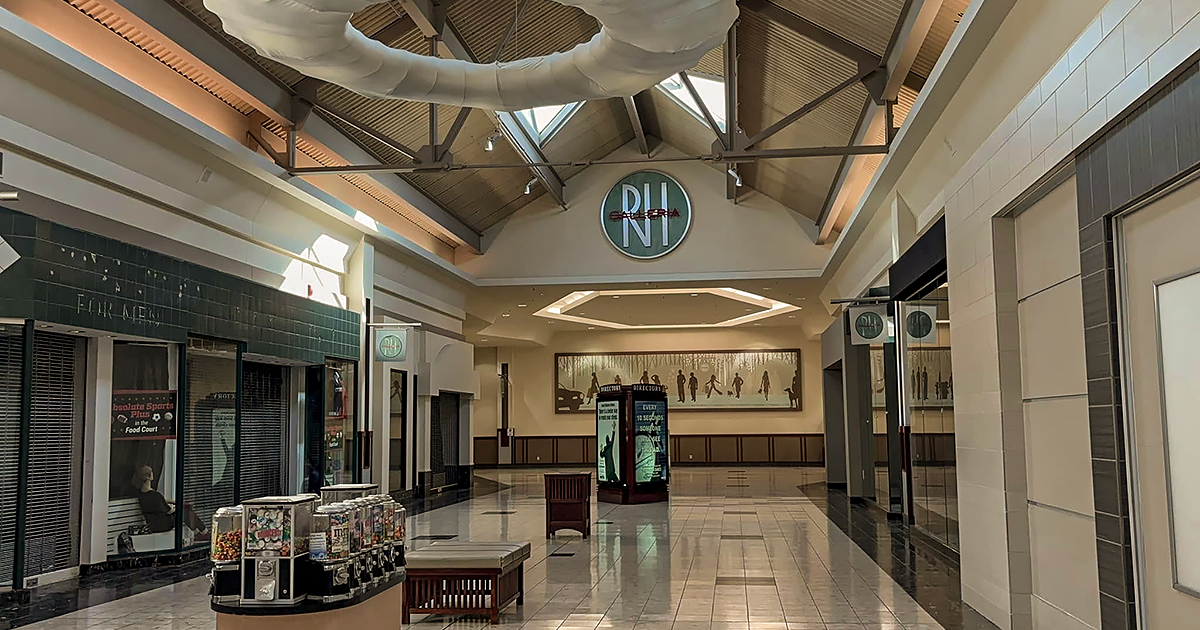
 For more than three decades, Rock Hill Galleria sat at the I-77 / Dave Lyle Boulevard interchange as York County’s enclosed shopping mall — the place that replaced the old Rock Hill Mall and was supposed to keep local retail from leaking north to Charlotte.
It is still open. Belk is still there. Walmart still sits on the property as a separately owned shadow anchor. Dick’s Sporting Goods, Ashley HomeStore, Stars and Strikes, and a new Big Air trampoline park occupy former department-store boxes.
That is the official story. The leasing listings tell another one.
As of August 2026, brokers were advertising about 125,000 square feet in 20 available spaces inside a mall whose enclosed portion is roughly 500,000 square feet. Interior and exterior big-box space is “immediate.” Management’s own materials still say plans to tear the enclosed concourse apart and rebuild it as an outdoor center with green space are “being explored.” That phrase has been on the listing for years.
The Galleria is not empty. It is something more common in 2026: a mall that keeps filling the big holes with entertainment and furniture while the hallway between them thins out.
How the anchors left
The property opened in May 1991 with the usual 1990s mix: Belk, Sears, JCPenney, Walmart, and a string of junior anchors that never lasted. Phar-Mor was gone within a year. Steve & Barry’s and Goody’s collapsed with their chains in 2008–09. The real break came in a two-year stretch:
- Sears announced in November 2018 that the Galleria store would close in early 2019.
- Revolutions and Home South followed in 2019.
- JCPenney put the Rock Hill store on its 2020 bankruptcy closure list.
Shoppers and reviewers at the time described more dark storefronts than lit ones, a food court that felt abandoned, and a roof that leaked when it rained. Those complaints are older, but they match the pattern every mid-tier mall in the Carolinas hit after Amazon, after the department-store bankruptcies, and after Charlotte’s bigger centers — SouthPark, Carolina Place, Concord Mills — pulled the remaining national chains.
Replacements arrived slowly. Dick’s opened in the former JCPenney in 2022. Stars and Strikes took the old Revolutions box in 2023 (bowling, arcade, laser tag, axe throwing). Ashley opened a 35,500-square-foot showroom in part of the old Sears in October 2024. Palmetto Moon opened that November. Big Air Trampoline & Adventure Park, promised for 2025, opened May 16, 2026, in the former Home South space.
That is not a classic mall revival. It is the standard late-stage playbook: turn dead department stores into places people stay for two hours, not ten minutes.
The problem is the space between those boxes. Directory sites still list a modest lineup — Bath & Body Works, Hot Topic, Hibbett, Kay Jewelers, Claire’s, Escape Eight — but they also list far fewer stores than a healthy regional mall of this size should carry. Mall hours have compressed in some published schedules to late-morning openings and 7 or 8 p.m. closings on weekdays, the schedule of a property that no longer expects all-day traffic.
The incident that put the mall back in the news
On the afternoon of Friday, Oct. 10, 2025, two men argued on the mall property. One of them shot the other in the shoulder. Rock Hill police said the shooter acted in self-defense after being accosted verbally and physically. The injured man, 26-year-old Martrell Telly Minter of Chester, was taken to Piedmont Medical Center in critical condition and later charged with third-degree assault and battery. The shooter was not charged.
The enclosed mall shut down for the rest of the day. Walmart, with its own entrance, stayed open. An ambulance sat outside the food-court doors. Shoppers told local television they were shocked because the Galleria is “usually pretty quiet.”
One shooting does not make a mall dangerous. It does make a struggling mall look like a place people already suspected it was becoming: a large building with thin crowds, where an argument in an entryway can empty the concourse.
Management could not be reached for comment the day of the shooting. That silence is typical. The property has changed owners and managers more than once since Zamias developed it. Warren Norman Company now leases and markets it.
The region already wrote this ending
Rock Hill has seen this movie. The original Rock Hill Mall on Cherry Road lost its anchors to the Galleria, then emptied out, and was demolished in 2006. Eastland Mall in east Charlotte — the other 1990s competitor that used to steal Galleria traffic — closed in 2010 and was torn down. The site is now Eastland Yards: apartments, a sports campus, the kind of mixed-use replacement cities build when they admit the mall is not coming back.
Signal Hill Mall in Statesville closed to the public in early 2024. Northlake Mall in north Charlotte has spent years shedding national tenants and fighting with small-shop owners over leases. Triangle Town Center in Raleigh is losing Saks and watching Macy’s wind down. Across the country, Coresight counted more than 8,000 U.S. store closures in 2025. Enclosed regional malls without a luxury trade area or a tourist draw are the format that keeps losing.
Charlotte’s overall retail vacancy is actually low. Money is not leaving the metro. It is leaving this building type. Power centers, outlets, grocery-anchored strips, and entertainment boxes are absorbing the growth. Concord Mills is still adding stores. The Galleria is adding bounce houses and bowling because those are the tenants that will still sign a lease in a 1991 concourse.
What happens next
Three paths are left, and none of them look like 1995.
Keep patching it. Fill another box with a furniture chain or a trampoline park. Leave 20 vacant bays on the leasing flyer. Hope Belk does not join the national contraction. This is what the property is doing now.
Open it up. Brokers already advertise a conversion to an outdoor center with green space. That is the script used on dying malls from Florida to Delaware: demolish the corridor, keep the best boxes, add apartments or medical if the land will support it. No groundbreaking date has been announced.
Lose the middle. If inline occupancy keeps sliding and another national name leaves, the Galleria becomes a cluster of independently entered big boxes around a locked hallway — the same fate as dozens of “zombie malls” that never get a formal closing day.
Rock Hill itself is not dying. Industry is landing along I-77. Housing is going up. The trade area has more people than it did when Sears left. That is what makes the Galleria’s condition pointed. The customers did not disappear. They stopped needing a single-story enclosed mall with a food court that no longer feeds a crowd.
The most recent chapter is not a bankruptcy filing or a padlock on the main doors. It is quieter than that: a shooting that closed the building for a day, a leasing sheet with 125,000 square feet still for rent, a trampoline park in a former furniture store, and a redevelopment plan that remains, year after year, “being explored.”
That is how a lot of regional malls end now. Not with a ribbon-cutting in reverse. With a hallway that gets a little longer between the stores that are left.