Students at a Gaston County high school have spent multiple days sweating through classes after air conditioning problems hit several campus buildings. Some students found relief through a water hose during a ‘fire challenge’ on one of the hottest days.
Students initially continued attending classes in hot classrooms when the power became intermittent. Some classes have since moved into other campus buildings with working air conditioning. However, Early College students still had to return to the affected building to be able to eat lunch.
On Friday, things were so hot that students were seen hosing eachother down during a “fire challenge”.
School officials have provided repair updates, but earlier estimates for restoring air conditioning have passed without a complete fix. In a Facebook post, the school acknowledged a challenging start to the year and thanked families for their patience. Officials referenced a Gaston College power outage and transportation issues.
Gaston Early College allows students to simultaneously earn a high school diploma and up to two years of transferable college credit at no cost.
Students attend classes on the college campus and can pursue associate degrees in arts, science or engineering.
For now, students and teachers continue adjusting schedules while waiting for the cooling problems to be resolved.
An invasive bug that has killed millions of trees in North Carolina has now reached Charlotte.
The Emerald Ash Borer (EAB) infestation appears to have killed several trees near South Tryon Street and Billy Graham Parkway.
EAB infestations begin with leaf loss at the tree tops, followed by tunnels under loose bark, and sprouts at the tree’s base. The EAB, a metallic green beetle, bores into ash trees and feeds on tissues beneath the bark, ultimately killing the tree. Adult borers lay eggs on the bark of ash trees. When the eggs hatch, larvae bore into the bark and feed on tree tissues. This process disrupts nutrient and water movement, causing the tree’s slow death, typically within three to five years.
Signs of EAB infestation include thinning crowns, increased woodpecker activity, and small, 1/8-inch D-shaped exit holes where adult beetles emerged. Additionally, symptoms include galleries inside the bark, cream-colored larvae, and epicormic sprouting from the tree’s main stem. Host plants include all native ash trees and native white fringetrees. The Chinese white fringetree, often planted for ornamental purposes, is believed to be resistant.
Adult EAB beetles are about a half-inch long and 1/8-inch wide. Under their wing covers, their bodies are metallic purple-red. In North Carolina, the adult EAB is typically active from late spring to early summer, usually from April through June. EAB larvae may be found under the tree bark most of the year.
“EAB has been found in more than 75% of North Carolina counties including all of Western North Carolina, most of the Piedmont and continues to track east,”The NC Forestry Service said in a press release. “The entire state is under a quarantine for EAB which prohibits the movement of ash plant parts, the insect itself, ash nursery stock and all hardwood firewood into nonquarantined areas such as central Tennessee, most of Alabama and Florida.”
The City of Charlotte is now asking all residents to report possible sighting of EAB to 800-206-9333 or newpest@ncagr.gov
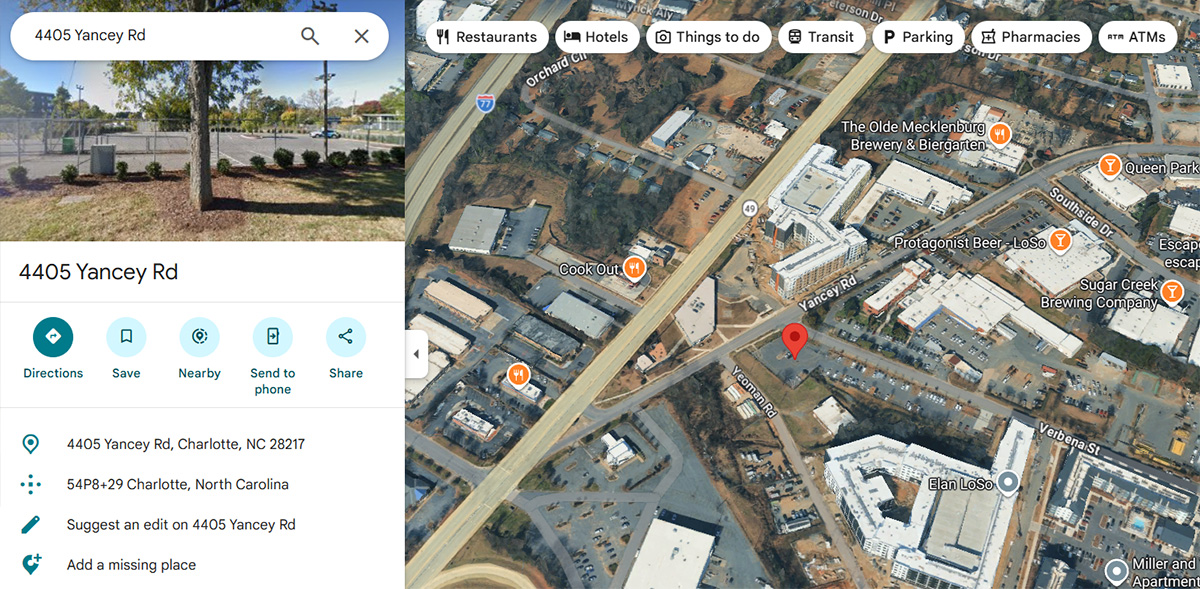
A massive new mixed-use district is officially on the horizon for Lower South End (LoSo) to be called “LoSo Synergy South”.
Pappas Properties, one of Charlotte’s most prominent real estate developers, has filed a rezoning petition to transform a nearly 15-acre industrial footprint into a vibrant, transit-oriented neighborhood hub. The project, tentatively named LoSo Synergy South, marks the next major evolutionary step for a district that has rapidly transitioned from an industrial zone into one of the city’s premier dining, entertainment, and residential hotspots.
The Footprint: From Natural Gas to Neighborhood Hub
The development targets a 14.87-acre site located at 4405 Yancey Road, situated right in the heart of LoSo.
The History: The sprawling land is currently owned by Duke Energy Corp. and was previously home to a major Piedmont Natural Gas operations office. For decades, the site served logistics and industrial utility functions.
The Future: Pappas Properties intends to completely scrap the site’s industrial past to build a high-density, walkable mixed-use community.
The Zoning Shift: What is “TOD-NC”?
According to public records, Pappas Properties filed Rezoning Petition RZP-2026-058, requesting a conventional zoning shift from ML-2 (Manufacturing and Logistics) to TOD-NC (Transit Neighborhood Center).
Because this is a conventional rezoning request rather than a conditional one, the developer is not locked into a rigid, pre-approved site plan or specific architectural renderings just yet. Instead, switching the 14.87 acres to a TOD-NC designation adopts a specific set of rules under Charlotte’s Unified Development Ordinance (UDO).
The TOD-NC designation is explicitly designed for land near LYNX Blue Line light rail stations (such as the nearby Scaleybark and Woodlawn stations). This zoning allows for:
High-Density Housing: Multi-family apartment complexes or townhomes.
Active Street Frontages: Ground-floor retail, boutique shops, and vibrant restaurants.
Pedestrian-First Infrastructure: Wide sidewalks, bike lanes, and a heavy emphasis on replacing industrial surface parking lots with structured parking and green space.
A public hearing is currently anticipated for November 16, 2026, where community members will have the opportunity to voice their thoughts on the project before it goes to the Charlotte City Council for a final vote.
Given Pappas Properties’ track record with large-scale projects like Midtown’s Metropolitan and South End’s design districts, LoSo Synergy South is poised to become the definitive southern anchor for the Lower South End neighborhood.
After breaking ground last month, Buc-ee’s has announced an official opening date for what will soon become the largest gas station in the Carolinas and the largest Buc-ee’s location in the South East. The company confirmed a official grand opening window between October and December of 2027.
The new location will be built at 1447 Trollingwood-Hawfields Road inside the 1,200-acre NC Commerce Park. Plans call for a 75,000-square-foot store, roughly the size of 1.3 football fields. The site will also feature 120 gas pumps and about 600 parking spaces.
The project is expected to bring between 200 and 300 full-time jobs, along with around 100 part-time positions. Hourly pay could range from $18 to $33, depending on the role.
Buc-ee’s has developed a strong national following, with 54 locations currently open. Expansion is underway across multiple states, including several new markets.
However, the large-scale development is expected to significantly impact traffic. A study estimates the site could generate more than 2,000 vehicle trips per hour during peak Saturday periods.
Unlike traditional truck stops, the location will not accommodate tractor-trailers.
Currently, South Carolina has one Buc-ee’s, which opened in Florence in 2020. The Mebane site is expected to be significantly larger than that location.
For North Carolina and the greater Charlotte region, the project signals continued growth along key travel corridors. It also highlights increasing demand for large-format travel centers that combine fuel, food, and retail into one destination.
One of Charlotte’s largest Christian gatherings in years is coming to UNC Charlotte this weekend.
Over 100 churches and ministries are uniting across denominational lines for two nights of worship, prayer, and evangelism that organizers say will offer a true solution to the crises facing our world right now.
The historic Charlotte Crusade will take place Saturday, Aug. 22, and Sunday, Aug. 23, at UNC Charlotte’s Halton Arena. Doors open at 5 p.m., with the program beginning at 6:30 p.m.
Over 127 churches and ministries are participating across denominational lines. Each evening will feature worship music, a large choir assembled from participating churches and messages of hope and transformation.
Admission is free, with no ticket required, although seating is first come, first served. Parking is also free.
Attendees can take the CATS Blue Line to UNC Charlotte Main Station, with university shuttles connecting riders to Halton Arena.
Organizers are also offering translations in more than 20 languages, along with designated ASL interpretation. UNC Charlotte’s clear bag policy will apply.
Both nights will also stream online for people unable to attend in person. You can find out more information or watch online at Charlottecrusade.com.
While most candidates in the special Senate race have been speaking out against Silfab Solar’s heavy industrial Fort Mill factory, one candidate, Congressman Ralph Norman, has largely avoided the subject and attempted to downplay his role in bringing the project to York County.
There’s now growing backlash over Norman’s public support, pressure tactics, campaign contributions, and the federal grants that allowed Silfab to lease a light industrial distribution building from the Rockefeller Group and transform it into a heavy industrial factory next to schools. After leasing the building to Silfab, the Rockefeller Group sold the building with Silfab as a tenant for $106 million – the highest priced commercial sale in Fort Mill’s history. The Rockefeller Group and Ralph Norman both still own other commercial properties around Rock Hill and Fort Mill.
At timestamp 1:46:35 Norman said “…I talked to [York County] council members when they asked my support for the [Silfab’s] fee in lieu and I agreed with that, so they wanted me to call people, so yes…people called me and said they may have trouble getting their [Silfab’s] fee in lieu – I said, ‘that’s not right’ – I make calls at time if they ask me to. Somebody said call somebody, so I did that…” (this is corroborated by York County Councilman Watts Huckaby stating during Silfab’s fee in lieu meeting, “…so I’m going to say publicly, Ralph Norman supports this project…”)
At timestamp 1:34:02 Norman said, “I didn’t know what silane was until I started looking at it – there’s 5,000 different types [of silane], it’s in concrete that you drive on – there are more chemicals at Home Depot and Walmart…I’m not at all concerned about it after looking into it.”
These statements prove especially damning. Norman misled the audience by claiming thousands of harmless silane varieties exist in everyday products like concrete. In reality, the silane used at Silfab is specifically SiH4 (according to numerous public documents) — a single, highly dangerous compound. Silane (aka SiH4) is pyrophoric and ignites spontaneously on contact with air. It is extremely explosive and toxic. Silfab’s own documents show the plant stores 26,456 pounds of this high-hazard gas.
The factory also holds 15,850 gallons of hydrofluoric acid — fatal if inhaled, swallowed or absorbed through skin. It plans on storing massive amounts of anhydrous ammonia, hydrochloric acid, sulfuric acid, boron trichloride, trimethylaluminum, phosphorus oxychloride, and numerous other deadly and highly-explosive chemicals, according to company documents.
These hazards now show real consequences. Workers suffer repeated medical emergencies after multiple chemical spills at the plant. Recent calls include a 23-year-old man struggling to breathe, a 25-year-old woman vomiting blood, as well as numerous other calls involving seizures, chest pain, high blood pressure and gas leaks.
By comparing the factory to Home Depot shelves, Norman implied everyday stores pose greater danger. His words misled the public and built false support for Silfab while residents feared for nearby schools.
Norman’s Federal support flowed to Silfab
In May 2024, the company won a $5 million grant from the Federal Solar Energy Technologies Office. Norman’s district secured the project. Meanwhile, OpenSecrets records show Norman received campaign contributions from Silfab’s lobbying group, SEIA.
Then came the big legislative move. In 2025, the House voted on President Trump’s “Big Beautiful Bill”. Norman held out at first as the tie-breaking vote. He negotiated last-minute changes to the bill, including accelerated repeals of Biden-era solar and wind credits, and then voted yes as the deciding vote to make the bill pass.
Silfab already had its grants, permits, and $100 million private funding locked in. Heavy tariffs on Chinese imports gave Silfab’s factory a premium edge. Competitors still seeking approvals faced a capital drought. Many canceled or downsized U.S. factories.
Norman’s last-minute changes and deciding vote on the Big Beautiful Bill protected Silfab’s Fort Mill factory and blocked newer rivals.
In a recent interview with WCNC, Ralph Norman downplayed his involvement in Silfab and repeated the line that ‘local decisions rest with local county officials’. Yet he failed to mention any of his numerous actions on both a local and federal level that helped Silfab narrowly secure approvals to build their heavy industrial factory in a light industrial district next door to 2 new schools.
One of Lake Norman’s most popular public swimming spots is officially done for the summer. Ramsey Creek Beach will remain closed through the rest of 2026 because lake levels are still too low.
The county originally closed Ramsey Creek Beach in May because of low water levels. The swimming season would normally continue through Labor Day weekend.
Several high-profile sewage spills into Lake Norman have also raised additional concerns among residents about water quality. Those incidents occurred after Ramsey Creek had already closed.
Other Mecklenburg County outdoor pools and spraygrounds remain open through Labor Day weekend.
President Donald Trump is expected to return to South Carolina this week, bringing the national spotlight to an increasingly high-profile Republican Senate runoff between Senator Darline Graham and Rep. Ralph Norman.
Trump is expected to appear at a Friday rally in Myrtle Beach supporting Graham ahead of the Aug. 25 Republican runoff.
The visit prompted the South Carolina Republican Party to postpone a previously scheduled Senate campaign event Friday in Anderson County. Party officials said they are working to reschedule the Anderson event.
“From the beginning, the purpose of these Stump Stops has been to give Republican voters across South Carolina the opportunity to hear directly from the candidates,” SCGOP Chairman Drew McKissick said in a press release. “We want to give both sides a voice, and we are not going to hold a Stump Stop where only one of the two candidates can participate. We are working to find another date that gives both candidates that opportunity.”
Trump has endorsed Graham in the Republican Senate race, giving her a major boost during the final stretch of the runoff campaign.
Graham and Norman advanced to the runoff after neither candidate secured enough support to win the Republican nomination outright.
The presidential visit could also draw significant attention beyond the Grand Strand. Republicans across the state are now approaching the final week of voting in the closely watched contest.
The winner on Aug. 25 will advance to the November general election to face Democratic candidate Dr. Annie Andrews and Libertarian candidate Kāsie Whitener in the November election.
Speeding is taking an especially deadly toll across the Carolinas. A new nationwide study ranks North Carolina third for speeding-related deaths, while neighboring South Carolina ranks seventh.
The study analyzed 2024 traffic data from all 50 states, including fatalities, crashes, seasonal trends and population-adjusted rates.
North Carolina recorded 676 speeding-related deaths, accounting for nearly 6% of the national total.
Only Texas, with 1,496 deaths, and California, with 1,139, recorded more.
Meanwhile, South Carolina reported 392 speeding-related deaths, ranking seventh nationwide.
Combined, the Carolinas recorded 1,068 speeding-related deaths in 2024. That represents roughly 9.5% of all 11,288 deaths nationwide.
A Saturday hike on Grandfather Mountain turned into a dramatic helicopter rescue after a hiker suffered a significant fall along the rugged mountain trail.
Avery County 911 received the emergency call around noon Saturday, Aug. 15, prompting a multi-agency response. Rescuers determined a helicopter was the fastest way to get the injured hiker to medical care.
Crews included Avery County EMS, Avery County Emergency Management and the Linville-Central Rescue Squad. The North Carolina Mountain Rescue Team 1 and Grandfather Mountain State Park also assisted.
North Carolina Emergency Management assisted with the operation, while a North Carolina State Highway Patrol aviation crew flew the helicopter.
Crews successfully airlifted the hiker from the trail and transported the patient to a nearby medical facility.
Officials have not released the hiker’s identity or additional details about the person’s condition.
Grandfather Mountain’s steep and rugged terrain can make ground rescues difficult, requiring specialized teams and equipment during serious emergencies.


 Students at a Gaston County high school have spent multiple days sweating through classes after air conditioning problems hit several campus buildings. Some students found relief through a water hose during a ‘fire challenge’ on one of the hottest days.





 After



 The factory also holds 15,850 gallons of hydrofluoric acid — fatal if inhaled, swallowed or absorbed through skin. It plans on storing massive amounts of anhydrous ammonia, hydrochloric acid, sulfuric acid, boron trichloride, trimethylaluminum, phosphorus oxychloride, and numerous other deadly and highly-explosive chemicals,