
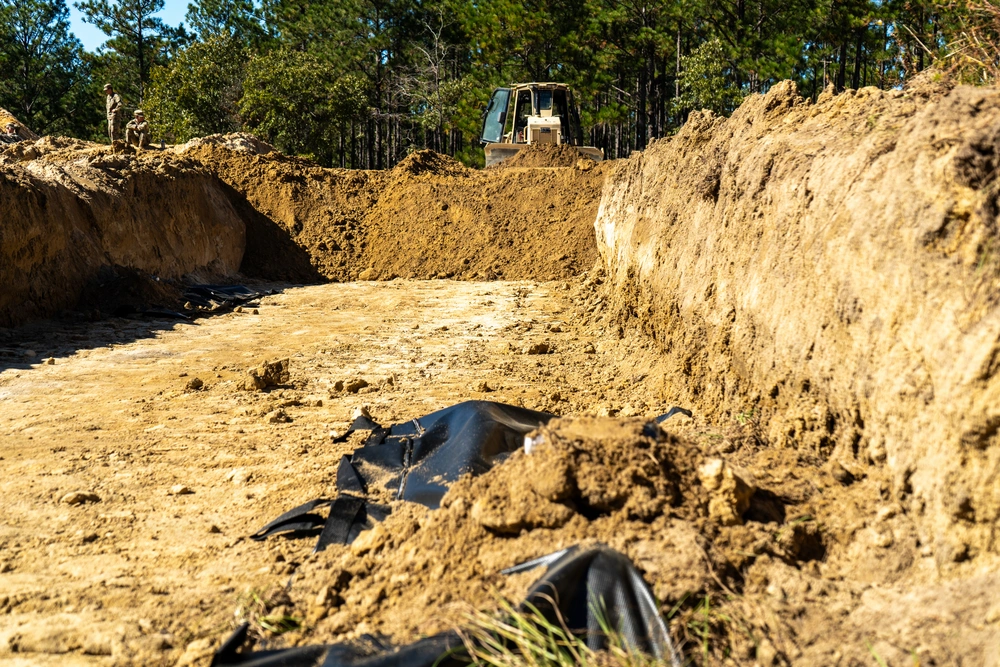
Soldiers in North Carolina are now engaging in ‘Operation Dragon Covenant‘ – digging mass graves for the first time since the Korean War, nearly 75 years ago.
The exercise near Fort Bragg’s St. Mere Eglise Drop Zone involves engineers, mortuary specialists, medical teams and chaplains.
Army engineers are using D6 bulldozers to dig long trenches designed to hold a mass number of fallen service members. They are testing how quickly those graves could be filled without damaging remains.
The Army used simulated skeletons and sealed water containers in place of real bodies.
“If we went to war tomorrow, we would be making this up as we went along. What we are doing here is taking a scientific, field-tested approach so that we can maintain positive control and respectfully care for our fallen,” said Sgt. 1st Class Delbert Ruede in a press release.
Why Is The Army Practicing This Now?
The Army is preparing for a very different kind of war than Iraq or Afghanistan.
During those conflicts, the U.S. usually controlled the skies and maintained reliable transportation routes. Fallen troops could often be quickly moved from the battlefield and returned home.
A major war against a powerful military could overwhelm that system.
Airfields could come under attack. Aircraft could become unavailable. Refrigerated storage could fill up, and transportation routes could be cut.
In that situation, the Army says temporary burial may become necessary until fighting slows enough to recover and return the dead.
“We realized quickly that the existing measurements in the book didn’t accommodate the physical reality of the equipment,” Ruede said. “To prevent running over the remains, we expanded the trench to a 15-foot width and maintained a nine-foot pillar of undisturbed soil between each trench. That undisturbed pillar allows the dozer to drive along the center corridor and cast dirt inward to backfill without exerting direct downward pressure on the remains.”
The military calls this type of conflict large-scale combat operations, or LSCO.
Army planners have warned that a war involving a major adversary could produce casualties far faster than the military experienced during the post-9/11 conflicts.
Army Tests Ability To Handle Thousands Of Fallen Troops
The scale of the exercise is perhaps its most startling detail.
Engineers completed a trench capable of holding 20 remains in about one hour and 15 minutes.
Based on those results, Army planners calculated that a company using eight bulldozers and four specialized excavators could prepare and close temporary graves for up to 2,400 fallen troops in 24 hours.
That does not mean the Army expects 2,400 soldiers to die every day.
It shows how quickly the equipment could operate during an extreme mass-casualty event.
About 130 military chaplains and religious-support personnel also participated, including troops connected to the 82nd Airborne Division, 101st Airborne Division, Fort Bragg and Special Forces units.
They practiced how to support troops and honor the dead when individual funerals may be impossible.
What This Means For North Carolina
The exercise does not mean Fort Bragg is preparing actual mass graves for North Carolina residents.
It does show a major shift in what the Army believes it must prepare for.
For decades, American forces operated with the expectation that fallen troops could be quickly removed from battlefields.
Now the Army is actively preparing for a war severe enough that thousands of casualties could overwhelm that system, forcing soldiers to temporarily bury their own until they can safely bring them home.
Operation Dragon Covenant is expected to continue with another phase testing nighttime operations, security forces and a full mortuary collection point.