
A hazmat response at a Charlotte chemical plant this morning has left at least one worker hospitalized and a local evacuation.
A Chemical Accident at DyStar Chemical Corporation
Emergency crews rushed to the DyStar Carolina Chemical Corporation facility on Wilkinson Boulevard early Friday afternoon following reports of a hazmat incident. According to company officials, an object accidentally leaned against a chemical tank, causing pressure to build up inside and pushed material out.
Multiple Charlotte area emergency and HAZMAT crews are now on scene, including the Charlotte Fire Department and MEDIC.
While the company clarified that no chemical explosion occurred and the building sustained no damage, at least one worker was hospitalized.
Industrial Dangers in the Carolinas
When a factory experiences a leak, the surrounding community often bears the consequences. For years, activists have warned that standard zoning laws do not do enough to keep dangerous operations far away from where people sleep and children play. Now, a massive battle over this exact issue is unfolding just across the state line in York County.
The Silfab Crisis in Fort Mill
Silfab’s Hazardous Materials Inventory: Vastly More Dangerous Than DyStar
Silfab’s official Hazardous Materials Inventory System (HMIS) report, DES Air Permit, and Industrial Wastewater Treatment Plans all detail massive quantities of chemicals that far exceed MMA in acute toxicity, corrosivity, reactivity, and potential for chain-reaction disasters. The Wastewater Treatment/Chemical storage area is classified as a High-Hazard Group H-3/H-4 occupancy because quantities vastly exceed Maximum Allowable Quantities (MAQs) under the South Carolina Fire Code.
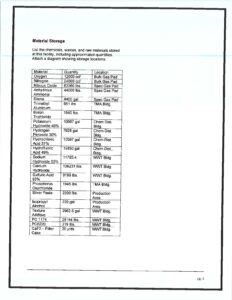
Silfab’s full list of chemicals and the quantities they would need to store on site.
Key chemicals and quantities include:
- Hydrofluoric Acid: 17,435 gallons in bulk storage
- Anhydrous Ammonia: 1,020,408 cubic feet in exterior bulk storage
- Silane Gas (SiH₄): 289,210 cubic feet in tube trailers (pyrophoric)
- Liquid Oxygen (LOX): 13,000 gallons (powerful oxidizer)
- Nitrous Oxide (N₂O): 245,614 cubic feet (oxidizing gas)
- Trimethylaluminum (TMA): 100 gallons in a dedicated 4-hour fire-rated H-3 building (extremely pyrophoric and water-reactive)
- Phosphorus Oxychloride (POCl₃): 59.4 gallons (plus process quantities; violently water-reactive, releases HCl gas)
- Boron Trichloride (BCl₃): 1,348 cubic feet (corrosive/toxic gas; reacts with moisture to form HCl fumes)
- Sulfuric Acid: 1,500 gallons
- Additional bulk corrosives: Hydrochloric Acid and Potassium Hydroxide at 11,095 gallons each, plus Hydrogen Peroxide at 7,978 gallons.
Real-World Precedents: These Exact Chemicals Have Already Caused Mass Casualties
History shows the deadly consequences of these chemicals — especially when stored or handled in large quantities:
- Silane Gas: Silane is notoriously pyrophoric and has caused a long history of fatal explosions in semiconductor and solar/PV manufacturing. A 2023 overview of silane incidents documents at least 12 fatalities across major events, including two separate backflow incidents (1988 in the US and 1991 at Osaka University in Japan) that each killed 5 people when nitrous oxide contaminated silane cylinders, creating explosive mixtures. Gas cabinet explosions alone have caused 7 fatalities worldwide between 1976 and 2012, often due to human error during cylinder changes. In solar plants specifically, silane leaks have led to fires, explosions, and worker deaths, including a 2007 incident in India that decapitated a worker and a 2005 Taiwan factory explosion that killed one worker and shut down production for months.
- Anhydrous Ammonia: In September 2023, a tanker truck carrying anhydrous ammonia overturned in Teutopolis, Illinois, releasing approximately 15,000 liters (~4,000 gallons). The resulting toxic vapor cloud killed five people (including a father and his two young children) and injured seven others. Hundreds of residents within a 1.6 km radius were evacuated. This was from a single tanker — far smaller than Silfab’s stored inventory of over one million cubic feet.
- Hydrofluoric Acid: A 2015 HF leak in China injured 253 workers, demonstrating the chemical’s ability to cause rapid systemic poisoning, severe burns, and cardiac effects even from limited exposure.
- Sulfuric Acid: In September 2025 at Hexin Chemical Industry in Henan Province, China, a sulfuric acid leak reacted in a septic tank to produce hydrogen sulfide gas, killing five people in a factory restroom.
These incidents involved the exact same classes of chemicals Silfab stores and uses in much larger volumes.
Why Silfab’s Placement in a Light Industrial Zone Is So Alarming
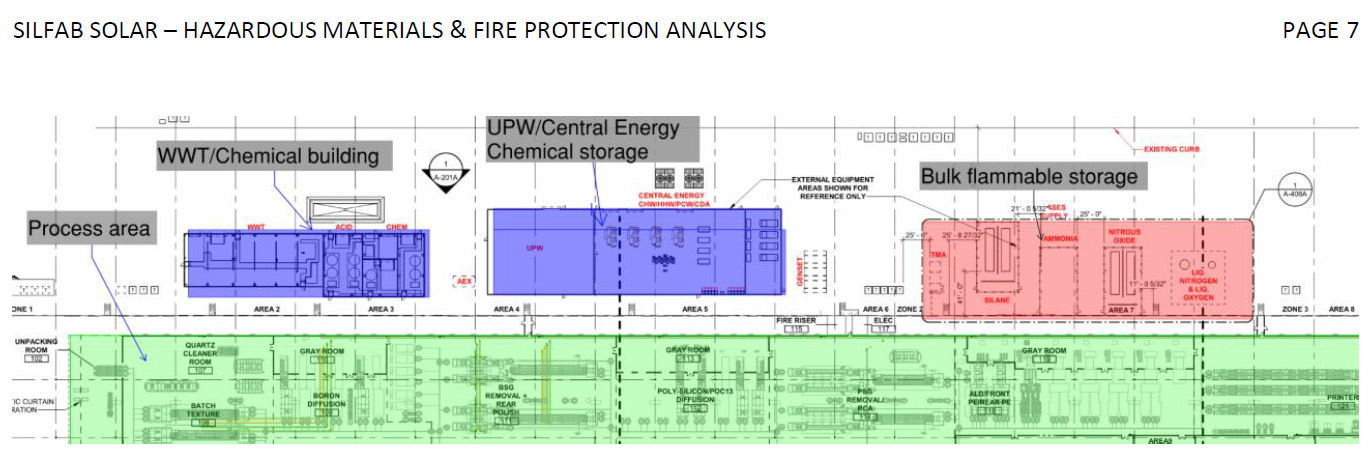
via Silfab’s HMIS
 Silfab’s operation is not light industrial assembly — it is a full-scale chemical manufacturing plant using High-Hazard Group H-3/H-4 processes and quantities. Placing it in a light industrial zone next to an elementary school and residential areas creates unacceptable risk. Real-world accidents prove that leaks, backflows, rollovers, or unintended reactions with these chemicals can kill or injure dozens to hundreds of people in minutes through toxic plumes, fires, explosions, and systemic poisoning.
A failure at Silfab could trigger cascading reactions: TMA or silane igniting spontaneously and being supercharged by LOX or nitrous oxide; POCl₃ or boron trichloride releasing HCl gas clouds; HF causing delayed cardiac arrests; ammonia forming ground-hugging lethal plumes; and sulfuric acid generating exothermic steam explosions and acidic mists.
Community impacts could be devastating:
- Children at Flint Hill Elementary facing immediate corrosive burns, respiratory failure, or cardiac effects from HF.
- Nearby homes and residents suffering toxic contamination and long-term health damage.
- Drivers on Logistics Lane and I-77 trapped in drifting plumes, leading to mass casualties and accidents.
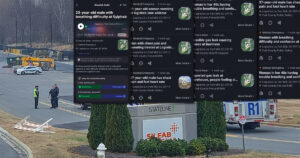 Previous smaller releases at Silfab (KOH spill and HF leak in March 2026) already preceded school closures and 911 surges, including vomiting blood, trouble breathing, and seizures. A major event would dwarf Charlotte’s DyStar accident this morning.