

Mindfulness Helps You Notice Patterns

0

Most habits do not feel like decisions while they are happening. You reach for your phone before getting out of bed, agree to a request before checking your schedule, or buy something online after a stressful day. The action feels natural because your mind has practiced the sequence so many times that it no longer requires much attention.

Money habits work the same way. You can create a zero based budget and assign a purpose to every dollar, but the plan may still be disrupted by patterns you have not noticed. A difficult conversation may lead to convenience spending. A quiet weekend may trigger online shopping. An unexpected bill may cause you to avoid checking your accounts for several days.

Mindfulness makes these patterns easier to see. It creates a small pause between what happens and what you do next. Inside that pause, you can observe your thoughts, emotions, and physical reactions before an automatic habit takes control.

Autopilot Is Useful Until It Is Not

Autopilot is not automatically harmful. It allows you to complete familiar tasks without carefully thinking through every step. You can brush your teeth, prepare coffee, or drive a familiar route while using relatively little mental effort.

Problems appear when autopilot controls behaviors that deserve a fresh decision.

You may automatically become defensive whenever someone questions your work. You might open a shopping app whenever boredom appears. Perhaps you avoid difficult conversations until resentment becomes impossible to hide.

These habits often began for a reason. Defensiveness may once have protected you from harsh criticism. Shopping may have provided relief during a lonely period. Avoidance may have helped you stay safe in a home where disagreement led to conflict.

A pattern can continue long after the original conditions have changed.

Mindfulness helps you notice when an old response is being applied to a new situation. It allows you to ask whether the habit is still useful rather than assuming that familiar means necessary.

The Trigger Usually Arrives Before the Story

Every recurring pattern has a beginning.

Sometimes the trigger is obvious, such as an upsetting email, an argument, or an unexpected expense. Other triggers are quieter. Hunger, fatigue, loneliness, physical tension, or a particular tone of voice can start a familiar reaction before you consciously understand what is happening.

The body often notices first.

Your shoulders tighten. Your breathing becomes shallow. Your stomach feels uncomfortable. Your face becomes warm. These sensations may appear seconds before the mind begins building a story around them.

A delayed reply becomes proof that someone is ignoring you. A mistake becomes evidence that you are incompetent. A financial setback becomes confirmation that you will never get ahead.

Mindfulness trains you to notice the sensation before fully accepting the story.

You might observe, “My chest feels tight, and I am having the thought that this will end badly.” That statement creates distance. It acknowledges the experience without treating the first interpretation as a confirmed fact.

A Pause Does Not Need to Be Long

People sometimes imagine mindfulness as a lengthy meditation practiced in complete silence. Formal meditation can be valuable, but the pause between a trigger and a response may last only a few seconds.

You can take one breath before replying. You can place an item in your online cart without purchasing it immediately. You can notice that your voice is becoming louder and choose to lower it.

The pause does not remove the emotion. It gives you enough time to decide what the emotion should be allowed to do.

According to the American Psychological Association overview of mindfulness, mindfulness involves awareness of internal states and surroundings and may help people avoid destructive or automatic responses. (American Psychological Association)

The goal is not to become slow or hesitant about everything. It is to interrupt the moments when speed is serving a habit rather than your values.

Judgment Can Hide the Pattern

When people notice an unwanted behavior, they often move immediately into criticism.

“I am so irresponsible.”

“I always ruin everything.”

“I should know better by now.”

These statements feel like accountability, but they contain very little useful information. They turn a specific behavior into a broad judgment about identity.

Judgment can also make observation less accurate. When you expect to find evidence that you are lazy, selfish, or undisciplined, you begin interpreting every mistake through that belief.

Mindfulness asks you to describe what happened before deciding what it means.

You might say, “I spent more than planned after a stressful meeting,” or, “I avoided opening the bill because I felt ashamed.”

These statements are specific. They identify the behavior, the trigger, and the emotional context. That information can guide a practical response.

You cannot change a vague identity judgment. You can change a repeated sequence.

Negative Self Talk Often Repeats Old Language

The voice inside your head may sound personal, but much of its language was learned.

You may repeat messages from parents, teachers, former partners, supervisors, or social expectations. Perhaps mistakes were treated as proof of weakness. Maybe asking for help was considered embarrassing. You may have learned that rest was laziness or that financial success determined personal worth.

Over time, these messages can become automatic thoughts.

Mindfulness helps you hear the exact words instead of experiencing them as unquestioned truth.

When a mistake happens, notice the first sentence that appears. Is it accurate? Is it useful? Does it describe the event, or does it attack your entire identity?

You do not need to replace every negative thought with exaggerated praise. A balanced response is often more believable.

Instead of “I am a failure,” try, “I made a decision that created a problem, and I can decide what to do next.”

The second statement does not remove responsibility. It keeps responsibility connected to action.

Stress Loops Feed Themselves

A stress loop occurs when a reaction creates conditions that produce more of the same stress.

Consider financial avoidance. You feel anxious about money, so you avoid checking your accounts. Because you do not check them, you miss a payment or continue overspending. The situation becomes more serious, which creates even more anxiety.

A similar loop can develop with sleep. Stress keeps you awake, exhaustion makes the next day harder, and the difficult day creates more stress at night.

Mindfulness helps by revealing where the loop can be interrupted.

You may not control the original stressor, but you can observe the moment when anxiety turns into avoidance. Instead of reviewing every account, you might check one balance. Instead of solving the entire financial problem, you could open one statement.

A small interruption changes the sequence. Repeated interruptions can gradually weaken the pattern.

Physical Sensations Offer Early Warnings

The body often provides useful information before a behavior becomes difficult to stop.

You may notice restlessness before opening social media, tension before becoming defensive, or fatigue before making an impulsive purchase. These sensations can act as early warning signals.

A simple body check can help.

Pause and notice your jaw, shoulders, chest, stomach, and hands. Ask whether anything feels tight, heavy, warm, numb, or unsettled. Then identify what happened immediately before the sensation appeared.

This practice does not require a special setting. You can do it at your desk, in a store, or during a conversation.

The purpose is not to remove every uncomfortable sensation. It is to recognize that your body may be signaling a familiar pattern.

Once you know that a tight chest often appears before you agree to something you do not want to do, the sensation becomes useful information. It reminds you to pause before answering.

Financial Patterns Often Follow Emotional Patterns

Spending is frequently treated as a math problem, but the transaction may be the final step in an emotional sequence.

You feel excluded, so you buy something that helps you feel more successful. You feel tired, so you pay for convenience. You feel uncertain, so you save aggressively and refuse reasonable expenses.

Mindfulness helps you observe what money is being asked to provide.

Before an unplanned purchase, ask what you are feeling and what you expect the transaction to change. Are you buying the object, or are you seeking comfort, control, excitement, or approval?

The purchase may still be worthwhile. Mindfulness does not require refusing everything that has an emotional component. Nearly every meaningful purchase has one.

The goal is to choose consciously. When you know what need is present, you can decide whether spending is the best way to meet it.

Patterns Become Visible Through Simple Notes

Memory is selective. You may remember a dramatic mistake while overlooking the smaller events that repeatedly led to it.

Writing brief notes can reveal connections that are difficult to see from memory alone.

Record the situation, emotion, thought, physical sensation, and action. The entry does not need to be long.

For example:

“I received critical feedback. My shoulders tightened. I thought I was about to lose the client. I ordered food and avoided the project for the rest of the evening.”

After several entries, patterns may appear. Certain people, times of day, environments, or emotions may show up repeatedly.

This is not a diary of personal failures. It is a collection of evidence about how your habits operate.

Patterns that seem random often become predictable when enough details are recorded.

Mindfulness Creates Choice, Not Perfect Control

Noticing a pattern does not guarantee that you will immediately change it.

You may recognize that stress is triggering an impulsive purchase and still make the purchase. You might notice that you are becoming defensive and still say something you regret.

Awareness is the beginning of change, not its completion.

At first, you may notice the pattern only afterward. Later, you may recognize it while it is happening. With practice, you may begin seeing it before the response starts.

Each stage matters.

The purpose of mindfulness is not to control every thought or emotion. That expectation can become another source of frustration. The purpose is to increase the number of moments in which a choice becomes possible.

Even choosing differently once out of five times can begin changing the habit.

A Healthier Response Should Meet the Same Need

Removing a behavior without understanding its purpose often creates an empty space.

If shopping provides excitement, simply banning shopping may leave boredom untreated. If avoidance protects you from shame, demanding immediate confrontation may feel overwhelming. If anger helps you feel powerful, telling yourself to remain calm may feel like surrender.

A replacement response works better when it addresses the same underlying need.

You might replace browsing with another enjoyable activity. You could review difficult financial information with a trusted person instead of facing it alone. You may express anger through a clear boundary rather than an explosive argument.

The new response does not need to create the same instant relief. It needs to be realistic enough that you can choose it when the trigger appears.

Mindfulness identifies the moment of choice. A practical alternative gives that choice somewhere to go.

Formal Practice Can Strengthen Everyday Awareness

Meditation is one way to practice noticing thoughts and sensations without immediately reacting.

You might sit quietly for a few minutes and focus on breathing. When attention moves to a worry, memory, or sound, you notice the shift and gently return to the breath.

The exercise is not about keeping the mind perfectly empty. The act of noticing that attention wandered is part of the practice.

The National Center for Complementary and Integrative Health review of meditation and mindfulness discusses evidence related to stress, anxiety, depression, sleep, and other areas while also noting that research quality and individual experiences vary. (NCCIH)

Formal practice may help some people become more familiar with observing thoughts rather than immediately following them. It is a skill, not a test of how calm or spiritual you can become.

Mindfulness Should Not Become Another Judgment

It is possible to turn mindfulness into a new standard for criticizing yourself.

You may become frustrated because your attention wanders, your habits continue, or you cannot remain calm during a stressful moment. You might decide that you are doing mindfulness incorrectly.

That reaction is another pattern worth noticing.

The mind wandered. You noticed. That is the practice.

You reacted automatically. You recognized it afterward. That is useful information.

Progress often appears as earlier recognition rather than complete prevention. A pattern that once controlled an entire day may eventually last one hour. Later, it may last ten minutes.

Mindfulness is not about becoming a person who never reacts. It is about becoming more aware of how reactions begin, what they are trying to accomplish, and whether they still serve you.

Patterns Lose Power When They Become Visible

Automatic habits are strongest when they remain unnamed.

A trigger appears, the familiar story begins, and the response follows so quickly that it feels unavoidable. Mindfulness slows the sequence enough for its parts to become visible.

You notice the tight shoulders. You hear the negative sentence. You recognize the urge to avoid, spend, argue, or withdraw.

Then you have a chance to choose.

The healthier response may be small. One breath. One delayed purchase. One honest sentence. One opened statement.

These moments do not look dramatic, but they change the pattern at its most important point. They place awareness between the trigger and the reaction.

Mindfulness does not promise that every habit will disappear. It gives you a clearer view of the habits shaping your days.

Once you can see a pattern, you are no longer completely inside it. You are in a position to decide whether it deserves to continue.

SHR Miner has launched a free cloud mining service for holders of BTC, XRP, and ETH, offering daily earnings of $10,700 or more

0

As cryptocurrency gains increasing global popularity, more and more investors are looking for ways to generate steady passive income without the need for expensive equipment or specialized skills.

SHRMiner’s new free mining service enables holders of BTC, XRP, and ETH to easily earn passive income without requiring costly hardware or technical expertise.

In the rapidly evolving world of cryptocurrency, ease of use and high returns are paramount. For those seeking an accessible way to earn a steady income with minimal hassle, cloud mining stands out as a highly attractive option. This article delves into the concept of cloud mining and—using the leading brand SHRMiner as an example—explains how it can help you generate daily earnings of $10,700 or even more.

The Appeal of Cloud Mining

Cloud mining has long been favored by cryptocurrency enthusiasts for its ease of use and convenience. Unlike traditional mining, it eliminates the need for expensive hardware, specialized technical expertise, or constant monitoring. Cloud mining simplifies the process, enabling anyone—regardless of experience level—to participate in the cryptocurrency revolution. Instead of investing in costly mining equipment and managing complex systems, users can simply rent mining capacity from remote data centers and earn a share of the profits.

Recently, SHRMiner, a UK-based cloud mining platform, officially launched a new “free cloud mining service.” This service is designed for holders of mainstream cryptocurrencies such as BTC, XRP, DOGE, LTC, and EHT, providing users with a new opportunity to participate in cryptocurrency mining without any entry barriers.

At the same time, SHRMiner has launched a new mobile app that enables users to manage their mining activities anytime, anywhere, effectively ushering in the “era of mobile mining.”

SHRMiner: The perfect blend of laziness and profit

SHRMiner takes the simplicity of cloud mining to the next level, making it an ideal choice for beginners. Its user-friendly interface ensures that even those new to cryptocurrency can get started with ease. For SHRMiner, simplicity is not a drawback but a pathway to success. As a pioneer in cloud mining, SHRMiner operates over 150 mining farms worldwide—equipped with more than 600,000 mining units powered entirely by renewable energy—and has earned the trust and support of over 5 million users thanks to its stable returns and robust security.

How can SHRMiner become a source of passive income?

You can start earning mining rewards in just three simple steps:

  1. Register an account

By visiting the official SHRMiner website, users can register for a free account in less than two minutes and receive a $15 sign-up bonus; this bonus allows them to quickly experience the platform’s services and earn a daily return of $0.60 from a complimentary trial contract.

  1. Select a cloud mining plan

Choose a cloud mining plan that suits your needs and budget. The platform offers flexible plans ranging from $100 to $200,000 to meet the investment goals of different users.

  1. Start earning returns

After purchasing a contract, earnings are automatically settled within 24 hours without requiring additional management or action; users can withdraw their earnings to their cryptocurrency wallet addresses at any time or reinvest the profits to benefit from the compounding effect.

The primary advantage of this model is that it significantly lowers the barrier to entry. Users do not need to research specific mining hardware models or hashrate configurations, nor do they need to set up their own system environments; simply by registering an account, depositing assets, and selecting a mining plan, they can start earning returns.

SHRMiner Platform Advantages:

  • Supports daily automatic settlement
  • No additional electricity or maintenance costs required
  • Utilizes advanced ASIC mining hardware, powered by renewable energy sources including hydropower, wind power, and solar power
  • Supports mining for multiple currencies: earn mainstream cryptocurrencies such as BTC, XRP, ETH, DOGE, USDC, USDT, SOL, LTC, and BCH.
  • Equipped with SSL encryption and DDoS protection, a real-time earnings dashboard for easy monitoring of mining performance
  • 100% remote access, fully accessible via the SHRMiner application or browser without hardware requirements, and 24/7 online technical support.

⦁Affiliate Program: The Affiliate Program allows you to earn up to 4.5% commission by referring friends, with the opportunity to earn an additional bonus of up to 30,000.

Examples of common contracts:

After purchasing a contract, earnings will be automatically credited to your account within 24 hours. Upon contract expiration, your principal will be returned in full. You may withdraw the principal or reinvest it to benefit from compound returns; please click here for more details regarding the mining contract.

Unimaginable money-making opportunities

What sets SHRMiner apart is its extraordinary daily passive income; users have the opportunity to earn $10,700 or even more each day, turning the dream of online wealth into reality. Imagine generating substantial income without the need for ongoing investment or complex setups—that is exactly what SHRMiner offers.

Safety and Sustainability

In the mining sector, trust and security are paramount; SHRMiner fully recognizes this and prioritizes user safety above all else. Committed to transparency and legitimacy, SHRMiner ensures your investment is protected, allowing you to focus on profitability. All mining facilities utilize clean energy, making this a carbon-conscious cloud mining operation. Renewable energy protects the environment from pollution while providing a powerful energy source.

In short

If you are looking for ways to generate passive income, cloud mining is an excellent choice. When approached correctly, these opportunities allow you to effortlessly build cryptocurrency wealth on “autopilot” with minimal time investment. At the very least, they are far less time-consuming than any form of active trading. Passive income is the ultimate goal for every investor and trader, and with SHRMiner, maximizing your passive income potential is easier than ever.

To learn more about SHRMiner, please visit the official website: https://shrminer.com

Charlotte Federal Grand Jury Indicts Woman in Alleged $9 Million Taxpayer Fraud Scheme

0

A North Carolina woman has just been indicted on federal charges after prosecutors accused her of orchestrating a multimillion-dollar scheme to steal money from a federal program created to compensate farmers who experienced discrimination.


A federal grand jury in Charlotte charged 64-year-old Linda Faye Hough with one count of mail fraud and six counts of making false or fraudulent claims involving more than $9 million in applications submitted to the U.S. Department of Agriculture’s Discrimination Financial Assistance Program (DFAP).

According to the indictment, Hough allegedly submitted fraudulent applications for herself and others between January and August 2024, falsely making applicants appear eligible for compensation. Prosecutors also allege she received kickback payments from some recipients after they were awarded federal funds.

Investigators say the fraudulent applications resulted in approximately $9 million being distributed to Hough and other applicants.

The DFAP was created under the Inflation Reduction Act of 2022, which allocated $2.2 billion to compensate farmers, ranchers and forest landowners who experienced discrimination in USDA lending programs before January 2021. Awards were capped at $500,000 per applicant.

The investigation was led by the USDA Office of Inspector General and the FBI, with assistance from the North Carolina State Bureau of Investigation’s Financial Crimes Unit.

Hough made her initial appearance in federal court. If convicted, she faces up to 20 years in prison on the mail fraud charge and up to five years for each false claims count.

The charges are allegations, and Hough is presumed innocent unless proven guilty in court.

Charlotte’s Top Chefs Headed to the 2026 NCRLA Chef Showdown Grand Finale

0

Several of Charlotte’s top chefs are in the running for one of North Carolina’s highest culinary honors after advancing to the 2026 NCRLA Chef Showdown Grand Finale.

The North Carolina Restaurant and Lodging Association announced its 20 culinary finalists following regional semifinals in Raleigh and Charlotte. The group includes 15 chefs and five pastry chefs from some of the state’s top restaurants.

Charlotte is strongly represented with chef finalists:

  • Lewis Donald of Sweet Lew’s BBQ
  • Matt Moore of Customshop
  • Brandon Staton of Supperland
  • Ericka Torres of STOKE at the Marriott Charlotte City Center

Charlotte also claimed two pastry chef finalist spots with Josh Dobson of Peppervine and Lei Van Note of STOKE.

The Chef Showdown Grand Finale will take place September 2 at Bay 7 on Durham’s American Tobacco Campus. Guests will sample dishes from all 20 finalists while enjoying cocktails, North Carolina wines, meads and ciders.

Although judges have already selected the 2026 Chef of the Year and Pastry Chef of the Year, the winners will not be revealed until the Grand Finale. Guests will also vote for the People’s Choice Awards.

The final mixology semifinals are still ahead, with competitions set for August 3 in Wilmington and August 10 in Charlotte.

Tickets are $150 and include unlimited food and beverage tastings. The event is open to guests 21 and older.

Charlotte has 15th highest reliance on H-2A and H-2B workers

0

As the Trump administration moves to end Temporary Protected Status for several immigrant groups and employers continue to warn about labor shortages, researchers at Manifest Law analyzed where businesses rely most heavily on the H-2A and H-2B seasonal worker programs—two legal pathways employers use to fill temporary jobs when domestic workers are unavailable.
The analysis ranks metropolitan areas by seasonal foreign labor requests relative to the size of their local workforce, offering a detailed look at where employers depend most heavily on H-2A and H-2B workers to meet recurring staffing needs. It also identifies which occupations generate the greatest demand and how reliance on agricultural and non-agricultural seasonal foreign labor differs across the country.

Key Takeaways, With Data for Charlotte-Concord-Gastonia, NC-SC

  • H-2A and H-2B programs explained. The H-2A program allows agricultural employers to hire foreign workers for seasonal farm jobs when there are not enough available U.S. workers, while the H-2B program serves employers with temporary non-agricultural labor needs in industries such as landscaping, hospitality, seafood processing, construction, and recreation.
  • Agriculture dominates H-2A demand. Nationally, employers requested more than 533,000 crop workers through the H-2A program, far more than any other occupation.
  • Landscaping leads H-2B demand. Nationally, landscaping and groundskeeping workers accounted for nearly 79,400 requested H-2B positions—almost six times the next-largest occupation.
  • The Charlotte metro’s national ranking. The Charlotte metro ranked #15 among large U.S. metropolitan areas, with 25 requested seasonal foreign workers per 10,000 resident employees.
  • Balanced seasonal workforce. Roughly 50.2% of requested seasonal foreign workers in the Charlotte metro were requested through the H-2A agricultural program, compared with 49.8% through the H-2B non-agricultural program.
  • Scale of overall demand. Charlotte metro employers requested a total of 3,510 seasonal foreign workers during the study period. 1,761 were through the H-2A agricultural program, while 1,749 were through the H-2B non-agricultural program.

The full report ranks every state and over 850 metropolitan areas, with breakdowns by workforce concentration, total requested workers, and occupation. We’ve also included high-resolution downloadable graphics at the bottom of this email.

You can read the full report here https://manifestlaw.com/blog/cities-states-most-reliant-h2a-h2b-workers

Christi Cox Declares “No Action” as York County Council Ignores Judge’s Final Ruling on Silfab Manufacturing in Fort Mill

0

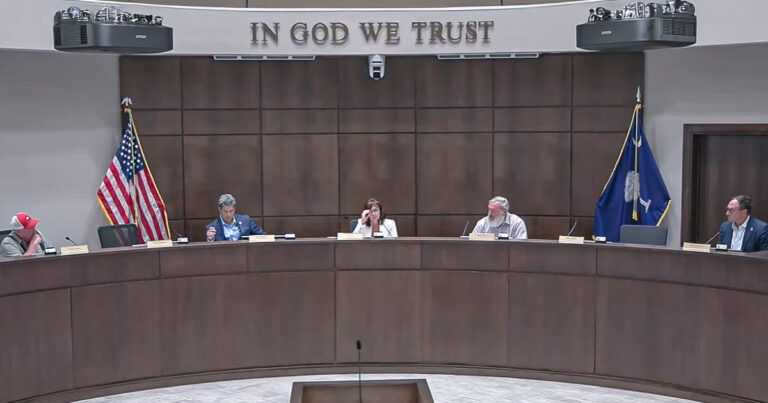
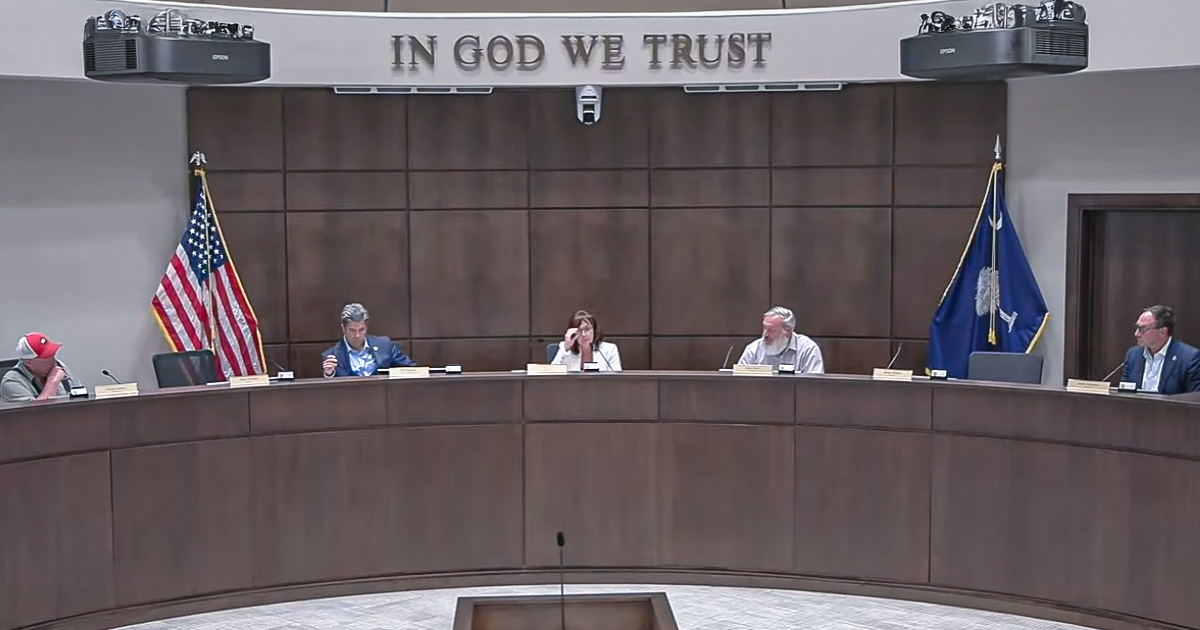
Last night the York County Council met to discuss the recent final ruling by Judge McKinnon regarding the Silfab manufacturing factory in Fort Mill. The order states Silfab Solar’s plant fails local zoning rules and the permits were not legally issued.

Silfab argued the ruling applies only to future permits. Company leaders claimed existing approvals remain valid. They also insisted the facility stays safe and compliant.

After nearly four hours in executive session, the council returned from the back room and Council Chairwoman Christi Cox spoke. “We are out of executive session. No action was taken,” adding, “The reason we called this meeting tonight was to receive legal advice regarding the order issued by Judge McInon on July 21st, we understand the order that was issued is not a final order.”

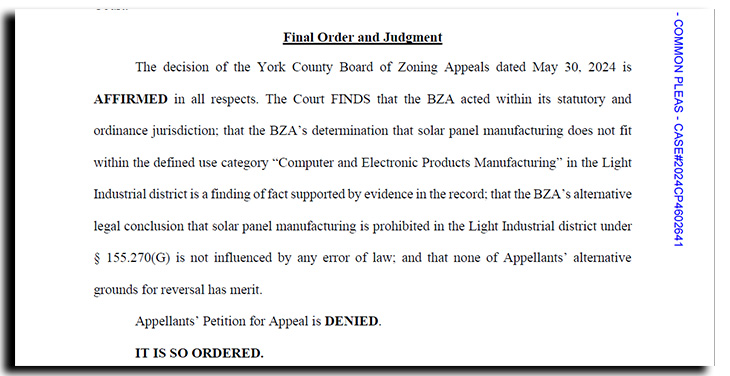
The signed order, however, clearly labels itself as a ‘final order’. It opens by reviewing Silfab and Exeter’s appeal of the May 30, 2024 ‘Final’ BZA decision. The conclusion reads clearly: “Final Order and Judgment. The decision of the York County Board of Zoning Appeals dated May 30, 2024 is AFFIRMED in all respects.”

The BZA voted 5-0 that solar-panel manufacturing is not permitted in the Light Industrial district. York County Code § 155.270(G) prohibits any use not listed in the tables. York County unlawfully issued Silfab all of their permits after the May 30th, 2024 BZA ruling – Silfab had no zoning compliance before the BZA ruled their proposed use as unlawful. The court upheld that finding under the any-evidence standard.

Yet Christi Cox and York County Council continue to ignore the law. They refuse to enforce the BZA ruling or the court’s July 21st final order. As a result, they fail to protect children at Flint Hill Elementary and Middle schools.

Meanwhile Silfab continues operations. The company stated on its website in March 2026 that cell and module manufacturing restarted, and they confirmed on July 21 that manufacturing operations are continuing. Multiple employees confirm both cell and module manufacturing are ongoing on site today.

via https://silfabsolarsc.com/2026/07/29/public-notice/

Workers inside are continuously suffering from vomiting blood, seizures, chest pain, and breathing emergencies at rates unmatched by any other solar manufacturing plant in the country.

Evidence now shows that Council Chairwoman Christi Cox and County Manager Josh Edwards’ staff not only fast-tracked the project — they back-dated permits, issued a Certificate of Occupancy without zoning compliance on February 13, 2026, and deliberately ignored their own laws to make it all happen.

In February 2024 a neighboring property owner asked the county to interpret whether Silfab’s operations were allowed at 7149 Logistics Lane. Zoning Administrator Rachel Grothe responded on February 16 that it was permitted under the vague “Computer and Electronic Product Manufacturing” use. The neighbor then appealed.

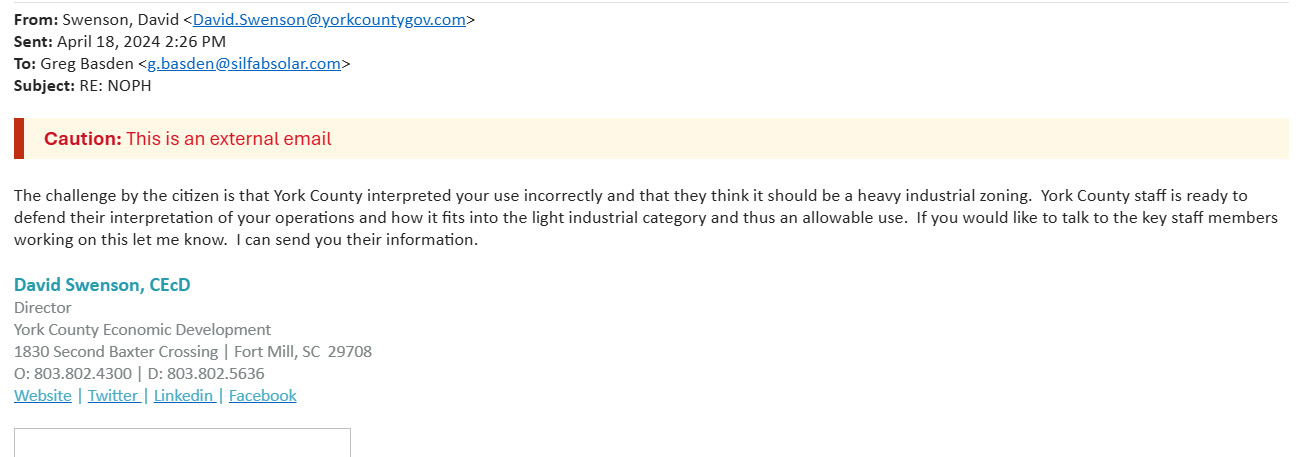
On April 18th, York County Economic Development Director David Swenson confirmed to Silfab’s Director of Operations, Greg Basden, that the upcoming BZA hearing was about Silfab’s operations.

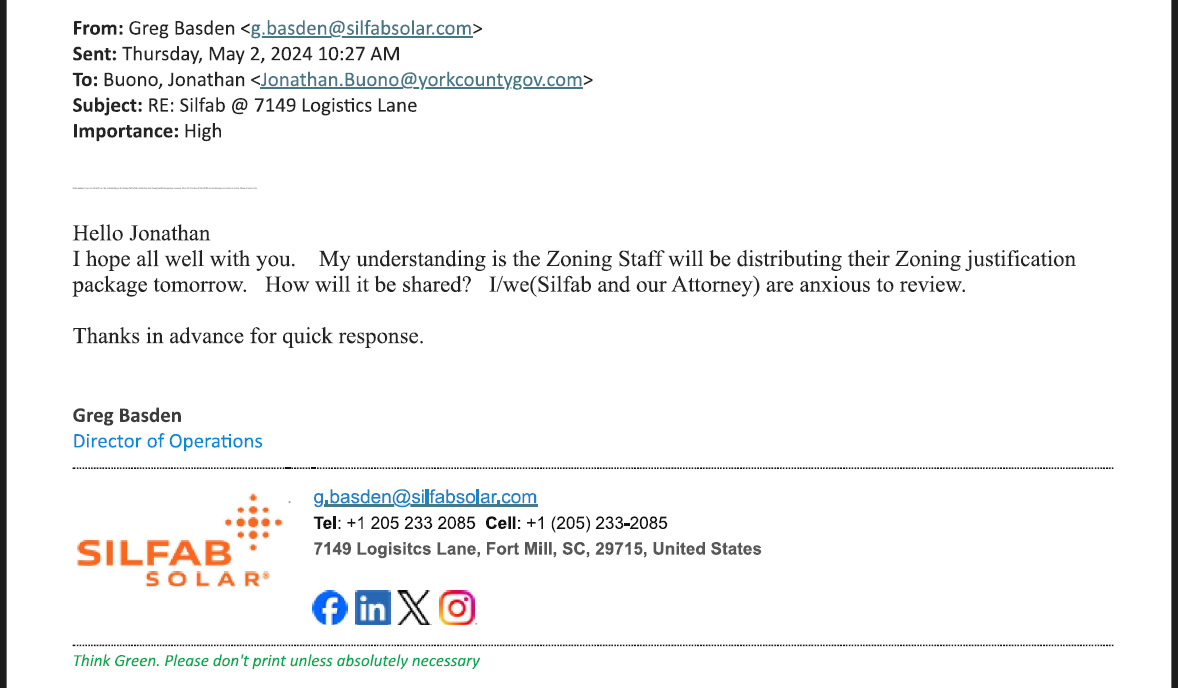
On May 2, 2024, Greg emailed county staff asking to review the county’s justification package.

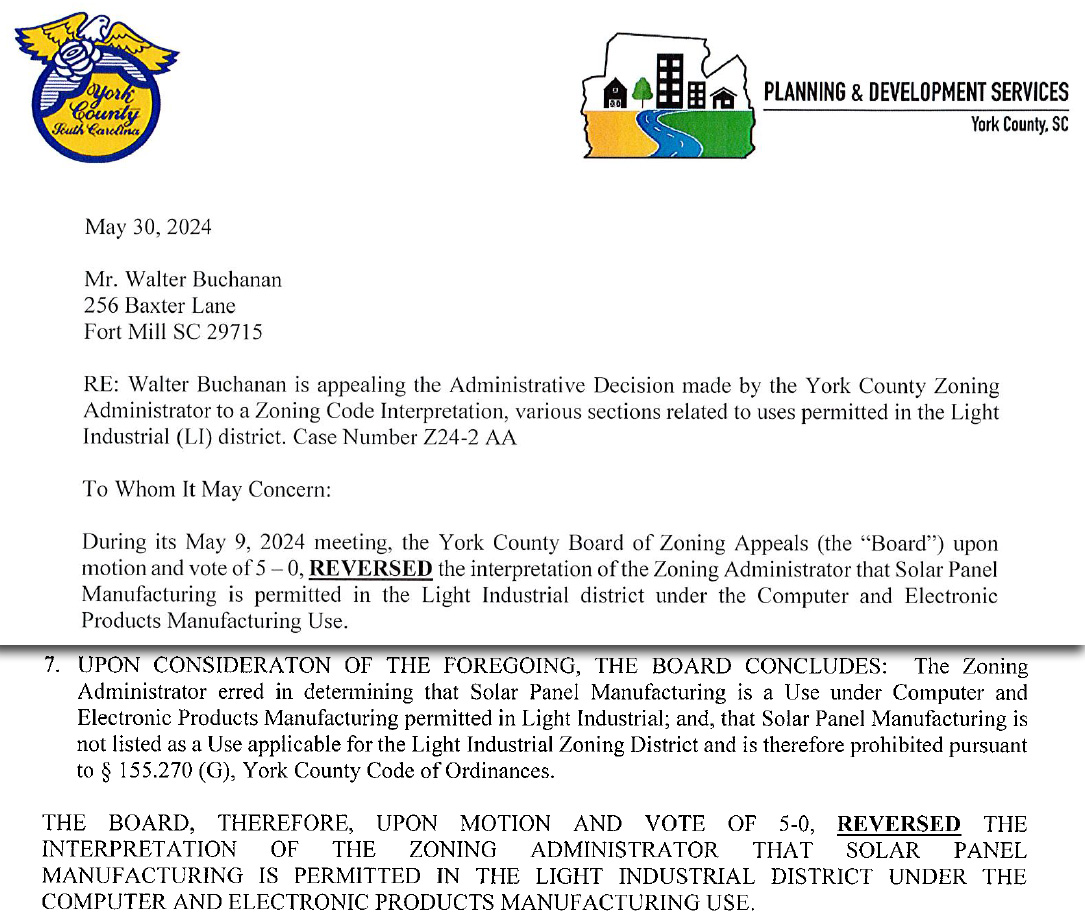
On May 9th, 2024, the Board of Zoning Appeals ruled 5-0 that Silfab’s operations were not allowed in a light industrial zone.

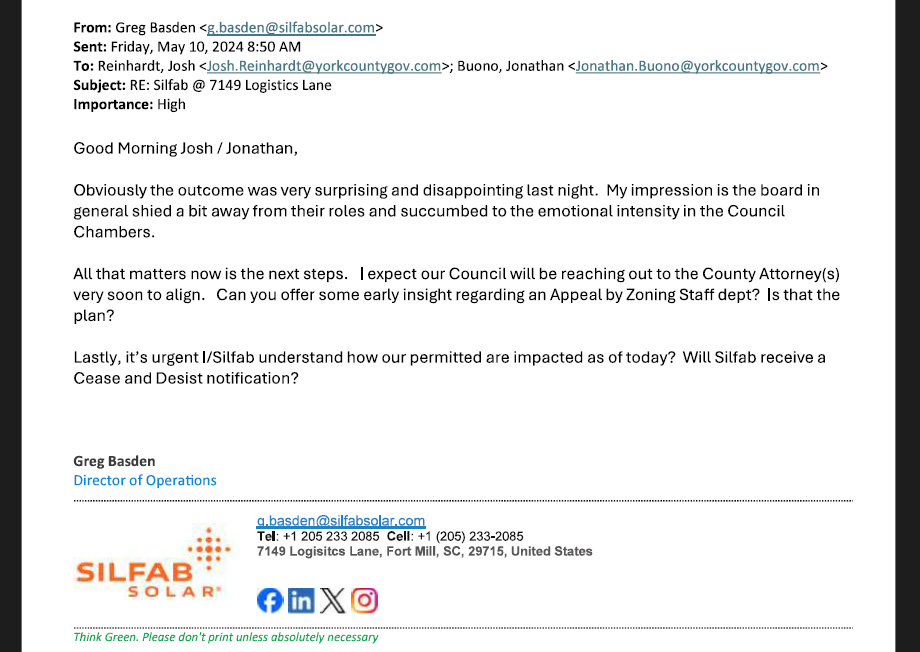
On May 10, 2024, Silfab’s Greg Basden emailed county officials asking point-blank if Silfab would be receiving a cease and desist:

On May 30 the BZA issued its written decision:

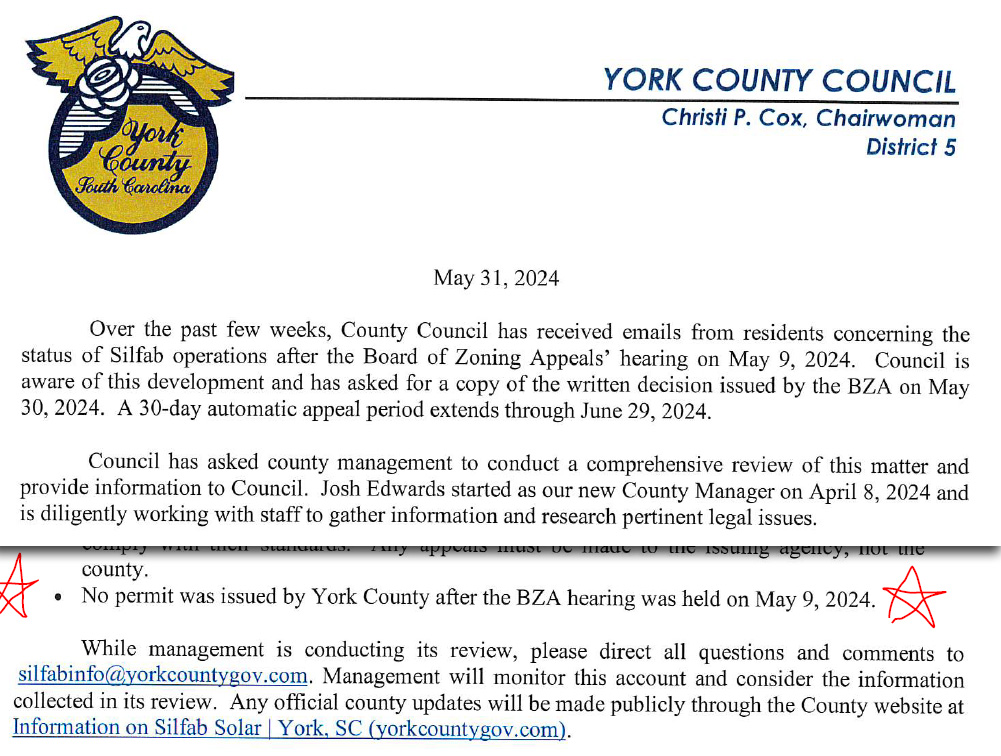
The very next day, May 31, 2024, Christi Cox signed a public letter telling residents that “No permit was issued by York County after the BZA hearing was held on May 9, 2024,” and that, Josh Edwards, who had started as County Manager on April 8, 2024, was “diligently working with staff to gather information and research pertinent legal issues.”

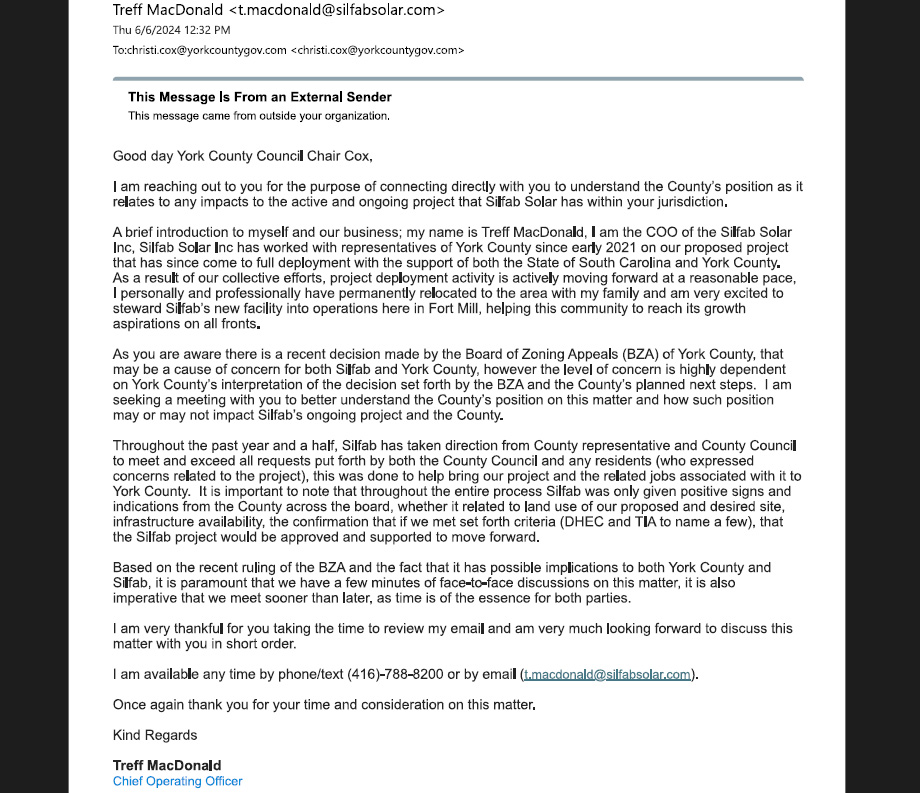
Silfab COO Treff MacDonald then asked for a meeting with Christi Cox a few days later on June 6th, saying “it is paramount that we have a few minutes of face-to-face discussions on this matter, it is also imperative that we meet sooner than later, as time is of the essence for both parties.”

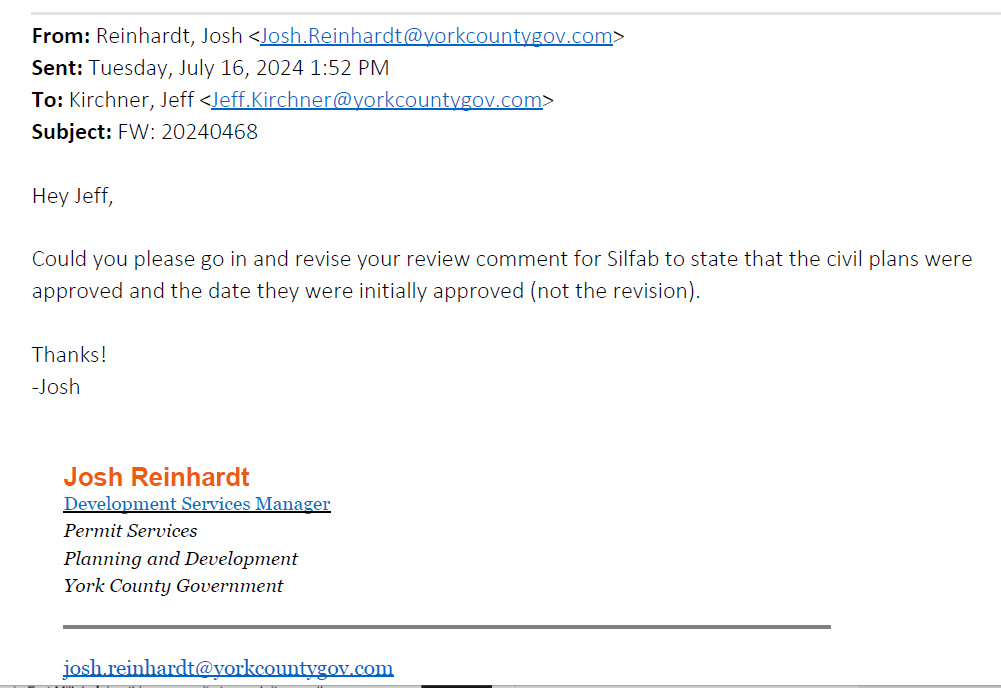
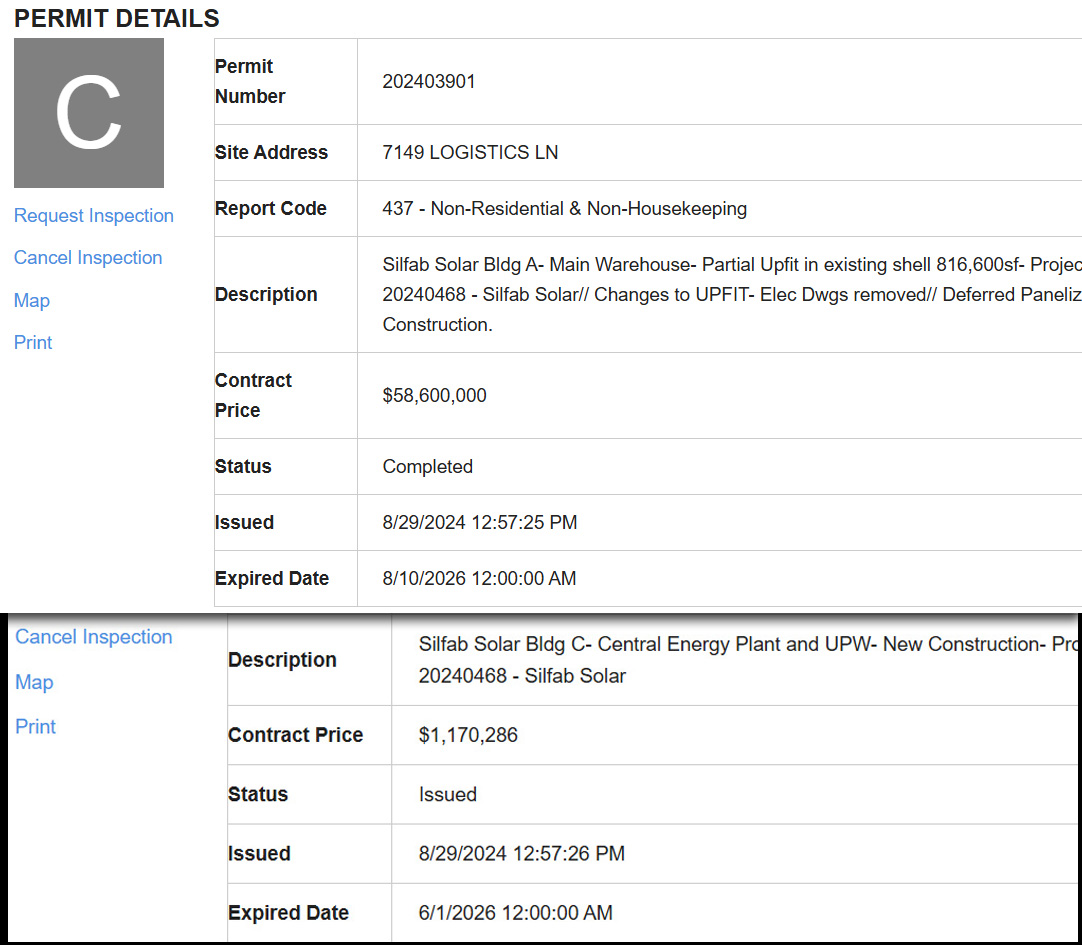
Internal emails also show that Cox and Edwards’ staff (including Reinhardt and Kirchner) discussing changes to approval dates. Silfab’s parking-lot civil plans were stamped April 24, 2024 — before the BZA hearing. The up-fit approval was dated July 16, 2024 — after the BZA reversal. The final “zoning compliance” stamp was back-dated to April 24 to pretend a valid approval existed before the BZA ruling and before citizens’ appeal window closed.

Roughly 1 month later, in August of 2024, Silfab began receiving all of their permits for the up fit of their main distribution building into a manufacturing factory, as well as the permits for the new construction of their chemical storage buildings and bunkers, wastewater treatment plant, and central energy plant.

These permits issued after the BZA ruling directly violated York County Zoning Code § 155.270(G), which states any use not expressly listed in the Use Tables “is prohibited.” It also violated York County Code § 155.262, which requires a formal Zoning Compliance application before any new or changed use can proceed. Silfab never filed one — it relied only on a 2022 non-binding “Zoning Verification” letter that county documents repeatedly describe as “not a permit or licensing” and “only states that the site can, with the proper permits, be used…”

Additional laws ignored include S.C. Code § 6-29-950 (unlawful to construct or occupy any building without a permit that complies with zoning ordinances) and S.C. Code § 6-29-800 (prohibiting the BZA from granting a variance that would allow a use not otherwise permitted).

Cox, Edwards, and the Council Vice Chair personally control what goes on the County Council agenda. Yet when two different council members publicly asked — twice — in open meetings that Silfab’s permits be placed on a future agenda, their requests were ignored. This was a direct, intentional violation of York County Code § 30.04(b), which mandates: “Any item … deferred from a proposed agenda shall be immediately placed on a future meeting agenda … by request of two members of Council.”

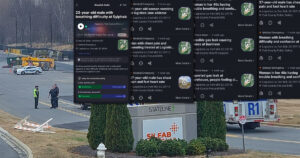
Under Christi Cox and Josh Edwards, the county continued issuing permits and ultimately the Certificate of Occupancy while a massive industrial operation loaded with hazardous chemicals moved forward next to Flint Hill Elementary School. Dispatch records show repeated 911 calls from inside the factory for workers vomiting blood (a 25-year-old woman on March 28, 2026), trouble breathing (a 23-year-old man on March 26, 2026), seizures (February 4, 2026), chest pain, high blood pressure, and cardiac symptoms — incidents that have occurred with alarming frequency and have no parallel at comparable solar plants.

The danger spilled over to the children. On one day in March 2026, while school was in session and kids were playing near the fence, 1,530 gallons of potassium hydroxide poured into the retention pond directly bordering Flint Hill Elementary. Days later a hydrofluoric acid leak forced the school to close for two days out of an abundance of caution. In response, Silfab pumped roughly 300,000 gallons of liquid from the retaining ponds for off-site disposal over a single weekend.

On March 10, 2026, the Fort Mill School Board passed a formal resolution demanding that Governor McMaster, the General Assembly, Attorney General Alan Wilson, and York County Council “permanently limit the facility’s operations strictly to non-hazardous assembly processes and remove all hazardous chemicals on site in accordance with the facility’s current light industrial zone.”

Even now, with the factory fully operational and the school regularly placed in harm’s way, Cox and Edwards have refused to place the matter on the council agenda despite two formal requests by fellow council members, and they have allowed the prohibited use to continue unchecked.

All records cited — the May 30 BZA decision, the May 31 Cox letter, the Silfab Processes Memo, internal staff emails (including Basden’s cease-and-desist inquiry and Buono’s response), the hazardous-materials inventory, dispatch logs, the School Board resolution, and the 300,000-gallon pump-out — are from FOIA (Freedom of Information Act) productions or public filings.

They paint a damning picture: under Christi Cox and Josh Edwards’ leadership and direction, their staff treated its own zoning code, council rules, public safety, and the health of elementary school children as optional while enabling a prohibited and dangerously toxic facility to begin operations within yards of elementary school children.

New Report: Charlotte Apartment Rents Decline as Thousands of New Units Hit the Market

0

Charlotte apartment renters are finally getting some relief. New data shows rents in the Queen City dipped slightly last month and are now lower than they were a year ago as a wave of new apartment construction continues to cool the market.

According to the latest Apartments.com Multifamily Rent Growth Report, average apartment rents in Charlotte fell 0.01% from June to July and are down 1.2% compared to July 2025.

Charlotte’s decline reflects a broader trend across many Sun Belt cities, where years of aggressive apartment construction have increased supply and eased pressure on renters.

Nationally, rents remained relatively stable during July, but growth has slowed considerably compared to recent years. Analysts say elevated apartment supply and more moderate demand continue to keep prices in check.

For renters, the softer market means landlords are facing more competition. Many apartment communities are offering concessions, including free rent, waived fees and other incentives to attract new tenants.

The cooling market follows an apartment construction boom that reshaped Charlotte over the past several years. Thousands of new units opened across neighborhoods including South End, Uptown, University City and the northern suburbs, giving renters more choices than they have had in years.

While rent growth has slowed, industry analysts don’t expect lower prices to last forever.

New apartment construction is projected to decline significantly over the next two years, which could eventually tighten supply and allow rents to rise again once demand catches up.

For now, however, Charlotte remains one of the more renter-friendly major housing markets in the Southeast, offering prospective tenants more negotiating power than they had just a few years ago.

Tiny Tega Cay Brewery Beats 8,000 Beers to Win 3 National Medals

0

A small brewery just south of Charlotte is once again proving it can compete with the biggest names in craft beer. Model A Brewing Company in Tega Cay brought home three medals at one of the nation’s largest beer competitions, beating out thousands of entries from around the world.

More than 8,000 beers were entered into the 2026 U.S. Open Beer Championship, one of the country’s largest brewing competitions, featuring breweries from across the United States and internationally.

via Model A Brewing

Model A Brewing earned one gold medal and two silver medals, adding to an impressive list of more than 30 major brewing awards since opening its doors in December 2020.

The Tega Cay brewery captured gold for UK Crusher in the Ordinary Bitter category. It also won silver for Dolcita IPA in the Single Hop Pale Ale category and silver for Amber Hearth in the Barrel Aged Dark Beer category.

Model A wasn’t the only local brewery to earn national recognition.

Several breweries from the greater Charlotte region also claimed medals during this year’s competition, including:

  • Primal Brewery in Huntersville, which won gold for Wheat Without Worry in the Non-Alcoholic Wheat category and bronze for Hops Mirage IPA in the Non-Alcoholic IPA category.
  • Forgotten Road Ales in North Carolina was also named Brewery of the Year in the 251-500 barrel production category.

The U.S. Open Beer Championship is considered the third-largest beer competition in the United States, with entries spanning more than 180 beer categories and subcategories. Judges evaluate beers based on style accuracy, aroma, flavor, appearance and overall quality.

For Model A Brewing, the latest awards continue a remarkable run of national success. Despite competing from a small lakeside brewery in Tega Cay, the company continues to earn recognition alongside some of the largest and most established breweries in the country.

DoorDash Just Earned Rare FAA Approval to Fly Drone Deliveries in Charlotte

0

DoorDash announced today that it has received FAA Part 135 air carrier certification, allowing it to launch DoorDash Air, its first in-house drone delivery program.

The certification is one of the FAA’s highest approvals for commercial drone operators. DoorDash is now just the eighth drone operator in the nation to earn it.

“We want drone delivery to work for any merchant, anywhere. We’re building the full stack to make that possible from the ground infrastructure to the drone itself, and the handoff systems that make it work together seamlessly,” said DoorDash Air Head Harrison Shih in a press release. “Advances in hardware, compute, and AI are creating extraordinary new capabilities for local commerce, and becoming a certified air carrier accelerates everything we’re building.”

DoorDash already offers drone delivery through its partnership with Wing in The Arboretum in south Charlotte, Matthews, Indian Trail, and Huntersville’s Northcross Shopping Center. The company has also explored expanding service into University City.

With DoorDash Air, the company plans to operate its own drone network instead of relying only on partners.

DoorDash says the new system will combine drones, landing infrastructure and AI-powered logistics to speed up local deliveries.

During pilot programs in 2025, drone orders arrived in an average of 25 minutes. Some participating merchants also saw DoorDash order volume increase by roughly 30% after drone service launched.

The company says drones are especially effective for deliveries between three and five miles. Moving those trips to drones allows Dashers to complete more nearby deliveries and potentially earn more.

DoorDash’s new aircraft is being designed and built in the United States by DoorDash Labs, with most components also manufactured domestically.

Despite the expansion, DoorDash says Dashers will continue handling the vast majority of its millions of daily deliveries. Human drivers remain essential for apartment buildings, large orders and deliveries drones cannot complete.

The company says FAA certification is only the beginning as it expands drone delivery alongside Dashers, autonomous robots and other emerging technologies.

Ukrainian Military Drone Co Investing $3.1 Million To Build First US Manufacturing Facility in NC

0

A battle-tested Ukrainian drone manufacturer is bringing its first U.S. production facility to North Carolina, creating 162 jobs and expanding the state’s growing role in military drone manufacturing.

Skyeton, Inc. has just announced plans to invest over $3.1 million in a 28,500-square-foot facility about two hours east of Charlotte. The site will serve as the company’s flagship U.S. manufacturing operation.

Skyeton is the American subsidiary of Skyeton Holdings, a Ukrainian company that builds unmanned aerial systems for defense and commercial use.

The company will design, engineer, manufacture, test and support its advanced composite drones at the new facility.

Its flagship Raybird drone has logged more than 350,000 combat flight hours during intelligence, surveillance and reconnaissance missions.

The expansion underscores Ukraine’s rise as a global leader in drone technology since Russia’s invasion, with years of battlefield experience accelerating innovation.

The project could also strengthen North Carolina’s military industry. The 82nd Airborne Division, headquartered at Fort Bragg, has increasingly integrated drones into training and combat operations.

Skyeton could receive a $500,000 performance-based grant from the state’s One North Carolina Fund. However, the company must first meet its job creation and investment goals before receiving any funding. Local governments must also provide matching support.

State leaders say the project will bring high-tech manufacturing jobs while reinforcing North Carolina’s position as a growing hub for aerospace and defense innovation.