Concord Mills Marijuana Dispensary Faces Eviction After Allegedly Owing Over $100,000 in Unpaid Rent

A marijuana dispensary in the Concord Mills mall is now facing eviction after allegedly not paying their rent for over a year.

According to a civil complaint filed in Cabarrus County District Court, EZ Purchase LLC, which operates Go Green CBD at Concord Mills, owes $104,770 in unpaid rent as of June 1.

The Florida-based retailer sells marijuana, CBD, and THC products at its location inside Concord Mills at 8111 Concord Mills Blvd. Court filings state the tenant has refused to vacate the space despite allegedly being nearly 14 months behind on rent.

The monthly lease payment is listed at $7,598, according to the complaint. A hearing is scheduled for 8:30 a.m. on July 8 in the Cabarrus County Magistrate’s Office.

The lawsuit was filed by Mall at Concord Mills Limited Partnership, whose owner, Simon Property Group, also owns SouthPark Mall and Charlotte Premium Outlets.

Get Fancy, Have Fun, Just Feast: Queen’s Feast: Charlotte Restaurant Week Returns This Month

0

Diners can splurge smart this summer as they treat themselves to 3-course menus at scrumptious prices during Queen’s Feast: Charlotte Restaurant WeekFriday, July 24, through Sunday, August 2, 2026.

Over 120 restaurants around the metro area will showcase their cuisine via multi-course dining deals, with prix fixe prices ranging from $30 to $55 per person. Customers can visit CharlotteRestaurantWeek.com to view the list of participating restaurants and their special Queen’s Feast menus and make reservations.

Participating restaurants this month can be found in 9 area counties:  Mecklenburg, Cabarrus, Gaston, Cleveland, Union, Lincoln, Catawba, Stanly, and York.

This month’s restaurant lineup features 11 first-time participants, including Italo and Packard Tavern in Uptown; Fontana Di Vino in Davidson; Frida’s Mexican Cantina in Pineville; Half Shell Raw Bar in South End; Henrietta’s in LoSo; Kasthamandap Kitchen at Northlake; Open Rice at the Metropolitan; Reid’s Fine Foods in Ballantyne; Shuckin’ Shack Oyster Bar in Promenade on Providence; and X Brazilian Steakhouse in MoRa.

Offering diners a delicious opportunity to experience the area’s culinary variety at palatable prices, the semi-annual Charlotte Restaurant Week provides restaurants a spotlight for their food and hospitality. Participating restaurants see trial business from local diners checking out new places, as well as visitor traffic drawn by prix fixe meal deals every January and July.

“Queen’s Feast gives diners the perfect reason to trade the same old routine for a fresh table and a great meal,” said Bruce Hensley, a partner in Hensley Fontana Public Relations, which owns and operates the promotion. “Whether you want to get fancy or have some laid-back fun, we have restaurants of all vibes ready to roll out the red carpet and become your new favorite.”

Reservations are recommended. Diners can follow the promotion on social media and e-news for updates:

North Carolina Approves Massive $34 Billion Budget: Here’s What’s Changing

After more than a year without a comprehensive state budget, North Carolina lawmakers have just approved a sweeping $34 billion spending plan that will impact nearly every resident—from teacher paychecks and driver’s license offices to taxes, Medicaid, sports betting, and Hurricane Helene recovery.

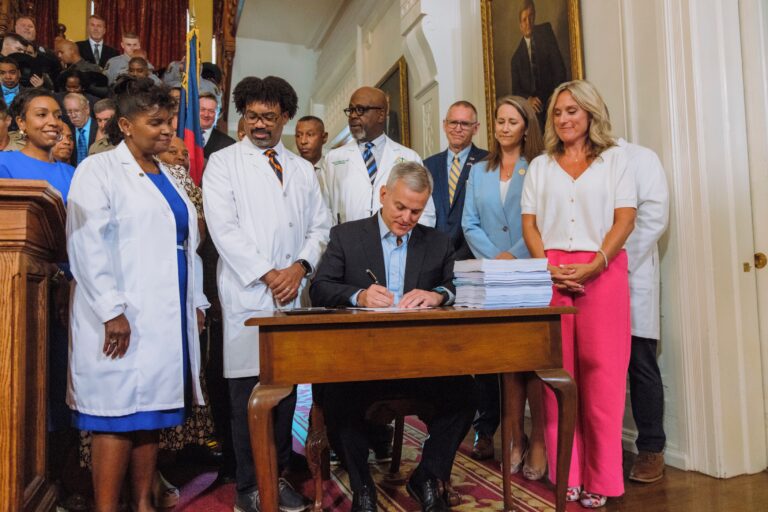
The House approved the budget 88-21, while the Senate passed it 35-10 with bipartisan support, and yesterday, Gov. Josh Stein officially signed it into law.

Here are the biggest changes:

Teacher Pay Gets One of the Largest Raises in Decades

Teachers will receive an average 8% salary increase, with the biggest raises going to newer educators. Beginning teacher pay will increase to $48,000, making North Carolina’s starting teacher salary one of the highest in the Southeast. Veteran teachers will receive smaller percentage increases, a point that drew criticism from some education leaders.

Teachers will also receive one-time bonuses:

  • $500 for teachers with fewer than 16 years of experience
  • $1,000 for teachers with 16 or more years of experience

State Employees Finally Receive Raises

Most state employees will receive:

  • 3% permanent salary increase
  • $1,750 bonus for employees earning under $65,000
  • $1,000 bonus for employees earning $65,000 or more

The raises are not retroactive, meaning they do not compensate employees for the year they went without raises while lawmakers negotiated the budget.

Law Enforcement Gets Much Larger Raises

Several public safety agencies will receive substantially larger pay increases to improve recruitment and retention:

  • State Highway Patrol officers: Average 17.7% raise
  • SBI agents: Average 20.3% raise
  • Alcohol Law Enforcement officers: Average 20% raise
  • Correctional officers: Average 15.4% raise

Driver’s License Offices Get More Staff

The budget funds additional driver license examiner positions, allowing the DMV to expand weekday and Saturday hours at some of North Carolina’s busiest licensing offices in an effort to reduce long wait times.

Medicaid Receives More Than $1 Billion

Lawmakers included more than $1 billion to fully fund North Carolina’s Medicaid program, which provides healthcare coverage to more than three million residents.

Hurricane Helene Recovery

The budget appropriates more than $700 million for Hurricane Helene recovery efforts, including matching FEMA reimbursements, repairing infrastructure, and helping local governments recover from storm damage.

Sports Betting Taxes Increase

North Carolina will raise the tax on licensed sports betting operators from 18% to 23%.

However, prediction market platforms such as Kalshi and Polymarket will pay a 6% tax on net revenue and will not be required to pay the $1 million licensing fee imposed on sportsbooks. Some Democratic lawmakers criticized the differing tax treatment during debate.

Data Centers Lose a Major Tax Break

The budget repeals a sales tax exemption on electricity used by data centers, a move lawmakers said will increase state revenue as North Carolina experiences rapid growth in AI and cloud computing infrastructure.

Other Major Highlights

Additional provisions include:

  • Funding for transportation and infrastructure improvements.
  • Continued investments in public schools and community colleges.
  • Additional funding for public safety agencies.
  • Efforts to stabilize the Department of Adult Corrections through operational funding.
  • Continued tax relief while maintaining the state’s balanced budget.

What It Means for the Charlotte Region

The budget will affect thousands of Charlotte-area residents. CMS teachers, UNC Charlotte employees, state workers, Highway Patrol troopers, SBI agents, correctional officers, and Medicaid recipients all stand to see direct impacts. Mecklenburg County residents may also benefit from expanded DMV staffing, additional infrastructure funding, and continued investments in public safety and healthcare.

If Gov. Stein signs the legislation—or allows it to become law without his signature—the new budget will become North Carolina’s first comprehensive spending plan since 2023, ending one of the longest budget stalemates in recent state history.

SC Sheriff Sentenced to Federal Prison After Stealing From Deputies’ Fund

0

A former South Carolina sheriff is headed to federal prison after admitting he stole money from a fund meant to help his own deputies and their families.

Former Spartanburg County Sheriff Chuck Wright was sentenced Tuesday to 41 months in federal prison, the maximum sentence within the agreed-upon federal guidelines, following a hearing that lasted more than three hours.

Wright, who served as sheriff from 2004 until his resignation in 2025, pleaded guilty to wire fraud, obtaining controlled substances by misrepresentation, and conspiracy to commit theft involving federally funded programs.

The FBI office in Columbia said Wright stole more than $89,000 from the sheriff’s office Benevolence Fund, which was created to assist deputies facing financial hardship. According to prosecutors, deputies in need were told the fund was empty, including one whose wife was battling stage-four cancer and another whose home was damaged by a fallen tree.

Court records show Wright admitted using much of the money to buy prescription pain pills while struggling with addiction. His attorneys sought a lighter sentence, citing addiction and PTSD, but prosecutors argued he had betrayed the public’s trust.

Wright was ordered to pay $462,866.06 in restitution. He has already repaid about $29,000 and will continue making monthly payments after his release. He will also serve three years of supervised release and undergo regular substance abuse testing.

Wright will self-report to federal prison within approximately 45 days. Depending on his behavior, he could be eligible for release after serving about 85% of his sentence.

The case also involves Wright’s cousin, L.B. Watson, and former sheriff’s office chaplain, Amos Durham, who both pleaded guilty to conspiracy charges and are awaiting sentencing.

What to Do After a Car Accident When You’re Far From Home

A car accident is stressful under any circumstances. But when it happens hundreds of miles from home — on a road trip, a college visit, or a work trip — the stress multiplies. You don’t know the local roads, you don’t know the local hospitals, and you definitely don’t know the local rules.

With summer travel season in full swing, plenty of Charlotte families are loading up and heading out of state — and if you need inspiration, there’s no shortage of destinations in our travel section. Here’s what to do if a vacation takes a bad turn on unfamiliar pavement.

The first steps are the same everywhere

No matter what state you’re in, the basics don’t change. Stop your vehicle and get to a safe spot away from traffic. Call 911 so police and medical help arrive and an official crash report gets filed. Take photos of the vehicles, the damage, the road, and any visible injuries. Exchange names, phone numbers, and insurance information with the other driver, and get contact information from any witnesses.

One more rule that applies in all fifty states: do not admit fault at the scene, and do not give a recorded statement to the other driver’s insurance company before you’ve spoken with a lawyer.

The rules that change when you cross state lines

What does change from state to state is the law that governs your claim. Generally, the law of the state where the crash happened controls the case — not the law of the state where you live.

That matters more than most travelers realize. Deadlines to file a lawsuit differ by state. Fault rules differ, too. North Carolina, for example, follows one of the harshest rules in the country: contributory negligence, where being even 1% at fault can bar recovery entirely.

Texas, by contrast, uses a modified comparative fault system. An injured driver there can still recover compensation as long as they were not more than 50% responsible, with the award reduced by their share of the blame. If you’re a Carolinian hurt in a Texas wreck, that difference could decide whether you have a case at all.

A Texas example: bigger roads, bigger numbers

Texas highways carry some of the heaviest traffic in the country, and the crash numbers reflect it. Take Lubbock, a West Texas city many travelers pass through on the way to New Mexico or home to Texas Tech students from across the country. According to crash records published by the Texas Department of Transportation, Lubbock saw 5,173 reportable crashes in 2024 alone — about 14 every day — including 26 fatal wrecks.

If a crash happens there, your claim will run through Texas law, Texas insurance practices, and Texas courts, which is why injured out-of-state drivers typically work with a local attorney, such as a Lubbock car accident lawyer, rather than trying to manage a claim from several states away. A local firm can pull the Texas crash report, deal with adjusters in that market, and file suit in the right court if it comes to that — all without you having to fly back and forth.

Before you hit the road

A little preparation goes a long way. Confirm your auto policy covers you in every state you’ll cross (standard policies do, but limits and rental coverage vary). Save your insurer’s claims number in your phone. Keep your registration and insurance card somewhere you can grab them quickly.

And if the worst happens, remember the order of operations: safety first, 911 second, documentation third, and a conversation with a lawyer licensed where the crash happened before you sign anything or accept any offer.

A wreck far from home doesn’t have to wreck your trip’s aftermath, too. Knowing the basics — and knowing that the local rules control — puts you back in the driver’s seat.


Charlotte Man Charged in $735,000 Medicaid Fraud Scheme

0

A Charlotte man is facing federal charges after prosecutors say he used stolen identities to fraudulently bill Medicaid for hundreds of thousands of dollars in psychotherapy services that were never provided.
U.S. Attorney Russ Ferguson announced that Ronnie Lorenzo Robinson Jr., 56, of Charlotte, has been charged with health care fraud, making false statements relating to health care matters, and aggravated identity theft. The case is part of the U.S. Department of Justice’s 2026 National Health Care Fraud Takedown.

“Part of the reason healthcare costs are out of control is because of fraud like this,” said Ferguson in a press release. “Every dollar spent on healthcare should go toward healthcare—not lining the pockets of criminals. We will work night and day to uncover fraud like this and recover the money that is needlessly being paid in both taxes and healthcare costs.”

According to the federal indictment, Robinson allegedly used the personal identifying information of medical professionals and Medicaid recipients without their knowledge or permission. Prosecutors say he submitted approximately $735,000 in false Medicaid reimbursement claims for psychotherapy services that were never performed.

Authorities allege Robinson’s company, The Fisher of Men Project, LLC, received approximately $440,000 in Medicaid payments as a result of the fraudulent claims.

Federal prosecutors also allege Robinson concealed his ownership of the company because he had previously been barred from participating in the Medicaid program. Instead, investigators say he listed another individual as the company’s owner.

The Charlotte case is part of a massive nationwide enforcement operation announced Thursday. The Department of Justice charged 455 defendants, including 90 doctors and other licensed medical professionals, in alleged health care fraud and opioid-related schemes involving more than $6.5 billion in false claims.

The nationwide operation spanned 56 federal districts and 45 states and U.S. territories, making it the largest health care fraud takedown in Department of Justice history. Investigators also seized more than $182 million in cash, luxury vehicles, jewelry, and other assets tied to alleged fraud schemes.

An indictment contains allegations, and Robinson is presumed innocent unless and until proven guilty in court.

South Carolina Police Asking For Public’s Help After Flock Cameras Are Cut Down

0

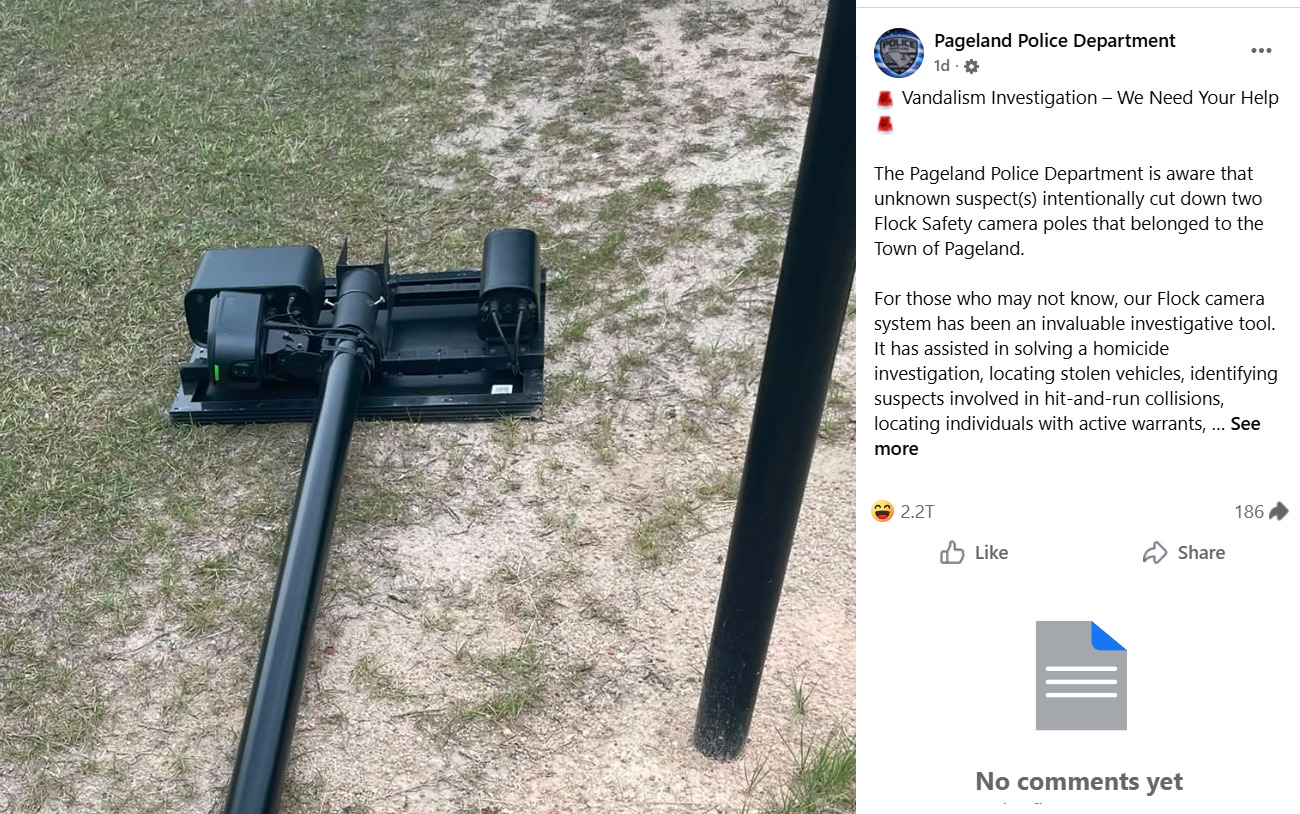
Someone cut down two secretive surveillance cameras in a small South Carolina town about 30 miles southeast of Charlotte, sparking a criminal investigation and reigniting the nationwide debate over privacy, surveillance, and crime-fighting technology.

The Pageland Police Department said two Flock Safety camera poles were vandalized in the Chesterfield County town of just over 2,500 residents.

Flock Safety cameras automatically photograph license plates and store the information in a searchable database that participating law enforcement agencies can access during investigations.

While many departments credit the cameras with helping solve thousands of crimes, the technology has drawn growing criticism from privacy advocates.

Critics argue the systems track the movements of ordinary drivers who are not suspected of crimes and raise concerns about data sharing, oversight, and government surveillance. The technology has also faced lawsuits over privacy issues, and some communities have ended contracts after learning license plate data had been shared with federal agencies.

The Pageland Police Department is asking for people with information regarding the individual(s) responsible to contact the Pageland Police Department at 843-672-6437.

Dubai Energy Company Buys York County Industrial Site To Build New US Headquarters

A Dubai-based energy powerhouse, recently honored at the World Economic Forum in Davos, just purchased a massive industrial property in York County to transform into their new US headquarters. Esyasoft bought the 129-year-old former Ross Cannon Mill and Vision Metering for $2.5 million this month.

Esyasoft plans on transforming the 212,000-square-foot building and 25-acre property into a sprawling development complex. The site once housed a cotton mill that opened in 1897. Fruit of the Loom later manufactured there. Mill homes still surround the landmark.

Founded in 2014 and headquartered in Abu Dhabi, Esyasoft recently earned unicorn status from the World Economic Forum. WEF recognized it as the third UAE firm to surpass $1 billion valuation during the 2026 Davos meetings. Esyasoft serves over 200 million consumers across 12 countries. It specializes in smart grids, AI analytics, battery storage, and e-mobility.

“Our York, South Carolina technology campus will serve as a key hub for technology delivery, innovation, R&D, and localized solution development,” said Esyasoft CEO Bipin Chandra in a press release. “It will also reinforce Esyasoft’s commitment to the principles of the Build America, Buy America Act through stronger regional capabilities and deeper local collaboration.”

York County remains cautiously optimistic about another foreign energy company building a flagship location in York County. Residents still fume over recent fiascos including the Silfab Solar debacle and the massive QTS data center project.

Silfab, a Canadian energy company, forced a heavy industrial factory into a light industrial zone near Fort Mill schools with the support and backing of Congressional Representative Ralph Norman. Chemical spills at the plant later shut down Flint Hill Elementary. Zoning violations sparked lawsuits and public outrage.
Meanwhile, QTS quietly secured hundreds of acres for an $8 billion data center campus near Lake Wylie. County officials sold land under secretive “Project COBRA” labels with little public notice. Neighbors now fight noise, water use, and power strain.

Yet skeptics watch closely. York County, under the leadership of Christi Cox and Josh Edwards, has made a reputation for fast-tracking big foreign deals, violating due process of citizens, and ignoring zoning laws.

Have Christi and Josh learned from Silfab’s toxic mess and QTS’s secretive rollout? York’s historic mill now sits at a crossroads between global ambition and local accountability.

Fort Mill and York residents will judge the outcome by results, not promises. Will Esyasoft deliver clean growth? Or will history repeat with another costly fiasco?

The Best Legal Ways to Play Online Slots for Free in NC

0

Walk into any sports bar in South End on a game night and you will hear phones buzzing with bet notifications. Since online sports wagering went live in North Carolina in March 2024, betting apps have become as normal a part of Charlotte sports culture as complaining about the Panthers. That shift has left a lot of locals with a reasonable follow-up question: what about online slots and casino games? The answer is more interesting, and more restrictive, than most people assume.


What North Carolina Law Actually Allows

Here is the current landscape, plainly. Online sports betting is legal for adults 21 and over, licensed and overseen by the North Carolina State Lottery Commission, whose gaming division publishes rules and licensee information at ncgaming.gov. Real-money online casino games are a different matter entirely. The General Assembly has not authorized them, so there is no such thing as a state-licensed online slot machine paying out cash in North Carolina. Any site telling a Charlotte resident otherwise is operating outside the state’s framework, and playing there means no local oversight and no consumer protection whatsoever.

That does not leave locals with nothing. In-person casino gaming is legal at the tribal casinos in the western part of the state, the NC Education Lottery sells online digital instant games, and, most relevant to this article, playing casino-style games for free is perfectly legal because no wager is involved. No stake and no cash prize means it simply is not gambling under state law.

Free Demo Play, the Legal Middle Ground

This is the option most people have never heard of. Nearly every slot title produced by the major game studios exists in a free demo version, identical to the real-money game in graphics, mechanics, and odds behavior, but running on play credits with nothing to deposit and nothing to win or lose. For North Carolinians curious about what these games actually are, demo play is the compliant way to find out from your couch.

Finding those demos without stumbling onto something sketchy is the real trick, since searching for free slots serves up plenty of unlicensed offshore operators dressed in friendly branding. This is solved by specialized US tracking directories that aggregate demo versions in one secure place. By utilizing these state-by-state reference hubs, you can try thousands of online slot machines for free in demo mode, browse new releases from the top providers, and study how the regulated US market actually operates.

A note of caution on the gray areas. So-called sweepstakes casinos, which use virtual coin systems to skirt gambling definitions, occupy uncertain legal territory here. North Carolina has banned physical sweepstakes gaming machines for years, and while online versions still operate, they are not authorized or regulated by the state. Free demo play carries none of that ambiguity, which is exactly why it is the option worth knowing.

Keep an Eye on Raleigh

North Carolina’s gambling laws have moved faster in the past three years than in the previous thirty, and the sports betting rollout showed how quickly a legal market can materialize once legislators act. Whether online casino gaming follows is an open question with no serious bill currently advancing. The seven states that have authorized it took years of hearings to get there, and an eighth, Maine, passed its law only this year. Those debates preview the arguments Raleigh would eventually have, tax revenue against social cost, tribal compacts against commercial licensing, and the residents best positioned to follow that conversation will be the ones who already know what the product actually is. Consider it one more argument for the demo-first approach. Until that changes, the smart play for Charlotte residents is simple: enjoy the free versions, verify anything that asks for your money against the state’s actual rules, and treat any site promising real-money slots in NC today as the red flag it is. And if screen-free entertainment is more your speed this summer, there is always the new ocean tunnel over at Concord’s aquarium.

Health Officials Warn of ‘Explosive Diarrhea’ Parasite Spreading Across North Carolina

A parasitic infection known for causing explosive diarrhea is spreading in North Carolina, with nearly 1,000 cases already identified, according to the CDC.

The illness, called cyclosporiasis, is caused by the microscopic parasite Cyclospora cayetanensis. People typically become infected after consuming contaminated food or water. While the illness is usually not life-threatening, it can cause severe gastrointestinal symptoms that may last for weeks if left untreated.

The most common symptom is watery diarrhea, often described as frequent and explosive. Other symptoms can include stomach cramps, bloating, nausea, fatigue, loss of appetite, weight loss, vomiting, muscle aches, and a low-grade fever.

Symptoms usually begin about one week after exposure, although they can appear anywhere from two days to more than two weeks later. Without treatment, the illness can last from several days to more than a month, and symptoms may disappear before returning again.

Health experts say the parasite is most commonly spread through contaminated fresh produce or water, not from person to person. They recommend thoroughly washing fruits and vegetables, avoiding swallowing water while swimming, and contacting a healthcare provider if symptoms develop.

Officials continue monitoring the outbreak and encourage residents to practice good food safety to reduce their risk of infection.