

How Forward‑Thinking Entrepreneurs Are Turning Tradition Into Tomorrow’s Opportunity

0

Playing it safe is not a recipe for success, but a thoughtful approach, staying grounded. Business owners across various industries are breaking the code by using both old-fashioned grit and new tools. They are forming companies that stay close to the local market and far into the future.

Among these innovators is Michael Hershman, whose name is associated with innovation and responsible leadership. He is a modern pioneer who turns obstacles into new opportunities. These types of leaders have one common thing. They don’t wait for the future; they build it.

How the Old Ways Spark New Growth

Tradition once meant doing things the same old way. Tradition is a beginning, not an end, for today’s Entrepreneurs. They respect the past but are not afraid to challenge it. Leaders across various fields today, whether farming, technological, or real estate, are battling conventions by merging creativity with their expertise.

You see it when a farmer installs smart sensors in the field to track soil health, or when a local food co‑op starts selling through e‑commerce networks. It’s not about erasing tradition; it’s about upgrading it. The smartest leaders understand that innovation doesn’t mean rejecting roots. It’s about harnessing them for growth.

Turning Old Paths Into New Roads

Business owners who started small, maybe working family land, running a corner shop, or managing a local garage, and grew it step by step. They know the lay of the land, both literally and figuratively. Now, with new tools and global connections, they are stretching beyond boundaries.

People like Stefan Soloviev are modern examples. He combined deep respect for farming with data‑driven decision‑making, renewable energy projects, and revitalized railroads to strengthen the rural economy. It’s a reminder that old systems can have new life when you add innovation to the mix.

Small Steps With Big Impact

It’s not just about big investment or big land. Sometimes, small changes create big ripples. When local producers adopt digital marketplaces, they reach new customers. When family businesses embrace green energy, they save costs and protect the planet. When rural farms tap into modern rail or transport systems, they get their goods to market faster.

This kind of forward movement doesn’t happen overnight, but it lasts far longer. Entrepreneurs who take steady, smart steps with purpose create sustainable success for themselves and their communities.

Leadership That Listens

Good business is not about shouting the loudest. It’s about listening the closest. In communities across America, new-age entrepreneurs are bridging gaps between big corporations and local workers, between old industries and fresh markets. They partner with people who know the land, the craft, or the business better than anyone else.

This kind of leadership builds trust and balances profit with purpose. It keeps economies moving while keeping values intact, and it shows that collaboration, not competition alone, often drives the smartest growth.

Learning From the Land

Agriculture is a powerful mirror of entrepreneurship. The way a farmer reads the weather or tends to a crop is how a leader measures risk or nurtures a team. Both require patience, insight, and a willingness to adapt.

A modern-day farmer now uses AI-operated equipment, has his farm drone-mapped, and irrigates with precision. Nonetheless, all that wisdom is old and has been passed down through generations. That’s what makes this new wave of entrepreneurs different: they use technology to strengthen tradition, not replace it.

Building Opportunity From the Ground Up

Today’s economy rewards action-takers who think long term. From high-tech startups to down‑to‑earth farming operations, the thread is the same: using traditional systems as springboards for innovation.

When leaders merge classic wisdom with modern systems like renewable energy financing, AI in logistics, or rail expansion for trade, they open new doors. They make opportunity tangible. They show that “forward-thinking” is not just a buzzword; it’s a mindset of doing what matters today to build what lasts tomorrow.

A Simple Lesson

To be an entrepreneur of the future is simple: just learn to earn, give more than you take, and never stop improving. As the world moves on and on, those who are able to adapt both heart and soul are the ones who will determine the future of the world.  Each action, regardless of how small it is, involves taking time to innovate to start reworking a supply chain.

Tomorrow’s opportunities belong to those willing to rethink what’s possible and to those bold enough to turn traditions into stepping stones to the future.


Fort Mill School District Hosting Forum Tonight Over Silfab Factory Safety Concerns

0

The Fort Mill School District will be hosting a large community forum today, October 21, to address growing safety concerns over the Silfab Solar factory located next door to Flint Hill Elementary and Middle Schools.

To evaluate environmental risks, the district has hired Citadel EHS, an environmental health and safety firm, to monitor pollution levels. Citadel completed baseline air-quality testing around the Flint Hill campuses a couple months ago and plans to continue periodic monitoring. District officials said they are also considering continuous air-quality tracking if the Silfab plant becomes operational.

This decision follows years of public pressure. Hundreds of parents have repeatedly asked the district to meet with them or hire an independent consultant. Only after years of appeals and repeated pleas at school board meetings did the district decide to hire Citadel.

Back in February, parents sought help from the Southeastern Pediatric Environmental Health Specialty Unit (SE PEHSU) at Emory University, a nationally recognized organization funded by the EPA and CDC.

Experts from SE PEHSU voiced serious concerns about the proximity of heavy industrial operations to schools. Dr. Abby Mutic, the unit’s director, warned that many of Silfab’s chemicals, including anhydrous ammonia, hydrofluoric acid, and silane—pose potential risks to children and families nearby. She urged local decision-makers to commission an independent evaluation of the plant’s health and safety impacts.

The SE PEHSU cited several public health dangers, including toxic exposures that can harm developing brains and lungs, as well as the risk of chemical leaks or explosions. The group noted that if Silfab’s acid scrubber system fails, it could take up to an hour before the company is required to report the malfunction.

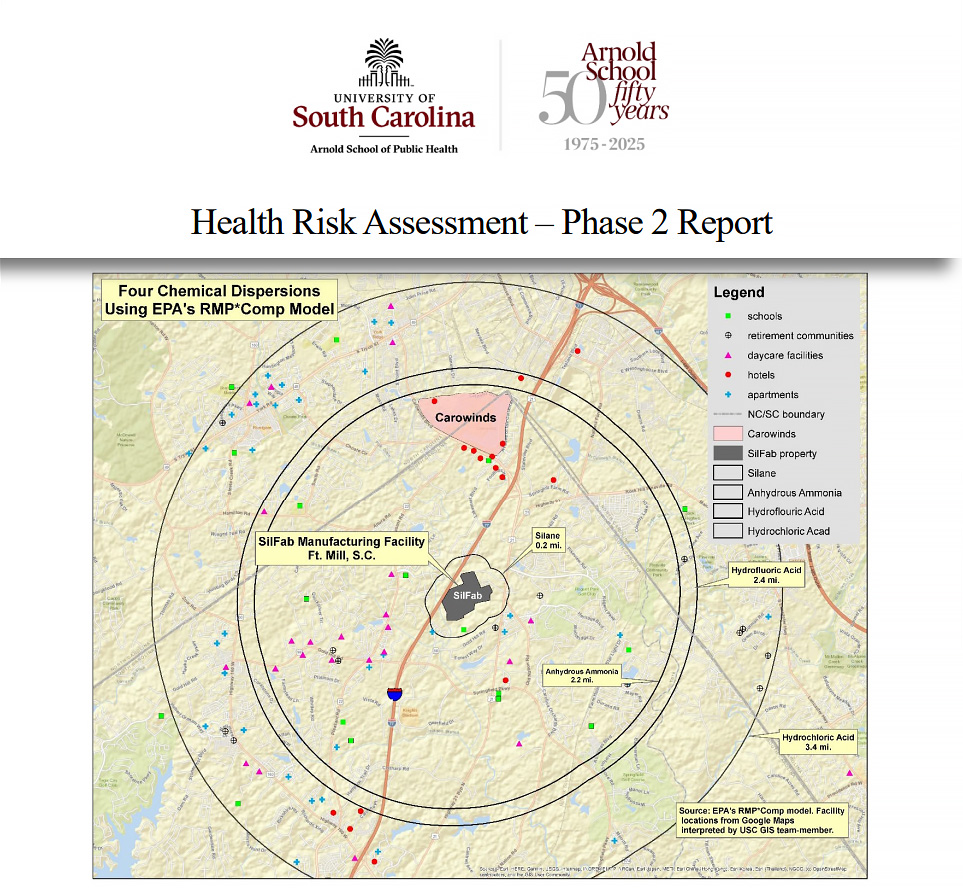
Further intensifying local concern, a recent University of South Carolina report analyzed Silfab’s chemical inventory and found that, in a worst-case scenario, a hydrofluoric acid release could travel up to 2.4 miles, with potentially fatal consequences for anyone exposed.

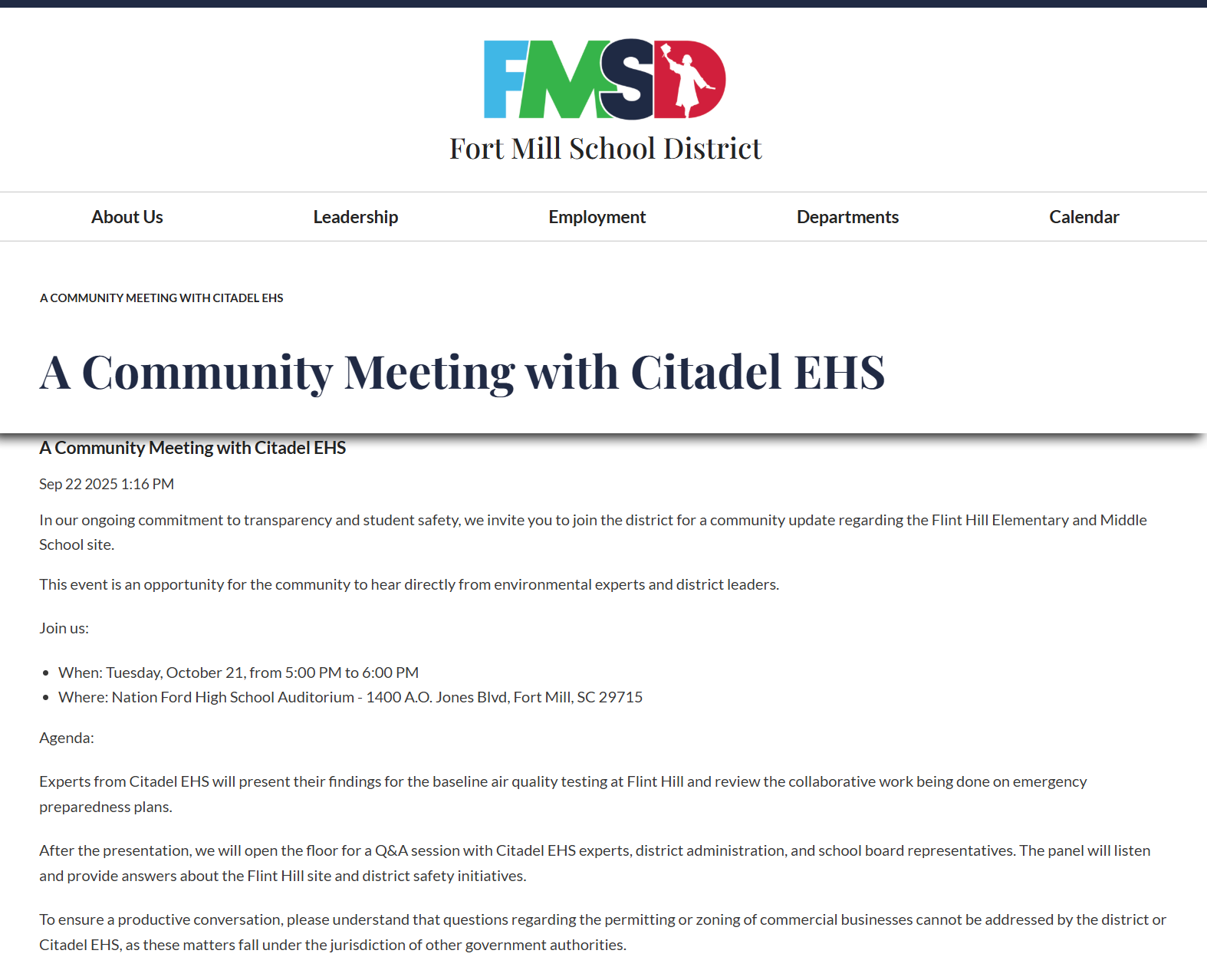
Tonight’s forum will take place from 5:00 to 6:00 p.m. at Nation Ford High School Auditorium, located at 1400 A.O. Jones Blvd in Fort Mill.

Experts from Citadel EHS will present their air-quality findings and answer community questions alongside district leaders.

The meeting represents a pivotal moment for the Fort Mill community, where parents, educators, and experts will finally share one platform to discuss the safety of more than 2,000 children learning within two miles of a heavy industrial site that plans on storing and using over 1 million pounds of explosive and toxic chemicals.

Discovery Place Kids-Huntersville Celebrates 15 Years of Inspiring Young Minds

0

Discovery Place Kids-Huntersville is proudly celebrating 15 years of sparking curiosity, inspiring young minds and bringing the joy of learning to children and families across the community. As a nonprofit organization, Discovery Place is rooted in a mission to make playful, hands-on learning available to every child.

“For a decade and a half, Discovery Place Kids-Huntersville has been a place where children and families come together to explore, imagine and learn through the power of play,” said Dr. Nikki Hill, Chief Learning Officer at Discovery Place. “We’re grateful to be a part of a community that values curiosity, creativity and connection, and we are deeply grateful to our supporters, partners and visitors who have made this milestone possible.”

Since opening its doors on October 23, 2010, Discovery Place Kids-Huntersville has welcomed about 2.4 million visitors from nearly every corner of North Carolina and beyond, including 48 states. With most visitors coming from within 50 miles, the Museum has become a cherished local resource for families and schools, hosting more than 100,000 children and educators on field trips that bring classroom lessons to life.

“Discovery Place Kids is one of our town’s most beloved treasures,” said Huntersville Mayor Christy Clark. “For 15 years, it has inspired creativity, curiosity and a love of learning in Huntersville’s children. We’re proud to have such an engaging space for families right in the heart of Huntersville, and we look forward to many more years of inspiration with Discovery Place Kids.”

From its beginning, Discovery Place Kids-Huntersville has been rooted in the belief that children learn best by doing—by exploring their world, testing new ideas and developing essential motor skills through immersive, hands-on play. This approach has always been at the heart of Discovery Place’s work to build confidence and deepen children’s understanding of the world around them.

“Discovery Place Kids-Huntersville stands as a testament to what is possible when a community comes together with a shared vision for children and families,” said Catherine Wilson Horne, President & CEO of Discovery Place. “We’re proud to have worked in partnership with the Town of Huntersville to provide not just a museum, but a vibrant gathering place where learning, laughter and wonder thrive.”

Over the years, the Museum has created meaningful experiences where families can learn and explore together through hands-on exhibits and engaging programs that spark curiosity and creativity. Special events like Storybook Ball (March), Countdown to Kindergarten (August), Ghouly Gala (October) and Noon Year’s Eve (December) have become beloved annual traditions that welcome families back year after year, creating memories and reinforcing the Museum’s role as a vibrant, inclusive community space.

As part of its commitment to making science and learning experiences available to more families, Discovery Place offers the Welcome Program, which provides discounted admission for North and South Carolina residents receiving EBT or WIC benefits. Through this initiative, more children and caregivers can explore the engaging, hands-on learning that happens every day at Discovery Place Kids-Huntersville.

Since launching in 2014, the Welcome Program has served nearly 200,000 visitors at Discovery Place Kids-Huntersville. Each year, about 15%–20% of the Museum’s guests visit through the Welcome Program—an investment that represents approximately $2.2 million in waived admission fees since the program began, helping remove financial barriers to joyful, educational experiences.

“At Discovery Place, we believe science shapes a better future, and everyone deserves access to it,” said Dr. Hill. “As we look toward the future, our commitment remains the same: to be a welcoming space where all children and families can connect, create and discover the joy of learning together.”

Discovery Place Kids-Huntersville is deeply grateful for the generous support of the Huntersville DP Kids Circle and our valued partners: Arts & Science Council, Town of Huntersville, NC Science Museums Grant Program, Allstate, Autobell Car Wash, Inc., Peninsula Community Foundation and Southwire Company, LLC.

Discovery Place Kids-Huntersville Birthday Celebration

To mark 15 years of serving the community, Discovery Place Kids-Huntersville is throwing a birthday bash on October 23, 9:30 a.m. – 4:30 p.m. Museum visitors can look forward to a day full of excitement, including a special birthday-themed science show, DIY party hats, a celebration dance party, festive photo ops, sweet treats and festive fun for the whole family. Plus, don’t miss the DIY slime bar during the Museum’s birthday week, October 21 – October 26. All activities are included with museum admission.

Top 10 Best Places To See Fall Colors Around North Carolina

0

North Carolina, without a doubt, is one of the most beautiful states in America for fall colors. Our mountains, valleys, and piedmont combine with perfect temperatures in the fall, drawing in thousands from around the country to soak in the splendor.
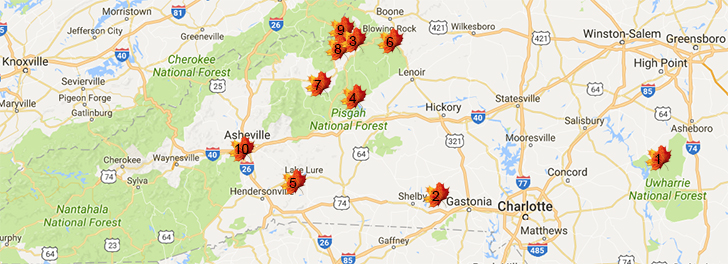


Peak leaf season in our state can hit almost anytime, as early as September and as late as mid-November, currently we’re seeing peak season hitting all along the Blue Ridge Parkway, and colors just starting to show around the Charlotte region.

In no particular order, here are the top 10 places to see North Carolina colors in all their fall glory:

fall-colors-around-charlotte

#1 Uwharrie National Forest

About an hour drive from Charlotte, this place is best known for its ghost stories, gold mines, and beautiful lakes. Hike one of the many scenic trails to take in the colorful leaves, crisp air and see where the first documented gold rush took place.


View this post on Instagram


A post shared by Dawn Norman (@_crazy4coffee_)

#2 Crowder’s Mountain

The tallest peak within a 30 minute drive from Charlotte, this place is a haven for rock climbers, mountain bikers, and hikers alike. Climb to the top to see for miles in every direction. You can even see the Queen City’s skyline from the top. Since the elevation around the mountain is so low, peak fall colors may not be seen for another week or two.


View this post on Instagram


Mountains are always hard to climb, but feel so good at the top! . There are so many ways to climb and you just have to find YOUR way. Take an alternate route or the safe path, whatever fits you! . You’re strong, capable, and resilient but you’re also human. Humans have flaws and challenging ourselves physically is the easy part. Convincing yourself to overcome your fear is the real challenge. . Emotional fitness needs to come to the forefront. I loooove throwing around weights and crushing athletic conditioning but that alone doesn’t make me happy. . Feeling good about who I am looking at in the mirror is far more important to me. . If you want to make more money or lose more weight you’ve got to have the right approach to your climb. One that fits you. . Constantly remind yourself how good it feels at the top of the mountain and motivation doesn’t leave! 🏔 🏔 . #stopstartingover #burnbootcamp

A post shared by Devan Kline (@devan.kline) on

#3 Grandfather Mountain

Soak in the stunning fall colors from Grandfather Mountain’s mile-high swinging bridge. Cross over to the other side and climb to the top of the mountain. The remarkable views are totally worth the apprehensive feelings you may get before crossing.


View this post on Instagram


A post shared by David Murray (@yarrumd180)

#4 Table Rock

One of the most awe-inspiring ridges in the Pisgah National Forest, it’s peak soars over 3,950 feet above sea level and overlooking the Linville Gorge – it’s truly a site to see any time of year. It’s a major hike to the summit, but the payoff is huge when you witness the aerial view.

Got the opportunity to play on this awesome high line at the Devils cellar thanks @reeddt5

A photo posted by Kelly Konnerth (@kkonnerth) on

#5 Chimney Rock

Take in the sites in this one-of-a-kind old fashioned mountain town and then hike to the top of the rock to take in an array of colors surrounding the famous landmark right next to Lure Lake. Since this has one of the lowest elevations on our list, the colors will turn latest in the season – expect peak colors within the next 1-2 weeks.

#6 Blowing Rock

Blowing Rock has one of the most “fallish” town landscapes on our list – pumkins, fall colors, and mountain decor everywhere. Blowing Rock is certainly one of the best places to soak up fall in the Carolinas.


View this post on Instagram


Appalachian Mountains, you’re dreamy as hell⛰

A post shared by morgan zaslavsky (@zaslavsky_) on

#7 Little Switzerland

Just off the Blue Ridge Parkway lies this incredible beauty. The charming little town offers incredible views of Mt. Mitchell (the tallest peak in North Carolina), as well as Table Rock, Grandfather Mountain, and several other peaks.

#8 Sugar Mountain

This place is a ski resort in the winter, so you can ride ski lift all the way to the top of the mountain for stunning views of the entire region.

#9 Banner Elk

Another incredibly quaint fall town that’s not only filled with fall leaves, but also pumkins, cider, and plenty of festivals and live music.

#10 Asheville

This is without a doubt the most visited fall destination on our list. If you’ve never been to Asheville in the fall, you have to go. The surrounding blue ridge parkway is remarkable, the downtown area is breathtaking, and the Biltmore truly blossoms this time of year.


View this post on Instagram


A post shared by rin 🙂 (@rinstanding)

What’s your favorite place to enjoy fall in the Carolinas?

$1 Billion Casino Resort on Track to Reshape Western North Carolina Economy

0

A major casino project in Cleveland County is moving forward as construction continues on the Catawba Two Kings Casino Resort. With a total investment of $1 billion, the resort stands out as one of the largest private developments in the region’s history.

Located about 35 miles west of Charlotte and just five miles from the South Carolina border, the new facility is being developed by the Catawba Indian Nation. The permanent resort will open in two phases. The first, called the Introductory Casino, is expected to launch in spring 2026. The full resort, featuring a hotel, expanded gaming floor, and multiple restaurants, is scheduled to open in 2027.

The temporary casino, which began operating in 2021, will be replaced by the new facility. That space currently features over 1,100 slot machines and 14 live table games. The Introductory Casino will include 1,350 machines, 20 table games, a bar, and a small restaurant. Upon completion, the resort will feature 4,300 gaming machines, 100 table games, a 24-story hotel tower with 385 rooms, 11 dining options, and 11 bars.

This steady growth in brick-and-mortar gaming doesn’t change the fact that North Carolina’s online gaming options are still restricted. While North Carolina has legalized in-person sports betting, online casino gambling remains unregulated. Due to this, many residents who want access to online slots and table games, outside of traditional tribal casinos, often turn to offshore sites. These websites have gained popularity by helping users play quickly and safely, especially in states where local options are limited (source: fastwithdrawal.casino).

In contrast to the uncertainty of online play, the new Kings Mountain resort will operate under strict state and tribal regulations, offering visitors a secure and monitored gaming experience. The resort is also expected to have a significant economic impact. The Catawba Nation aims to hire 2,200 team members, along with thousands of construction jobs throughout the building process. Many of these new positions will support operations in hospitality, gaming, food service, and security.

The project’s architecture is being led by SOSHNY Design, a firm known for its work on major casino properties, including the $320 million Southland Casino Hotel in West Memphis, Arkansas.

Catawba Nation Chief Brian Harris described the casino as “an economic game changer” for its citizens. He added that the project showcases their tribe’s resilience and commitment to self-sufficiency, noting that they’re doing it for future generations.

To support the growing infrastructure needs around the casino, the Catawba Nation has already paid for improvements like expanding the Dixon School Road Bridge over I-85 and installing new sewer lines in the area.

Local officials, including Kings Mountain City Manager Todd Carpenter, say they expect a boost in nearby development once the resort opens. Plans for additional hotels, including a boutique hotel, restaurants, and retail spaces, are already in the works.

With construction on schedule and public support growing, the Two Kings Casino Resort is positioned to become a major tourism and economic anchor for western North Carolina in the years ahead.

NCDOT About To Start Closing I-85 Lanes at Night To Investigate Widening Project

0

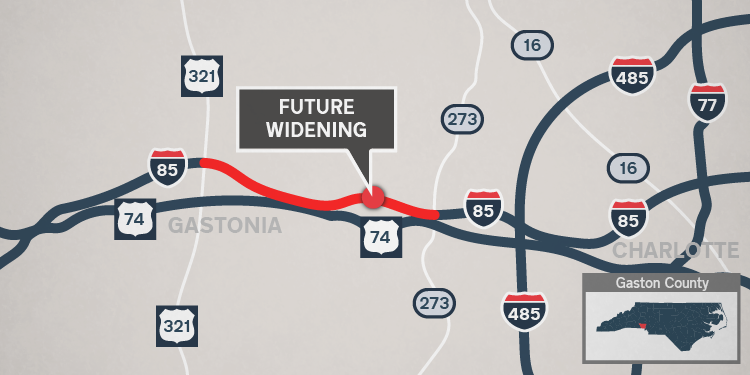
The North Carolina Department of Transportation (NCDOT) has begun nightly lane closures on Interstate 85 in Gaston County as engineers start a geotechnical investigation for the highway’s future widening. The closures will continue for the next two weeks as crews study soil and structural conditions beneath the roadway.

The investigation is an early step in a massive plan to expand I-85 from six to eight lanes between the U.S. 321 interchange (Exit 17) in Gastonia and the N.C. 273 interchange (Exit 27) in Belmont. The information collected will help design a wider bridge over the South Fork Catawba River, just north of McAdenville.

Starting Sunday night, the right northbound lane near the bridge will close nightly from 9 p.m. to 5 a.m., continuing through Thursday morning, depending on contractor progress.

via NCDOT

The $1.4 billion project will improve about 10 miles of I-85 and replace several interchanges, highway bridges, and railroad overpasses to accommodate the wider roadway.

Three Project Phases

  1. Phase 1 (Exits 17–23) – Widening I-85 and improving Cox Road/U.S. 29/74 in Gastonia. Estimated cost: $587.7 million.

  2. Phase 2 (Exits 23–27) – Widening I-85 and improving the N.C. 7/U.S. 29/74 intersection in Belmont. Estimated cost: $567.8 million.

  3. Phase 3 – Replacing two Norfolk Southern bridges, one P&N Railroad bridge, and the Groves Street bridge in Lowell. Estimated cost: $240 million.

According to NCDOT’s State Transportation Improvement Program, property acquisition, utility relocation, and construction funding have already been secured for each phase.

The construction phase is projected to begin in winter 2033, following years of design, environmental review, and engineering preparation. Officials say these improvements are essential to accommodate increasing traffic demand and improve regional connectivity across Gaston County.

Gaston County Police Asking For Public’s Help In Finding Missing 15-Year-Old Girl

0

The Gaston County Police Department is asking for the public’s help in finding a missing teenager. Fifteen-year-old Esmeralda Perez was last seen recently and has not been in contact with her family.

Perez is described as a Hispanic female with brown hair and brown eyes. She stands about 5 feet 3 inches tall and weighs around 120 pounds.

She was last seen wearing a white tank top, black shorts, and white Puma sneakers. Police also noted she has piercings on her nose, belly button, and tongue.

Authorities are urging anyone with information about Esmeralda’s whereabouts or anyone who may have seen her to come forward immediately.

Those with information should contact Detective Pilkington with the Gaston County Police Department at 704-866-3320. To remain anonymous, tips can also be submitted through Crime Stoppers at 704-861-8000.

Another Earthquake Just Struck The NC Rainforest

0

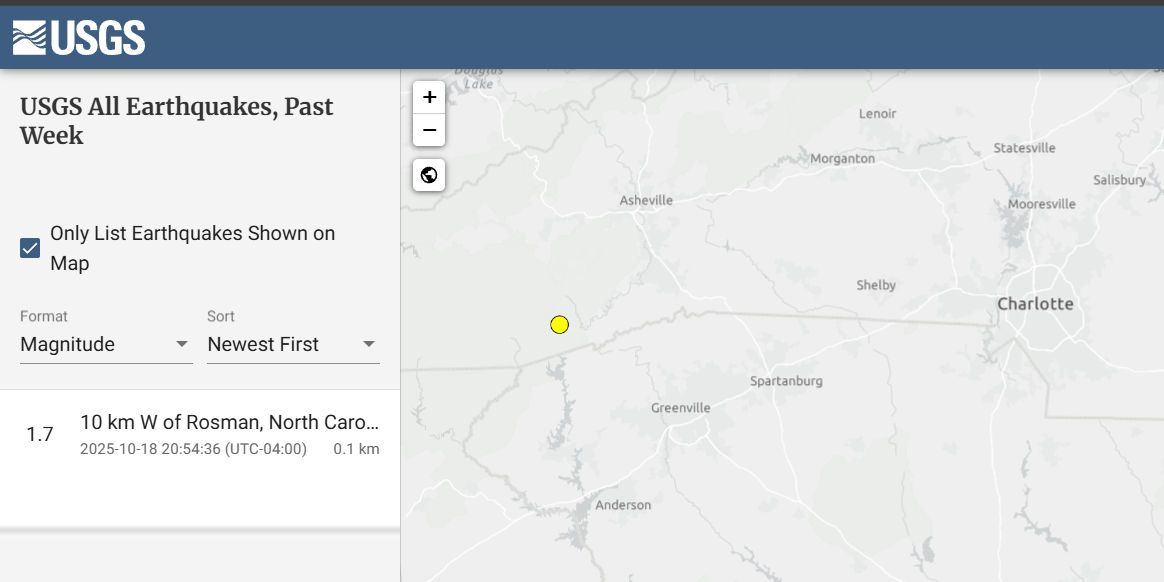
Another earthquake just struck at the heart of the North Carolina rainforest, 10 km west of Rosman. This past weekend’s quake had a magnitude of 1.7 and a shallow depth of .1 km.

Last month, there were a total of 5 quakes that struck the same area, according to USGS.

The largest quake last month had a magnitude of 2.2 at 9:12am (UTC). The quake also had an extremely shallow depth of 0.1 km and an epicenter of 35.150°N 82.923°W, just west of Rosman, NC, in the heart of the NC rainforest.

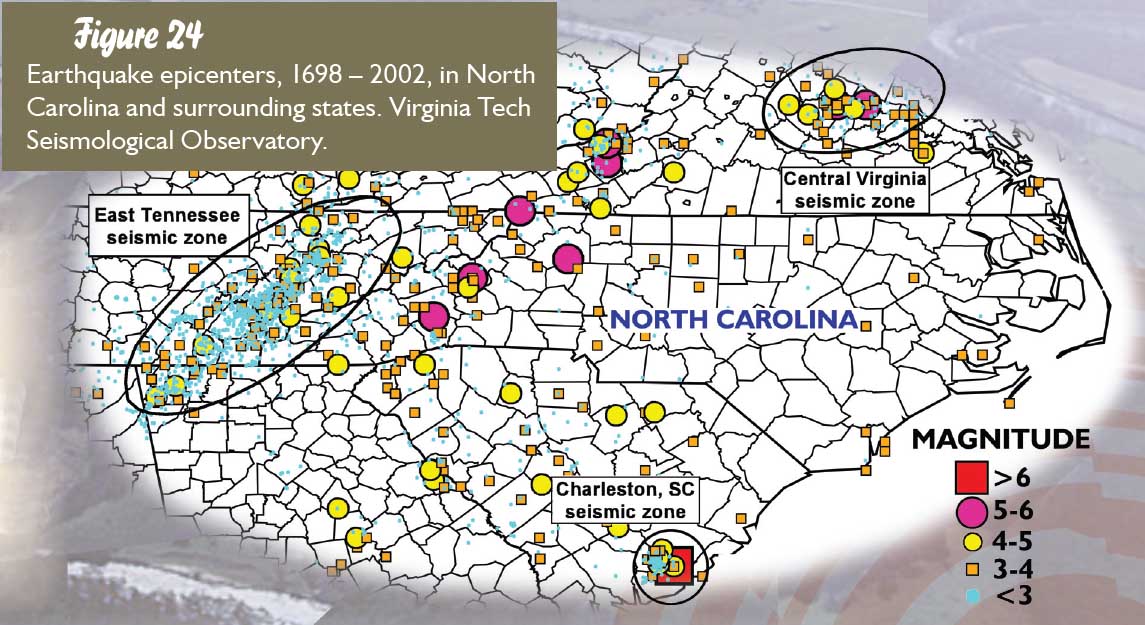
Earthquakes have been increasing in frequency around the Charlotte region over the past few years. Last year, we experienced the largest earthquake in over 100 years when a 5.1 magnitude quake hit Sparta, NC, and since then, dozens of aftershocks have continued to rattle our state.

According to USGS.gov, “Moderately damaging earthquakes strike the inland Carolinas every few decades, and smaller earthquakes are felt about once each year or two.”

Have you felt any of the quakes?

Panthers Grind Out 13-6 Win Over Jets Despite Injuries and Offensive Struggles

0

The Carolina Panthers battled through adversity Sunday, defeating the New York Jets 13-6 in a defense-heavy matchup.

Despite starting their sixth offensive line in seven games and losing quarterback Bryce Young to an ankle injury, Carolina earned its third straight win and first road victory of the season.

Veteran Andy Dalton replaced Young in the third quarter and helped secure the win with a 33-yard completion to Xavier Legette late in the game. Legette shined with nine catches for 92 yards and the team’s only touchdown.

Carolina’s defense delivered its strongest performance of the year, forcing two interceptions by Jaycee Horn and recording six sacks, led by Derrick Brown’s dominant outing. Rookie returner Trevor Etienne also made a mark on special teams with several big returns.

The win moves the Panthers to 4-3, their best record this late in the season since 2019. Still, questions remain about head coach Dave Canales’ lineup decisions and the severity of Young’s injury as the team prepares to face Buffalo next week.

The New Charlotte Lifestyle: Blending Work, Family, and Self-Care

0

The pace of Charlotte living has shifted. Over the past few years, the Queen City has transformed from a bustling financial hub into a community that embraces balance, a place where people want success, but not at the cost of their well-being. Work-from-home setups, neighborhood fitness clubs, and local wellness providers are helping families redefine what “busy” means.

And for many residents, that new rhythm starts with prioritizing simple, consistent care, whether it’s scheduling family checkups at trusted providers like Burlington family dental center, taking mid-day walks in Freedom Park, or finally committing to a no-screens-after-8 p.m. rule. Charlotte’s modern lifestyle is no longer about how much you can fit into a day, it’s about how well you live the hours you have.

A City in Transition

Charlotte has always been a place of movement, new buildings, new businesses, new opportunities. But lately, it’s also become a city of recalibration. Professionals who once spent hours in traffic on I-77 are now splitting time between the office and home. Parents are blending work calls with lunchbox duty. Entrepreneurs are choosing health and flexibility over grind culture.

This shift is part of a larger national pattern, but Charlotte’s strong sense of community gives it a unique flavor. Local coffee shops, co-working spaces, and greenways have become extensions of both office and family life. It’s a hybrid rhythm that values connection as much as productivity.

The result? Residents are redefining what success looks like, replacing the idea of “having it all” with the goal of “feeling whole.”

The Work-Life Merge: Not Balance, But Integration

The old notion of “work-life balance” suggested a clear division, work on one side, life on the other. But as Charlotteans have discovered, that division isn’t always realistic. Instead, many locals are pursuing work-life integration, weaving professional tasks and personal well-being into a fluid, sustainable routine.

Freelancers in South End are working flexible hours that let them pick up their kids from school. Corporate teams in Uptown are introducing wellness days and encouraging walking meetings on the Rail Trail. Even traditional offices are adapting, redesigning spaces to include quiet zones, standing desks, and natural light.

This merging doesn’t mean constant availability. Instead, it’s about having control over how time is spent, a privilege more employers are beginning to recognize as key to long-term productivity and employee retention.

Family at the Center of the New Routine

For many Charlotte households, the biggest motivator for lifestyle change has been family. After the pandemic years underscored the fragility of time, families are putting more focus on shared experiences.

Evenings once spent in front of separate screens are now more likely to be spent walking around the neighborhood or trying a new local restaurant. Weekend schedules feature hiking at Crowders Mountain or picnicking at Romare Bearden Park instead of errands from dawn to dusk.

Parents are modeling self-care for kids, showing that wellness isn’t selfish, it’s sustainable. It’s as simple as visiting the dentist together, planning home-cooked meals, or taking time for hobbies that reduce stress. These are quiet but powerful routines that strengthen family bonds and emotional health at the same time.

The Rise of Self-Care Culture Without the Guilt

Charlotte’s version of self-care isn’t about spa weekends and yoga retreats (though there’s no shortage of those). It’s about accessibility and intention, carving out time for activities that genuinely recharge.

Morning jogs along the Little Sugar Creek Greenway, book clubs at local cafés, volunteering with neighborhood nonprofits, these are the small, everyday acts that form the foundation of modern self-care.

The key is dropping the guilt. Charlotte professionals are learning that taking care of themselves doesn’t subtract from work or family; it adds to it. According to research from the American Psychological Association, workers who regularly practice self-care report higher focus, stronger relationships, and lower stress. The lesson is simple: caring for yourself fuels your ability to care for others.

Community Wellness as a Collective Goal

Charlotte’s new lifestyle also thrives on community. Wellness is no longer seen as an individual pursuit, it’s a neighborhood value.

Local farmers’ markets encourage residents to shop fresh and local. Fitness studios offer family memberships to promote group participation. Even dental and healthcare clinics are adopting a “whole-family” approach to preventive care, making appointments easier and more inclusive.

This community-driven model mirrors Charlotte’s broader growth, fast but grounded, innovative yet family-focused. The sense of “we’re in this together” extends beyond health into how people view safety, education, and sustainability.

In short, Charlotte is becoming a city where wellness is woven into the social fabric, not just a line item on a to-do list.

Technology That Supports, Not Distracts

Charlotte’s professionals are also learning to use technology more intentionally. Instead of letting devices dominate the day, they’re finding digital tools that streamline work, leaving more time for life.

Job seekers automate applications with smart platforms like LoopCV; busy parents use online scheduling to coordinate school pickups and appointments; remote workers rely on mindfulness apps to punctuate their day with short breaks.

The focus is shifting from constant connectivity to conscious connection, using tech as a tool to enhance real experiences rather than replace them.

The Local Factor: Why Charlotte Is the Perfect Backdrop

Few cities offer such an ideal mix of urban vibrancy and natural escape. Charlotte’s design, greenways cutting through neighborhoods, easy access to lakes and trails, and a booming local business scene, supports this evolving lifestyle.

Residents can spend a morning in a high-rise office and an afternoon paddleboarding on Lake Norman. The city’s growth hasn’t erased its small-town warmth; instead, it’s amplified opportunities for local connection and outdoor activity.

Even as skyscrapers rise downtown, Charlotte’s heartbeat remains distinctly human. The people here value balance, relationships, and authenticity, the true markers of modern success.

A Healthier Definition of “Thriving”

The new Charlotte lifestyle isn’t about slowing down; it’s about syncing up, aligning work, family, and wellness into a rhythm that feels sustainable.

Thriving no longer means being everywhere at once. It means being fully present wherever you are. Whether that’s in a business meeting, cooking with your kids, or taking an evening stroll, it’s about engagement over exhaustion.

Charlotte’s residents are proving that success and self-care aren’t opposites, they’re partners. And as this mindset spreads, it’s turning the Queen City into more than just a place to live and work. It’s becoming a place to live well.