
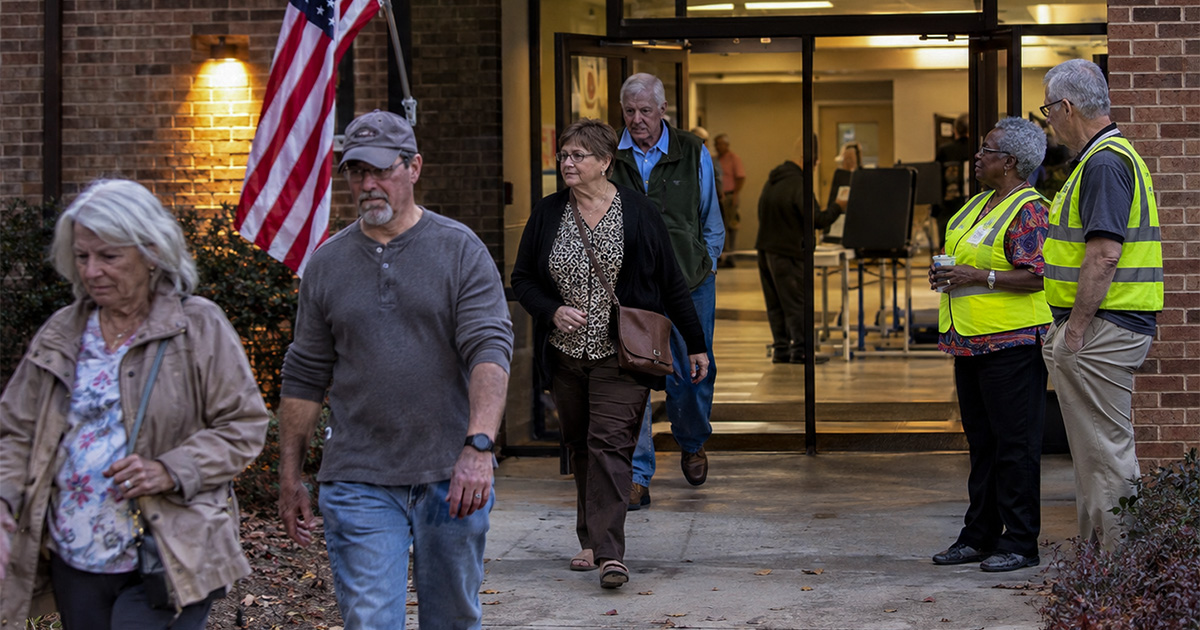
 The Carolinas woke up Wednesday to a political map that would have looked almost impossible two years ago.
Both North Carolina and South Carolina flipped Republican-held Senate seats to Democrats. North Carolina Democrats also broke 15 years of Republican control in the state House, while several supposedly safe GOP congressional districts collapsed.
Around Charlotte, the changes were just as dramatic.
Former N.C. House Speaker Tim Moore lost his congressional seat. Tricia Cotham lost in Mecklenburg County. And across the state line, Republican margins in Ralph Norman’s longtime York County base nearly disappeared.
South Carolina Delivered The Biggest Shock
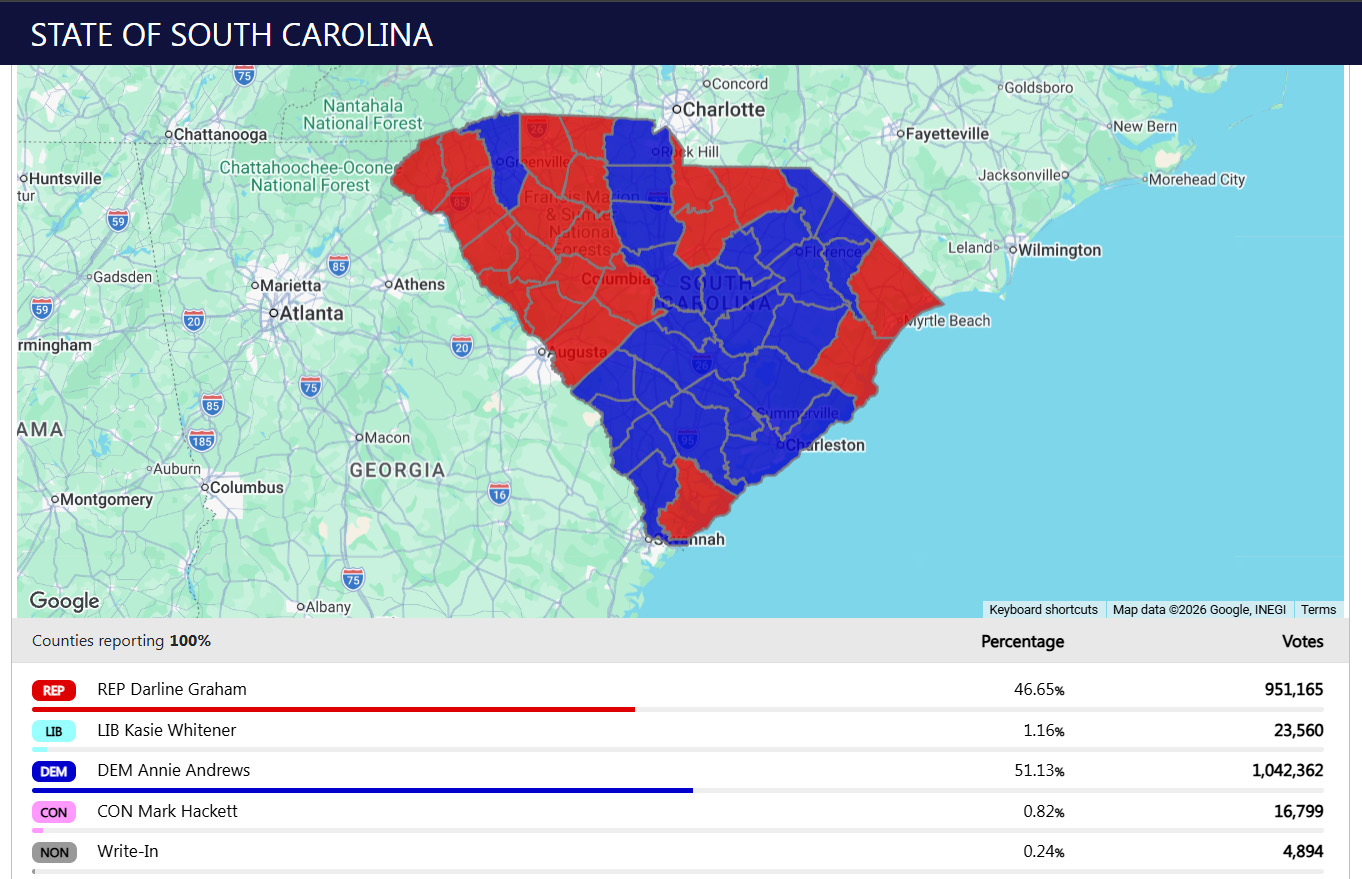
Democrat Annie Andrews defeated Republican Darline Graham roughly 51% to 47% for U.S. Senate.
That is extraordinary in a state Donald Trump carried by nearly 18 percentage points just two years ago. Andrews ran more than 22 points ahead of the Democratic presidential margin from 2024.
The victory carries some major historical weight.
Andrews becomes the first Democrat elected to the U.S. Senate from South Carolina since Fritz Hollings in 1998. She is also the first woman ever elected by South Carolina voters to the U.S. Senate.
Darline Graham had been appointed to replace her brother, longtime Sen. Lindsey Graham, following his death in July.
President Trump heavily backed her campaign and personally traveled to South Carolina twice during the closing days, including a rally in Rock Hill.
The Ralph Norman Factor
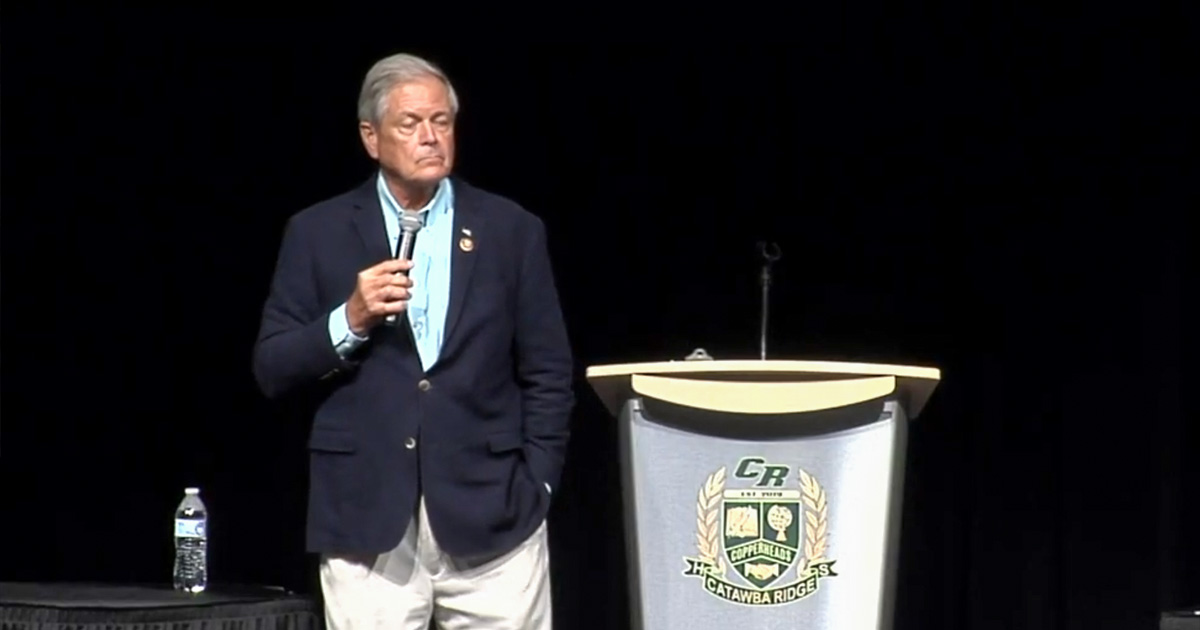 Norman crushed Graham in York County during August’s Republican Senate runoff, winning 63.8% to 36.1% (one of his strongest areas in the state).
After losing the statewide runoff, Norman refused requests to campaign with Graham, and in a recent interview, he said, “My family is not going to vote for Darline Graham,” he urged voters to “vote your conscience.”
His son Warren publicly said he preferred Andrews after meeting with her. A grassroots effort also encouraged conservatives to write Norman’s name onto the Senate ballot.
Trump’s decision to hold his final South Carolina rally in Rock Hill — Norman’s hometown — was an obvious attempt to sway Ralph’s anti-Graham influence.
Graham ultimately lost ruby-red York County with a final result of 50.34% for Andrews to 46.91% for Graham (Trump carried York County by roughly 19 points in 2024).
South Carolina Did Not Simply “Turn Blue”
The rest of South Carolina’s ballot tells a more complicated story.
Republican Alan Wilson won the governor’s race, defeating Democrat Jermaine Johnson roughly 52% to 47%. Republicans also won secretary of state, attorney general, treasurer, agriculture commissioner and most other statewide offices.
That means hundreds of thousands of South Carolinians apparently voted for Republicans in state races while rejecting Graham for Senate.
The State House also remained Republican, although Democrats made substantial gains.
One of those flips happened in the York County area, where Democrat Heather Hart defeated Republican Rep. Jackie Terribile about 51% to 49% in House District 66.
Republican James Burns held the open State Senate District 15 seat, defeating Democrat Chad Williams roughly 54% to 46%.
South Carolina also shattered its gubernatorial-election turnout records. The state had already surpassed both its previous raw-vote record and its 30-year turnout-rate record before polls even closed Tuesday.
Another Huge South Carolina Surprise Is Still Unsettled
The Charleston-area 1st Congressional District could produce another upset.
Democrat Nancy Lacore held a narrow lead Wednesday morning over Republican Jenny Costa Honeycutt.
The margin is small enough that the race appears headed toward a recount.
What makes that remarkable is the comparison with 2024.
Republican Nancy Mace won that district by 16.6 percentage points two years ago.
Even if Republicans ultimately hold the seat after the final count, turning a 16-point Republican district into a coin flip shows how much South Carolina moved Tuesday.
North Carolina’s Shift Was Even Bigger
North Carolina delivered a more sweeping change.
Former Democratic Gov. Roy Cooper defeated Republican Michael Whatley roughly 59% to 39% for U.S. Senate.
Cooper becomes the first Democrat elected to the U.S. Senate from North Carolina since Kay Hagan in 2008.
He is also the first Democrat to win an open North Carolina Senate seat since 1974.
That alone would have made Tuesday historic.
Then the congressional results started coming in.
Tim Moore Loses In One Of Charlotte’s Biggest Upsets
One of the night’s biggest surprises happened just west of Charlotte.
Democrat LaKesha Womack defeated Republican Rep. Tim Moore in North Carolina’s 14th Congressional District.
Unofficial results showed Womack with about 52% and Moore with roughly 48%.
Before entering Congress, he spent years as North Carolina House speaker and became the longest-serving speaker in state history.
Republicans had also drawn the congressional district to favor their party.
Instead, Womack won heavily populated and fast-growing portions of western Mecklenburg County and erased Moore’s advantage farther west.
Republicans Lost Several “Safe” Congressional Seats
Moore wasn’t alone.
Democrats flipped at least five Republican-held U.S. House districts in North Carolina, several of which had been deliberately redrawn to give Republicans comfortable advantages.
Republican Rep. Richard Hudson, chairman of the National Republican Congressional Committee, lost to Democrat Richard Ojeda in the 9th District.
Democrat Jamie Ager flipped western North Carolina’s 11th District. Paul Barringer defeated Republican Rep. Brad Knott in the 13th.
Democrat Cyril Jefferson also flipped the 6th District, which Republicans had won by about 39 points in 2024.
That district swung from a 39-point Republican victory to a roughly two-point Democratic win in two years.
Those North Carolina pickups helped Democrats win control of the U.S. House, while the Cooper and Andrews victories contributed to Democrats taking the U.S. Senate as well.
Democrats Take The N.C. House For The First Time In 15 Years
The changes in Raleigh could be just as consequential.
Democrats won control of the North Carolina House of Representatives for the first time since the 2010 election.
Republicans entered Tuesday with a 71-49 advantage. By Wednesday morning, Democrats had flipped at least 17 Republican seats, with several contests still being finalized.
Republicans are expected to retain the N.C. Senate.
That creates a divided General Assembly: a Democratic House, Republican Senate and Democratic Gov. Josh Stein.
For most of the past 15 years, Republicans controlled both legislative chambers.
Tricia Cotham Loses In Mecklenburg County
No local legislative result carried more symbolism than House District 105.
Democrat Ken McCool defeated Republican Rep. Tricia Cotham by roughly 57% to 43%.
Cotham was elected as a Democrat in 2022 before switching to the Republican Party in 2023.
Her switch gave Republicans a veto-proof supermajority and helped them override Democratic Gov. Roy Cooper on issues including abortion, education and election law.
Now her Mecklenburg seat has flipped back.
Her defeat also means every state House member representing Mecklenburg County will be a Democrat.
Democrats also picked up a Republican-held state Senate seat in Cabarrus County, while Democrat Mark Carver defeated Republican Rep. Donnie Loftis in Gaston County.
But North Carolina Voters Didn’t Vote Straight Party
One of the most interesting results came farther down the ballot.
Even while voters elected Cooper by a landslide and handed Democrats the state House, they approved all three Republican-backed constitutional amendments.
The amendments expand photo-ID requirements to mail voters, lower the constitutional cap on the state income tax to 3.5%, and require limits on local property-tax increases.
That is another sign Tuesday wasn’t simply voters checking one party all the way down the ballot.
North Carolina voters backed Democrats for many candidates while simultaneously approving policies generally favored by Republicans.
Democratic Supreme Court Justice Anita Earls also won reelection, preserving one of the court’s two Democratic seats. Republicans still hold a 5-2 majority.
Charlotte Voters Approved All Three Bond Packages
Inside Charlotte, voters approved the city’s three bond packages.
That includes $280 million for transportation, $125 million for affordable housing and $20 million for neighborhood improvements.
Democrats also maintained their 9-0 majority on the Mecklenburg County Commission.
Those results were far less surprising than what happened in the surrounding congressional and legislative districts.
What Happened?
The simplest answer is that 2026 produced a national Democratic wave.
Democrats won both houses of Congress while taking Senate seats in states including North Carolina, South Carolina, Texas, Kansas and Ohio.
Associated Press voter polling found widespread frustration over prices, inflation, the economy and the country’s direction. Concerns about the Iran war and government corruption also played roles nationally.
But the Carolina results also show important local differences.
North Carolina moved broadly toward Democrats at nearly every level, including Congress and the General Assembly.
South Carolina was much more selective.
Its voters reelected Republicans across most statewide offices and kept Republican control of state government, yet rejected the GOP Senate nominee and dramatically narrowed Republican margins in several congressional and legislative districts.