

While Flint Hill Elementary School sits just yards away, York County quietly allowed Silfab Solar to open a massive manufacturing plant loaded with 15,850 gallons of hydrofluoric acid, 26,456 pounds of explosive silane, and hundreds of thousands of pounds of other deadly chemicals — even though the Board of Zoning Appeals had already ruled 5-0 that solar-panel manufacturing is prohibited in the Light Industrial district.
In March 2026 alone, York County reported that 1,530 gallons of potassium hydroxide spilled into a retention pond bordering the school, followed by a multi-week hydrofluoric acid leak that forced a two-day school closure and a state-ordered shutdown.
 Workers inside have continuously suffered vomiting blood, seizures, chest pain, and breathing emergencies at rates unmatched by any other solar plant in the country.
Evidence now shows that Council Chairwoman Christi Cox and County Manager Josh Edwards’ staff not only fast-tracked the project — they back-dated permits, issued a Certificate of Occupancy without zoning compliance on February 13, 2026, and deliberately ignored their own laws to make it all happen.
In February 2024 a neighboring property owner asked the county to interpret whether Silfab’s operations were allowed at 7149 Logistics Lane. Zoning Administrator Rachel Grothe responded on February 16 that it was permitted under the vague “Computer and Electronic Product Manufacturing” use. The neighbor then appealed.
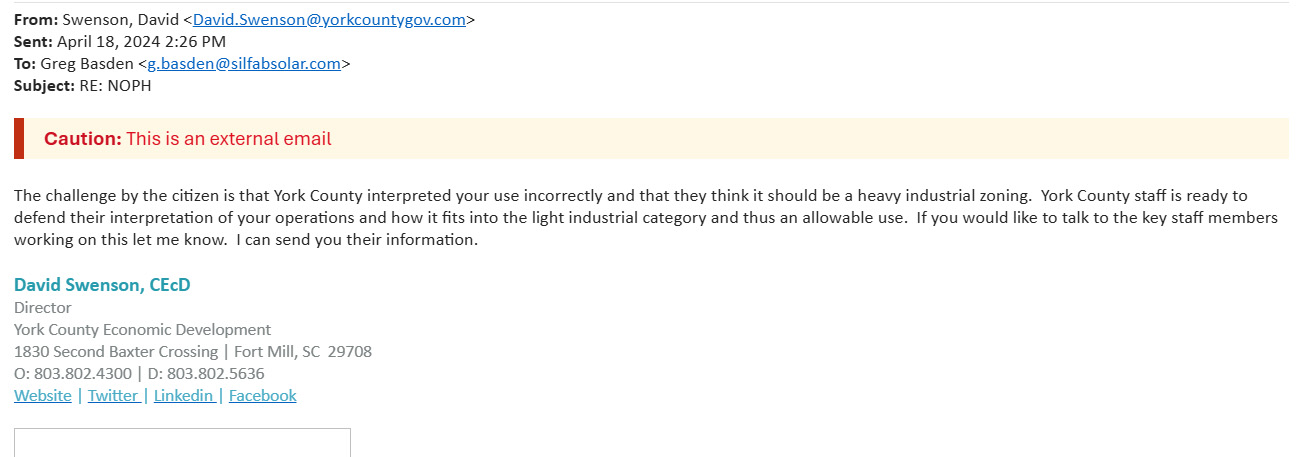
On April 18th, York County Economic Development Director David Swenson confirmed to Silfab’s Director of Operations, Greg Basden, that the upcoming BZA hearing was about Silfab’s operations.
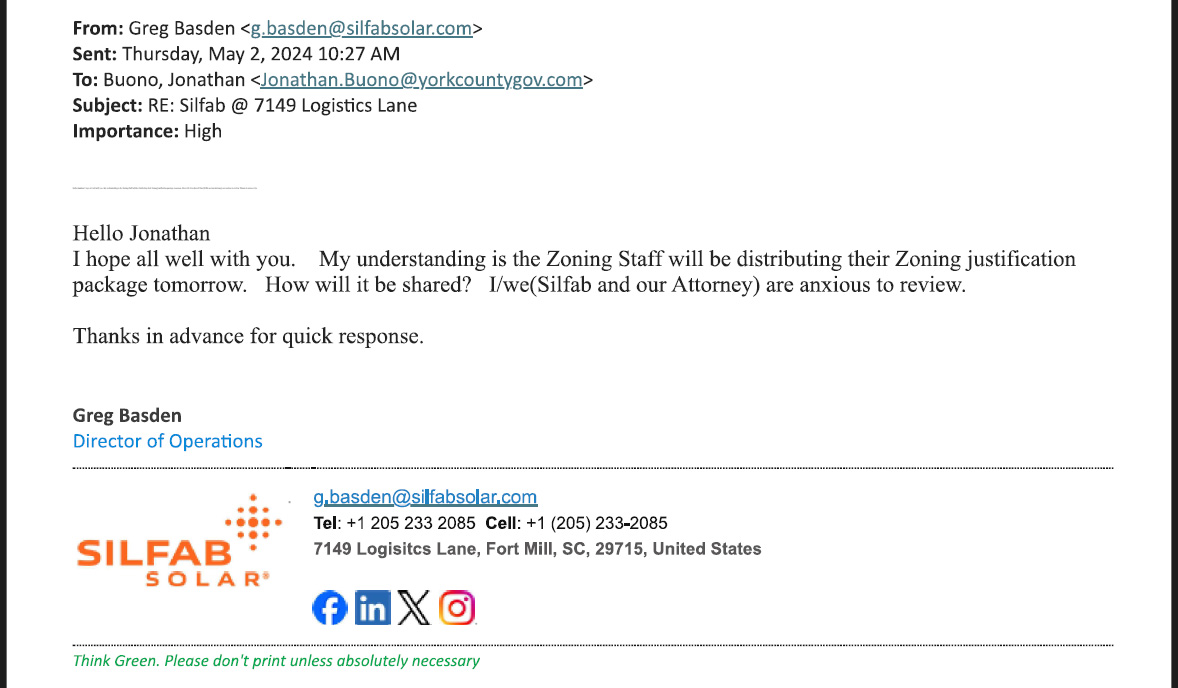
On May 2, 2024, Greg emailed county staff asking to review the county’s justification package.
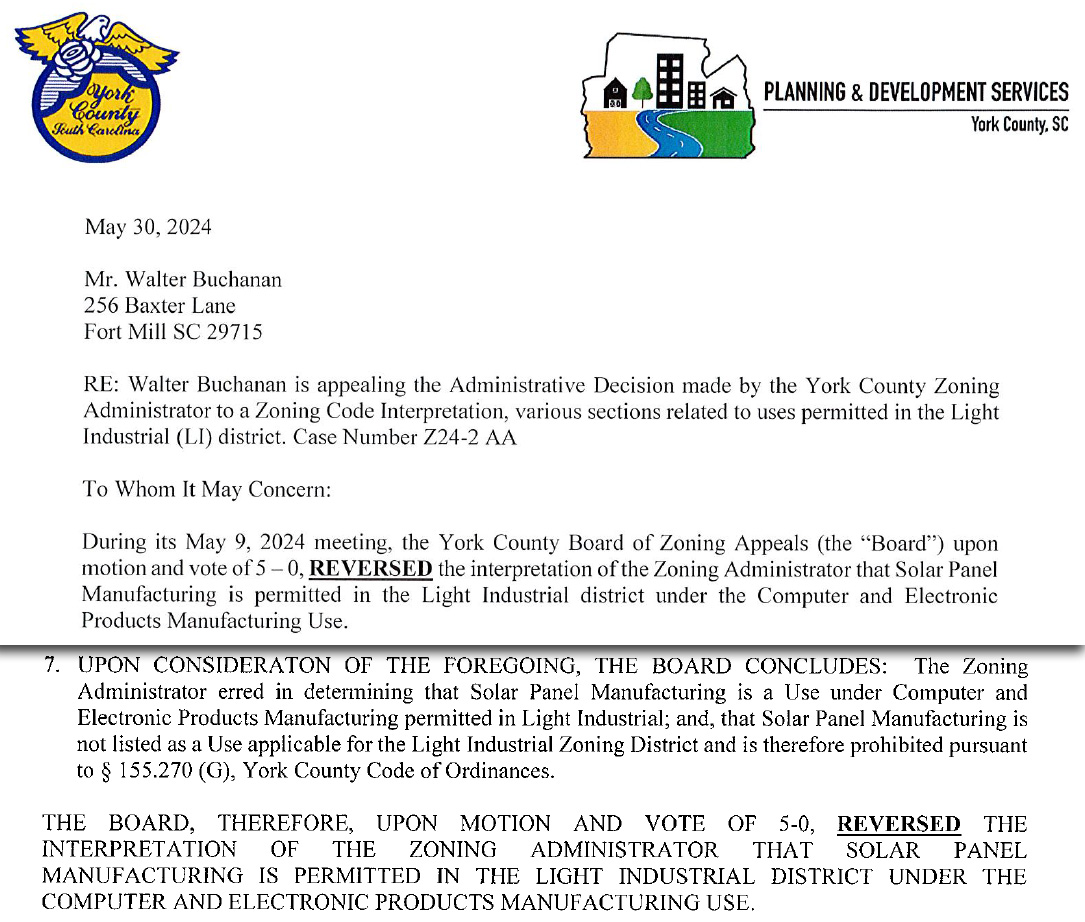
On May 9th, 2024, the Board of Zoning Appeals ruled 5-0 that Silfab’s operations were not allowed in a light industrial zone.
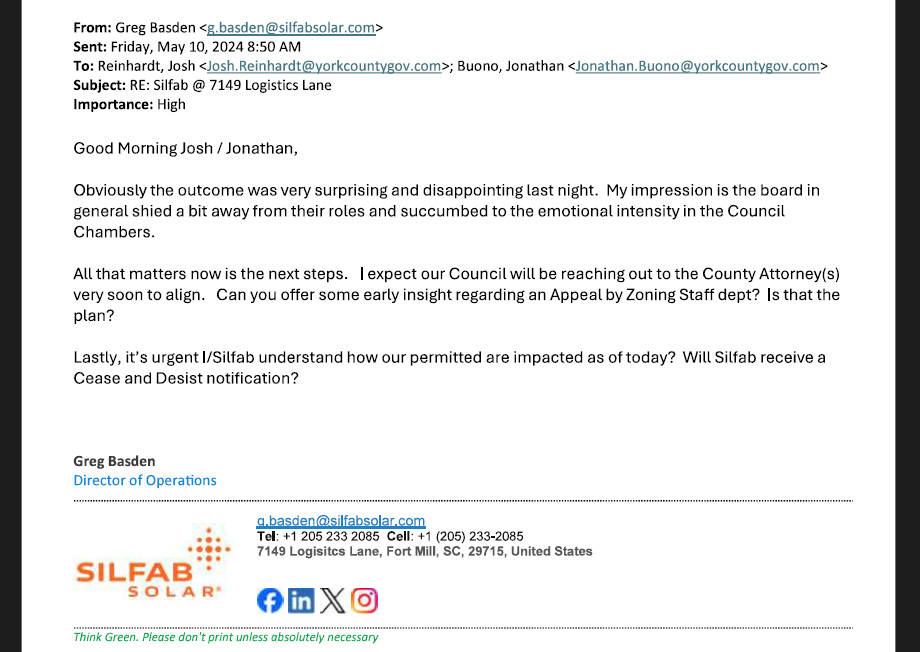
On May 10, 2024, Silfab’s Greg Basden emailed county officials asking point-blank if Silfab would be receiving a cease and desist:
On May 30 the BZA issued its written decision:
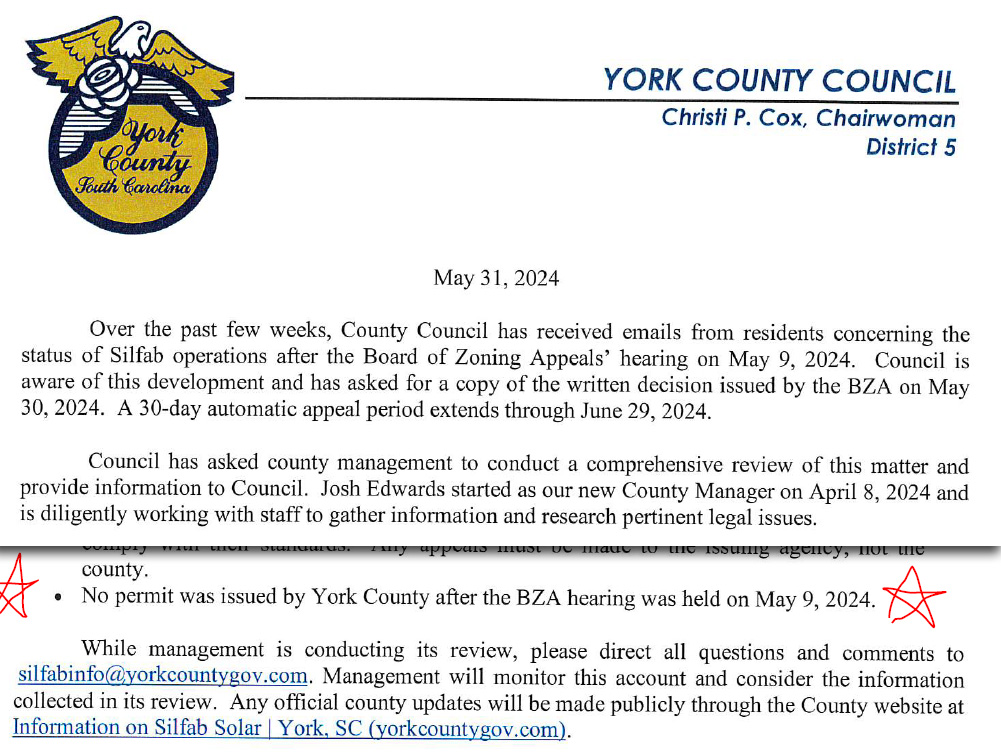
The very next day, May 31, 2024, Christi Cox signed a public letter telling residents that “No permit was issued by York County after the BZA hearing was held on May 9, 2024,” and that, Josh Edwards, who had started as County Manager on April 8, 2024, was “diligently working with staff to gather information and research pertinent legal issues.”
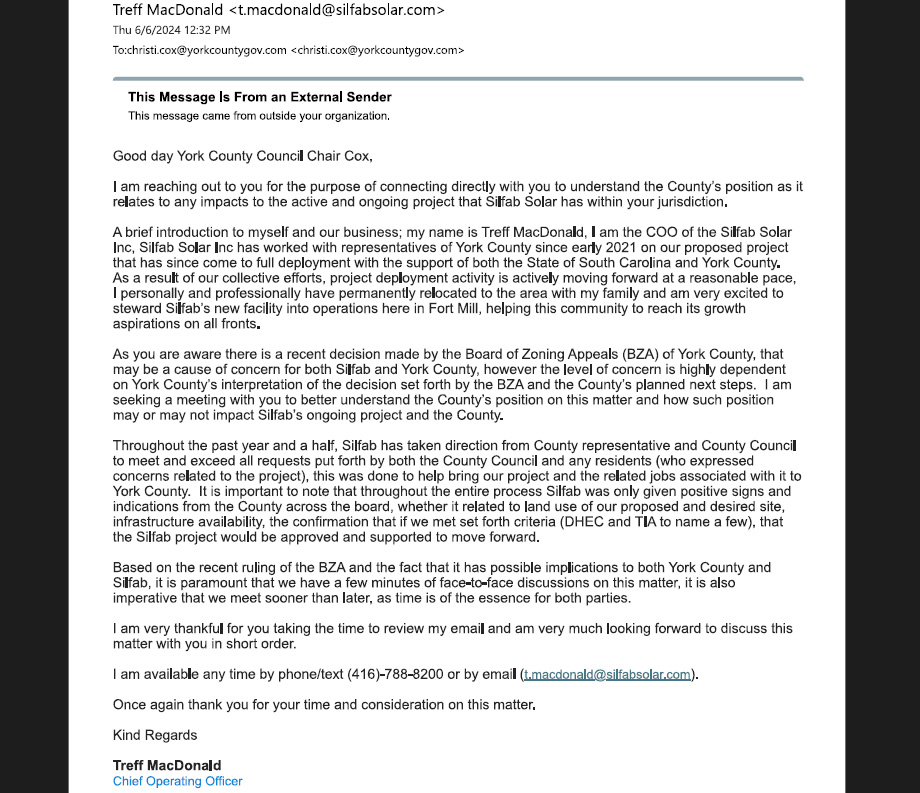
Silfab COO Treff MacDonald then asked for a meeting with Christi Cox a few days later on June 6th, saying “it is paramount that we have a few minutes of face-to-face discussions on this matter, it is also imperative that we meet sooner than later, as time is of the essence for both parties.”
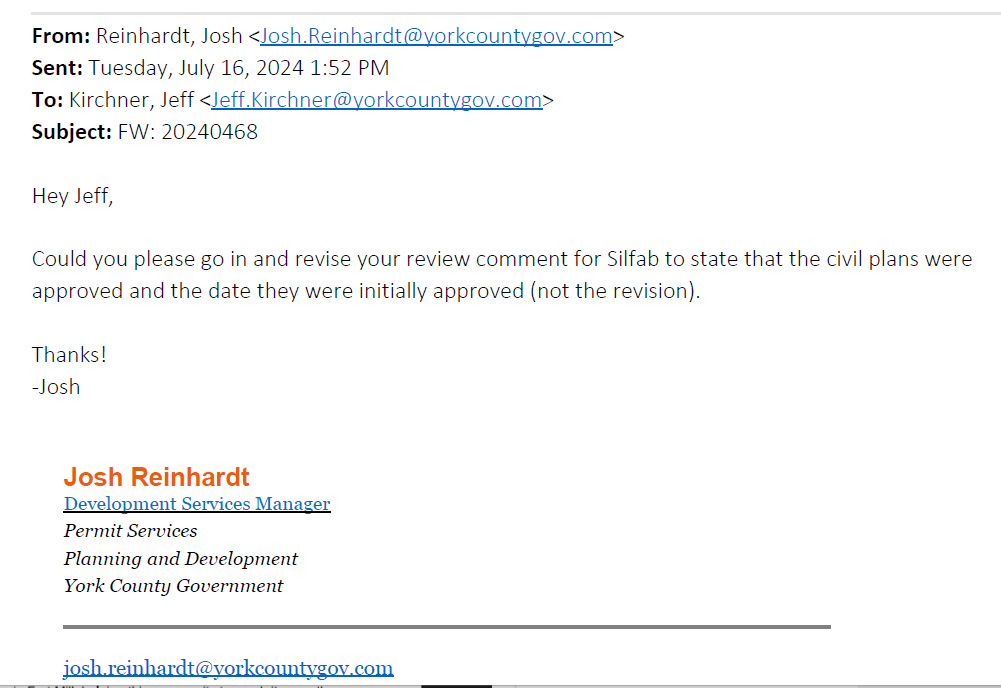
Internal emails also show that Cox and Edwards’ staff (including Reinhardt and Kirchner) discussing changes to approval dates. Silfab’s parking-lot civil plans were stamped April 24, 2024 — before the BZA hearing. The up-fit approval was dated July 16, 2024 — after the BZA reversal. The final “zoning compliance” stamp was back-dated to April 24 to pretend a valid approval existed before the BZA ruling and before citizens’ appeal window closed.
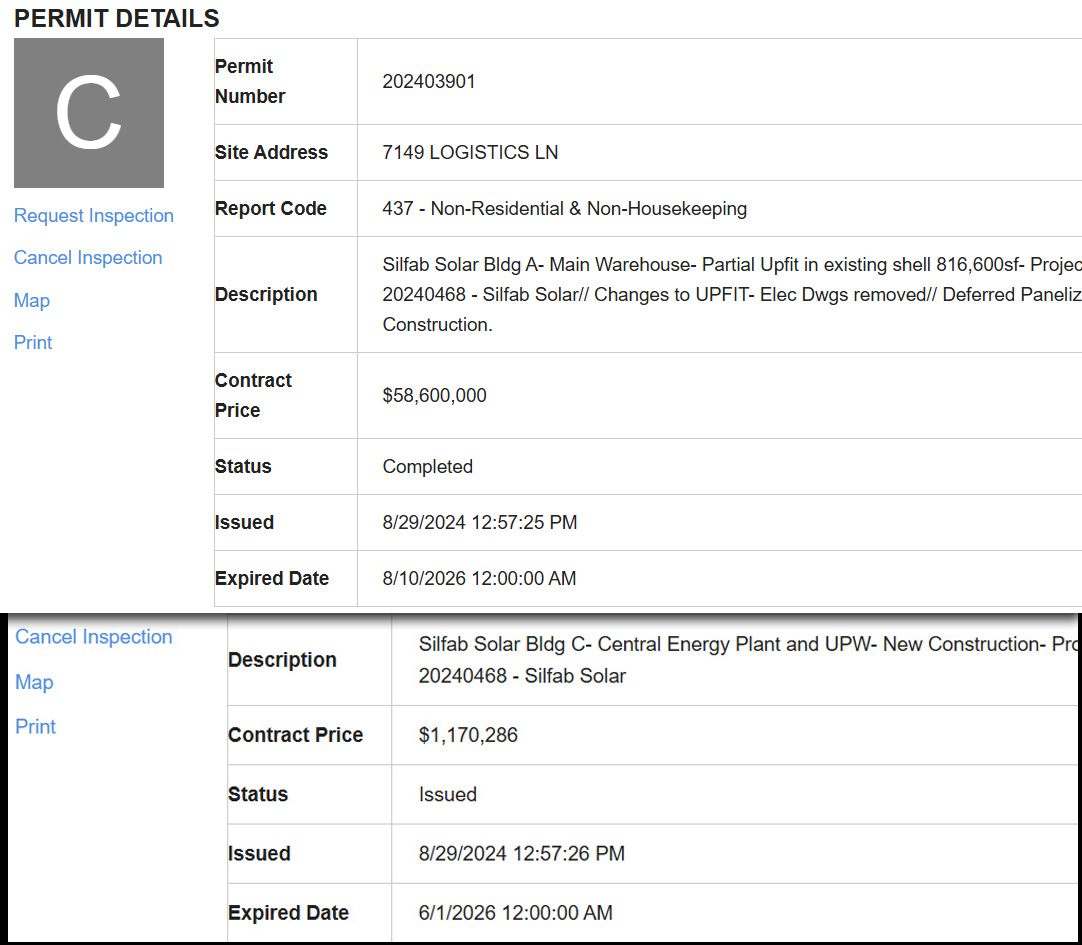
Roughly 1 month later, in August of 2024, Silfab began receiving all of their permits for the up fit of their main distribution building into a manufacturing factory, as well as the permits for the new construction of their chemical storage buildings and bunkers, wastewater treatment plant, and central energy plant.
These permits issued after the BZA ruling directly violated York County Zoning Code § 155.270(G), which states any use not expressly listed in the Use Tables “is prohibited.” It also violated York County Code § 155.262, which requires a formal Zoning Compliance application before any new or changed use can proceed. Silfab never filed one — it relied only on a 2022 non-binding “Zoning Verification” letter that county documents repeatedly describe as “not a permit or licensing” and “only states that the site can, with the proper permits, be used…”
Additional laws ignored include S.C. Code § 6-29-950 (unlawful to construct or occupy any building without a permit that complies with zoning ordinances) and S.C. Code § 6-29-800 (prohibiting the BZA from granting a variance that would allow a use not otherwise permitted).
Cox, Edwards, and the Council Vice Chair personally control what goes on the County Council agenda. Yet when two different council members publicly asked — twice — in open meetings that Silfab’s permits be placed on a future agenda, their requests were ignored. This was a direct, intentional violation of York County Code § 30.04(b), which mandates: “Any item … deferred from a proposed agenda shall be immediately placed on a future meeting agenda … by request of two members of Council.”
Under Christi Cox and Josh Edwards, the county continued issuing permits and ultimately the Certificate of Occupancy while a massive industrial operation loaded with hazardous chemicals moved forward next to Flint Hill Elementary School. Dispatch records show repeated 911 calls from inside the factory for workers vomiting blood (a 25-year-old woman on March 28, 2026), trouble breathing (a 23-year-old man on March 26, 2026), seizures (February 4, 2026), chest pain, high blood pressure, and cardiac symptoms — incidents that have occurred with alarming frequency and have no parallel at comparable solar plants.
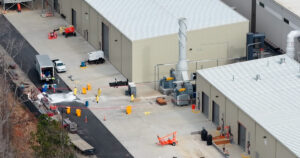 The danger spilled over to the children. On one day in March 2026, while school was in session and kids were playing near the fence, 1,530 gallons of potassium hydroxide poured into the retention pond directly bordering Flint Hill Elementary. Days later a hydrofluoric acid leak forced the school to close for two days out of an abundance of caution. In response, Silfab pumped roughly 300,000 gallons of liquid from the retaining ponds for off-site disposal over a single weekend.
On March 10, 2026, the Fort Mill School Board passed a formal resolution demanding that Governor McMaster, the General Assembly, Attorney General Alan Wilson, and York County Council “permanently limit the facility’s operations strictly to non-hazardous assembly processes and remove all hazardous chemicals on site in accordance with the facility’s current light industrial zone.”
Even now, with the factory fully operational and the school regularly placed in harm’s way, Cox and Edwards have refused to place the matter on the council agenda despite two formal requests by fellow council members, and they have allowed the prohibited use to continue unchecked.
All records cited — the May 30 BZA decision, the May 31 Cox letter, the Silfab Processes Memo, internal staff emails (including Basden’s cease-and-desist inquiry and Buono’s response), the hazardous-materials inventory, dispatch logs, the School Board resolution, and the 300,000-gallon pump-out — are from FOIA (Freedom of Information Act) productions or public filings. They paint a damning picture: under Christi Cox and Josh Edwards’ leadership and direction, their staff treated its own zoning code, council rules, public safety, and the health of elementary school children as optional while enabling a prohibited and dangerously toxic facility to begin operations within yards of elementary school children.