
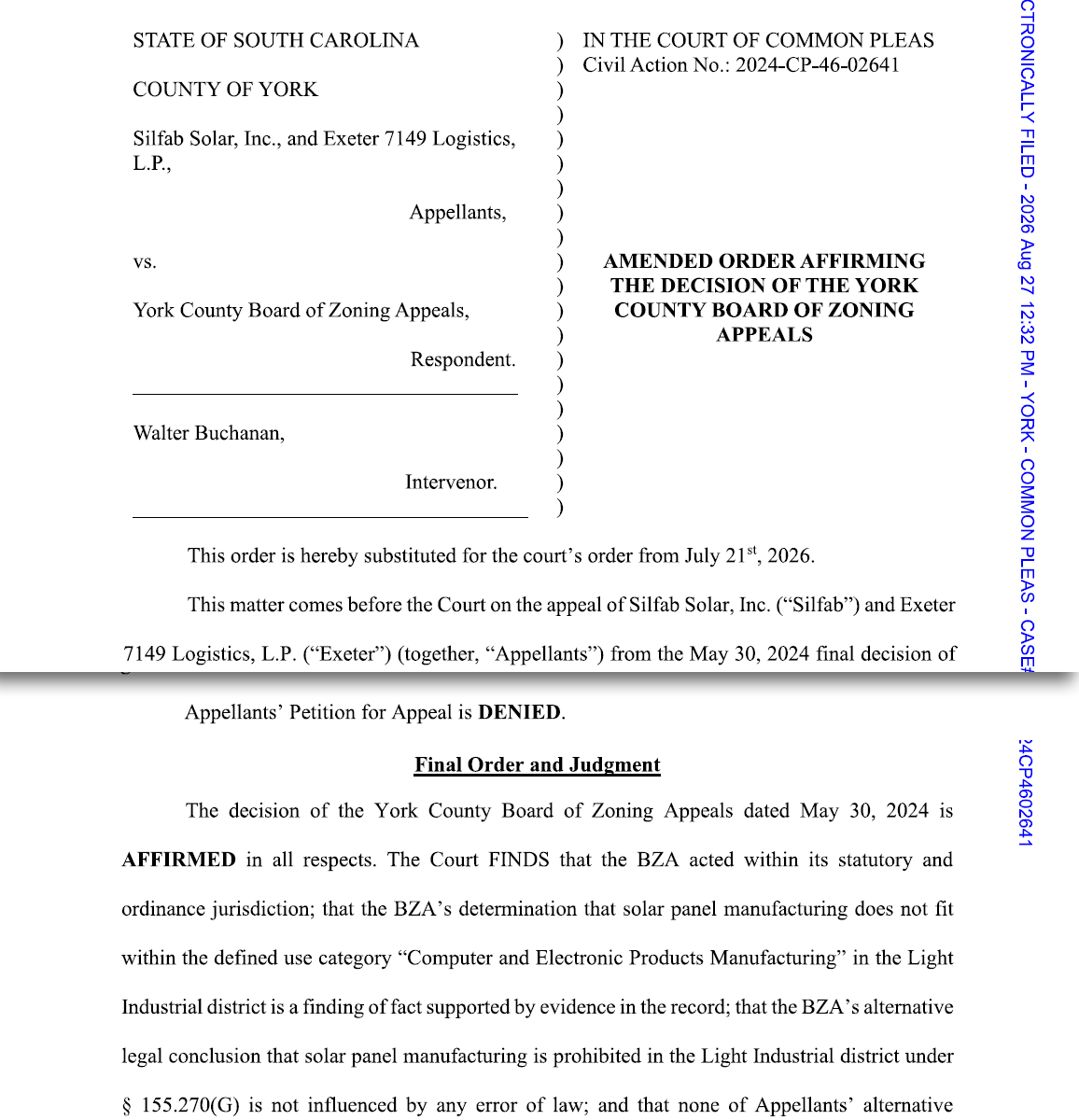
Yesterday, a York County judge issued a final amended order affirming the county’s Board of Zoning Appeals ruling against Silfab Solar, placing new pressure on York County officials to explain why the project’s permits and certificate of occupancy remain active. Judge William McKinnon affirmed the BZA “in all respects” and denied the appeal filed by Silfab Solar and Exeter 7149 Logistics. The ruling confirms that the BZA acted within its authority when it rejected York County’s 2024 interpretation that solar panel manufacturing fit within the “Computer and Electronic Products Manufacturing” category in the Light Industrial district.
The amended order replaced McKinnon’s earlier July ruling, but it did not change the bottom line. Silfab still lost its appeal at the circuit court level. The BZA ruling still stands. The court also rejected the major defenses used to justify the project’s zoning path. McKinnon found that the 2022 zoning verification letter was not a permit, was not a formal zoning code interpretation, and was not the decision under review. He also rejected the argument that York County Council’s FILOT tax agreement amended zoning law, stating that FILOT agreements are tax-incentive tools and do not change the zoning code.
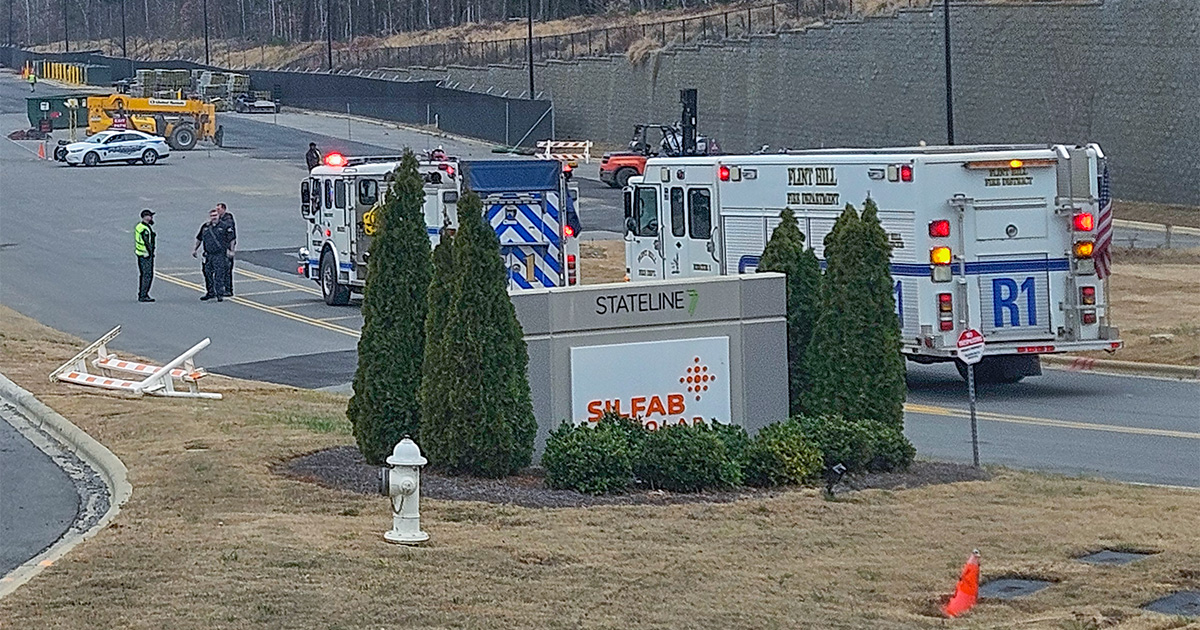 That finding now creates a direct question for York County: if the 2022 letter was not a permit, and the FILOT did not amend zoning, what lawful zoning authority allows Silfab’s current use to continue? County officials have argued that the BZA decision does not automatically cancel previously issued approvals, but if the judge ruled the 2022 letter was not a permit, the FILOT didn’t amend the zoning code, and all construction permits were issued after the BZA ruled their use unlawful, what ‘previously issued approvals’ are left?
South Carolina law makes that question especially serious. Under S.C. Code §6-29-950, “No permit may be issued or approved” unless state planning law and local zoning ordinances are followed. The same statute states, “A violation of any ordinance adopted pursuant to the provisions of this chapter is a misdemeanor… Each day the unlawful erection, construction, reconstruction, alteration, conversion, maintenance, or use continues is considered a separate offense.“
No court has yet declared any specific county official guilty of a misdemeanor, and no prosecutor has yet announced charges. But if Silfab’s unlawful use continues, the first potential daily violator would likely be Silfab as the operator of the facility. Exeter, the property owner, could also face scrutiny if it knowingly allowed or benefited from a prohibited use on its property (Exeter is currently receiving an estimated $500k per month, according to Silfab’s lease).
A number of county officials might also be held responsible if unlawful permits or occupancy approvals remain in place. The most obvious scrutiny would fall on County Manager Joshua Edwards, Planning & Development Services director Jonathan Buono, Development Services Manager Josh Reinhardt, Building Official Jennifer Culver, and Zoning Administrator Rick Abboud. It could also include lower-level planning and development officials who continue processing, honoring, or defending approvals tied to a zoning classification the BZA and Circuit Court have now rejected.
County Council members, especially Chair Christi Cox, could also face charges if it was found that council members knowingly directed staff to ignore the ruling, refuse enforcement, or ratify continued occupancy without a lawful zoning basis.
The amended order leaves the county with one simple demand from residents: if they exist, show us the documents. Show the lawful zoning approval. Show the stay order. Show the supersedeas order. Show the vested-rights determination. Show the separate use classification that authorizes the project today.
Until York County produces that authority, the county’s position will remain under growing legal and public pressure. The BZA has been affirmed. The 2022 letter was not a permit. The FILOT did not amend zoning. And South Carolina law says zoning violations can be misdemeanors.
The remaining question is no longer academic – when the dust settles, who will be held accountable for the possible daily misdemeanor violations?