

 North Carolina agriculture officials have just confirmed the state’s first established population of invasive yellow-legged hornets in the Charlotte area, raising concerns for homeowners, beekeepers and the region’s pollinators.
The North Carolina Department of Agriculture and Consumer Services (NCDA&CS) said the invasive hornets were confirmed in Matthews after a Union County homeowner noticed unusual hornet activity around a hummingbird feeder.
A follow-up survey found additional yellow-legged hornets near the Union-Mecklenburg county line. State and federal officials are now working together to locate and destroy the nest before the population spreads.
The discovery comes just months after officials confirmed a population of the invasive hornets in York County, just south of Charlotte.
Unlike many native hornets, yellow-legged hornets are notorious for attacking honeybees. They often hover outside hives in a behavior known as “hawking,” capturing bees as they leave to forage.
State Apiarist Don Hopkins warned the insects could devastate North Carolina’s beekeeping industry by reducing pollination, lowering honey production and causing entire bee colonies to collapse.
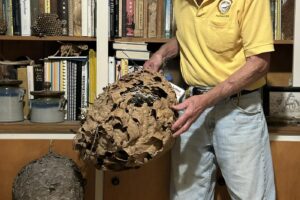
The hornets also build unusually large nests with a distinctive reddish-brown, muddy appearance. At this point in the summer, nests are often about the size of a volleyball. By fall, they can grow large enough to fill the bed of a pickup truck.
To stop the invasion, NCDA&CS has placed more than 200 survey traps around the area where the hornets were discovered. Officials are urging homeowners and beekeepers to report suspicious sightings and help monitor for additional populations.
Residents looking to reduce stinging insect activity around their property may consider hanging WHY Traps, which is designed to capture multiple hornet and wasp species without attracting honeybees.
Homeowners and beekeepers can learn how to build monitoring traps, identify yellow-legged hornets and report sightings by visiting the NCDA&CS Yellow-Legged Hornet information page.