
Biggest Poker Tournaments in Charlotte

0

Charlotte lacks major professional poker tournaments. The city operates under North Carolina gaming laws that cap cash games at $100 maximum bet and restrict tournament buy-ins to $500. No World Series of Poker Circuit events or World Poker Tour stops occur in Charlotte proper. The closest professional tournament action happens at Harrah’s Cherokee Casino Resort, located 160 miles west in the Great Smoky Mountains.

Despite these restrictions, Charlotte has built a steadily growing poker community driven by weekly local tournaments, charity events, and private club games. The city’s players often compensate for the lack of high-stakes action by traveling to regional venues or participating in statewide poker series. This distinct environment creates a unique blend of recreational play, charity competition, and regional travel for more serious tournament grinders.

The Cherokee Connection

Harrah’s Cherokee hosts the WSOP Circuit North Carolina series twice yearly. The venue runs a 12-event schedule each January and August with buy-ins from $400 to $1,700. Main Event prize pools reach $1 million with 500 to 700 entrants participating. Players from Charlotte constitute roughly 30 percent of the field according to tournament registration data. The casino provides 24 poker tables and expanded tournament space accommodating 240 players during peak events.

Cherokee’s tournament schedule includes $400 No Limit Hold’em events, $600 Pot Limit Omaha tournaments, and the $1,700 Main Event. Starting stacks begin at 20,000 chips for preliminary events and 30,000 for the Main Event. Blind levels run 40 minutes for ring events and 60 minutes for the championship. The venue adds High Roller tournaments at $2,200 and $3,250 buy-ins during select series.

Harrah’s Cherokee has become the de facto tournament hub for Charlotte-area poker players. The casino’s WSOP Circuit events attract not only local grinders but also traveling professionals from Atlanta, Knoxville, and surrounding regions. During major series, the property frequently sells out hotel rooms, creating a true poker festival atmosphere that Charlotte itself cannot replicate due to state gaming limitations.

Local Venue Formats and Entry Requirements

Charlotte’s poker rooms operate under North Carolina’s specific gaming regulations that shape tournament structures. The city’s card rooms run Texas Hold’em, Omaha, and Seven Card Stud tournaments with buy-ins ranging from $50 charity events to $500 capped entries due to state law restrictions. These venues mix traditional poker games like Pot-Limit Omaha with variants such as H.O.R.S.E. and Razz during their weekly schedules.

Big Al’s on Independence Boulevard runs free-roll tournaments every Tuesday and Thursday at 7 PM, while charity organizations host quarterly events at the Charlotte Convention Center with proceeds supporting local nonprofits.

Tournament entry in Charlotte requires players to register either online through venue apps or in person at least 30 minutes before start time. Most venues enforce a dress code prohibiting athletic wear and require valid photo identification for all participants aged 21 and over. The standard tournament structure uses 20-minute blind levels for daily events and 30-minute levels for weekend championships. Players receive between 10,000 and 25,000 starting chips depending on the buy-in level.

Venue operators also implement late-registration periods to help boost prize pools, allowing players to enter up to Level 6 in most formats. Re-entry options exist in many weekly tournaments, enabling players to return to the field after busting out early. While the stakes remain modest, local competition can be surprisingly tough, as Charlotte’s player pool includes a mix of enthusiasts, traveling regulars, and recreational players aiming to qualify for larger regional events.

Charity Tournament Operations

North Carolina law permits charitable organizations to host poker tournaments with specific restrictions. Buy-ins cannot exceed $100 per player with total prizes capped at $10,000 per event. Organizations must file permits 60 days before tournament dates and submit financial reports within 30 days after completion.

The Keep NC Beautiful Foundation runs quarterly tournaments at the Charlotte Convention Center attracting 200 to 300 players. The Levine Children’s Hospital hosts an annual championship each October with a $500 buy-in split between prize pool and donation. Local businesses sponsor tables and provide dealer volunteers for these events.

Charity tournaments serve as an important pillar of Charlotte’s poker scene. They offer structured play for those who prefer organized events without long-distance travel, while also supporting community causes. These tournaments frequently feature raffles, silent auctions, and local media participation, strengthening both community engagement and event turnout.

Regional Championship Series

The North Carolina Poker Championship operates a points-based series across Charlotte, Raleigh, and Greensboro. Players earn ranking points at 40 qualifying events throughout the year. The top 100 players advance to a $1,000 buy-in championship held in Kannapolis, 20 miles northeast of Charlotte. Prize pools reach $75,000 with the winner receiving $20,000 and a trophy.

Bar Poker Open Charlotte stages monthly qualifiers at 12 locations. Winners receive free entry to quarterly regional finals with $10,000 guaranteed prizes. The organization tracks player statistics through a mobile app providing real-time standings and tournament schedules.

These networking opportunities help develop skill progression for local players who want to elevate their experience beyond small weekly events. Many Charlotte grinders use these series as stepping stones toward WSOP Circuit participation or larger regional championships in neighboring states.

Private Game Regulations

Charlotte permits private poker games in residences and private clubs under specific conditions. Hosts cannot take rake or charge fees beyond actual expenses. Games must remain invitation-only without public advertising. Stakes stay unrestricted in private settings, though organizers face liability for violations.

Country clubs, including Myers Park and Charlotte Country Club, organize member tournaments monthly. Buy-ins range from $200 to $1,000 with proceeds supporting club improvements. These events attract 50 to 80 players, including local business executives and professional athletes. Tournament directors enforce Robert’s Rules of Poker with floor decisions final and binding.

Private games often serve as the highest-stakes action available in the Charlotte area, since public venues must adhere to strict betting limits. These exclusive events maintain strong security and appeal to more serious players seeking deeper stacks and competitive formats.

Conclusion

Charlotte’s poker tournament landscape operates under strict state regulations, limiting the size and scope of events within city limits. Even so, the region maintains a lively poker ecosystem supported by weekly tournaments, charity events, private club competitions, and a strong pipeline to Harrah’s Cherokee. While major WSOP or WPT events may not arrive in Charlotte anytime soon, players still benefit from diverse formats, steady community engagement, and convenient access to one of the largest tournament venues on the East Coast. For recreational players and competitive grinders alike, Charlotte offers a surprisingly active and interconnected poker scene shaped by regional travel, community support, and a commitment to maintaining local poker culture.


When Humidity Becomes Structural Trouble Beneath the Floor

0

Most homeowners think of humidity as a comfort issue, something that makes the air feel heavy or leads to musty smells. They don’t connect it to structural damage. Yet excess moisture beneath a home can quietly weaken beams, rot subflooring, and invite mold that spreads unseen through the crawl space. The damage happens slowly enough that you might miss it entirely until the floor starts feeling soft or uneven underfoot. That’s when you realize the problem has been there much longer than you thought.

The crawl space acts like a hidden ecosystem where warm air from above and cool surfaces below collide constantly. Condensation forms from this temperature clash, and moisture accumulates faster than most homeowners realize. Understanding this connection between moisture and actual structural failure helps you protect your home before damage becomes visible and expensive. When humidity gets out of control, it doesn’t just sit there, it actively destroys wood and compromises the integrity of everything supported from below.

That’s why recognizing humidity as a structural threat rather than just a comfort problem changes how you approach crawl space waterproofing Nashville, TN and maintenance. Once you understand the real consequences, taking action shifts from optional to essential. The hidden ecosystem beneath your floor is either protecting your home or slowly eating it away, and the difference comes down to moisture control.

Why Moisture Below Matters More Than People Think

Wood loses strength as it absorbs moisture, and that loss happens gradually until suddenly your floor feels wrong. Joists that have absorbed water for months or years become softer and less capable of bearing the weight they were originally designed to support. Nails loosen as wood swells and shrinks with moisture cycles, creating tiny movements that add up over time. Flooring above starts to shift subtly, and people often dismiss it as normal settling when it’s actually progressive structural failure.

The structural strain that moisture creates grows steadily but quietly, often mistaken for normal aging of an older home. A floor that was perfectly level five years ago begins to sag near one corner, and homeowners assume the house is just settling the way old homes do. But settling shouldn’t be dramatic or visible, it should be minimal and stable. When you’re noticing new movement year after year, that’s moisture damage, not normal aging. The wood is literally becoming weaker as it absorbs moisture.

Paint peeling on walls, drywall cracks appearing, and doors hanging differently are all signs that moisture has weakened structural components underneath. These aren’t random failures, they’re symptoms of wood losing structural capacity. The sooner you address the moisture source, the sooner the structural degradation stops. Continue ignoring it, and you’re looking at expensive beam replacement and floor reinforcement work that could have been prevented.

The Hidden Cycle of Condensation and Decay

Condensation in crawl spaces happens through a vicious cycle that perpetuates itself. Warm air from your home rises through gaps in flooring and meets cool foundation walls and soil. That temperature difference causes moisture in the air to condense into liquid water on surfaces. That water soaks into wood, and the moisture creates an ideal environment for mold to flourish. Mold growth compromises wood strength further and releases spores that get drawn upward into your living spaces.

The cycle feeds itself because wet conditions encourage more decay, which creates more air leaks that allow humidity to continue rising. Mold needs only moisture and organic material to thrive, and crawl spaces have both in abundance. As mold spreads, it breaks down the cellulose in wood fibers, literally eating the structural material. The wood loses density and strength in direct proportion to how much mold colonizes it. What started as condensation becomes active biological decay happening in real time.

Insects and rodents are also attracted to this environment, and their presence creates additional damage and accelerates decay. They tunnel through weakened wood, further compromising structural integrity. The entire crawl space becomes an active zone of biological and physical degradation, all driven by that initial moisture problem. Breaking this cycle requires addressing the root cause, not just treating the symptoms.

Breaking the Cycle with Proven Solutions

Encapsulation systems seal the crawl space with vapor barriers that prevent moisture from rising through the soil in the first place. By blocking upward moisture migration from the ground, you eliminate the primary source of humidity. Vapor barriers work everywhere in the crawl space, not just in the wettest spots, creating consistent protection across the entire area beneath your home. A sealed space means condensation can’t form because there’s no temperature differential driving it.

Proper drainage installed beneath the vapor barrier collects any water that does enter and directs it away from the foundation. Sump pumps remove that water completely, ensuring it never accumulates. Dehumidifiers maintain low humidity levels year-round, providing a second line of defense against any moisture that might penetrate the sealed system. Together, these solutions don’t just dry the space, they fundamentally transform it from a damp ecosystem into a controlled environment.

These systems stabilize the entire structure and reduce long-term repair costs dramatically because they stop the damage cycle at its source. Wood that stays dry stays strong, and wood that stays strong keeps supporting your home without degradation. Mold can’t grow in dry conditions, so encapsulation eliminates both the biological decay and the air quality problems that come with it. The investment in proper sealing and drainage returns dividends for decades as your foundation system remains stable and your floor stays level.

Conclusion

Humidity beneath your home isn’t just a comfort issue or a cosmetic problem, it’s a silent structural threat that compounds over time. What seems like minor moisture today becomes serious decay tomorrow if left unchecked. Managing moisture early keeps your floors level, your air cleaner, and your home stable for decades to come.

When you treat your crawl space as a critical part of your structural system rather than just an empty space, everything changes. Professional encapsulation and moisture control transform an overlooked area into one of the most protective parts of your entire house. That shift in perspective and immediate action is what separates homeowners who have stable homes from those who deal with ongoing foundation problems.

With the right combination of sealing and waterproofing measures, you’re not just fixing a current problem, you’re preventing years of future decay and expensive repairs. Your crawl space holds up everything else, so keeping it dry and controlled is one of the smartest investments you can make in your home’s longevity.

Chief of Catawba Indians Says Tribe Plans A Second Venue Amid Celebrations of $1 Billion NC Casino

0

The Catawba Indian Nation marked a major milestone with the opening of their $1 billion casino project. Community members proudly gathered at King’s Mountain to celebrate the achievement. Once there, Chief Brian Harris announced that plans to open a second casino were also underway. The project represented years of persistence that finally paid off. After all the planning and legal challenges, the project is expected to breathe new life into the community. The added job creation and other opportunities are also welcome amid tough economic times.


The casino sector has changed rapidly in the last two decades. As online casinos become more popular throughout the country, options like casinos with $10 minimum deposit requirements have begun heavily competing with traditional brick-and-mortar venues. The convenience these platforms bring represent a huge turning point for the local tribes. In doing so, they have become a major disruptor to the industry. Low stakes platforms offer players the chance to play with minimal investment but still provide all the same games as regular casinos. However, gaming libraries tend to be much larger at digital casinos. These add to their appeal while the digital nature of such platforms provide lower barriers for gaming enthusiasts to enjoy them. 

There are plenty of modern games too. Live dealer games and other popular offerings like crash games have begun lowering foot traffic in casinos across the world. However, the Catawba tribe’s latest project hopes to showcase that conventional casino models are far from obsolete. The permanent Two Kings Casino Resort covers more than two million square feet. Its first phase is expected to open in 2026 and adds to the mega projects already planned in the state. The hope is that the project will draw in higher tourism rates. The new casino holds fast to a resort experience replete with restaurants and a host of other entertainment options that can’t be replicated online. 

The tribe has not disclosed the planned second site’s location. However, the announcement of the second project provides a glimpse into the faith shown by the tribe. Casinos have become synonymous with tribal identity throughout the country. The Catawba’s leadership locally has emphasized that profits will go toward education, healthcare, and infrastructure for tribal members. The profits generated from tribal casinos have become a major driver of preserving cultural heritage for many tribes. In an area largely dependent on the manufacturing industry, projects like these offer a huge boost. 

As times changed, across the nation, many tribes are seeing their long-standing gaming compacts being challenged. Major casino developers all want a piece of the pie. There’s also immense pressure on many tribes to go digital and tear up the conventional casino models. Meanwhile, many industry leaders feel that rights to digital casinos should be open to all.

Despite all this, construction continues to move forward with hundreds of workers on site. As the steel frame now stands complete, crews will shift focus to interior work. This will pave the way for the next stage of development. For the Catawba Nation, the project is also a symbolic one. It represents the culmination of years of effort to bring the project to life. For many, it also heralds a new chapter in merging tribal identity with much-needed economic growth.

North Carolina Launches Government-Run A.I. Leadership Council

0

This week marked a significant milestone for North Carolina as the state’s AI Leadership Council convened for its inaugural meeting. This council has been established to enhance the state’s leadership in artificial intelligence (AI) literacy, governance, and deployment, in line with Governor Josh Stein’s Executive Order on AI.
Bringing together nearly 30 public and private sector experts, the meeting laid the groundwork for North Carolina’s goal to become the most AI-literate state in the nation. The council will play a critical role in advising and supporting the Governor and state agencies on developing AI strategies, policies, protections, and training initiatives aimed at driving innovation and advancing AI-driven industries.

In his opening remarks, Governor Stein emphasized the pivotal role AI plays in shaping the future of North Carolina’s economy, growth, and safety.

“Through the Council’s leadership, we can harness AI to unlock economic growth, attract innovation, improve government efficiency, and prepare our workforce for the jobs of today and tomorrow,” said Governor Josh Stein. “We must be well-equipped to take on these opportunities and challenges to make North Carolina stronger, safer, and more prosperous.”

The council is chaired by Secretary of Information Technology Teena Piccione and Secretary of Commerce Lee Lilley, both of whom expressed their commitment to ensuring the responsible and effective deployment of AI technologies in the state.

“Building trustworthy AI is essential for creating efficient and safe experiences that save time and expand job opportunities,” Secretary Piccione emphasized. “Prioritizing trust in AI development ensures that innovation aligns with fairness and transparency, ultimately fostering a future where technology benefits all communities.”

North Carolina is already home to significant AI projects, including Amazon’s new $10 billion AI innovation campus in Richmond County. Additionally, the FUJIFILM Diosynth facility in Holly Springs stands out as the largest end-to-end biomanufacturing facility in North America, showcasing the state’s commitment to embracing cutting-edge technologies.

“Artificial intelligence is reshaping the global economy, and North Carolina will shape, not merely adapt, to that transformation,” said Secretary Lilley. “Through Governor Stein’s AI Leadership Council, we’re bringing together industry, education, and government partners to make sure our state’s workforce and businesses are ready to compete and to ensure that innovation translates into real opportunities, good jobs, and sustainable growth for people in every region of North Carolina.”

The council’s initiatives will also include deploying AI to improve government operations, identifying unnecessary regulations, and providing user-friendly AI agents to assist North Carolinians in navigating state services.

As North Carolina takes this monumental step toward advancing its AI capacity, the state remains committed to developing a tech-savvy workforce prepared for the evolving technological landscape.

In Executive Order 24, the Governor also established the North Carolina AI Accelerator within NCDIT to serve as a centralized hub for AI governance, research, partnership, development, implementation, and training. The executive order also mandates the establishment of an AI Oversight Team for each state agency and outlines parameters for an AI Literacy and Fraud Prevention Training Program for the general public.

Members of the AI Leadership Council:

  • Teena Piccione, Secretary of North Carolina Department of Information Technology and State CIO (Co-Chair)
  • Lee Lilley, Secretary of North Carolina Department of Commerce (Co-Chair)
  • Sen. Todd Johnson, NC Senate, District 35, Senate Majority Whip
  • Sen. DeAndrea Salvador, NC Senate, District 39
  • Rep. Zack Hawkins, NC House of Representatives, District 31
  • Rep. Jake Johnson, NC House of Representatives, District 113, House Deputy Majority Whip
  • Dr. David Yokum, Ph.D., Chief Scientist, North Carolina Office of State Budget and Management
  • Mary Penny Kelley, Chief of Staff, NC Office of State Human Resources
  • Kunal Choksi, Senior Deputy Attorney General, Consumer Protection Director at North Carolina Department of Justice
  • Vera Cubero, NC Emerging Technologies Consultant, Department of Public Instruction
  • Bryan Harris, Executive Vice President, Chief Technology Officer at SAS
  • Phaedra Boinodiris, Global Leader of Responsible AI at IBM Consulting
  • Marina Chase Carreker, Founder, Galleon Strategies
  • Igor Jablokov, Chairman, Pryon Inc.
  • Dr. Thomas Reardon, former VP, Research at Meta; Partner, Lux Capital
  • Dr. Stan Ahalt, Ph.D., Dean, School of Data Science and Society, University of North Carolina at Chapel Hill
  • The Hon. Tommy Sowers, Ph.D., Deputy Director, Duke Initiative for Science and Society
  • Dr. Andrea Crowley, Ph.D, Executive Director, NC Student Success Center, North Carolina Community Colleges
  • Dr. Siobahn Day Grady, Ph.D., Founding Director, Institute for Artificial Intelligence and Emerging Research & Associate Professor of Information Systems at North Carolina Central University
  • Dr. Angel Hsu, Ph.D., Associate Professor of Public Policy and Environment, Ecology and Energy, University of North Carolina at Chapel Hill; Founding Director, Data-Driven EnviroLab
  • Markell Storay, Chief Information Officer and Director of Innovation & Technology, City of Charlotte
  • The Hon. Shinica Thomas, Wake County Commissioner
  • Jennie Bowen, Workforce Development Director, Rivers East Workforce Development Board
  • Leslie Boney, Principal, BoneConnector.com; Former Director, Institute for Emerging Issues, NC State University
  • Rick Knafelz, Managing Director, Employee Experience Technology, Bank of America
  • Hannah Drummond, RN, Vice President, NC AFL-CIO
  • Todd Olson, CEO & Co-founder, Pendo
  • Sarah Bacha, Senior Vice President, Head of Corporate Strategy, Analytics, and AI, LendingTree

For more information about the AI Leadership Council and the state’s AI efforts, visit it.nc.gov/ai.

Crowds Flock to the Blue Ridge to Witness North Carolina’s Mysterious ‘Shadow of the Bear’

0

An epic natural event known as the Shadow of the Bear is once again captivating visitors in the Blue Ridge Mountains near Cashiers.

Between mid-October and early November, the setting sun aligns perfectly with Whiteside Mountain, casting a shadow across the valley that resembles a massive bear moving through the forest.

The rare phenomenon appears for about 30 minutes on clear days, typically around 5:30 pm. Locals say it’s best viewed from the Rhodes Big View Overlook off Highway 64, where crowds gather with cameras ready to capture the fleeting spectacle.

The event coincides with peak fall foliage, making it one of the most photographed natural scenes in the state. Visitors are encouraged to arrive early to secure a good viewing spot and to use caution, as the area often experiences heavy traffic during the display.

For those who miss the fall viewing window, nature offers a second chance — the Shadow of the Bear will return again between mid-February and early March, when the sun’s position recreates the same magical effect.

Charlotte Ranked Among The 10 Most Dangerous Cities for Pedestrians in 2025

0

As summer turns to fall, peak Holiday travel season is around the corner, and Americans continue to attend festivals as evenings get shorter and cooler. With so much walking activity, pedestrian safety remains a crucial concern.


According to a new report from KURU, Charlotte ranks among the top 10 most dangerous U.S. cities for pedestrians in 2025.

With 2.29 pedestrian deaths per 100,000 residents and a Walk Score of 26, the city’s car‑first design and low walkability contribute to higher pedestrian risk.

The Most Dangerous U.S. Cities for Pedestrians in 2025

City Number of Pedestrian Deaths per 100,000 People Walk Score Total Safety Score Rank
Albuquerque 4.68 26 12 1
Jacksonville 3.54 26 15 2
Las Vegas 3.41 42 29 3
Mesa 2.96 38 30 4
Phoenix 2.96 41 32 5
Tucson 2.96 43 34 6
San Antonio 2.71 37 34 7
Fort Worth 2.64 35 34 8
Memphis 2.62 35 35 9
Charlotte 2.29 26 37 10

Downed Power Line Shuts Down I-77 in Both Directions – NCDOT Asks Drivers To Stay Away

0

UPDATE 11/7/2025 10:17 am: 

NCDOT crews have now completed the power line repair and have reopened all lanes on I-77 in both directions.

Original Article 11/7/2025 7:10 am: 

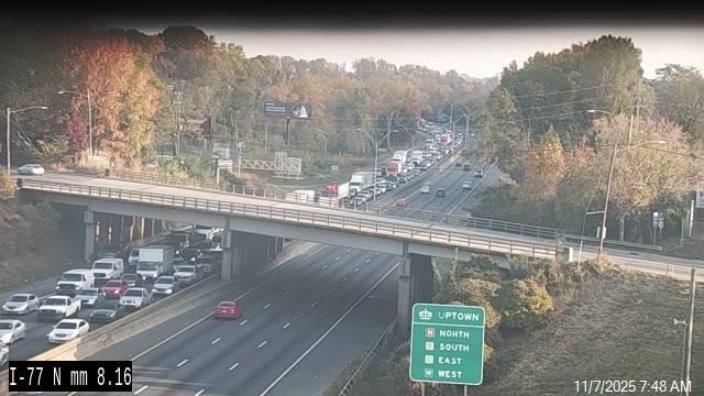
All lanes of Interstate 77 in Charlotte were shut down early Friday morning after power lines reportedly fell across the highway. The North Carolina Department of Transportation (NCDOT) said incident 752760 occurred around 6:54 a.m. near the exits for Billy Graham Parkway and West Woodlawn Road, close to mile marker 6.

According to NCDOT traffic cameras, what appear to be downed utility lines are stretched across both northbound and southbound lanes. Officials have confirmed that all six lanes are currently closed as crews work to remove the hazard and restore power.

Traffic on 77 quickly backed up from Huntersville down to the SC line, also causing severe congestion on nearby roads, including South Tryon, Tyvola, and 485. Drivers are being urged to avoid the area and use alternate routes.

Traffic cam on I-77 at Remount Rd

Authorities expect cleanup and repairs to continue through the morning rush hour. NCDOT estimates the interstate could reopen around 9:54 a.m., depending on the progress of utility crews and safety inspections.

Motorists traveling through the Charlotte area should plan for significant delays and check NCDOT’s real-time traffic map before heading out.

Crime Debate Heats Up: GOP Pushes for National Guard in Charlotte as City Data Shows Drop in Crime

0
The National Guard was deployed in Charlotte in 2016 during the Keith L. Scott protests.

A coalition of Republican lawmakers urged North Carolina’s governor on November 5 to deploy the National Guard in Charlotte, citing a surge in violent crime and citing rising numbers of offenders. The letter, sent to Gov. Josh Stein, argues that local law-enforcement resources are “stretched dangerously thin” and calls for an emergency stabilizing presence.

In their letter, the lawmakers claim the Charlotte-Mecklenburg area faced eight homicides in a single week and that the murder rate in Uptown is “now 200 percent higher” than a year ago. They also refer to figures from the Charlotte‑Mecklenburg Fraternal Order of Police showing increases in aggravated assaults (from 86 in 2024 to 111 in 2025) and strong-arm robberies (from 26 to 31). The letter lists multiple arrests of the same individuals—including one teen with 111 arrests in two years—as evidence of systemic breakdowns.

By contrast, the Charlotte‑Mecklenburg Police Department (CMPD) released its Third Quarter Public Safety Report on October 15, which shows a drop in crime: overall incidents fell 8 percent and violent crime decreased 20 percent year-over-year. Homicides fell 24 percent while aggravated assaults and robberies fell 19 percent and 22 percent respectively.

The department noted that convictions remain lower for repeat offenders, which continues to fuel public-safety perceptions.

The disparity between the lawmakers’ letter and CMPD data highlights a tense narrative battle. On one side, the GOP letter underscores anecdotal spikes and repeat offenders as justification for Guard deployment. On the other hand, CMPD emphasizes the downward crime trend city-wide while acknowledging perception issues, especially in certain neighborhoods like Uptown.

Charlotte Among Top U.S. Cities for Hotel-to-Apartment Conversions

0

Charlotte is joining the growing list of cities turning old hotels into new homes.

Our city added 234 apartments through hotel conversions in 2024 — the eighth-highest total nationwide and the third-highest in North Carolina, right behind Raleigh and Durham.

Here are the details from the latest Adaptive Reuse Report from RentCafe:

  • Among its notable projects is the conversion of the former Arbor View Hotel, built in 1997, into the Vivo Living Arbor View Apartments, offering 138 new units.
  • Looking ahead, Charlotte has 2,499 apartments in the adaptive reuse pipeline. Of these, 1,735 units are expected to come from converted office spaces, while 694 units will result from hotel redevelopments.
  • Nationwide, hotels once again dominated adaptive reuse in 2024, accounting for 37% of all completed projects and producing more than 9,100 new apartments. Office conversions followed, making up roughly a quarter of new adaptive reuse units as cities continue to repurpose their commercial spaces.

Explore all the rankings, charts, and national data in the full report here –
https://www.rentcafe.com/blog/rental-market/market-snapshots/adaptive-reuse-apartments/

Krispy Kreme Doughnuts is North Carolina’s Most Loved Homegrown Brand

0

From O’Neill surfboards in California to Ben & Jerry’s ice cream in Vermont, and Ford trucks out of Michigan, some products are stitched so tightly into their home state’s identity that they’re practically part of the local flag. But which North Carolina-made goods inspire the most pride today?

That’s the question MarketBeat.com, a leading financial media company, set out to answer. Surveying 3,015 respondents, they asked North Carolinians to name the products that make them beam with state pride. The results were as follows:

#1 Krispy Kreme Doughnuts (Winston-Salem)
Iconic glazed doughnuts with a “Hot Now” sign that draws crowds. North Carolinians beam with pride knowing their hometown treat still makes people pull U-turns for a warm dozen.

#2 Burt’s Bees (Durham)
Natural personal care products with global reach. Ask any North Carolinian, and they’ll smile knowing a little beekeeper’s hobby from their state became a worldwide brand.

#3 Mt. Olive Pickles (Mount Olive)
The largest privately held pickle company in the U.S., rooted in Eastern North Carolina. Locals love that their jars add the crunch to sandwiches from coast to coast.

#4 Biltmore Wines (Asheville)
Wines produced from grapes grown on the famous Biltmore Estate. For locals, it’s proof that North Carolina doesn’t just have mountains to admire – it has vintages worth toasting, too.

#5 Texas Pete Hot Sauce (Winston-Salem)
Despite the name, this hot sauce has been made in NC since the 1920s. North Carolinians get a kick out of the name confusion – and an even bigger kick out of putting it on everything.