JetZero Picks North Carolina For $4.7 Billion Advanced “Blended-Wing” Airplane Factory

0

JetZero has just confirmed that it will build its new aircraft factory in North Carolina, bringing nearly 15,000 jobs and $4.7 billion in investment to Guilford County.

JetZero, founded in 2021, is developing the Z4—a fuel-efficient, blended-wing aircraft backed by the U.S. Air Force and several airlines. The company aims to launch test flights by 2027 and begin commercial service in the 2030s.

The Greensboro site will also include a national innovation hub for advanced composite materials and manufacturing methods.

The North Carolina Economic Investment Committee officially approved the project today. JetZero plans to create 14,564 jobs from 2027 to 2036, with average wages of $89,340.

The state will offer $1.5 billion in incentives, while Guilford County added $75 million in local support.

The California-based company chose Greensboro after a year-long search requiring a 10,000-foot runway and room for infrastructure.

Governor Josh Stein is expected to formally announce the project at a 1 p.m. event at the airport.

Charlotte Water Forcing Mandatory Water Restrictions Starting Today Due To Ongoing Drought

0

Charlotte-area residents will face mandatory water restrictions starting Friday as worsening drought conditions continue shrinking lakes and straining the region’s water supply.

Charlotte Water is implementing Stage 2 restrictions under its Low Inflow Protocol, limiting non-essential water use across the region.

The drought is already taking a visible toll on Lake Norman, where falling water levels are exposing shorelines, tree stumps, rocks, and debris normally hidden underwater.

According to Duke Energy, Lake Norman is now roughly 5.5 feet under full pool. Some boat ramps have already closed because the water is too shallow.

Officials say the lower lake levels are being maintained to help protect drinking water supplies for the nearly 2 million people who rely on the Catawba-Wateree River Basin.

Beginning Friday, lawn watering will only be allowed twice per week:

  • Odd-numbered addresses: Tuesday and Saturday
  • Even-numbered addresses: Wednesday and Sunday
  • Watering only before 6 a.m. or after 6 p.m.

Additional restrictions include:

  • No washing vehicles at home
  • No filling residential swimming pools
  • No non-essential power washing
  • No decorative water features without aquatic life
  • No charity or fundraising car washes

Residents may still hand-water plants, use drip irrigation, and visit commercial car washes.

Boating companies around Lake Norman are also warning renters to use extra caution due to submerged hazards now sitting much closer to the surface.

With summer approaching and drought conditions expected to continue, officials say conserving water now is critical to avoiding even stricter restrictions later.

Christi Cox and Josh Edwards Ignored The Law To Force Silfab’s Toxic Factory Next To Kids

0

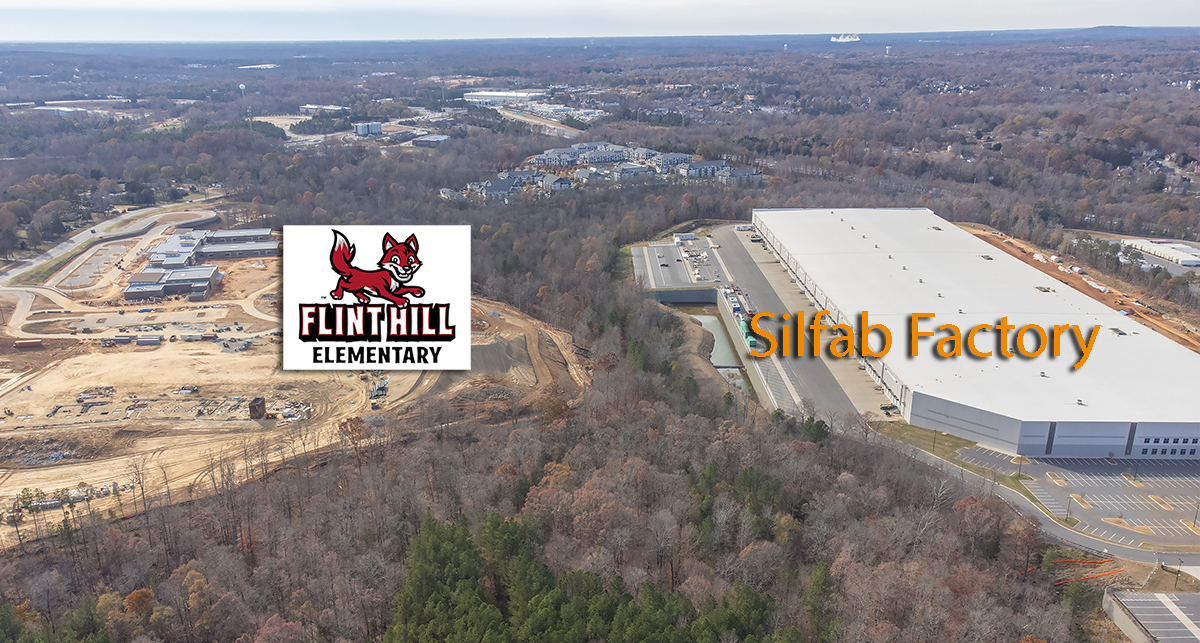
While Flint Hill Elementary School sits just yards away, York County quietly allowed Silfab Solar to open a massive manufacturing plant loaded with 15,850 gallons of hydrofluoric acid, 26,456 pounds of explosive silane, and hundreds of thousands of pounds of other deadly chemicals — even though the Board of Zoning Appeals had already ruled 5-0 that solar-panel manufacturing is prohibited in the Light Industrial district.

In March 2026 alone, York County reported that 1,530 gallons of potassium hydroxide spilled into a retention pond bordering the school, followed by a multi-week hydrofluoric acid leak that forced a two-day school closure and a state-ordered shutdown.
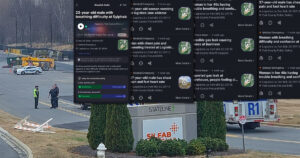
Workers inside have continuously suffered vomiting blood, seizures, chest pain, and breathing emergencies at rates unmatched by any other solar plant in the country.

Evidence now shows that Council Chairwoman Christi Cox and County Manager Josh Edwards’ staff not only fast-tracked the project — they back-dated permits, issued a Certificate of Occupancy without zoning compliance on February 13, 2026, and deliberately ignored their own laws to make it all happen.

In February 2024 a neighboring property owner asked the county to interpret whether Silfab’s operations were allowed at 7149 Logistics Lane. Zoning Administrator Rachel Grothe responded on February 16 that it was permitted under the vague “Computer and Electronic Product Manufacturing” use. The neighbor then appealed.

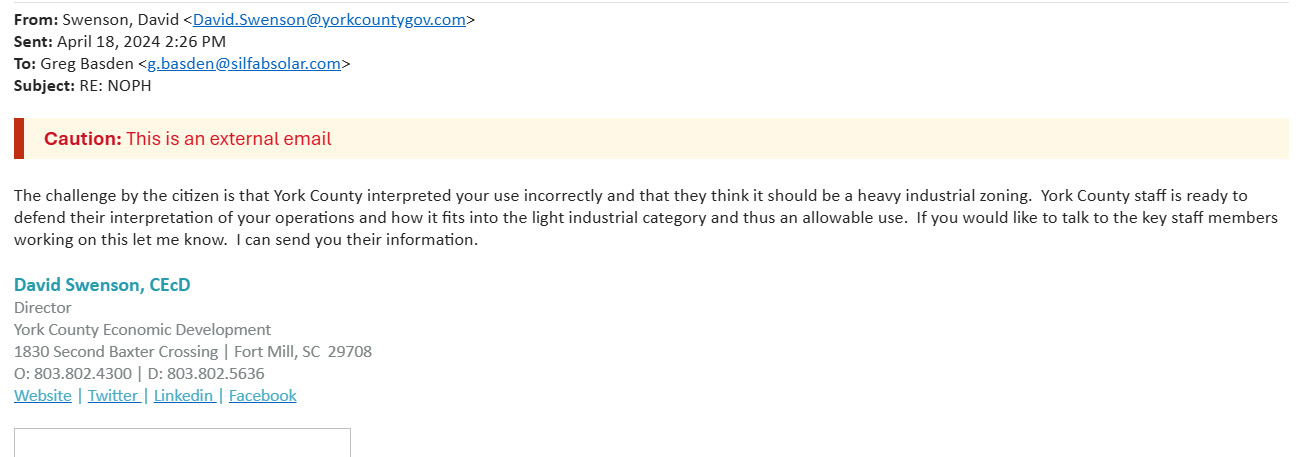
On April 18th, York County Economic Development Director David Swenson confirmed to Silfab’s Director of Operations, Greg Basden, that the upcoming BZA hearing was about Silfab’s operations.
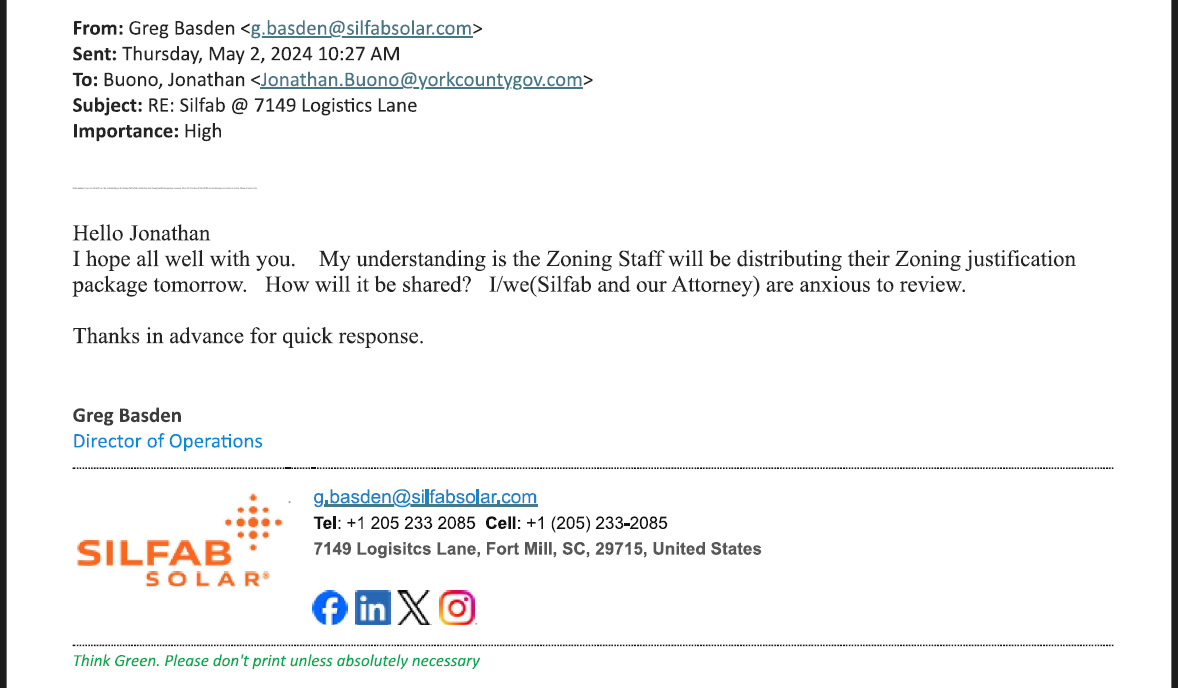
On May 2, 2024, Greg emailed county staff asking to review the county’s justification package.
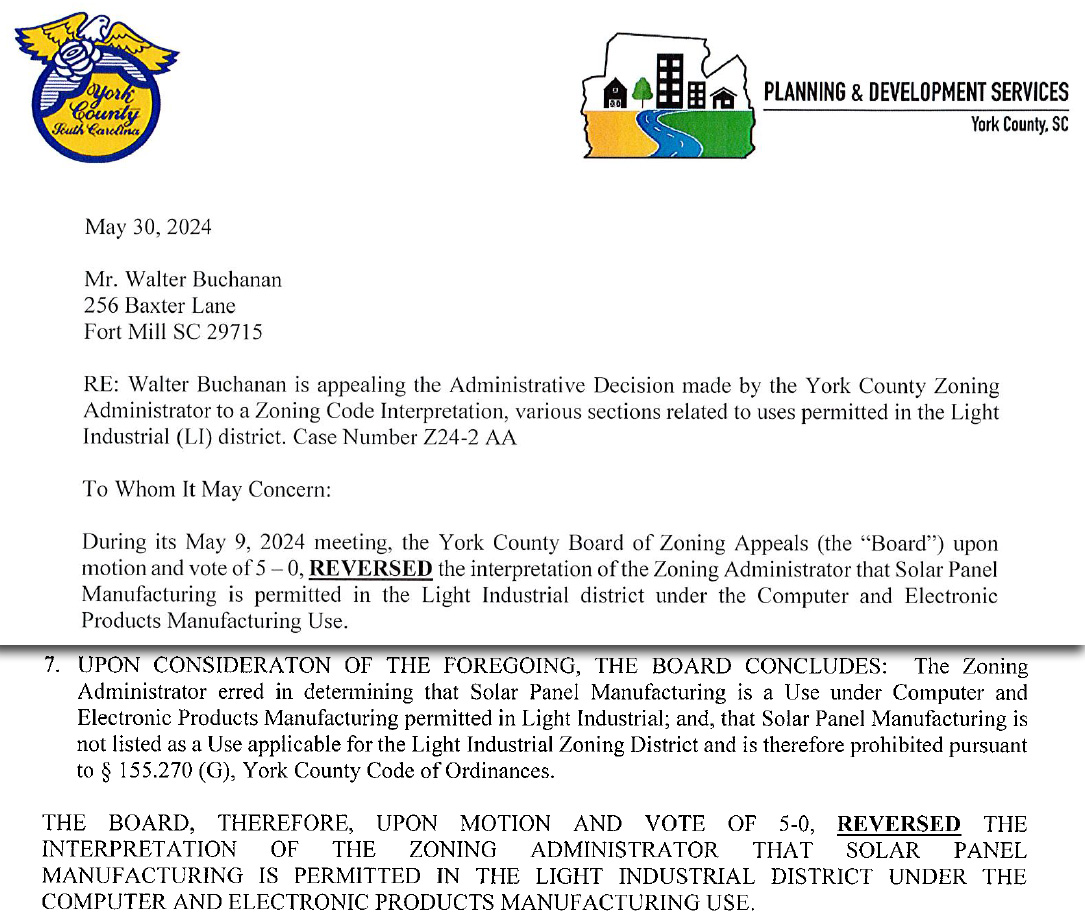
On May 9th, 2024, the Board of Zoning Appeals ruled 5-0 that Silfab’s operations were not allowed in a light industrial zone.

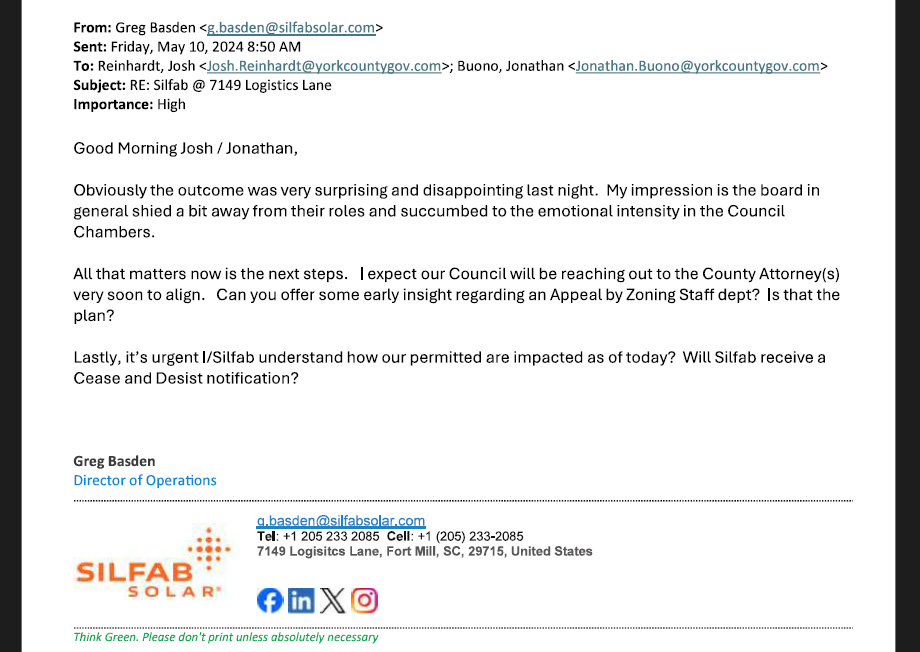
On May 10, 2024, Silfab’s Greg Basden emailed county officials asking point-blank if Silfab would be receiving a cease and desist:
On May 30 the BZA issued its written decision:
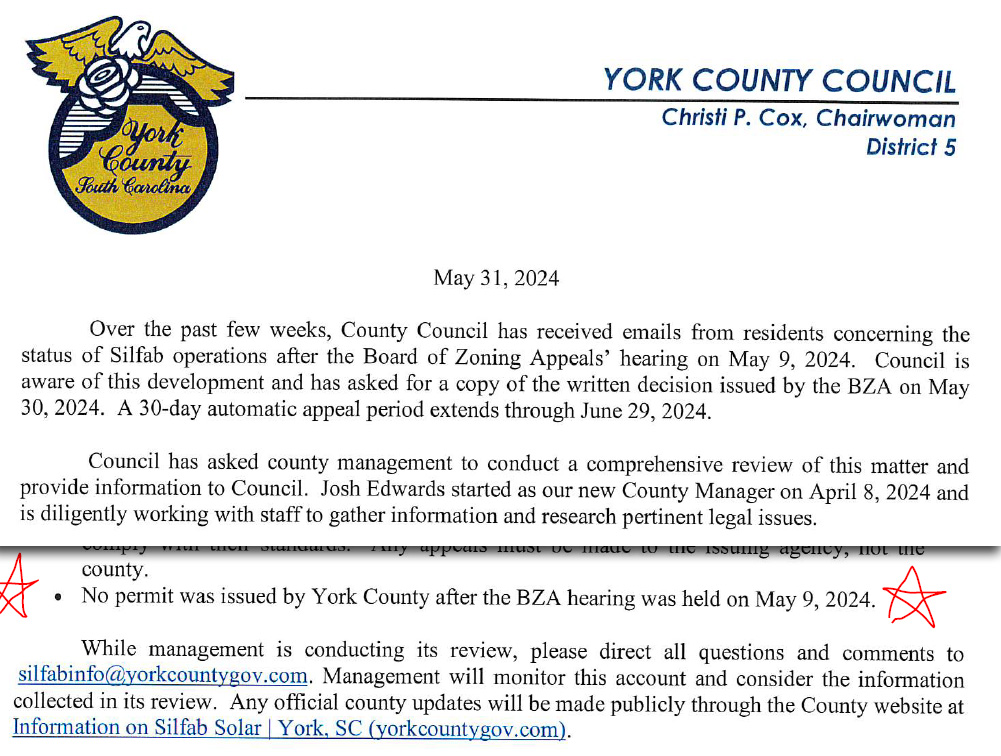
The very next day, May 31, 2024, Christi Cox signed a public letter telling residents that “No permit was issued by York County after the BZA hearing was held on May 9, 2024,” and that, Josh Edwards, who had started as County Manager on April 8, 2024, was “diligently working with staff to gather information and research pertinent legal issues.”
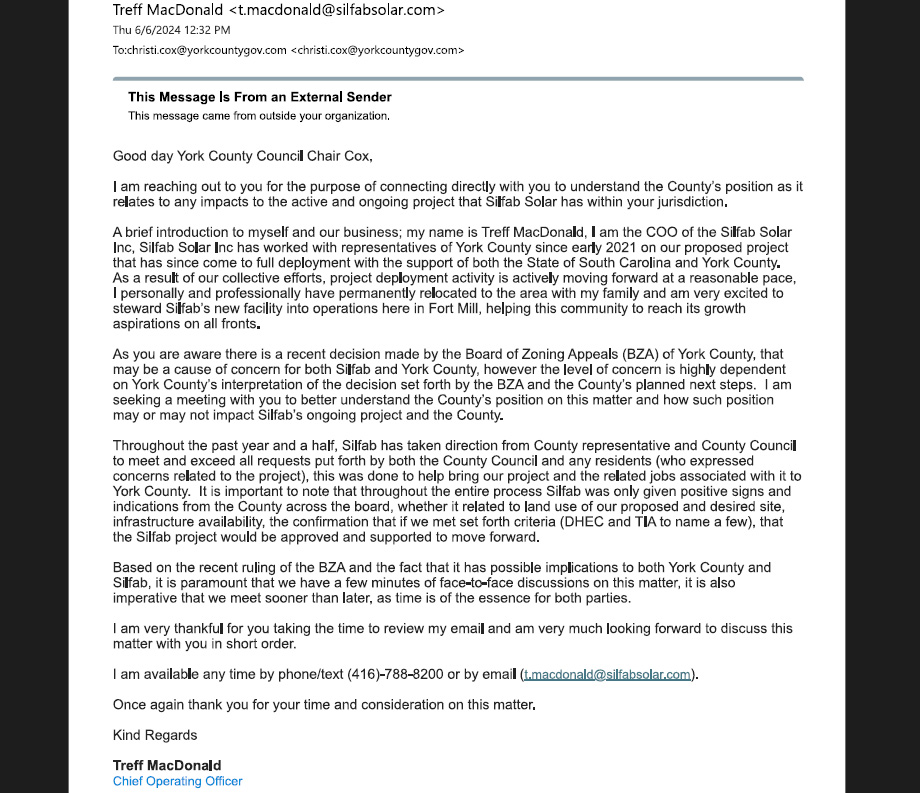
Silfab COO Treff MacDonald then asked for a meeting with Christi Cox a few days later on June 6th, saying “it is paramount that we have a few minutes of face-to-face discussions on this matter, it is also imperative that we meet sooner than later, as time is of the essence for both parties.”
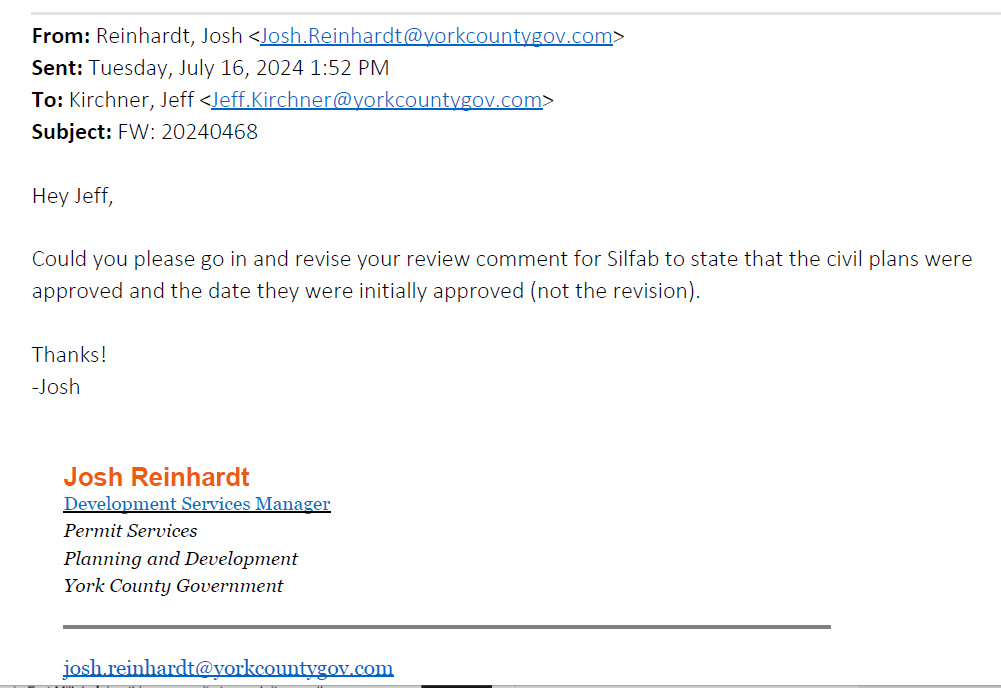
Internal emails also show that Cox and Edwards’ staff (including Reinhardt and Kirchner) discussing changes to approval dates. Silfab’s parking-lot civil plans were stamped April 24, 2024 — before the BZA hearing. The up-fit approval was dated July 16, 2024 — after the BZA reversal. The final “zoning compliance” stamp was back-dated to April 24 to pretend a valid approval existed before the BZA ruling and before citizens’ appeal window closed.
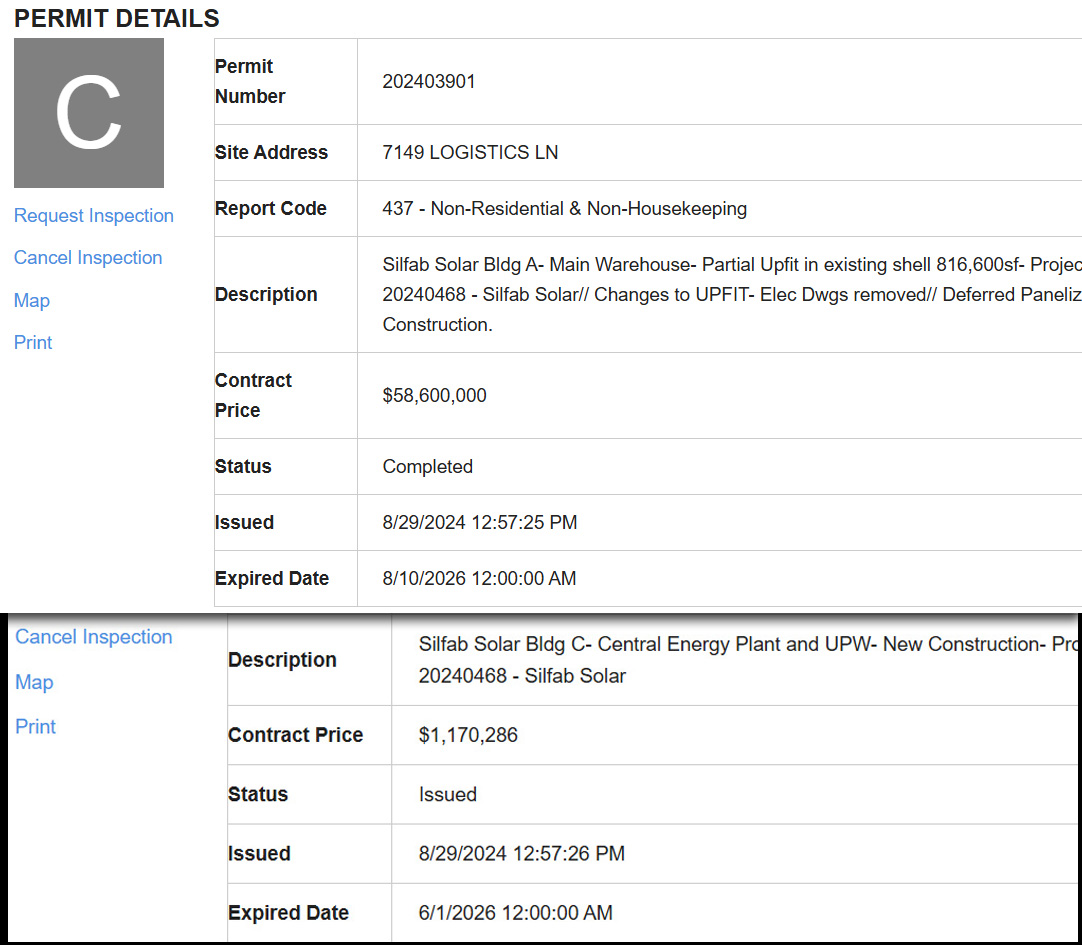
Roughly 1 month later, in August of 2024, Silfab began receiving all of their permits for the up fit of their main distribution building into a manufacturing factory, as well as the permits for the new construction of their chemical storage buildings and bunkers, wastewater treatment plant, and central energy plant.
These permits issued after the BZA ruling directly violated York County Zoning Code § 155.270(G), which states any use not expressly listed in the Use Tables “is prohibited.” It also violated York County Code § 155.262, which requires a formal Zoning Compliance application before any new or changed use can proceed. Silfab never filed one — it relied only on a 2022 non-binding “Zoning Verification” letter that county documents repeatedly describe as “not a permit or licensing” and “only states that the site can, with the proper permits, be used…”

Additional laws ignored include S.C. Code § 6-29-950 (unlawful to construct or occupy any building without a permit that complies with zoning ordinances) and S.C. Code § 6-29-800 (prohibiting the BZA from granting a variance that would allow a use not otherwise permitted).

Cox, Edwards, and the Council Vice Chair personally control what goes on the County Council agenda. Yet when two different council members publicly asked — twice — in open meetings that Silfab’s permits be placed on a future agenda, their requests were ignored. This was a direct, intentional violation of York County Code § 30.04(b), which mandates: “Any item … deferred from a proposed agenda shall be immediately placed on a future meeting agenda … by request of two members of Council.”

Under Christi Cox and Josh Edwards, the county continued issuing permits and ultimately the Certificate of Occupancy while a massive industrial operation loaded with hazardous chemicals moved forward next to Flint Hill Elementary School. Dispatch records show repeated 911 calls from inside the factory for workers vomiting blood (a 25-year-old woman on March 28, 2026), trouble breathing (a 23-year-old man on March 26, 2026), seizures (February 4, 2026), chest pain, high blood pressure, and cardiac symptoms — incidents that have occurred with alarming frequency and have no parallel at comparable solar plants.

The danger spilled over to the children. On one day in March 2026, while school was in session and kids were playing near the fence, 1,530 gallons of potassium hydroxide poured into the retention pond directly bordering Flint Hill Elementary. Days later a hydrofluoric acid leak forced the school to close for two days out of an abundance of caution. In response, Silfab pumped roughly 300,000 gallons of liquid from the retaining ponds for off-site disposal over a single weekend.

On March 10, 2026, the Fort Mill School Board passed a formal resolution demanding that Governor McMaster, the General Assembly, Attorney General Alan Wilson, and York County Council “permanently limit the facility’s operations strictly to non-hazardous assembly processes and remove all hazardous chemicals on site in accordance with the facility’s current light industrial zone.”

Even now, with the factory fully operational and the school regularly placed in harm’s way, Cox and Edwards have refused to place the matter on the council agenda despite two formal requests by fellow council members, and they have allowed the prohibited use to continue unchecked.

All records cited — the May 30 BZA decision, the May 31 Cox letter, the Silfab Processes Memo, internal staff emails (including Basden’s cease-and-desist inquiry and Buono’s response), the hazardous-materials inventory, dispatch logs, the School Board resolution, and the 300,000-gallon pump-out — are from FOIA (Freedom of Information Act) productions or public filings. They paint a damning picture: under Christi Cox and Josh Edwards’ leadership and direction, their staff treated its own zoning code, council rules, public safety, and the health of elementary school children as optional while enabling a prohibited and dangerously toxic facility to begin operations within yards of elementary school children.

Charlotte Was Just Ranked #1 Fastest Growing City in America

0

Charlotte was just ranked the #1 fastest growing city in America, according to a new report from the US Census. Charlotte grew by 20,731 people between July 2024 and July 2025, pushing the city’s estimated population to 964,784.

The surge kept Charlotte ranked as America’s 14th-largest city and moved it closer to overtaking San Jose, California, for the No. 13 spot.

Even with the massive increase, Charlotte’s growth rate slowed slightly from the previous year. The city grew 2.2% in 2025, compared to 2.8% growth the year before.

The 15 Cities With the Largest Numeric Increase Between July 1, 2024, and July 1, 2025 With Populations of 20,000 or More1
Rank Area Name State Name Numeric Increase 2025 Total Population
1 Charlotte city North Carolina 20,731 964,784
2 Fort Worth city Texas 19,512 1,028,117
3 San Antonio city Texas 14,359 1,548,422
4 Celina city Texas 12,710 64,427
5 Seattle city Washington 11,572 784,777
6 Houston city Texas 11,515 2,397,315
7 Fulshear city Texas 11,196 64,630
8 Nashville-Davidson2 Tennessee 9,244 721,074
9 Port St. Lucie city Florida 9,131 268,062
10 McKinney city Texas 8,504 236,001
11 Atlanta city Georgia 8,350 529,110
12 Jacksonville city Florida 8,319 1,017,689
13 Surprise city Arizona 7,702 175,304
14 Columbus city Ohio 7,696 938,396
15 Goodyear city Arizona 7,690 125,359

Meanwhile, several surrounding suburbs grew even faster on a percentage basis.

Fort Mill again led the region, growing 6.8% to reach nearly 39,000 residents. That ranked Fort Mill among the nation’s 20 fastest-growing midsized cities.

Census officials say midsized suburbs across the country are increasingly outpacing major cities, driven by migration, housing development, and continued movement to Southern states.

Nationally, the South dominated population growth rankings, while New York City posted the nation’s largest population decline.

The new numbers highlight what many Carolinians already experience daily: packed roads, nonstop construction, and rapid growth spreading across the Charlotte metro.

Rare Synchronous Fireflies to Light Up Grandfather Mountain This Summer

0

One of North Carolina’s most popular summer nature events has become so competitive that visitors now need to win a lottery just to buy tickets.


Grandfather Mountain announced its annual “Grandfather Glows” firefly viewing event will again use a lottery system for 2026 because of growing demand.

The event is often compared to the famous synchronous firefly displays in the Great Smoky Mountains National Park and features rare glowing insects that appear for only a few weeks each year.

The lottery opens May 22 and closes May 28. Entries cost $5 plus tax and are limited to one per email address.

Event dates will be announced May 21 and will take place between mid-June and mid-July.

Researchers have confirmed 10 luminous insect species on the mountain, including synchronous fireflies, blue ghost fireflies, and glowworms.

Lottery winners can purchase up to six tickets. Adult tickets cost $50, while children’s tickets cost $40.

Each event runs from 7 p.m. to 11 p.m. and includes educational programs before guests move into designated viewing areas.

Organizers say the event is wheelchair accessible. Flash photography, pets, and alcohol are prohibited.

The first group of winners will be notified May 29, with a second round announced June 3.

Nearly 100 Firefighters Respond to Major Gas Explosion and Fire in Matthews

0

A massive gas explosion sent flames soaring over a Matthews neighborhood Wednesday afternoon, damaging homes and triggering a huge emergency response involving nearly 100 firefighters.

The explosion happened near Pleasant Plains Road and Morningwood Drive after a contractor drilling and setting poles reportedly struck a natural gas line around 11:55 a.m.

According to Matthews Fire & EMS, the leak ignited shortly after crews arrived, escalating into a dangerous fire that burned for more than an hour.

The Charlotte Fire Department HazMat team responded alongside Union County agencies and Piedmont Natural Gas crews.

Officials say two homes were heavily damaged, but no residents were inside at the time. No civilian injuries have been reported.

Several firefighters experienced heat-related issues but are expected to recover.

Fire officials intentionally allowed the flames to continue burning while crews worked to shut off the gas flow. Authorities said extinguishing the fire too early could have allowed explosive gas to spread through the neighborhood.

Firefighters instead focused on protecting surrounding homes while Piedmont Natural Gas crews located and shut down the damaged line.

The incident also caused power outages for nearby Duke Energy customers.

Authorities say crews will remain on scene as cleanup and damage assessments continue.

Study Reveals the 3 North Carolina Communities Most Confident About Reaching 100

0

In parts of the Mediterranean, living into your 90s (and beyond) isn’t unusual. These “blue zone” communities have long been seen as proof that, under the right conditions, a longer life isn’t just luck — it’s shaped by lifestyle, environment, and daily habits.

The U.S. doesn’t carry the same reputation — but it does have its own pockets where people seem to thrive well into later life.

So where in America do people feel most confident about their future — and why? A Mission for Michael commissioned Cherry Data Signals to survey 3,025 respondents, exploring how people think about their own longevity — not just in years, but in terms of control, optimism, and mindset.

Respondents were asked to estimate their chances of reaching 100. From this, they identified the communities with the strongest “longevity mindset” — places where people feel most positive, proactive, and in control of their long-term health.

The top 10 communities where people are most confident of reaching 100:

#1. St. Augustine, Florida
St. Augustine blends history, walkability, and coastal living into a lifestyle that naturally supports long-term wellbeing. With pedestrian-friendly streets, easy access to the waterfront, and a steady rhythm that encourages time outdoors, staying active feels like part of daily life. There’s also a strong sense of place and community, which helps support social connection. It’s the kind of environment where routine movement and a slower pace work together over time.

#2. Kula, Hawaii
Upcountry Maui has a more rustic, alternative feel than the beach towns below, and Kula captures that especially well. It’s a quaint area on the slopes of Haleakalā known for farms, botanical gardens and rich volcanic soil, with the wider Upcountry region rooted in agriculture and small-scale rural living. That makes it a strong fit for a longevity angle built around lower stress, local food and a more intentional pace of life.

#3. Dunedin, Florida
Dunedin offers a more relaxed, community-driven version of healthy living. Anchored by the Pinellas Trail and a network of parks and waterfront spaces, it makes walking and cycling feel like second nature. Residents often point to that everyday activity, combined with a friendly, low-stress atmosphere, as key to feeling positive about their long-term health — a mindset that aligns with greater confidence about living longer.

#4. Asheville, North Carolina
Asheville blends outdoor living with a strong creative and wellness-focused culture. Surrounded by the Blue Ridge Mountains, it encourages regular movement through hiking, walking, and time spent outside, while its arts scene keeps people mentally engaged. In communities like this, residents often feel that lifestyle plays a direct role in longevity, with many expressing confidence that their routines and environment could support them living well into older age.

#5. Northshore Chattanooga, Tennessee
Northshore brings a more active, neighborhood-scale version of healthy living into the city. Access to the Tennessee Riverwalk and nearby green spaces makes walking and cycling part of everyday life, while local businesses and community spaces keep people socially connected. That balance between movement and engagement often shapes how residents view their future health, with many feeling confident about living well into later life.

#6. Hanalei, Hawaii
Hanalei offers a slower, more grounded take on long-term wellbeing. At the foot of misty mountains and alongside its famous taro fields, it has a setting that feels deeply tied to nature and everyday routine. Communities like this can naturally foster the sense that a long life is something you can shape through pace, environment and daily habits — which fits neatly with the mindset side of your survey.

#7. Blue Hill, Maine
Blue Hill leans into a quieter, more reflective way of living. Surrounded by forests and coastline, it encourages a slower pace where routines feel easier to maintain. Daily life often includes time outdoors and close community interaction, both of which support long-term wellbeing. In places like this, residents often feel that consistency and environment play a meaningful role in how long they can live.

#8. Haleʻiwa, Hawaii
Haleʻiwa has a laid-back, surf-town rhythm that makes healthy living feel unforced. Known as the social and artistic hub of Oʻahu’s North Shore, it’s surrounded by famous beaches and local food spots, giving it a strong mix of movement, outdoor time and community life. It’s easy to frame as the kind of place where people stay active almost by default, simply because the setting pulls them outside.

#9. Midway, Kentucky
Midway leans into a quieter, small-town rhythm that feels easy to sustain. With walkable streets, local shops, and surrounding countryside, it encourages regular movement and time outdoors without much effort. Residents often point to that balance between activity and pace as a reason they feel positive about their long-term health, making it a natural fit for a longevity-focused angle.

#10. Apalachicola, Florida
Apalachicola leans into a quieter, more unhurried way of life. With its coastal setting and small-town scale, it encourages time outdoors and a slower daily rhythm that feels easier to maintain. Fishing, walking, and community interaction are part of everyday life rather than planned activities. It’s a place where lower stress and consistency help support both physical and mental wellbeing over time.

North Carolina has 2 other communities most confident about reaching 100 years old:

#17. Boone
Boone offers a more outdoors-driven take on wellbeing. Set in the mountains, it naturally encourages walking, hiking, and year-round activity, while its smaller scale helps maintain a strong sense of community. That combination of movement and connection shapes how people think about long-term health, with many feeling that staying active in this kind of environment makes living to 100 feel more achievable.

#31. Carrboro
Carrboro leans into a more grounded, community-first version of healthy living. Known for its local food culture, walkability, and strong social ties, it encourages a pace that feels manageable and consistent. Daily life often revolves around connection and routine rather than pressure, and residents frequently point to that balance as a reason they feel optimistic about their chances of reaching 100.

Major Production Company Casting New Reality Show on Lake Norman

0

A new reality TV project is brining the bright lights and cameras to the Charlotte region’s most popular summer destinations.

Ain’t That Something Entertainment, described as a major production company, is casting for a reality show centered around Lake Norman’s young adult social scene.

The company says it is specifically looking for people in their 20s who regularly vacation or spend time on the lake.

The production company did not specify how often participants need to visit the lake to qualify.

The casting announcement hints at a show focused on the personalities, relationships, and lifestyle surrounding Lake Norman’s busy warm-weather scene.

For many Charlotte-area residents, weekend trips to the lake have become a major part of local culture, despite heavy Interstate 77 traffic and increasingly crowded shorelines.

Anyone interested in being considered for the show can submit their story to casting@aintthatent.com.

South Carolina Supreme Court Overturns Alex Murdaugh Murder Convictions

0

In a stunning decision that could reshape one of South Carolina’s most infamous criminal cases, the South Carolina Supreme Court has just overturned the murder convictions of Alex Murdaugh and ordered a new trial.
The court unanimously ruled Wednesday that Murdaugh’s constitutional right to a fair trial was violated due to improper conduct by former Colleton County Clerk of Court Rebecca “Becky” Hill.

Murdaugh was convicted in March 2023 for the murders of his wife, Maggie, and son, Paul, in a case that captured national attention and became known as South Carolina’s “Trial of the Century.”

In its ruling, the court said Hill improperly influenced jurors during the trial. Justices cited testimony that Hill encouraged jurors to closely watch Murdaugh’s body language and warned them not to be “fooled” by the defense.

The ruling also referenced findings that Hill sought publicity and financial gain connected to a book she later promoted about the trial. Justices wrote that she “placed her fingers on the scales of justice.”

The court further criticized how much evidence prosecutors introduced regarding Murdaugh’s financial crimes, calling portions of that testimony unfairly prejudicial.

Despite the reversal, Murdaugh will remain in prison. He is still serving lengthy sentences tied to dozens of financial crime convictions and guilty pleas.

South Carolina Attorney General Alan Wilson quickly announced the state plans to retry the murder case.

The ruling vacates Murdaugh’s murder convictions and life sentences, sending the case back to circuit court more than three years after the original verdict.

New Data: Young Adult Homeownership in Charlotte is 31%

0

The homeownership rate in the United States has fallen for two consecutive years, and the decline has been steepest among young adults between 25 and 34. Historically the prime ages for first-time homebuyers, young adult homeownership has been driven down to just 30% amid a series of compounding financial hurdles, undoing virtually all of the homeownership gains made over the previous decade.

As a result, not only are more young people renting longer, many are taking a third option: living in someone else’s owned home. This could mean living with parents, grandparents, friends, etc, and in 2025 it accounts for 20 percent of all young adults – more than 9 million people between the ages of 25 and 34.


The Local Outlook:
Young adult homeownership ranges from the low teens in California to the high 30s in the Upper Midwest. In Charlotte metro specifically, it stands at 31.4%, ranking #18 among the nation’s 50 largest markets. We see a strong correlation between homeownership rates, prices, and demand, with higher rates in lower-cost, lower-growth markets and lower rates in the nation’s most expensive, supply-constrained markets.

For more charts, analysis, and commentary, check out the full report:

Not really a renter, definitely not a homeowner: over 9 million young adults are stuck somewhere in between.