
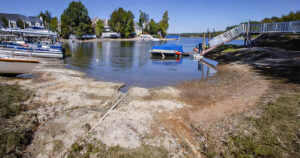
 A prolonged drought across the Carolinas has now been officially declared an agricultural disaster, unlocking federal aid for farmers across the Charlotte region and beyond.
The U.S. Department of Agriculture has issued a Secretarial disaster designation covering much of North Carolina and surrounding states. As a result, eligible farmers can now apply for emergency loans and other assistance through the Farm Service Agency.
These loans can help replace equipment or livestock, reorganize operations, or refinance debt. Officials say approvals will depend on the extent of losses, available security, and ability to repay.
The latest data from the U.S. Drought Monitor shows every part of North Carolina is experiencing drought. About 95% of the state is under severe, extreme, or exceptional conditions.
The designation was triggered after many counties endured at least eight weeks of severe drought or reached extreme to exceptional levels.
Primary eligible counties in North Carolina:
Alamance, Alexander, Bertie, Cabarrus, Cherokee, Clay, Cleveland, Cumberland, Davie, Duplin, Edgecombe, Franklin, Gaston, Guilford, Halifax, Harnett, Haywood, Iredell, Johnston, Lee, Lincoln, Macon, Madison, Martin, Mecklenburg, Nash, Northampton, Orange, Person, Randolph, Richmond, Rowan, Sampson, Stanly, Swain, Union, Warren, Wilkes, Wilson, Yadkin
Contiguous eligible counties in North Carolina:
Alleghany, Anson, Ashe, Beaufort, Bladen, Buncombe, Burke, Caldwell, Caswell, Catawba, Chatham, Chowan, Davidson, Durham, Forsyth, Graham, Granville, Greene, Henderson, Hertford, Hoke, Jackson, Jones, Lenoir, Montgomery, Moore, Onslow, Pender, Pitt, Robeson, Rockingham, Rutherford, Scotland, Stokes, Surry, Transylvania, Vance, Wake, Washington, Watauga, Wayne, Yancey
Eligible counties in South Carolina:
Cherokee, Chesterfield, Lancaster, Marlboro, Oconee, York
Farmers can check eligibility and available programs through tools on Farmers.gov.
For local farmers, the designation brings much-needed relief after months of worsening conditions. Still, with crops already impacted and dry weather lingering, the economic effects could continue across the region.