Top 5 Cost Segregation Firms for Single Family Rentals in Charlotte and North Carolina in 2026

0

Charlotte, North Carolina, has solidified its reputation as one of the fastest-growing housing markets in the United States. Driven by a booming financial sector, high-paying tech jobs, and a steady influx of new residents, the Queen City’s single-family rental (SFR) market is a prime target for real estate investors. Whether you own a 1990s suburban home in Ballantyne, a renovated bungalow in Plaza Midwood, or a new-build townhome in Steele Creek, maximizing your cash flow is essential. 

One of the most powerful tools in a real estate investor’s toolkit is a Cost Segregation Study. By breaking down your residential rental into different components, you can reclassify certain assets (flooring, specialized lighting, landscaping, etc.) from a standard 27.5-year depreciation schedule into 5-, 7-, or 15-year recovery periods. 

In a market like Charlotte, where North Carolina’s flat state income tax rate sits at a highly competitive 4.5%, accelerating your depreciation can yield massive upfront federal and state tax savings, allowing you to reinvest that capital straight back into your portfolio. Because North Carolina’s individual income tax rate is scheduled to continue dropping gradually toward 3.99% by 2027, accelerating your depreciation today allows you to offset income at current, higher tax rates, maximizing your immediate tax arbitrage. 

Whether your properties are located in the bustling Charlotte metro, the rapidly growing Research Triangle (Raleigh-Durham-Cary), coastal Wilmington, or scenic Asheville, choosing the right firm is critical to unlocking thousands of dollars in year-one tax savings on your North Carolina rentals. 

At-a-Glance: Top North Carolina Cost Segregation Providers

Before diving into the detailed reviews, here is how the top five firms stack up for North Carolina residential real estate investors:

Firm Best For Site Visit Method Price Point Est. Turnaround
SMF Cost Segregation Advisors Single-Family, Short-Term Rentals & Small Multifamily  Virtual Video Walkthrough  $1,750 Flat Rate 3 Business Days
KBKG High-Value Commercial & Complex Portfolios  Physical / On-Site  Premium  3–6 Weeks 
CSSI Mid-to-Large Residential Portfolios  Mixed (On-Site Representative)  Moderate to High  4–6 Weeks 
Source Advisors Multi-Family Commercial ($500k+ basis)  Physical / On-Site  Premium  4–5 Weeks 
Vance Flouhouse & Garges Hyper-Local Charlotte In-House CPA Clients  Traditional On-Site  Hourly / Premium Flat  Varies 


  1. SMF Cost Segregation Advisors

Topping our list is SMF Cost Segregation Advisors, a firm that has carved out a highly respected niche by specializing specifically in small-scale residential real estate. While many massive corporate firms overlook single-family rentals or price their services out of reach for individual landlords, SMF has designed its entire business model around single-family homes, townhomes, short-term rentals (like Airbnbs), and small multifamily properties up to 10 units. 

SMF offers CPA-ready, engineering-based studies that utilize virtual site visits to keep costs low and turnaround times incredibly fast. 

  • Pros:
    • Built for Residential Investors: Highly specialized in single-family rentals, Airbnbs, and small multifamily portfolios. 
    • Transparent, Flat-Rate Pricing: Highly competitive flat-rate pricing starting at just $1,750, making it substantially more affordable than traditional, commercial-focused firms. 
    • Industry-Leading Speed: Features an incredibly fast 3-business-day turnaround time for final reports. 
    • IRS-Compliant & Audit Defense: Uses defensible, engineering-based methodologies and includes audit defense at no extra charge. 
    • Virtual Site Visits: Seamless, modern process using video walkthroughs. 
  • Cons:
    • Not Designed for Massive Commercial Real Estate: If you own a $50M shopping center or a high-rise office building in Uptown Charlotte, SMF is not built for those asset classes. 

Pro Tip: Before committing to a full study, you can use SMF’s free online Cost Segregation Savings Calculator or their “Do I Qualify?” tool on their website to instantly estimate your tax savings and verify your property’s eligibility.

  1. KBKG

KBKG is a powerhouse in the specialty tax space, offering nationwide cost segregation services with an active presence across North Carolina. Operating since 1999, KBKG’s team consists of highly experienced CPAs and structural engineers. They are known for providing “bullet-proof” reports, strictly conforming to the IRS’s “13 Principal Elements” of a quality study. 

  • Pros:
    • Authority: Decades of experience with tax codes, 1031 exchanges, and passive activity loss rules. 
    • Audit-Proof Reports: Highly detailed reports cross-referenced with estimated cost manuals and IRS citations. 
  • Cons:
    • Higher Price Point: Their extensive, engineering-first approach means their fees may eat into the ROI of lower-value single-family rentals. 
    • Overkill for Simple SFRs: Their deep structural engineering focus is often far more than a standard single-family rental actually requires. 
  1. CSSI

CSSI is one of the largest and most well-known cost segregation companies in the country, having completed tens of thousands of studies. In recent years, they have heavily focused on educating residential landlords on how to apply these strategies to single-family homes and build-to-rent communities. 

  • Pros:
    • Consistent Quality: A highly standardized process that has been tested and refined across thousands of IRS filings. 
    • Local Representatives: They have a broad network of local representatives who understand North Carolina market dynamics. 
    • Strong Education Focus: Excellent resources for both investors and their CPAs to understand the benefits of SFR cost segregation. 
  • Cons:
    • Varying Customer Experience: Because they operate through a vast network of independent representatives, the initial onboarding experience can vary depending on who you work with. 
  1. Source Advisors

Source Advisors is a prominent national specialty tax firm that frequently services the North Carolina real estate market. They are highly agile, known for offering tailored solutions that focus on speed, responsiveness, and maximum tax optimization. While they handle massive commercial assets, they also offer fixed-asset reviews that help residential landlords clean up past depreciation schedules. 

  • Pros:
    • Comprehensive Tax Strategies: Beyond cost segregation, they can help with fixed-asset reviews and partial asset dispositions. 
    • Highly Collaborative: Work closely with your existing CPA to ensure seamless tax integration. 
  • Cons:
    • Minimum Threshold Recommendations: They typically recommend their full studies for properties with $500,000+ in capitalized costs, making them less ideal for cheaper single-family homes. 
  1. Vance Flouhouse & Garges, PLLC

For investors who prefer a local touch, Vance Flouhouse & Garges is a respected regional CPA and accounting firm based right in Charlotte. Through their affiliate, VFG Associates, Inc., they offer localized cost segregation studies tailored specifically to the North Carolina tax environment. 

  • Pros:
    • Hyper-Local Expertise: Deeply familiar with Charlotte real estate trends, local tax codes, and North Carolina-specific tax filings. 
    • All-in-One Service: Excellent option if you want your cost segregation study and your annual tax preparation handled under one roof. 
  • Cons:
    • Less Tech-Forward: Unlike national, residential-focused firms that use virtual workflows, their process is more traditional, which can mean slower turnaround times. 
    • Higher Fees: Local accounting firms often charge hourly or premium flat rates compared to automated or specialized residential providers. 

The Bottom Line

If you own single-family rentals in North Carolina’s competitive market, leaving money on the table with standard 27.5-year straight-line depreciation is a missed opportunity. For the vast majority of SFR and short-term rental investors, SMF Cost Segregation Advisors offers the best balance of specialized residential expertise, fast turnaround times, affordability, and audit-ready security. However, if you are scaling into massive commercial projects or want a hyper-local Charlotte accountant, firms like KBKG or Vance Flouhouse & Garges are excellent alternatives.

Frequently Asked Questions (FAQs)

Can I do a cost segregation study on a single-family rental (SFR) in North Carolina?

Yes. While cost segregation was historically used for commercial buildings, specialized firms like SMF Cost Segregation Advisors have optimized the process for SFRs, townhomes, and small multifamily properties up to 10 units. This allows individual landlords to benefit from accelerated depreciation without paying corporate-level fees. 

How does North Carolina’s flat income tax rate affect my tax savings?

North Carolina features a competitive flat state income tax rate of 4.5%. By accelerating your depreciation schedule from 27.5 years down to 5, 7, or 15 years, you can significantly lower both your federal and state taxable income in year one. This provides immediate, non-dilutive cash flow to reinvest back into local North Carolina real estate. 

Is a virtual site visit accepted by the IRS for cost segregation?

Yes, provided it is paired with a defensible, engineering-based methodology. Virtual site visits utilize detailed video and photographic evidence provided by the owner, which a qualified specialist or engineer reviews to accurately categorize assets. This approach dramatically reduces costs and turnaround times while remaining fully IRS-compliant.

This LUXEAR Produce Saver Set Could Help Charlotte Shoppers Waste Less Spring Produce

0

Charlotte-area farmers markets and grocery stores make it easy to overbuy in spring. Strawberries look perfect in the basket. Spinach is destined for a week of salads. A bunch of herbs feels like an easy way to make dinner better. Then the week gets busy, moisture collects in the produce drawer, and some of that food ends up in the trash.

The USDA estimates that 30 to 40 percent of the U.S. food supply is lost or wasted. No storage container can solve all of that, but a better fridge routine can help households use more of what they buy.

The LUXEAR 3-piece produce saver set is designed for that routine. It combines adjustable vents, removable colander baskets, foldable dividers, and bottom drains in three clear containers. Together, those parts address trapped moisture, crushed produce, and the familiar problem of forgetting what is behind the milk.

What comes in the LUXEAR 3-piece produce saver set?

LUXEAR lists three capacities: 18 cups, 6.8 cups, and 1.92 cups. The large container can hold items such as a head of lettuce, cabbage, or longer vegetables. The medium size works for grapes, berries, cherry tomatoes, or cut vegetables. The smallest container is useful for herbs, citrus wedges, and small amounts of prepped produce.

The clear bodies are made from BPA-free, food-grade PET. Because the three sizes stack, they can create a cleaner vertical footprint than a collection of mismatched bowls and produce bags.

This set is best for people who want one system for rinsing, draining, separating, and refrigerating produce. It is especially helpful when delicate and sturdy foods need to share limited shelf space.

The drain and colander basket keep produce above residual water

Ordinary containers often let condensation or rinse water collect directly under the food. LUXEAR places a removable basket inside each container so produce sits above the base. A small drain at the bottom can be opened over the sink, which saves a transfer from colander to storage box.

That feature still needs a little common sense. The FDA recommends drying produce with a clean cloth or paper towel after washing. North Carolina Cooperative Extension also advises waiting to wash strawberries until just before use because added moisture can encourage mold. For berries, the basket and drain are most useful at serving time. If produce is washed before storage, drain and dry it thoroughly first.

Foldable partitions protect delicate food and adapt to larger items

The dividers are the feature that makes the LUXEAR set different from a basic produce keeper. Fold them up to create separate sections, or lay them flat when one large space makes more sense.

That flexibility can keep a handful of raspberries away from heavier apples, prevent herbs from being pinned under cucumbers, and separate a small amount of cut produce from whole items. The partitions also make it easier to group foods by meal. Salad ingredients can stay together without being piled directly on top of one another.

A clear, divided container also shows what is available and what should be used soon. Food at the back of a crowded refrigerator is easy to forget.

Adjustable vents help manage condensation

Each lid has an adjustable vent that changes how much air moves through the container. There is no single correct setting for every fruit and vegetable. A useful rule is to watch the container: open the vent when condensation builds, and reduce airflow if leafy produce starts to dry out.

LUXEAR says the vent system can help keep produce fresh for up to two weeks. Actual results will depend on the food, its condition when purchased, the vent setting, and refrigerator temperature. The FDA recommends keeping perishable produce such as strawberries, lettuce, herbs, and mushrooms at 40 degrees Fahrenheit or below.

The vent is a tool, not an automatic freshness switch. Used with the raised basket and a cold, uncrowded refrigerator, it gives shoppers more control than a sealed plastic bag.

A practical setup for a Charlotte grocery run

After a trip to a Charlotte-area farmers market, place sturdy greens or a head of lettuce in the largest container with the partition folded down. Use the medium container for vegetables that will be packed into lunches. Reserve the small one for herbs or a few cut items that need to stay visible.

Keep raw meat, poultry, and seafood separate from produce that will be eaten raw. Label cut food with the preparation date if it will not be used immediately. Checking the containers while planning dinner also helps move food from the refrigerator to the plate.

Care instructions matter

This LUXEAR set is hand wash only. PET can lose clarity or warp under dishwasher heat, and the product listing says the containers are not dishwasher safe. They are also not intended for microwave use. Wash the lids, baskets, dividers, and bases with mild dish soap, then let every part dry before reassembly.

That is the main tradeoff. Anyone who wants containers that can move directly from microwave to dishwasher should consider a heat-resistant PP or glass system instead. For cold produce storage, however, the clear PET construction keeps the set light and easy to see through.

Is the LUXEAR produce saver set worth it?

The set makes the most sense for households that buy fresh produce every week, have limited refrigerator space, or regularly lose berries and greens to moisture and crowding. Its strongest advantage is the combination of drainage, elevation, ventilation, and adjustable separation in one matching set.

Price and coupons change, so readers should check the current Amazon listing for the LUXEAR 3-piece produce saver before ordering. If the containers help a household use even a few more boxes of berries, bunches of herbs, or bags of greens, they can reduce both grocery waste and fridge clutter.

Frequently asked questions

Can LUXEAR produce saver containers go in the dishwasher?

No. LUXEAR lists this three-piece PET set as hand wash only. It should not go in the dishwasher or microwave.

What sizes are included?

The set includes 18-cup, 6.8-cup, and 1.92-cup containers, each with a lid, inner basket, and adjustable divider.

Do the vents guarantee that produce will last two weeks?

No. LUXEAR advertises freshness for up to two weeks, but shelf life varies by food, starting condition, refrigerator temperature, moisture, and vent setting.

Should strawberries be washed before storage?

North Carolina Cooperative Extension recommends waiting to wash strawberries until just before use. If berries are rinsed ahead of time, dry them thoroughly before refrigerating them.

18 Cases of Explosive Diarrhea Disease Now Confirmed in Charlotte

Health officials are warning Charlotte-area residents after a parasitic illness known for causing explosive diarrhea continues to spread across North Carolina, with 18 confirmed cases in Mecklenburg County and more than 200 reported statewide, according to NCDHHS.

The illness, called cyclo­sporiasis, is caused by the microscopic parasite Cyclospora cayetanensis. Mecklenburg County health officials say international travel appears to be a major factor, with trips to Mexico and Central America linked to at least 60% of local cases.

People typically become infected after consuming contaminated food or water. Health experts say the illness is extremely unlikely to spread from person to person.

The most common symptom is watery, explosive diarrhea, which can occur frequently and become severe. Other symptoms include:

  • Stomach cramps
  • Bloating
  • Nausea
  • Fatigue
  • Loss of appetite
  • Weight loss
  • Vomiting
  • Muscle aches
  • Low-grade fever

Symptoms usually begin about one week after exposure, but they can appear anywhere from two days to more than two weeks later.

Without treatment, the illness can last from several days to more than a month, and symptoms may disappear before returning again.

Health officials recommend thoroughly washing fresh fruits and vegetables, avoiding swallowing water while swimming, and practicing good food safety. Because contaminated produce is a common source of infection, washing fresh foods before eating them is especially important.

Anyone experiencing persistent diarrhea or other symptoms of cyclosporiasis should contact a healthcare provider. Early diagnosis and treatment can help shorten the illness and reduce the risk of prolonged symptoms.

UNC Charlotte Lands Historic Grant For $2 Billion Energy Initiative That Could Create 20,000 Jobs

The Charlotte region is set to receive a major economic boost after UNC Charlotte secured a $160 million federal award to lead a massive electric grid modernization initiative expected to create up to 20,000 jobs and generate an estimated $2 billion in economic impact across the Carolinas.

The U.S. National Science Foundation selected the Carolinas Grid Engine as one of only 12 Regional Innovation Engines chosen nationwide from nearly 300 competing proposals.

Led by UNC Charlotte, the initiative will receive funding over the next 10 years and serve 36 counties across North and South Carolina with support from more than 100 partners.

“This federal investment will allow UNC Charlotte to continue to bring together partners from across the Carolinas and ensure North Carolina remains a leader in research, manufacturing and industry partnerships critical to advancing the next generation of grid technologies,” said U.S. Rep. Richard Hudson ’96, R-N.C.

The project will focus on modernizing the nation’s electric grid to meet growing demand from artificial intelligence, advanced manufacturing, data centers, and population growth.

Key priorities include:

  • Accelerating grid technology research and commercialization
  • Strengthening domestic supply chains
  • Supporting startups and entrepreneurship
  • Expanding workforce training
  • Improving grid reliability and resilience

Major partners include Duke Energy, Dominion Energy, Siemens Energy, Honeywell, Nucor, EPRI, Clemson University, York Technical College, and the North Carolina and South Carolina Departments of Commerce.

Officials say the investment positions Charlotte and the Carolinas as a national leader in next-generation energy technology while creating thousands of high-paying jobs and strengthening the region’s growing advanced manufacturing and technology economy.

Duke Energy Reaches Deal w/ NC Regulators To Significantly Increase Rates For Millions of Customers

Millions of Duke Energy customers in North Carolina could soon see higher electric bills after the utility reached a partial agreement that keeps its proposed rate increase moving forward, though at a lower level than originally requested.

The agreement, filed with the North Carolina Utilities Commission, resolves several issues in Duke Energy Carolinas’ ongoing rate case but still requires approval from regulators.

“If the settlements are approved by regulators, monthly electric bills for typical Duke Energy Carolinas residential customers using 1,000 kWh per month would increase $9.39 a month – from $156.81 to $166.20 – starting Jan. 1, followed by a $5.52 increase on Jan. 1, 2028,” said Duke spokesman Bill Norton in an e-mail sent out this week.

The settlement follows Duke Energy’s decision last month to cut its proposed residential rate increase from 18% to 11.6%, the largest voluntary reduction in a rate request during the rebuttal phase of a case in company history.

The agreement also allows Duke to use surplus hurricane bond funds to cover February’s winter storm costs and expand the use of federal solar tax credits to help offset customer bills.

Several issues remain unresolved, including Duke’s proposed 10.48% return on equity, which affects the utility’s allowed profit.

The North Carolina Utilities Commission will continue hearing testimony before deciding later this year whether to approve, modify, or reject the proposed rate increases.

Charlotte-Area Chick-fil-A Restaurants Giving Away Free Chicken Today

0

Charlotte chicken fans have a reason to celebrate today. Chick-fil-A restaurants across the Charlotte area are giving away free chicken entrées as the chain brings back its popular Cow Appreciation Day after a seven-year break.

The promotion returns Tuesday, July 14, for the first time since 2019 as part of Chick-fil-A’s 80th anniversary celebration.

From 7 a.m. to 7 p.m., customers who visit participating Charlotte-area Chick-fil-A restaurants dressed like a cow—or wearing cow-themed clothing—can receive one free entrée.

Guests can choose from:

Breakfast:

  • Original Chick-fil-A Chicken Biscuit
  • 4-count Chick-n-Minis

Lunch & Dinner:

  • Original or Spicy Chicken Sandwich
  • 8-count Original or Grilled Nuggets
  • 3-count Chick-n-Strips

Children 12 and under dressed in cow attire can also receive a free kids’ entrée and prize while supplies last.

The offer is available only for in-person orders, including dine-in, carry-out, and drive-thru. It does not apply to Chick-fil-A app or delivery orders.

Cow Appreciation Day became one of Chick-fil-A’s most recognizable promotions before being paused after 2019. Now, the tradition is returning for one day only, giving Charlotte-area customers another chance to score free chicken simply by dressing the part.

Police Officers Fired Over Abuse of Flock Surveillance Cameras

0

The nationwide debate over Flock Safety cameras continues to grow after five Georgia police officers were fired and arrested for allegedly misusing the surveillance system, the same week that two Flock camera poles were cut down in Pageland, South Carolina, about 30 miles southeast of Charlotte.

The Pageland Police Department recently launched a criminal investigation after two Flock Safety camera poles were intentionally vandalized. The incident renewed concerns over the expanding use of automated license plate readers, with supporters calling them valuable crime-fighting tools and critics raising questions about privacy, government surveillance, and data sharing.

Now, those concerns have intensified following arrests in Georgia.

The Albany Police Department said an internal audit uncovered “serious policy violations” involving its Flock Safety system. According to the Georgia Bureau of Investigation, five officers repeatedly and unlawfully accessed license plate data for “non-law enforcement purposes.” Investigators have not released details about how the information was allegedly used.

The department fired the officers and referred the case to the GBI, which charged each with misuse of license plate data and violation of their oath of office.

The former officers are:

  • Tytianna Davis, 27
  • Jade Jackson, 32
  • Nicholas Richardson, 30
  • Brittney Smith, 23
  • Issac Whitus, 24

The arrests come only weeks after two Cherokee County Sheriff’s Office supervisors in Georgia were also fired and charged for allegedly misusing an automated license plate reader system.

Flock Safety cameras automatically photograph license plates and store the information in a searchable database that participating law enforcement agencies can use during investigations.

Critics argue it tracks the movements of law-abiding drivers, raising concerns about privacy, oversight, and how the data is shared between agencies.

Concord Mills Bringing Several New Retailers Amid Lawsuit Drama

0

Concord Mills is adding several new retailers this summer as the Carolina’s largest mall continues to navigate recent store closures and eviction lawsuits.

The mall announced three new stores aimed at attracting shoppers ahead of the back-to-school and football seasons.

Request Boutique is now open, offering a marketplace where customers can buy, sell, and trade sneakers and streetwear.

JD Sports is expected to open later this summer with athletic footwear, apparel, and accessories from major brands.

Rally House is also scheduled to open this summer, bringing officially licensed merchandise for NFL, college, and other sports fans.

The new openings come as several existing tenants have recently faced financial and legal issues.

Most recently, the marijuana dispensery Go Green CBD became the latest Concord Mills retailer facing eviction after allegedly falling more than $104,000 behind on rent.

According to a civil complaint filed in Cabarrus County District Court, EZ Purchase LLC, which operates Go Green CBD, owed $104,770 in unpaid rent as of June 1. Court records allege the retailer had not paid rent for nearly 14 months and refused to vacate.

Despite those challenges, Concord Mills continues to attract new tenants and remains one of the region’s busiest shopping destinations with more than 180 stores, restaurants, and entertainment venues.

Lindsey Graham’s Sudden and Tragic Death Sets Off Race to Fill Powerful SC Senate Seat

South Carolina’s political landscape changed dramatically over the weekend after the sudden and tragic death of U.S. Sen. Lindsey Graham – attention is now turning to who will temporarily fill his Senate seat and who will become the Republican nominee in November.

Gov. Henry McMaster is expected to announce his decision during a 4 p.m. news conference this afternoon, where he will reflect on Graham’s life and name an interim replacement.

Former President Donald Trump weighed in this morning, saying he has recommended that McMaster appoint Darline Graham Nordone, Lindsey Graham’s sister, to serve the remainder of the senator’s current term.

Governor Will Appoint a Temporary Senator

Under South Carolina Code Section 7-19-20, the governor has the authority to appoint someone to temporarily fill a vacant U.S. Senate seat caused by death, resignation, or another vacancy.

Because Graham died more than 100 days before the November general election, the governor’s appointee would serve only the remainder of Graham’s current term, ending on Jan. 3, 2027.

That appointment does not automatically make the person the Republican nominee for the next six-year Senate term.

Republicans Must Hold a New Primary

Since Graham had already won the Republican primary before his death, South Carolina law requires the GOP to choose a replacement nominee through another primary election, rather than allowing party leaders to simply select a candidate.

Based on the statutory timeline, the expected schedule is:

  • July 21: Candidate filing opens
  • July 28: Filing closes
  • Aug. 11: Republican special primary
  • Aug. 25: Runoff election, if needed

The winner would become the Republican nominee for the Nov. 3 general election, although the South Carolina Election Commission is expected to formally confirm the election calendar.

Several Republicans Already Considering a Run

Even if Darline Graham Nordone is appointed to the temporary seat, it remains unclear whether she would seek a full six-year term.

Several prominent Republicans have already been mentioned as potential candidates, including U.S. Reps. Nancy Mace. Other names are also expected to emerge once the filing period opens.

Graham, who served in the Senate since 2003, died Saturday at age 71 after a brief illness. His death leaves South Carolina with its first U.S. Senate vacancy in more than two decades and sets off both an interim appointment and a fast-moving Republican primary that will determine who appears on the November ballot.

School Board Sides with County Against City in Bombshell Octapharma Vote

0

York County’s School Board just voted this morning 5-2 to support the county’s amendment to the Octapharma FILOT which would essentially change the 3-way split of taxes between the City of Rock Hill, Rock Hill Schools, and York County to just a 2-way split between Rock Hill Schools and York County.

This Swiss pharmaceutical giant aims to build on Rock Hill’s former Panther site. The project would create 1,500 new jobs for our region and an overall $1.5 billion investment.

This morning’s vote creates fresh drama, given that the 5-2 vote simply affirms the county’s change that the City of Rock Hill is calling unlawful. The amendment takes $43 million away from the City of Rock hill over 30 years, and it would send $40 million extra to schools over that time frame.

Christi Cox rushed the final county meeting last week to force the amendment. She changed the location at the last minute. Chaos erupted during the session. Councilman Tom Audette proposed a fair compromise. It gave schools even more money while protecting the city split. Cox’s allies rejected it 4-3.

The city’s attorney fired a strong warning last week. Paul W. Dillingham called the change unlawful. He said it violates Rock Hill’s prior resolution. That resolution required the city’s proportional share. Breaking it voids the city’s consent immediately.

The multi-county park needs Rock Hill’s approval. Without it, special tax breaks disappear. A separate Panthers-era agreement may also block incentives. The city holds key consent rights there too.

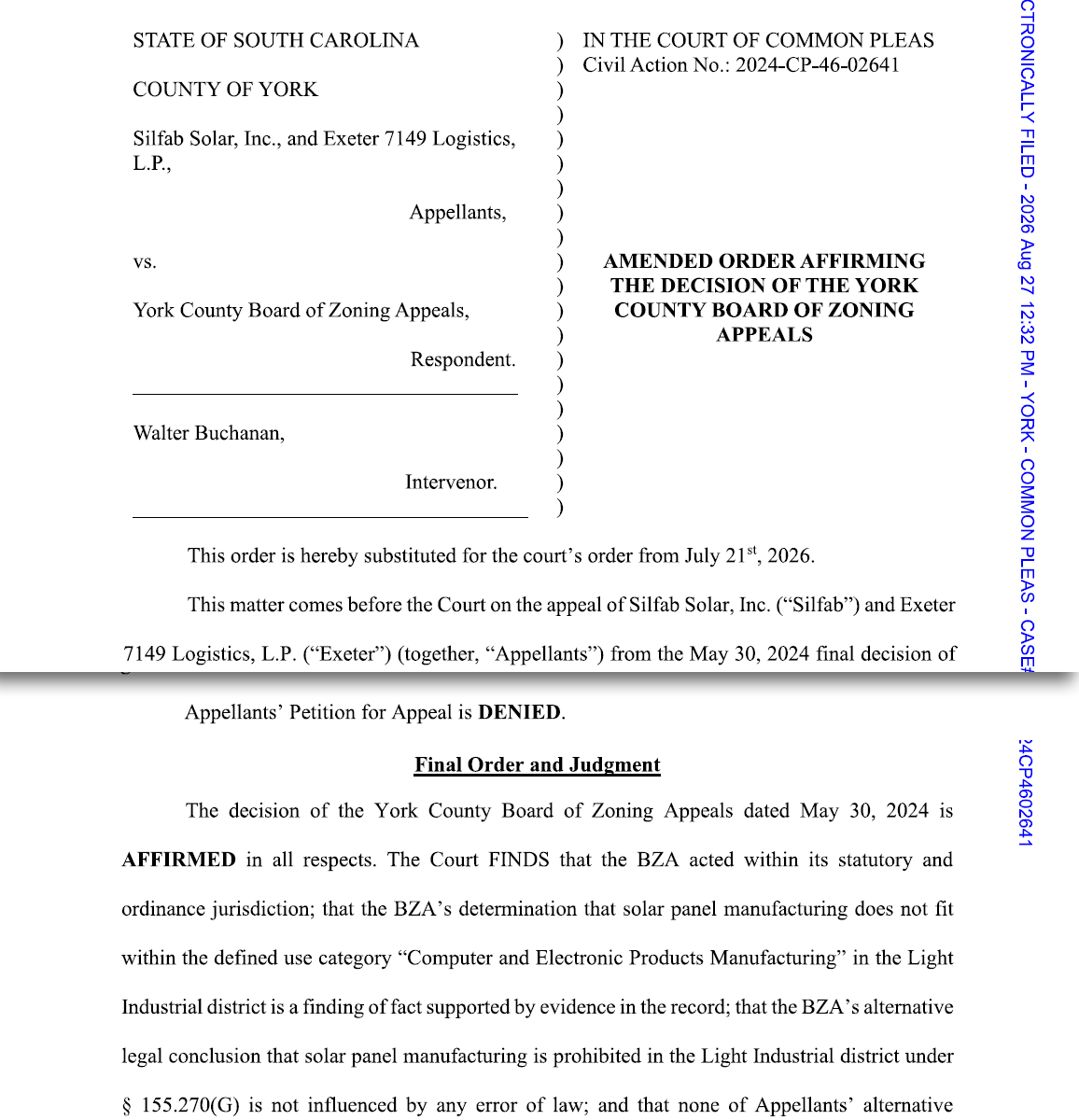
This fiasco reveals Cox’s troubling leadership pattern. She championed the Panthers headquarters early on. Her public blame game with Rock Hill helped sink it. She ignored a unanimous 5-0 zoning ruling against Silfab Solar. Permits issued anyway near Flint Hill Elementary. Hazardous chemicals and spills followed. Residents still worry about safety.

Transparency problems compound the damage. Cox canceled multiple meetings with Rock Hill Mayor John Gettys. Collaboration gave way to confrontation under her watch.

The stakes could not be higher. Failure means losing $1.5 billion in investment. York County forfeits 1,200 high-paying jobs. Schools, roads, and services face decades of lost revenue.

Rock Hill City Council will now hold the next vote on the Octapharma deal – a vote that could finalize or kill the deal entirely.