
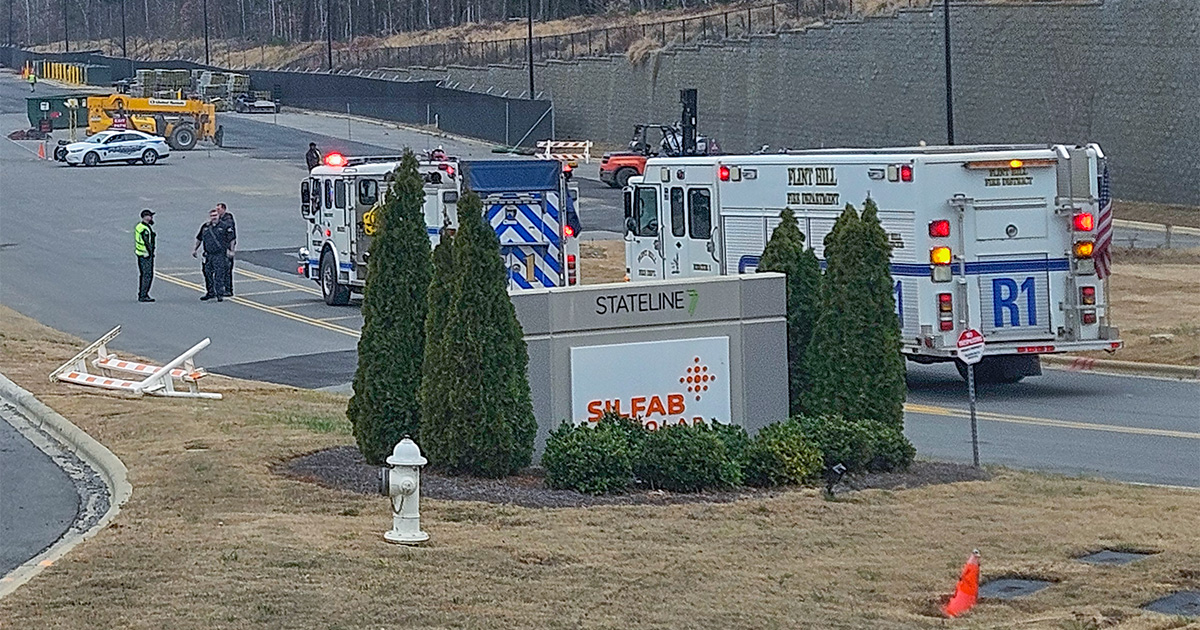
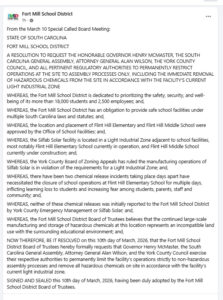
 After two separate chemical spills last week at Silfab Solar’s factory in Fort Mill, the Fort Mill School Board has just passed a major resolution calling on top state officials to permanently restrict Silfab’s operations and require all hazardous chemicals be permanently removed from the site.
The new resolution specifically reads:
“NOW THEREFORE, BE IT RESOLVED on this 10th day of March, 2026, that the Fort Mill School District Board of Trustees hereby formally requests that Governor Henry McMaster, the South Carolina General Assembly, Attorney General Alan Wilson, and the York County Council exercise their respective authorities to permanently limit the facility’s operations strictly to non-hazardous assembly processes and remove all hazardous chemicals on site in accordance with the facility’s current light industrial zone.”
The Tuesday night vote follows a series of chemical leaks at the facility located adjacent to Flint Hill Elementary School and within close proximity to several other Fort Mill schools.
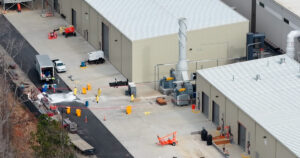 Last week, a major Potassium Hydroxide (KOH) spill triggered a hazardous-materials response at the Fort Mill plant. According to York County officials, “there was an incident at 7149 Logistics Lane, which resulted in 1,530 gallons of potassium hydroxide being released”. The chemical spilled into Silfab’s retention pond bordering Flint Hill Elementary School and connected to the Fort Mill watershed. Over the weekend, Silfab pumped out roughly 300,000 gallons of liquid from the retaining pond for disposal off site, according to DES.
According to employees at the factory, the KOH spill began at around 7:30am on Tuesday morning. According to York County, the first emergency crews arrived at 9:45am. According to eye witnesses, the first emergency HAZMAT crew arrived on site at 10:36am.
 At the time of the spill, school was in session and children were outside playing near the retention pond, according to parents.
SCDES later ordered Silfab to pause certain operations while investigators reviewed the incident.
The KOH spill was followed days later by the community being made aware of another chemical leak involving hydrofluoric acid at the factory.
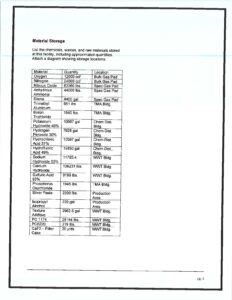
York County officials confirmed the HF leak and Flint Hill Elementary was forced to close the school Thursday and Friday out of an abundance of caution. It’s still unclear exactly how much HF leaked and how much of it became airborne.
Beyond the chemical incidents, the Silfab project has been at the center of a long-running zoning dispute in York County.
The factory sits on property zoned Light Industrial, and the York County Board of Zoning Appeals ruled in May of 2024 that Silfab’s operations cannot take place in a light industrial zone. That ruling occurred before any permits were issued to Silfab, and to this day, Silfab has still not received any change of use, zoning change, or zoning compliance from the county.
There are currently multiple active lawsuits that various organizations and community members have filed against Silfab and York County regarding the legality of their operations. There are even rumors that the legal fight could make it’s way up to the Supreme Court of the United States.
Over the past week, numerous high ranking politicians and officials across South Carolina have spoken out against Silfab, including Senator Tim Scott, Nancy Mace, Pamela Evette, and the Attorney General of South Carolina, Alan Wilson, who has called for full investigations into the chemical spills, and confirmed that county officials and the County Council has the authority to revoke Silfab’s permits.
With multiple investigations ongoing, several active lawsuits pending, and school officials now formally weighing in, the future of Silfab’s operations in Fort Mill are now more uncertain than ever.