
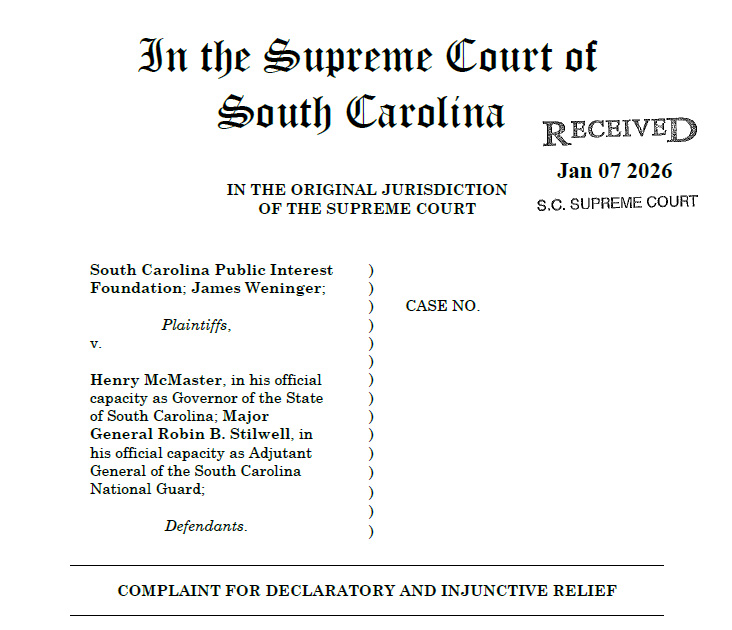
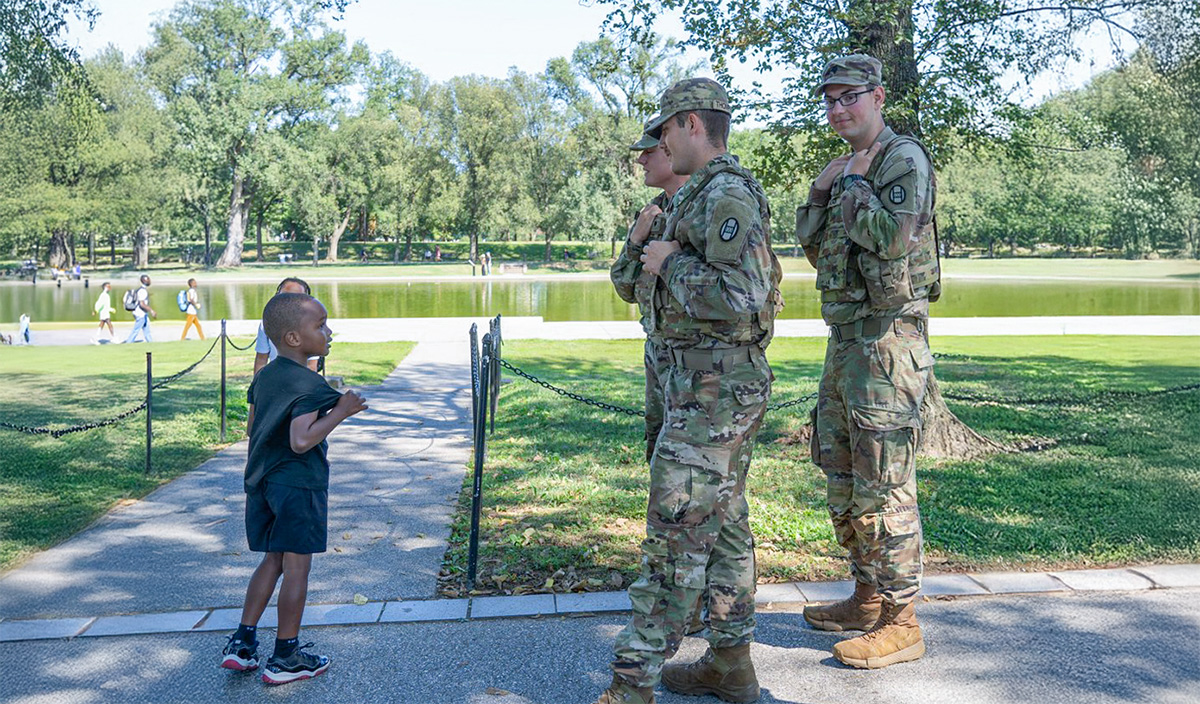
 A new lawsuit has just been filed in the South Carolina Supreme Court to block Gov. Henry McMaster from sending South Carolina National Guard troops to DC for policing missions tied to President Donald Trump’s 2025 “crime emergency” actions.
The suit was filed yesterday and is specifically asking the court for an order declaring the latest deployment unlawful and stopping future deployments under the same initiative.
Details
Who’s suing: The South Carolina Public Interest Foundation and James Weninger, a Navy veteran and Berkeley County resident.
Who’s named: Gov. Henry McMaster and Maj. Gen. Robin B. Stilwell, the adjutant general of the South Carolina National Guard.
What the lawsuit argues:
-
The complaint says McMaster has now twice deployed South Carolina Guard troops to Washington, D.C., and that the deployments exceed the governor’s authority under South Carolina law.
-
Plaintiffs point to state statutes that list limited circumstances for calling up and deploying the Guard (including war, invasion, insurrection/riot, imminent danger, or public disaster).
- They also cite the state constitution’s requirement that military power remain subordinate to civil authority.
What they want the court to do:
-
Declare the Nov. 26, 2025 deployment unlawful.
-
Permanently block the state from carrying out that deployment and bar future deployments tied to Trump’s D.C. executive order and memo.
Why this is moving fast: The plaintiffs filed directly in the South Carolina Supreme Court’s original jurisdiction under Rule 245, instead of starting in a lower court.
Brief take on the chances of success
This case has a plausible legal theory but faces real procedural and precedent headwinds.
-
Big first hurdle: The South Carolina Supreme Court may decline to take the case immediately if it believes a lower court can handle it first. Rule 245 says the court generally won’t take original jurisdiction unless public interest, emergency, or other strong reasons justify it.
-
On the merits: The lawsuit leans on the plain language of South Carolina’s Guard-deployment statutes and argues Washington, D.C., does not meet those triggers.
-
What similar litigation suggests: A West Virginia state-court challenge to that state’s D.C. Guard deployment was dismissed after a judge found the governor acted within state authority, underscoring how uphill these cases can be.
Bottom line: If the South Carolina Supreme Court accepts the case, plaintiffs have a clearer shot at a legal ruling on statutory limits. But winning quickly—and winning outright—is far from guaranteed given how courts often treat Guard deployments and executive discretion.
Background Information
What triggered the deployments: The complaint describes an Aug. 11, 2025 Trump executive order declaring a crime emergency in Washington, D.C., plus a same-day memo directing the Defense Department to coordinate with governors for additional Guard forces under Title 32 (not a full federal “Title 10” activation).
South Carolina’s first deployment: McMaster announced Aug. 16, 2025 he was sending 200 South Carolina Guardsmen to support federal law enforcement activities, funded under Title 32 and subject to recall for hurricanes or natural disasters.
The second deployment: The complaint says McMaster announced a second deployment on Nov. 26, 2025.
West Virginia’s lawsuit (the closest state-court parallel): In West Virginia, a civic group sued Gov. Patrick Morrisey over that state’s D.C. deployment. A judge allowed the deployment to continue and dismissed the case without prejudice.
Other recent lawsuits in state courts: The West Virginia case and this new South Carolina case are the two prominent state-court challenges that surfaced in reporting and court filings I could verify. Most of the broader legal fight over the D.C. deployments has played out in federal court, including D.C.’s lawsuit against the Trump administration.
Local impact for Charlotte readers
Charlotte sits at the center of a two-state metro, and this lawsuit matters because it tests how far a governor can go when federal officials request Guard help outside state lines. If South Carolina’s Supreme Court tightens the rules, it could reduce future out-of-state deployments—and keep more Guard capacity closer to home during hurricane season and other regional emergencies.