
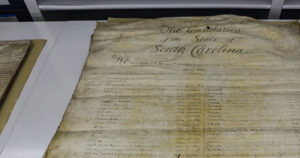
 A rare collection of South Carolina’s founding documents will be on display for a single day at Winthrop University.
The exhibit, titled Foundations of a Revolution: South Carolina, 1775 to 1777, will be hosted at the Louise Pettus Archives this coming Tuesday from 10 am to 4 pm, with a presentation scheduled at 11:30 a.m. Admission is free.
The traveling exhibit, organized by the South Carolina Department of Archives and History, features three original documents from the American Revolution era that are rarely available for public viewing.
Those documents include the 1775 Articles of Association for the District East of the Wateree, the South Carolina Constitution of 1776, and the 1777 Treaty of DeWitt’s Corner.
Why these documents matter
These records capture the earliest foundations of American independence at the state level.
The Articles of Association helped organize resistance to British rule and shows how ordinary citizens formally aligned with the revolutionary cause:
- “We do solemnly promise and agree, and do hereby bind ourselves under the sacred ties of virtue, honor, and love of our country, to adhere to and support the Continental Congress…”
- “We will not import, purchase, or use any goods, wares, or merchandise whatsoever, imported from Great Britain…”
- “We will… oppose the execution of several arbitrary and oppressive acts of the British Parliament…”
The South Carolina Constitution of 1776 is considered one of the first governing documents created by an American colony after breaking from British authority, laying the groundwork for self-government:
- “That all political power is originally vested in the people, and that government is instituted for their protection, security, and benefit.”
- “The legislative authority shall be vested in a General Assembly, to consist of two distinct branches…”
- “The president and commander-in-chief shall be chosen by the General Assembly…”
Meanwhile, the Treaty of DeWitt’s Corner marked a critical agreement between South Carolina leaders and Cherokee representatives, reshaping territorial control during the Revolutionary War:
- “All the lands to the eastward of the Unacaya mountains… are hereby ceded, released, and forever relinquished to the State of South Carolina.”
- “The said Cherokee nation shall deliver up all prisoners, negroes, and other property taken during the late war.”
- “The State of South Carolina, on their part, do agree to extend protection to the Cherokee nation, and to secure to them the remainder of their lands.”
Together, these documents reflect the political, military, and diplomatic decisions that helped form both South Carolina and the emerging United States.
W. Eric Emerson, SCDAH agency director, state historic preservation officer and state archivist, said the SCDAH has a long tradition of making South Carolina’s historic records available to the public. “The 250th anniversary of our nation’s founding is an excellent time to educate South Carolinians about their state’s crucial role in the American Revolution by bringing key foundational documents to communities throughout the state,” he added in a press release.